How to Choose an Outdoor LED Screen for an Event
Selecting an outdoor LED screen for a live event is not as simple as picking the biggest display or the lowest quote. The best outdoor LED screen for a downtown Minneapolis watch party differs from the right choice for a rural Wisconsin festival, even when the physical dimensions look similar on paper.
How to Choose an Outdoor LED Screen: Key Factors at a Glance
Choosing an outdoor LED screen requires evaluating many factors simultaneously: audience size, viewing distance, daylight exposure, screen dimensions, weather conditions, structural support, power distribution, content format and venue restrictions. Each of these shapes the final system in ways that a spec sheet alone cannot communicate.
Here are the core decision areas every event team should work through:
-
Screen size relative to audience layout and sightlines
-
Brightness measured in nits for the specific lighting conditions
-
Pixel pitch matched to viewing distance and content type
-
Weather resistance verified through IP ratings and manufacturer specs
-
Mounting method: ground-supported, flown, trailer or wind-permeable
-
Structural engineering, ballast and wind management
-
Power availability, cable paths and energy efficiency
-
Content resolution, aspect ratio and outdoor readability
-
Venue access, permits and local restrictions
Total cost considerations for outdoor LED include installation, maintenance, and energy costs, not just the rental price of panels. Front Row FX works as a production partner across Minnesota, Wisconsin, Illinois and Georgia to match the complete outdoor LED wall system to each specific event, coordinating everything from LED screen wall production to on-site technical operation.
Defining Audience, Viewing Distance and LED Wall Size
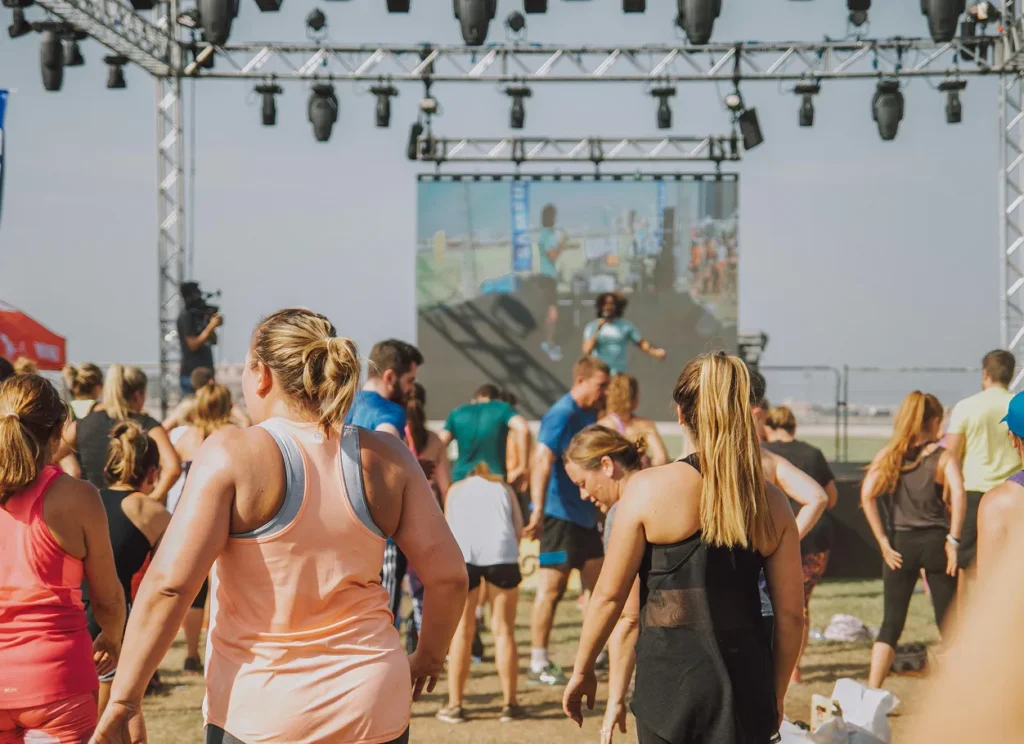
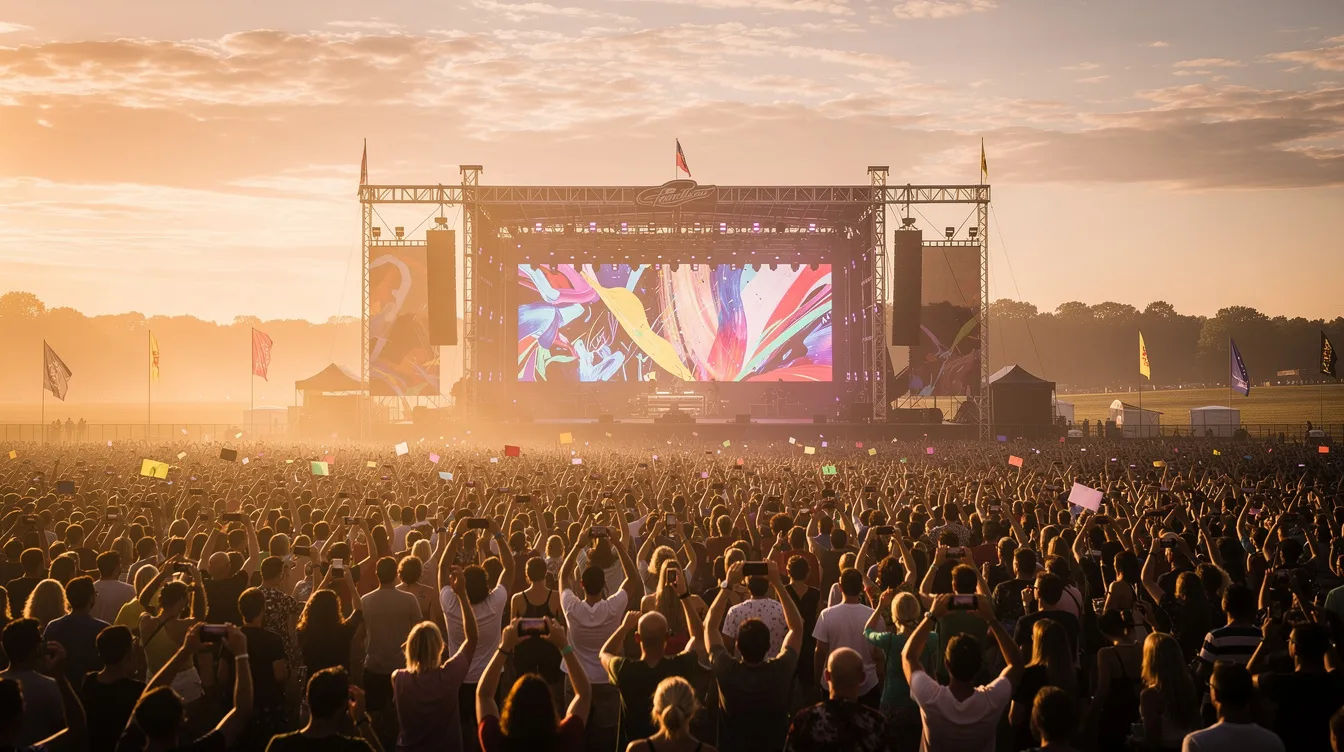
Audience size, layout and sightlines are the foundation for any outdoor rental LED screen decision. Before discussing brightness or resolution, you need to understand where people will stand or sit relative to the screen.
Start by estimating three distances: first row (closest viewers), mid-crowd and back-of-house (farthest spectators). For a community watch party, the first row might be 20 feet away and the back 80 feet. For a large festival, those numbers could be 30 feet and 300-plus feet.
-
A few hundred attendees in a park typically need a smaller LED wall, perhaps 12 to 16 feet wide
-
Mid-size events of 500 to 2,000 people often call for screens in the 16 to 24 foot range
-
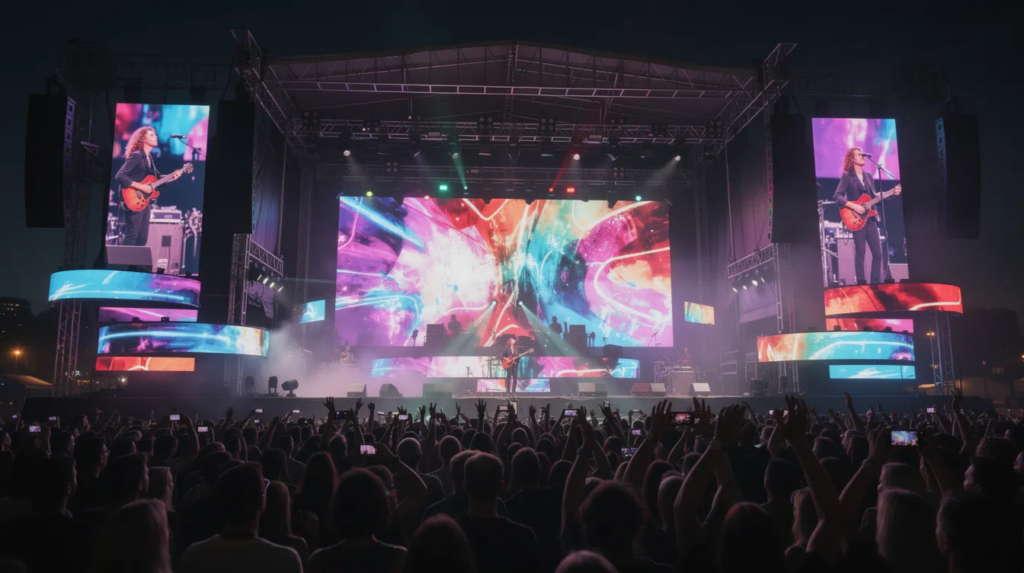
Large-scale gatherings of several thousand may require video walls 28 feet wide or larger, sometimes with multiple screens
A taller LED wall often matters more than adding width in flat outdoor spaces. People standing farther back need to see above the heads and staging in front of them. Height improves sightlines dramatically.
Aspect ratio should follow content type: 16:9 for live camera and video, 4:3 for presentation slides, and custom layouts for scoreboards or sponsor loops. The ideal screen size always depends on context. For deeper sizing strategy, see our guide on LED wall size for events.
Brightness and Visibility in Daylight, Shade and at Night
Outdoor LED screen brightness is measured in nits (candelas per square meter), which describes how much light the display emits per unit of surface area. Unlike indoor environments, outdoor LED screens must overpower ambient light from the sun, sky and surrounding reflective surfaces to ensure visibility.
Outdoor LED screens require high brightness over 5,000 nits for daytime use, and outdoor LED displays need brightness over 5,000 nits especially when facing direct sunlight. Bright sunlight and snow glare necessitate high brightness levels for readability, sometimes pushing requirements to 6,500 nits or higher. High brightness combats glare in direct sunlight effectively, but brightness impacts visibility in various lighting conditions differently:
-
Daytime in direct sun: 5,000 to 8,000+ nits depending on orientation and reflective surroundings
-
Shaded or semi-outdoor conditions: 3,000 to 5,000 nits often sufficient
-
Evening and night events: lower brightness with dimming to avoid glare, light pollution and neighbor complaints
Brightness levels can be adjusted based on ambient light. Screens with auto-brightness sensors or operator-controlled dimming automatically adjust output at dusk, reducing energy consumption and improving comfort. LED displays are designed for high visibility in harsh conditions, but content design matters equally: bold fonts, high-contrast graphics and large elements read far better outdoors than fine detail.
Brightness levels must consider daytime conditions in Minneapolis for clear visibility, and local regulations in Minneapolis govern the brightness and operational limits of LED displays. Front Row FX assesses sun paths, venue photos and event schedules to recommend suitable brightness capabilities for each deployment.
Pixel Pitch, Viewing Distance and Image Clarity
Pixel pitch is measured in millimeters between LED centers and directly affects the clarity of images on LED displays. A smaller pixel pitch provides higher resolution displays with sharper images, while a larger pitch reduces cost and weight.
The general rule of thumb is 1 meter of viewing distance per millimeter of pixel pitch. Here is how common pitches map to distance:
-
P4 to P6 panels: suitable for audiences starting around 4 to 6 meters away, common for mid-size outdoor events
-
P8 displays are best viewed from 10 to 30 meters away, making them practical for festivals and fairgrounds
-
P10 displays have a best viewing distance of 8 to 24 meters (some sources cite 10 to 30 meters), ideal for long distance visibility at large gatherings
A smaller pixel pitch is ideal for close-up viewing and camera-heavy productions using IMAG, where higher pixel density improves image clarity for close viewers. Smaller pixel pitch is needed for closer viewing distances, but choosing an extremely fine pixel pitch for a large field event increases cost without visible benefit when viewers are too far away to perceive the extra resolution.
High refresh rates reduce visual distortion in LED displays, which matters for camera capture and fast-motion content. For detailed technical guidance, see our resource on LED wall pixel pitch. Front Row FX balances the right pixel pitch with content resolution, physical screen size and viewing distance rather than optimizing any single factor in isolation.
Weather-Resistant Outdoor LED Panels and IP Ratings
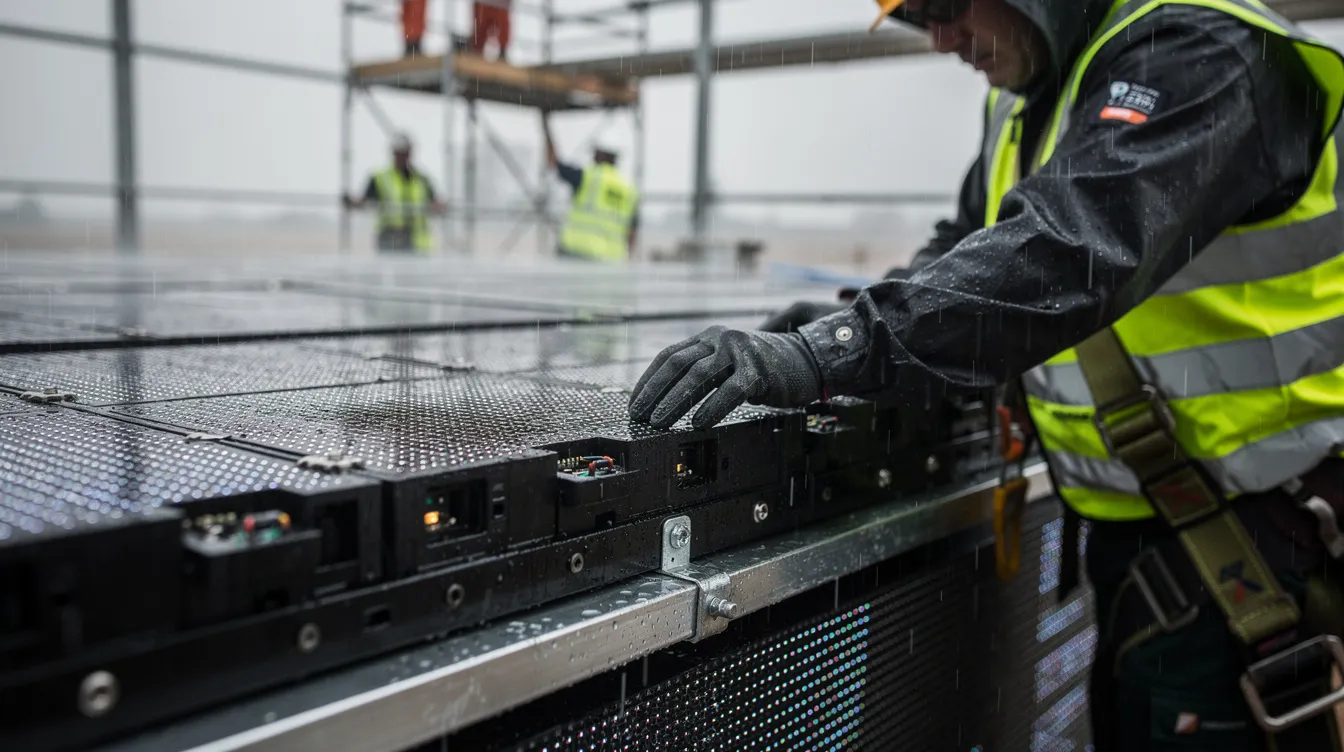
A weather resistant LED screen relies on sealed modules, conformal coating on circuit boards, gaskets between panels and outdoor-rated power and data connections. These features protect the light emitting diodes and electronics from moisture, dust and ultraviolet rays.
IP ratings follow the IEC 60529 standard. The first digit (0 to 6) indicates solid particle protection, and the second digit (0 to 9K) indicates water resistance. LED displays should have at least an IP65 rating for weather protection, meaning fully dust-tight and protected against water jets. Many outdoor LED screens are rated IP65 or higher for weather protection, with some systems offering IP66 or IP67 for harsher environments.
However, “weather resistant” is not the same as weatherproof in all conditions. Outdoor LED screens must withstand extreme temperatures and humidity, and outdoor LED displays withstand high humidity and extreme temperatures within their rated range. LED displays can operate in wet conditions like rain and snow, and outdoor LED screens are designed to resist high winds during storms, but each system has manufacturer-defined limits. LED screens must have lightning protection for outdoor installations, and electrical safety through GFCI protection, proper grounding and weather-protected power distribution is as important as the panels’ IP rating.
For events in the Upper Midwest, sudden rain showers, spring snow, heavy dew and wide temperature swings between afternoon and late evening are practical realities. Front Row FX reviews manufacturer specs and weather guidelines for each outdoor LED screen rental deployment.
Mounting Options: Ground-Supported, Flown, Trailer and Blow-Through Screens
The support structure is a major safety and logistics decision for any outdoor LED wall. Here is how the four primary options compare:
|
Configuration |
Typical Application |
Primary Advantage |
Key Planning Consideration |
|---|---|---|---|
|
Ground-supported outdoor LED wall |
Festivals, fairgrounds, corporate outdoor programs |
Flexible placement; ground support systems allow flexible height and width adjustments |
Ground loading capacity, ballast requirements, level surface needed |
|
Flown outdoor LED wall |
Touring concerts, large stages with roof systems |
Better audience sightlines with elevated position |
Flown mounting requires strong structural support for safety; certified rigging points required |
|
Mobile LED screen trailer |
Community watch parties, one-day city events, temporary activations |
Fast setup and teardown; self-contained power and data |
Truck access, parking footprint, trailer weight on surface |
|
Wind-permeable / blow-through LED screen |
High-wind venues, open plazas, exposed locations |
Reduced wind load by allowing airflow through panels |
Does not eliminate need for engineering, ballast, rigging or wind monitoring |
LED screens can be wall-mounted for a clean look in certain venue configurations, and mobile LED screens are often mounted on vehicles for events where load-in windows are tight. Installation methods affect maintenance access and overall cost, so the choice shapes both budget and logistics.
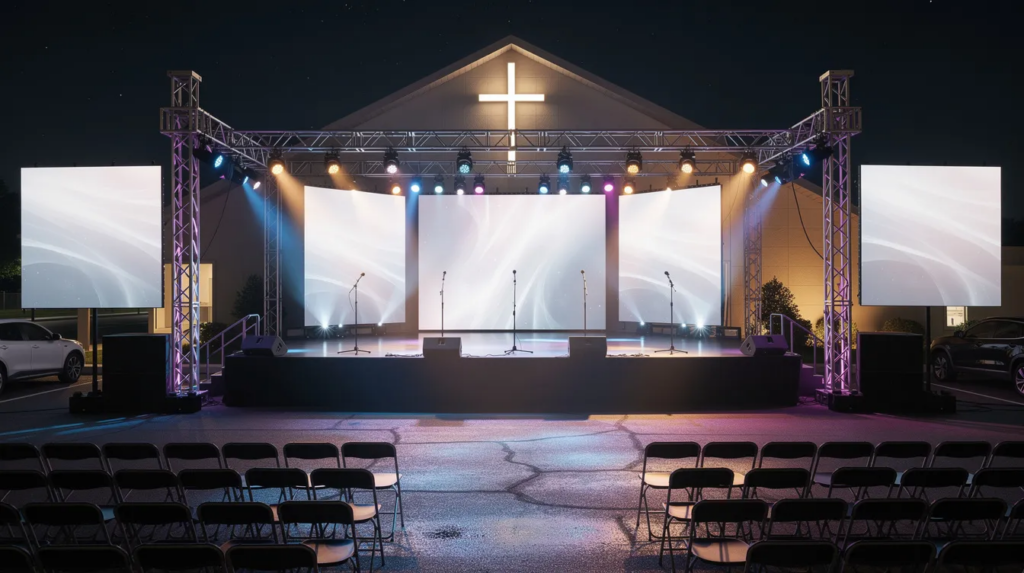
Blow-through LED screens allow air to pass through, reducing but not removing wind loads. They still require professional engineering, ballast, active wind monitoring and documented shutdown thresholds. A mobile LED screen trailer may be the most practical giant LED screen rental choice for one-day community events with street closures or limited setup time. Front Row FX evaluates stage design, audience placement, venue rigging capacity and access routes before recommending any mounting method.
Structural Engineering, Ballast, Rigging and Wind Management
Structural safety is non-negotiable. Large LED walls act like sails, and wind loads often govern structural requirements more than the weight of the panels themselves. Wind-rated structural engineering is essential due to potential severe weather in Minneapolis, where weather conditions include significant temperature swings and heavy snow.
Engineering requirements depend on the LED wall size, height, support system, surface conditions and local regulations. Ballast or anchoring is almost always required for ground-supported screens, and the amount must come from engineered drawings and manufacturer guidance rather than generic formulas. For flown walls, certified hardware, proper bracing and regular inspections during the event are essential.
Thermal management systems are required to prevent overheating during summer events in Minneapolis and similar climates. Active wind management includes monitoring forecasts, using real-time wind sensors, maintaining documented threshold actions and coordinating decisions with event management. Front Row FX does not publish universal ballast values or wind-speed limits but works with structural engineers, venues and local authorities to design compliant outdoor LED wall installations.
Power, Cable Paths and Energy Efficiency Considerations
Estimating power needs early is critical. The total load includes LED panels, video processing, control systems, audio and lighting. LED billboards consume 30 to 46 times more energy than households, making power planning essential for outdoor use.
Energy-efficient LED displays reduce operational costs significantly. Industry targets aim to reduce power consumption from 660 watts to 110 watts per square meter, and some LED displays now consume only 100 watts per square meter. Auto-brightness adjustment optimizes energy use in LED displays by lowering output during twilight and nighttime hours, which also reduces generator size and fuel costs.
-
Confirm whether house power or a generator is available, and coordinate capacity early
-
Plan cable routes that avoid vehicle and foot traffic hazards using ramps or overhead trays
-
Use separate power circuits to prevent voltage drops and nuisance breaker trips during high-brightness content
-
Prepare emergency power plans including backup generators or orderly shutdown procedures
Front Row FX maps cable paths around audience areas, barricades and vendor tents to ensure safety and comply with local codes across each state served.
Content Resolution, Aspect Ratio and Outdoor Readability
Content resolution, aspect ratio and LED processing combine to deliver clear visuals on the chosen LED wall. Matching your media content to the display’s native pixel matrix avoids scaling artifacts that degrade image quality, especially with high resolution camera feeds.
-
Match content resolution to the LED wall’s native pixel matrix when possible
-
Choose an aspect ratio that fits primary content: 16:9 for live camera and video, custom layouts for scoreboards or sponsor grids
-
Avoid tiny text, thin lines and low-contrast color combinations that disappear in daylight
For LED screens for concerts, IMAG camera feeds, lyrics and branding need specific layout planning so critical information sits within the most visible central viewing area. Content management systems enable remote updates for LED displays, and a dedicated content operator ensures smooth transitions and emergency messaging capability. Front Row FX helps clients preflight graphics and videos for outdoor LED display visibility.
Venue Access, Load-In, Permits and Local Restrictions
Logistics and approvals often determine which outdoor LED wall option is realistic, especially in city centers and public spaces.
-
Truck and trailer access for LED panels, truss and mobile screen trucks
-
Load-in windows relative to street closures, park hours and neighboring events
-
Required footprint for ground-support bases, ballast, control and power distribution
Permitting may involve city or park authorities, building management and transportation departments. Some municipalities enforce limits on maximum brightness, operating hours and advertising content for outdoor signage. Front Row FX coordinates approvals, access routes and build schedules with event producers and local partners in Minnesota, Wisconsin, Illinois and Georgia.
Outdoor LED Screen Selection Checklist
Use this checklist when gathering information for your outdoor LED screen planning:
-
Event basics: date(s), city, venue, schedule, expected attendance and programming style (concert, festival, ceremony, watch party, corporate program)
-
Visual goals: type of content (live camera, slides, sponsor loops, scores, feeds), desired LED screen size and approximate viewing distances
-
Environment: sun direction, shade, typical weather, wind exposure, surface type (pavement, turf, gravel)
-
Technical: brightness expectations, pixel pitch preference (if known), audio needs, camera use, content sources and format
-
Structure: preferred mounting (ground-supported, flown, trailer, blow-through), rigging options, known venue restrictions
-
Power and logistics: power availability, generator plans, access routes, load-in times, cable paths, local permits and neighborhood considerations
Sharing this checklist with Front Row FX allows the team to recommend an appropriate outdoor rental LED screen system and complete LED screen wall production package.
Planning Your Outdoor LED Screen with Front Row FX
Choosing an outdoor LED wall involves screen size, brightness, pixel pitch, weather resistance, support structure, power, content and logistics working together as a system. The right configuration depends on your specific event, not a catalog model number.
Contact Front Row FX with these details to begin:
-
Event date(s)
-
City and venue
-
Expected audience size and general layout
-
Viewing distances to the LED wall
-
Preferred screen dimensions or rough size ideas
-
Event hours and whether the screen runs in full daylight, twilight or after dark
-
Screen orientation if known (e.g. facing west toward the sunset)
-
Content format (camera, slides, media files, feeds)
-
Available power and generator plans
-
Expected outdoor conditions and any known venue restrictions
Front Row FX uses this information to recommend a complete production configuration, including LED display technology, support structure, video processing, power distribution and on-site technicians. Reach out early in the planning timeline for outdoor events in Minnesota, Wisconsin, Illinois and Georgia so site visits, engineering reviews and permitting can be completed without schedule pressure.