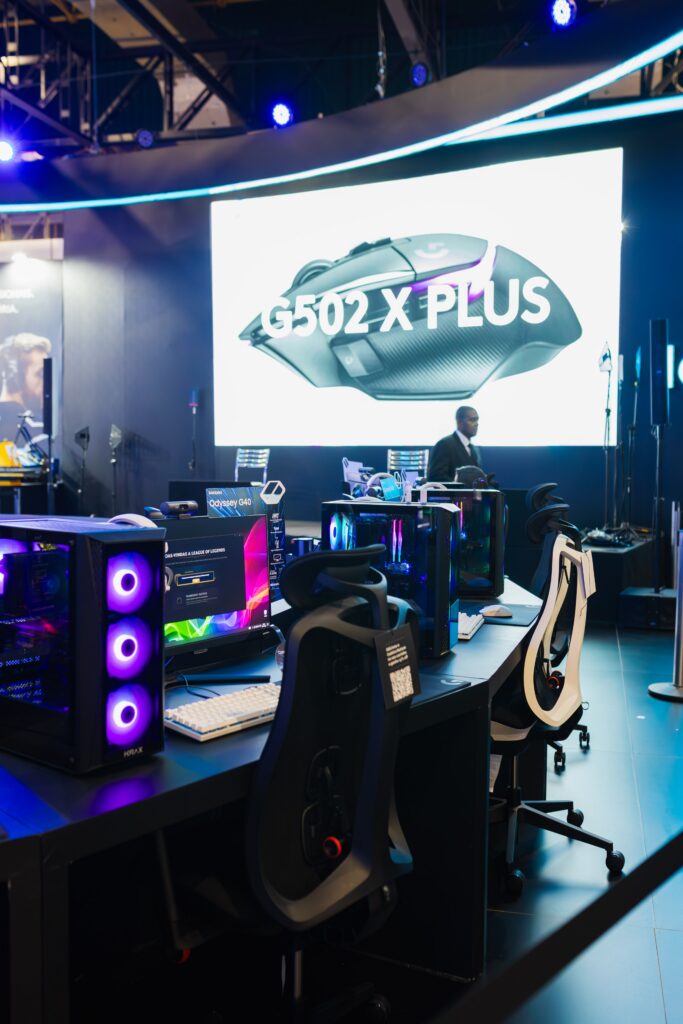
The Hidden Costs in Event Production-and How to Control Them Before Show Day
Most event planners start their AV planning with a gear list: LED walls, speakers, lighting, projection. But event production costs are shaped far more by the decisions made weeks or months before anyone powers on a console. Venue choice, schedule design, dock access, power infrastructure, and labor rules quietly determine what you’ll actually spend-often more than the equipment itself.
This article breaks down where those costs come from, how to anticipate them, and what to ask before show day so your event budget reflects reality.
Quick Answer: Where Event Production Costs Really Come From
The most expensive AV decisions are often made before the equipment list is finalized. Venue selection, schedule tightness, access windows, and agenda changes lock in costs that many planners don’t see until the invoice arrives.
The main hidden cost drivers include:
-
Event labor costs (technicians, stagehands, riggers, electricians)
-
Venue labor rules and union mandates
-
Event rigging costs (engineering, motors, hardware, inspections)
-
Event power costs (service drops, temporary distribution, venue electricians)
-
Trucking and freight (vehicles, fuel, driver time, routing)
-
Internet and connectivity (dedicated bandwidth, backup circuits)
-
Drayage (material handling at convention centers)
-
Late changes and scope creep (cascading into overtime, additional gear, reworked plans)
Event production costs are affected by size, complexity, location, and technical requirements-not just by what’s on the spec sheet. The complexity of production increases costs due to more equipment and technical expertise needed at every level.
A concrete example: Consider a 500-person corporate event in Minneapolis. The initial equipment-only quote comes in at $60,000 for sound, lighting, and video. But the venue requires electrician labor at roughly $163/hour straight time. Rigging crew is needed for a flown LED wall. A 200-amp 3-phase power drop costs $1,100 if ordered in advance ($1,650 onsite). Drayage for 1,000 pounds of crated gear adds another $1,000. Then the gala runs late, pushing the strike crew into overtime. The actual total: north of $80,000.
This article will help corporate event planners anticipate these items early, reduce preventable financial surprises, and keep their event production budget aligned with what the show actually requires. Front Row FX approaches every project from the complete audiovisual production picture-venue, access, power, rigging, labor, logistics-not just a gear list.
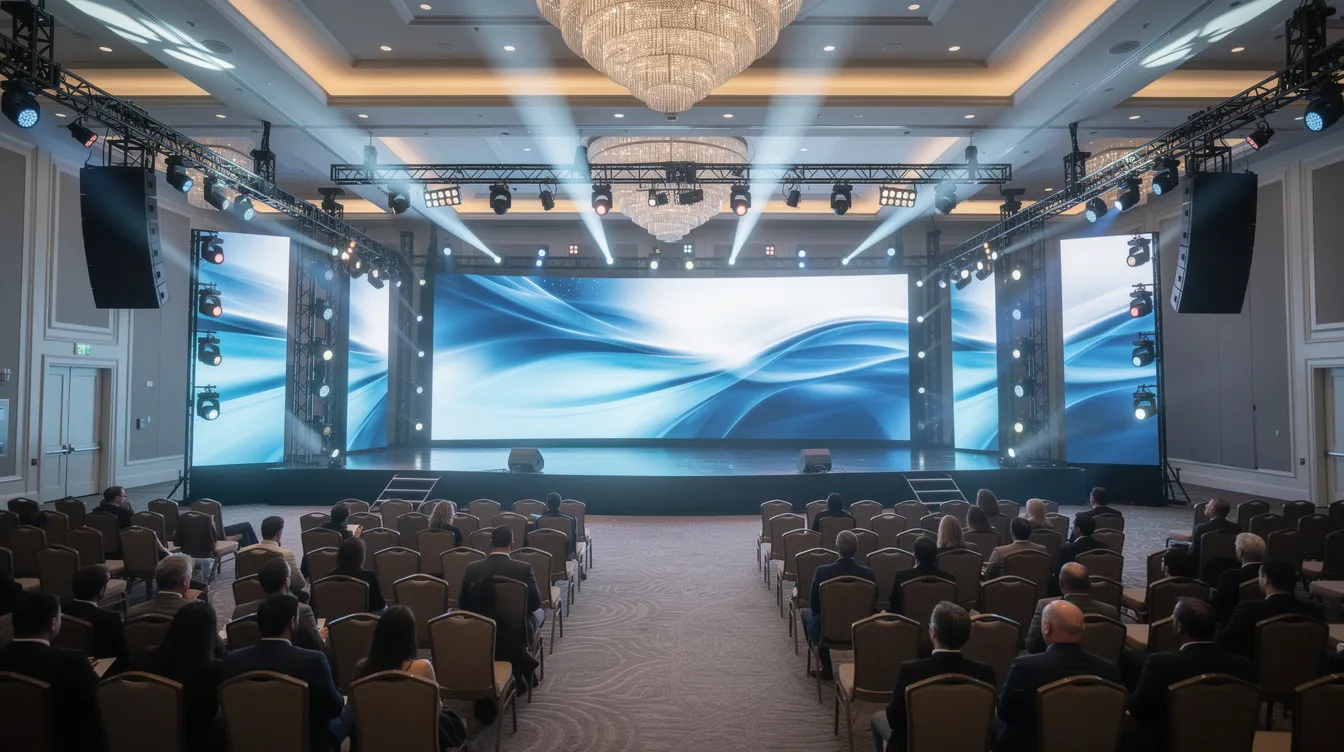
What We Mean by “Event Production Costs” (Beyond the Gear)
Event production costs cover everything required to make the live technical and audio visual elements of an event work-from pre-production planning through load-out and strike. This is distinct from general event expenses like catering costs (which typically account for about 33% of event budgets, with average catering costs ranging from $160 to $300 per person), décor, or speaker fees.
Production costs break into four categories:
-
Equipment costs: Rental of audio, lighting, video, LED walls, projection, stage decks, and scenic pieces. Audio, visual, and staging components include microphones, speakers, LED screens, and lighting. Design and decor costs cover stage design, signage, floral arrangements, and furniture.
-
Event labor costs: Crew, operators, and specialists from load-in through strike. Labor expenses include event producers, technicians, stagehands, and security personnel.
-
Venue-controlled services: Power, rigging points, internet, in-house electricians, and building engineers. These are often mandatory regardless of which AV partner you choose.
-
Event logistics costs: Freight, trucking, drayage, dock access, storage, and transportation costs involving equipment delivery, travel, and setup logistics.
Event budgets categorize costs into fixed and variable expenses. Fixed costs-like venue rental and base equipment packages-do not change with attendance numbers. Variable costs scale with the number of attendees at an event, affecting things like room count, seating, and staffing needs.
For many corporate events in the Upper Midwest, non-equipment items can equal or exceed the equipment rental line. Event size and attendance impact venue capacity, catering, and staffing requirements across the board. Understanding these categories is the first step to building an honest event budget proposal. Keep in mind that catering and hospitality expenses encompass food, beverages, and service staff, with food and beverage costs sometimes accounting for 50–70% of total spend. F&B overages are common budget pitfalls for event planners-and F&B costs can increase by 20–30% due to taxes and gratuities.
How Early Decisions Lock In Corporate Event Production Costs
Decisions about dates, agenda, and event venue are often finalized before an AV partner is involved-but they carry major cost implications. To control event production costs, set a clear event scope and prioritize spending before locking in contracts.
-
Room selection: Ceiling height determines whether you can fly LED, lighting, or audio. Availability of rigging points, distance from the loading dock, and freight elevator access all influence AV production costs. Choosing venues based on total production costs rather than just rental fees can reduce expenses significantly. Venue fees can range from $10,000 to $100,000 per day, and venue rental costs are influenced by location, accessibility, and permitted event hours.
-
Schedule tightness: If load-in, rehearsal, and show all happen in the same window, you need larger crews working overtime or double shifts. Event production can be optimized through better scheduling and resource management.
-
Agenda changes: Adding sessions, extending the evening program, or adding rehearsals cascades into more crew hours, overtime, and sometimes additional equipment.
One often-overlooked planning lever: sponsorship revenue can offset 20–40% of total event costs. Start forecasting sponsorship revenue 12–16 months before events and treat sponsorships as a planned budget line, not a bonus. Historical data helps set realistic sponsorship revenue expectations, and sponsorships should include clear deliverables and measurable returns for partners.
Bring your AV partner in while still comparing venues and building the agenda. Early collaboration during the planning process prevents cost surprises downstream.
Labor: The Most Misunderstood Line in Your Event Production Budget
Event labor costs often rival or exceed equipment costs-especially for multi-day conferences and complex corporate event production. Professional AV production costs can reach $10,000 to $35,000 even for mid-scale shows, and AV costs increase with event complexity and required equipment.
Typical onsite roles include:
-
Audio engineers (lead and assistants)
-
Lighting directors and technicians
-
Video engineers, graphics operators, camera operators
-
Stage managers and technical directors
-
Riggers and rigging supervisors
-
General stagehands and support labor
-
Building electricians and house riggers
Labor is driven by room count (multiple rooms require concurrent crews), schedule length, system complexity, rehearsal needs, and venue access windows-not just audience size or attendee headcount. Last-minute staffing can lead to unexpected expenses that blow past projections.
Different markets and venues have different rules. Some require minimum call lengths, mandatory breaks, or specific venue electricians. In Minneapolis, stagehand straight time runs roughly $64/hour while electricians can exceed $163/hour. In South Florida, a certified rigger might be $71/hour straight time and $106.50 overtime. Planners should avoid assuming one standard rate applies everywhere. Labor costs for AV technicians can significantly impact budgets regardless of market.
Front Row FX builds labor schedules from the full run-of-show and access plan, clearly stating assumptions so procurement teams can compare quotes accurately and make informed decisions.
Overtime, Long Days, and “Off-Hours” Costs
Overtime labor is one of the biggest quiet multipliers in corporate event production costs. Labor costs can increase by 50% for overtime pay, and if any part of load-in, show, or strike pushes into off-hours, the budget can expand fast.
Common triggers include:
-
A gala or evening program running past contracted strike time
-
Early-morning technical checks before venue standard hours
-
Back-to-back rehearsals compressing crew breaks
-
Delays from room turnover or late access by the venue
Most venues define straight time within specific windows-for instance, the Minneapolis Convention Center defines straight time as Monday through Friday, 8:00 a.m. to 4:30 p.m. Everything outside those windows triggers overtime or double time.
Example: A conference in St. Paul where a keynote overran by two hours and the venue delayed room release for strike. The crew hit overtime thresholds on load-out night, adding multiple hours of premium-rate labor that wasn’t in the original AV budget.
Share realistic rehearsal and show timing with your AV partner early. Ask for a “what happens if we run late?” scenario and build that contingency into projected expenses.
Rigging: Flown LED, Lighting, and the Cost of Going in the Air
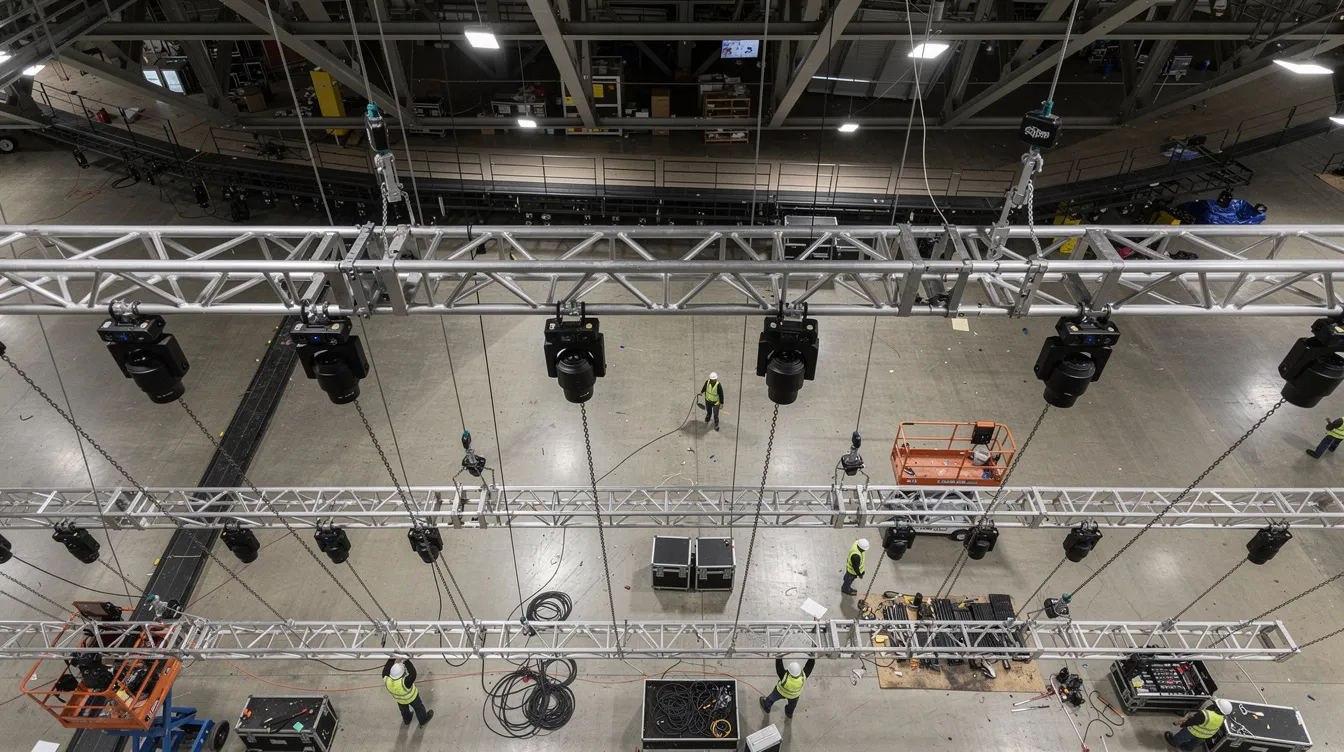
Event rigging costs encompass far more than hanging a truss. They include engineering, motors, hardware, inspections, and specialized labor. AV rigging fees for small to mid size setups can range from $500 to over $12,000 depending on scope and venue requirements.
Flown solutions are typically considered when:
-
Large LED video walls need to be suspended above the stage
-
Line-array audio systems require overhead hang points
-
Extensive lighting rigs need to clear floor space for traffic and sightlines
Rigging charges can include venue approval processes, house rigger time, structural drawings, load calculations, and required inspections-costs that are often separate from the AV quote. Modular and reusable production elements can help manage costs effectively over multiple events, particularly with truss and motor inventory.
Ground support-ground-stacked LED or floor-supported truss-can sometimes reduce rigging labor, but isn’t always possible due to sightlines, exits, or stage design. Don’t assume ground support is automatically cheaper; sometimes the floor space trade-off creates other problems.
Confirm rigging policies when choosing venues in Minneapolis, Chicago, or regional convention centers. Ask your AV partner to present both flown and ground support options with clearly separated event rigging costs.
Power: Why It Has to Be Designed with the AV System
Event power costs are not about plugging into the wall-they’re an integral part of the AV system design. A large LED wall, concert-style event lighting, and a full PA system can easily require dedicated high-amperage service that goes well beyond standard 20A circuits.
Key concepts planners should understand:
-
Circuit types: 20A circuits for small setups; 100–200A three-phase service for LED walls and large audio
-
Voltage: 120V single phase vs. 208V three-phase for heavy gear
-
Temporary distribution: Spider boxes, distro panels, Cam-Lok connectors feeding dimmers and processors
-
Venue electricians: Many venues require in-house electricians to install power drops above certain thresholds
At a Columbia Convention Center rate, a 200-amp 3-phase drop costs $1,100 if ordered in advance, or $1,650 onsite. Some venues charge roughly $3 per amp per leg per day for special service drops.
Permits and insurance are usually needed for events involving larger crowds or outdoor settings. Permit fees can range from $50 to several thousand dollars depending on the jurisdiction and event space requirements.
Share early AV concepts with both the venue and your AV partner so power requirements can be coordinated and priced before contracts are finalized.
Venue Labor, Rules, and “House” Services
Many hidden fees in event production come from venue-specific rules and required staff-not from your chosen AV partner or outside partner.
Common venue-controlled roles include:
-
House electricians and riggers
-
Union labor stagehands and dock personnel
-
Building engineers and required security
-
In house AV team operators (if exclusive contracts exist)
Some properties in larger markets-like McCormick Place in Chicago-require multiple unions: Teamsters for freight, IBEW for electrical, IATSE for rigging and installation. Other regional venues may be more flexible. Don’t assume every venue or market is union; responsibilities and rules vary by property.
Taxes and gratuities can add 20–30% to your venue bill, and hotel service charges can add 18–25% to initial quotes-service charges that often surprise planners reviewing final invoices. Credit card fees can range from 1–5% per transaction on top of that.
Ask venues detailed questions: what labor is required vs. optional, who can perform what work, and how venue charges will appear-on the venue bill, through the AV vendor, or via a show decorator. Add a “venue labor and services” line item to every event budget template so these venue related costs aren’t buried under generic service fees.
Freight, Drayage, and Trucking: Getting the Gear to the Room
Three related but distinct cost categories deserve separate attention in your event production budget: trucking, venue access, and drayage.
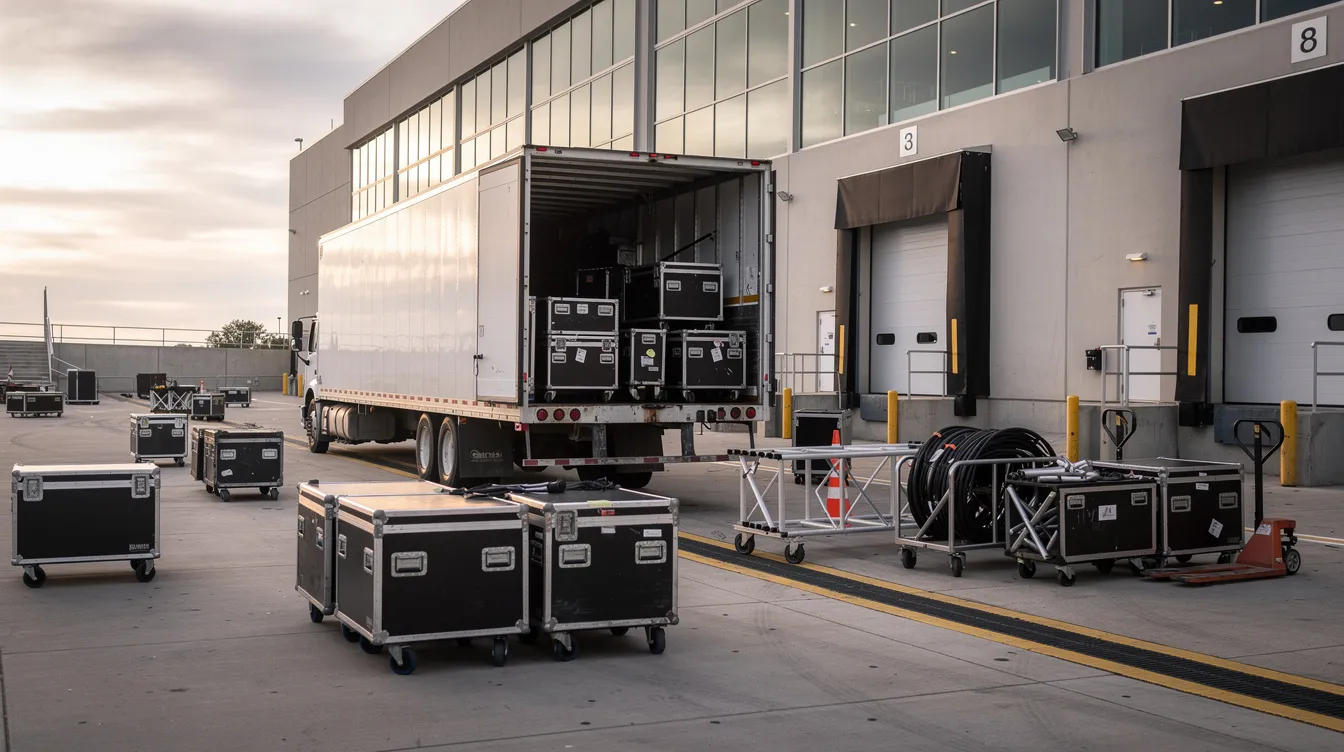
Trucking includes the number and type of vehicles (box trucks, trailers), driver hours, routing across Minnesota, Wisconsin, or Illinois, fuel, tolls, and overnight parking requirements. A multi-truck LED wall stage design or scenic-heavy show compounds these travel costs quickly.
Venue access affects labor and timelines. The venue address is not the load-in plan. Key variables include:
-
Loading docks vs. street loading
-
Security check-in procedures
-
Freight elevators and long pushes through service corridors
-
Limited staging areas and truck parking
Drayage applies primarily in trade show and expo environments. Material handling is billed per hundredweight (CWT), typically $95–$185 per CWT for advance warehouse shipments and higher for direct-to-show freight. In Minneapolis, advance shipments run roughly $95 per 100 lbs with a 200-lb minimum, while late freight jumps to $125 per 100 lbs. Chicago venues can run $100–$200+ per CWT.
Request access diagrams and dock procedures from venues. Include a discrete freight, drayage, and trucking section in your detailed budget, especially for large LED or scenic-heavy shows.
Internet and Connectivity for AV, Streaming, and Hybrid Elements
Event internet costs are highly variable and tied to how mission-critical the connection is for show systems. High-quality streaming bandwidth is often expensive for hybrid and virtual events, yet many planners treat it as an afterthought.
There’s a critical difference between casual attendee Wi-Fi and dedicated bandwidth for:
-
Livestreaming and virtual events
-
Remote speakers joining via video
-
Cloud-based presentations and digital signage
-
Registration kiosks and live polling
-
Production communications and backup connectivity
Venues may charge separately for dedicated wired drops, higher bandwidth tiers, backup circuits, or VLAN configuration. Most venues have ordering deadlines 10–14 days ahead; missing them can mean higher pricing or limited options.
Example: A hybrid leadership summit in Minneapolis where remote presenters, live polling, and a broadcast feed required both a primary and backup wired internet circuit. The redundancy added cost-but protected event success when the primary circuit experienced latency issues during the keynote.
Scope internet needs with your AV partner during event production planning rather than leaving it as a last minute add to the venue order form. This is a core part of event technology planning, not an optional upgrade.
Late Changes, Scope Creep, and Extra Crew
Agendas evolve. Last minute changes are normal. But they have real cost impacts that compound across systems.
Common late changes include:
-
Moving rooms or doubling breakout count
-
Adding a second screen or larger LED wall
-
Increasing stage size or adding a live performance
-
Extending the program into a late evening reception
-
Adjusting audience size or seating configuration
Each of these triggers downstream effects: reworked power drops, new cabling routes, rigging layout changes, additional video processing, more consoles, and expanded crew coverage. Simplifying decor can sometimes create a polished event appearance without excessive decoration costs-freeing budget for the technical changes that matter most.
Additional crew is not wasted spend. Staffing needs increase because scope increases, schedules compress, access is difficult, or technical support requirements expand across multiple rooms. Extra technicians ensure the event runs smoothly and safely.
Centralized show and technical management helps here. When one team understands how a single request-like adding a breakout session-affects power, video, audio, rigging, and labor, they can explain the additional cost and downstream impact before changes are approved. That’s expert advice built into the production workflow.
Building a Realistic Event Production Budget (and Proposal)
A realistic event production budget matches the actual show-not just the equipment spec sheet. A detailed budget helps track actual expenses against projections and gives leadership confidence in financial goals.
Structure your total event budget around these categories:
|
Category |
What It Covers |
|---|---|
|
AV Equipment |
Audio, lighting, video, LED, projection, staging |
|
Production Labor |
Load-in through strike: crew, operators, supervisors |
|
Venue Labor & Services |
House electricians, rigging, power drops, internet fees |
|
Logistics |
Freight, drayage, trucking, vehicle parking, storage |
|
Contingency |
Overtime, late changes, unforeseen venue costs |
Contingency funds should be 10–15% of total budget. Allocate a contingency fund specifically for unexpected expenses-emergency funds help cover last minute changes or overruns. Use if/then statements to frame contingency scenarios: “If the gala runs 90 minutes past scheduled end, then strike labor increases by X hours at overtime rates.” Regularly review your budget to manage unexpected costs as the planning process progresses.
Build room-by-room, day-by-day, tying each cost to a specific function: general session, breakouts, gala, tradeshow booth, product launches. Request itemized quotes from your AV partner that clearly list inclusions, exclusions, and assumptions-access times, rehearsal windows, internet and power assumptions. This is how you achieve financial success in event planning.
Procurement Questions That Reveal Hidden Event AV Costs
When comparing vendor proposals, the lowest equipment quote is often not the lowest final corporate event production cost. These prompts help procurement teams surface hidden assumptions:
Labor and schedule:
-
What labor schedule is assumed? How many crew, what hours, what days?
-
What room-access hours are assumed? What happens if access changes?
-
When do overtime thresholds apply?
Venue and infrastructure:
-
What power is included or excluded? What power drops are assumed?
-
What venue services are unknown or estimated in the quote?
-
Is in house AV required, or can an outside partner handle all systems?
-
Are insurance requirements, permit fees, or floor protection included?
Logistics:
-
Who is responsible for trucking, dock scheduling, drayage coordination?
-
Is overnight storage included if rooms must be cleared between days?
Change management:
-
How are scope changes handled?
-
How will the AV partner communicate new cost impacts before change orders are signed?
Reinforcing the core point: initial quotes that exclude these categories create surprise costs downstream. Feel prepared by asking these questions before you sign, not after.
Hidden Cost Checklist for Your Next Corporate Event
Run through this checklist while building or reviewing your event budget template for your next event:
Access and logistics:
-
[ ] Venue access hours vs. required load-in/out/rehearsal/show/strike windows
-
[ ] Dock policies: hours, outside vendor rules, freight elevator availability
-
[ ] Truck parking and overnight equipment storage
-
[ ] Floor protection, printed materials for signage, and house rules
-
[ ] Push distance from dock to event space
Labor and schedule:
-
[ ] Venue labor requirements (house electricians, riggers, building engineers)
-
[ ] Overtime triggers, meal penalties, off-hour and weekend rates
-
[ ] Rehearsal timing assumptions and staffing needs
-
[ ] Security for dock access or overnight gear watch
Production systems:
-
[ ] Rigging approvals and structural engineering sign-offs
-
[ ] Power design: amperage, voltage, phases, temporary distribution
-
[ ] Internet for AV, streaming, and backup drops
-
[ ] Corkage fees or exclusivity rules for outside vendors
Show close:
-
[ ] Strike timing and venue penalties for late removal
-
[ ] Outbound drayage and post-show trucking coordination
-
[ ] Holding gear overnight vs. same-night load-out
-
[ ] Late-night labor surcharges
Share your dates, venue, and working budget with Front Row FX so a production specialist can help clarify assumptions before contracts are locked. Budget constraints are easier to manage when you identify them early.
How Front Row FX Approaches Event Production Costs
Front Row FX treats every project as a combination of venue, access, power, rigging, labor, schedule, logistics, and technical systems-not simply an equipment list. The goal of every successful event is that the overall event experience matches what leadership envisioned, without financial surprises on the back end.
The team builds budgets around the entire run-of-show and venue plan across Minnesota, Wisconsin, Chicago, and the Upper Midwest-with clear notes on what is known, what is assumed, and what is still pending. Services like complete audiovisual production, corporate event production, and the full range of production experiences are designed to integrate equipment, labor, and venue services into one coherent plan.
Not every hidden cost can be predicted. Venues may not disclose full rate cards until after contracts are signed. Fuel prices shift. Agendas change. But good pre-production with the right AV partner can reduce preventable surprises, keep the attendee experience strong, and maintain leadership confidence in the final event budget.
The best time to control event production costs is before show day-not after. Plan the cost before it becomes a change order.
If you’re building a cost effective production plan for an upcoming event, reach out to Front Row FX with your agenda, venue, and target budget. A production specialist can help clarify what’s known, what’s assumed, and where the real cost drivers are hiding.