LED Wall Power Requirements for Live Events
Why There Is No Single Rule for LED Wall Power
There is no traditional rule, no universal watts-per-square-foot figure, and no single amps-per-panel number that applies to every LED wall at every event. LED wall power consumption varies based on size, resolution, and brightness, and each system must be evaluated using its exact equipment specifications.
LED display power consumption is driven by the specific LED panels, LED technology, panel model, manufacturer data, voltage, content, brightness settings, power supplies, receiver cards, video processors and the overall power distribution design. Screen size or physical dimensions alone are not enough to calculate LED panel power consumption or average power consumption for planning circuits. A 7 m × 4 m indoor LED screen built from fine-pitch panels and the same-sized outdoor LED display built from high brightness cabinets will draw different loads from different electrical infrastructure.
This guide is written for event planners, production managers, venues and technical directors who need understanding of what electrical information must be confirmed before installing indoor or outdoor LED screens. Front Row FX is a full-service AV production company providing complete LED screen systems, power planning support and on-site operation in Minnesota, Wisconsin, Illinois and Georgia.
Key Variables That Determine LED Wall Power Consumption
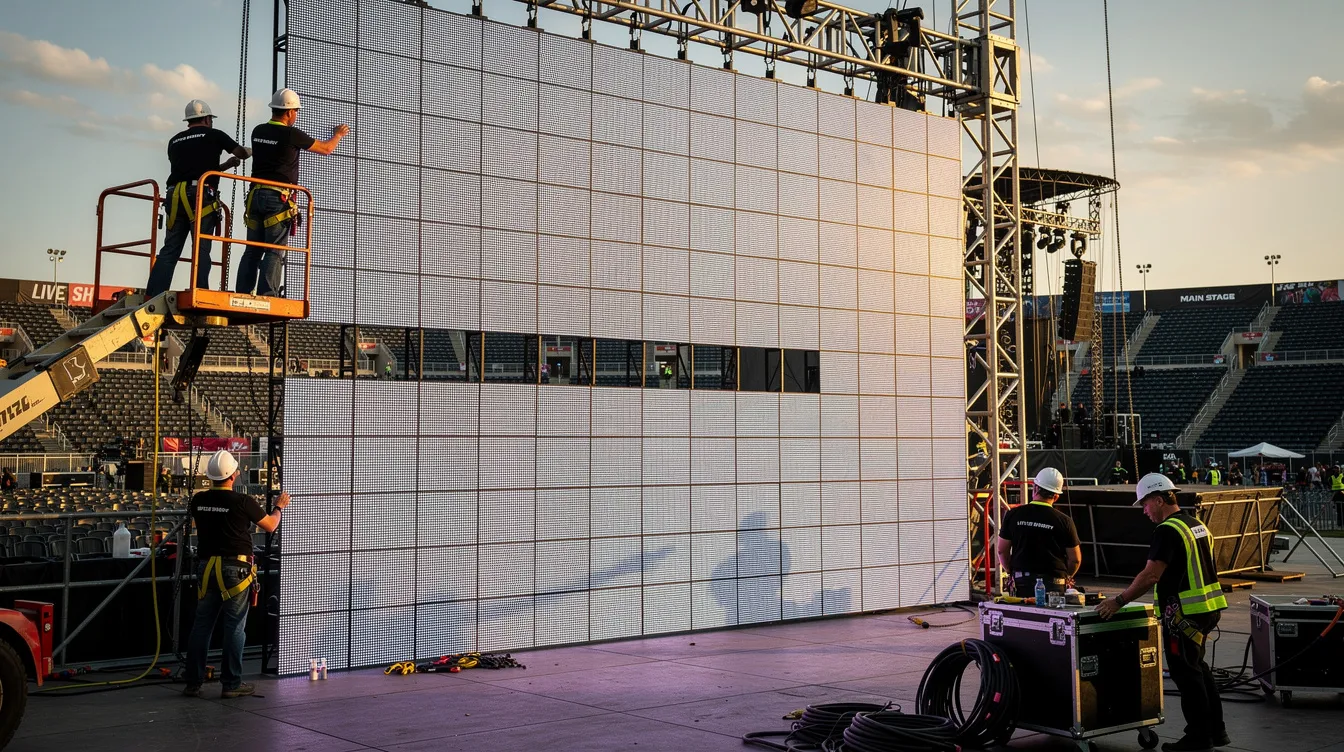
Power consumption of LED walls for live events depends on several measurable variables. No single factor determines the total power consumption alone.
-
Panel model and LED technology. Indoor LED panels at fine pixel pitch (P2 to P3) typically draw 150 to 500 watts per square meter under operating conditions. Maximum power consumption for indoor fine-pitch displays can reach 600 to 900 watts per square meter, while average power consumption for those same displays ranges from 200 to 500 watts per square meter. Outdoor LED panels typically range from 300 to 1,000+ watts per square meter depending on brightness levels. Power density is measured in watts per square meter (W/m²), and power scales linearly with surface area for LED displays.
-
Panel count and auxiliary equipment. The number of LED panels is a primary driver, but adding ancillary gear increases the total power requirements for LED setups. Video processors, playback computers, LED controllers, routing and switching gear, and network monitoring all add to connected load. These must be included in every calculation.
-
Brightness and content. Higher brightness levels increase the power consumption of LED panels. Indoor LED displays typically operate around 800 to 1,500 nits; outdoor LED displays require 5,000 to 10,000 nits to remain legible under sunlight. Average power for outdoor high brightness displays can range from 300 to 800 watts per square meter, with maximum power reaching 900 to 1,300 watts per square meter. Displaying a stark white background can increase consumption far beyond what typical content with varying colors and large black regions draws. Brightness adjustment and content design directly affect actual consumption during a show.
-
Black level power consumption. Even when no content is displayed, drivers, receiver cards and control electronics still draw power. This standby power consumption, the black level, represents the baseline energy consumption of the system.
-
Environmental conditions. Indoor or outdoor placement, ambient light, temperature, humidity and daylight readability all influence how conservatively power must be planned. Outdoor products operating in direct sunlight need more power to maintain legible brightness.
Maximum vs Average Specifications and a Safe Planning Framework
Three distinct concepts apply to every LED wall power plan:
-
Maximum power consumption is the manufacturer’s peak rating, measured at full brightness with white content, all LEDs on, all internal components running. Electrical engineering must use maximum peak power for breaker provisioning. This is the conservative starting point.
-
Average power consumption reflects typical power consumption under mixed content and moderate brightness. Typical power consumption is calculated using maximum and black level consumption. It helps estimate energy costs and cooling, but using average power for infrastructure planning can lead to circuit overloads and hardware damage.
-
Measured operating consumption is what a power meter records on-site for a specific show. It varies with content, brightness and environmental conditions.
The preliminary planning framework (estimates only, not final electrical design): Panel maximum power: total panel maximum watts = number of panels × manufacturer maximum watts per panel. Preliminary total connected load: preliminary total watts = panel maximum watts + processors + playback computers + switching and auxiliary loads. Preliminary single-phase current: Amps = watts ÷ (voltage × power factor). Energy use: kilowatt-hours (kWh) = kilowatts × operating hours.
These formulas do not determine circuit count, conductor size, connectors, feeder capacity, generator size, overcurrent protection or code compliance. Planners should request both maximum and average manufacturer specs and review them with their LED provider and a qualified electrician.
Worked Example (Illustrative Only; Not Front Row FX Specifications)
The following numbers are invented for illustration. They must never be presented as Front Row FX equipment data or applied to any other LED product.
A sample LED wall uses 28 panels with an invented maximum of 300 W per panel and an invented average of 150 W per panel. Panel maximum: 28 × 300 W = 8,400 W maximum panel load. Add auxiliary loads: 8,400 W + 600 W (processors, computers, switching gear) = 9,000 W preliminary connected load. Average panel consumption: 28 × 150 W = 4,200 W estimated average panel consumption. The power consumption formula (Screen Area × Power Density × Brightness) produces similar results when panel-level specs are converted to area-based values.
Converting: 9,000 W = 9.0 kW. For a 6-hour show: 9.0 kW × 6 h = 54 kWh, useful for forecasting energy cost, not circuit sizing. Calculating LED wall power requirements involves determining total wattage and understanding peak versus average usage.
This example does not specify a recommendation for any number of 15 A, 20 A, 30 A or 50 A circuits. Circuit allocation depends on operating voltage, power factor, manufacturer specs, continuous-load treatment, connector ratings, distribution hardware and a professional electrical plan.
Voltage, Amps, Brightness, Content and Power Distribution
Most commercial venues commonly use 120V or 208V three-phase power for heavy loads. Power (watts) = volts × amps × power factor. LED screens and their switch-mode power supplies often have power factors between 0.8 and 0.95, meaning more apparent power (VA) is required for a given watt draw. This efficiency factor must be accounted for in every line of the power plan.
Content affects LED display power consumption directly. Full-screen white at full brightness draws the maximum; darker IMAG video, motion graphics with black regions and content designed for energy efficiency draw less. LED screens consume 50% to 70% less energy than traditional displays such as fluorescent lights or older projection systems across various applications, but the actual consumption within an LED wall still varies by content and configured power levels.
Planning only from LED wall dimensions is insufficient. Planners must know panel model, panel count, manufacturer max W/panel or W/m², and average W/panel. General guidelines suggest indoor LED panels require a maximum of 14 panels per 20A breaker; outdoor LED panels recommend a maximum of 10 panels per 20A breaker. Continuous loads must not exceed 80% of a circuit’s rated capacity according to commercial electrical standards, though the qualified electrician and authority having jurisdiction make the final determination.
LED power supplies experience inrush current when first turned on, which requires careful planning and conservative margins. On large outdoor sites, long cable runs cause voltage drop that can degrade performance and longevity of the display; cable sizing and layout must be engineered, not guessed.
Only the venue, power vendor and qualified electrical professionals can determine circuit ratings, feeder sizing, overcurrent protection and connections. This guide is not a DIY wiring manual.
Generators, Outdoor Conditions, Safety and Redundancy
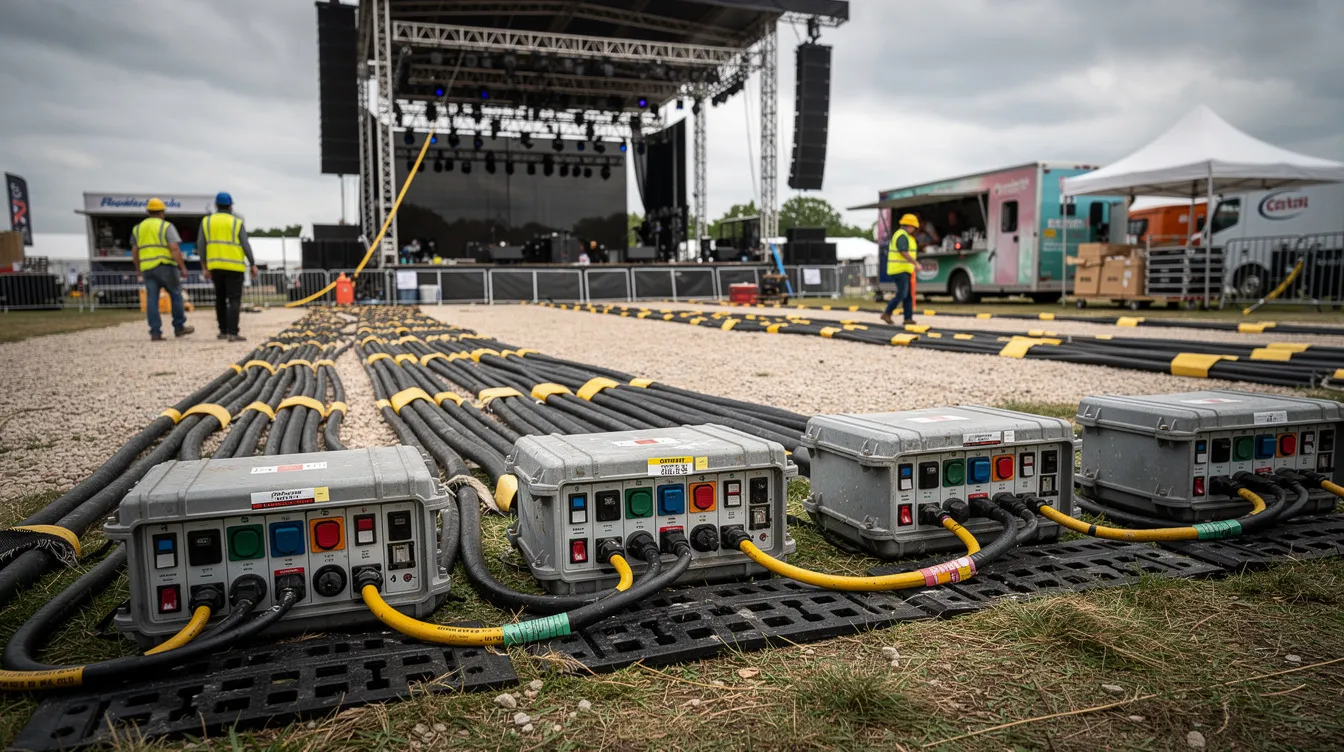
Generator sizing for LED display power consumption requires evaluation of voltage, phase configuration, load balance, power factor, transient behavior, grounding, environmental conditions and reserve capacity. A simple watts-to-kW conversion is not sufficient.
Dedicated distribution for LED panels, processors and show control often runs from a common generator system, but with separation between critical video systems, audio, lighting systems and general services. This reduction in shared risk helps ensure safety during high traffic areas of the show schedule.
Circuit installations must comply with local electrical codes for safety and operational standards. Minneapolis requires electrical permits for certain temporary installations related to events. Minnesota adopted the 2026 National Electrical Code effective August 17, 2026, and temporary event power in Minnesota requires specific compliance with electrical code requirements. Practices in Wisconsin, Illinois and Georgia may differ. Front Row FX coordinates with each venue and the local electrical provider to align LED wall power plans with those regional requirements.
Outdoor LED walls in rain or on damp ground require properly designed grounded systems with GFCI/RCD protection. Cables, data lines and panels must be rated for the environment, protected from standing water and vehicle traffic, and inspected for damage. Redundancy for critical shows means separating primary and backup processors onto different circuits, maintaining independent feeds for control systems and preserving spare capacity for safe limits during live operation.
Information to Confirm with Your LED Provider, Venue and Electrician
Before finalizing any LED wall power plan, gather this information:
From the LED provider:
-
Exact LED panel model(s) and configuration (indoor LED or outdoor, pixel pitch, cabinet size)
-
Manufacturer maximum power consumption (per panel and/or W/m²) and any published average power consumption or black level power consumption values
-
Total panel count, total wall area and any planned expansion for the same event
-
Estimated connected load for processors, LED controllers, playback machines, switching/routing, monitoring and control networks
-
Recommended operating brightness range for the venue and whether the provider can adjust content and brightness for energy efficiency, especially during off peak hours
From the venue and electrical provider:
-
Available voltages, phases and connection points
-
Maximum capacity allocated to the event and any specific limits for LED screens or show power
-
Required use of house power vs temporary generators and restrictions on equipment placement
-
Local policies on GFCI usage, outdoor distribution, cable routing and any mandatory third-party electrical involvement
Front Row FX typically prepares a preliminary power distribution plan, coordinates with the venue’s technical contact and the qualified electrician, and adjusts based on final panel counts, staging layout and other show systems. Involve your LED partner early in planning, ideally at the same time you confirm rigging, staging and room layouts, so that power and data paths are integrated from the start.
Learn more about Front Row FX LED screen wall services, and explore how LED wall power planning integrates into full-service event production and event experiences of every scale. Understanding LED wall amounts, screen size requirements and essential power data early in the process leads to smoother load-ins and more reliable shows.
Pre-Event Testing, Monitoring and Ongoing Energy Awareness
Even when paper calculations look correct, final testing and real-time monitoring are essential. On site, Front Row FX and the electrical provider will typically verify: correct voltage at distribution points feeding the LED display; proper phase balancing across three-phase services where applicable; tight, appropriate connections and the absence of visible damage or overheating on cables and connectors.
A controlled power-up procedure brings distribution online first, then processors and control, then LED panels in a managed sequence while monitoring for abnormal current spikes or unexpected behavior. Power monitoring during rehearsals and the live show confirms that measured operating consumption stays within expected ranges as content or brightness changes. Regular maintenance checks during multi-day events catch issues before they become failures.
Designers can work with the event team to adjust brightness and make content choices that reduce power consumption without compromising the audience experience, improving both energy efficiency and system stability. Document the final power layout, breaker assignments and notable measurements so that future events in the same venue with similar LED walls can be planned more accurately, taking into account each display’s real-world draw.
With a coordinated plan between the LED provider, venue and qualified electrical professionals, LED technology delivers reliable, high-impact visuals while managing power safely and responsibly.
Electrical Safety Disclosure
The information in this article is provided for event-planning purposes only. It does not constitute electrical engineering advice, a licensed electrical design, or instructions for building, modifying, energizing or connecting temporary electrical distribution systems. All electrical infrastructure, circuit design, conductor sizing, overcurrent protection, grounding, bonding and code compliance must be determined and implemented by qualified, licensed electrical professionals in accordance with the locally adopted electrical code and the authority having jurisdiction. Front Row FX is an audiovisual production company, not a licensed electrical contractor. Power distribution plans, generator specifications, circuit assignments and all temporary power installations for live events require the direct involvement of a licensed electrician or electrical engineer, the venue’s facilities team and, where required, local electrical inspection and permitting authorities. Electrical codes, inspection requirements and venue policies vary by jurisdiction and project. Do not rely on the general information, formulas or examples in this article as a substitute for professional electrical evaluation of your specific event, equipment and site conditions.