One Production Partner vs. Multiple AV Vendors: Where an Event Production Company Actually Saves You Money
The Real Cost of Splitting Your Event AV
Most corporate events still split AV across separate vendors: one for LED, another for audio, a third for lighting, a fourth for streaming. Each vendor submits a quote that looks reasonable on its own. But when four invoices land on the same desk, the overlap is hard to miss. Professional audiovisual production is vital for corporate events, conferences, and concerts; the question is how many companies need to be involved to deliver it. Corporate events can range from intimate dinners to large-scale productions, and the vendor structure should match the scope, not multiply the overhead.
An event production company does not automatically cost less than a collection of specialists. What consolidation removes is duplicated spend in project management, logistics, labor, and onsite troubleshooting. Consider a 600-person sales kickoff in Minneapolis in 2025 where LED, audio, lighting, and streaming were originally quoted by four separate AV vendors. When one corporate event production partner took over, overlapping project management (~$8,000), redundant trucking (~$6,000), duplicate crew hours (~$5,000), and repeated power infrastructure (~$3,000) disappeared from the budget. The show didn’t shrink. The waste did.
Two ideas guide this article. First: one point of communication, one technical plan, one accountable production team. Second: consolidation should remove duplication, not remove capability.
How Event Production Companies Structure Corporate AV vs. Multiple Vendors
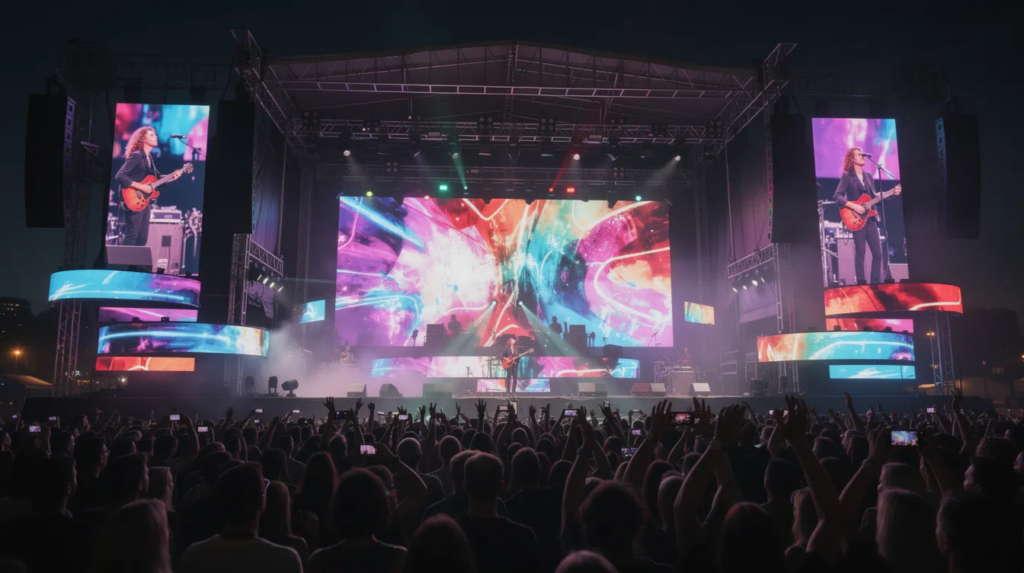
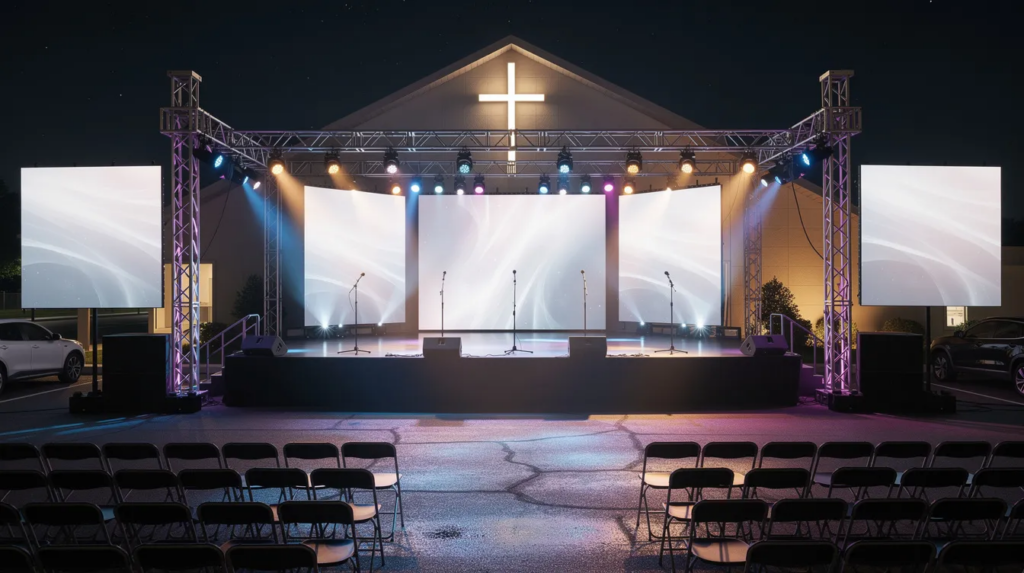
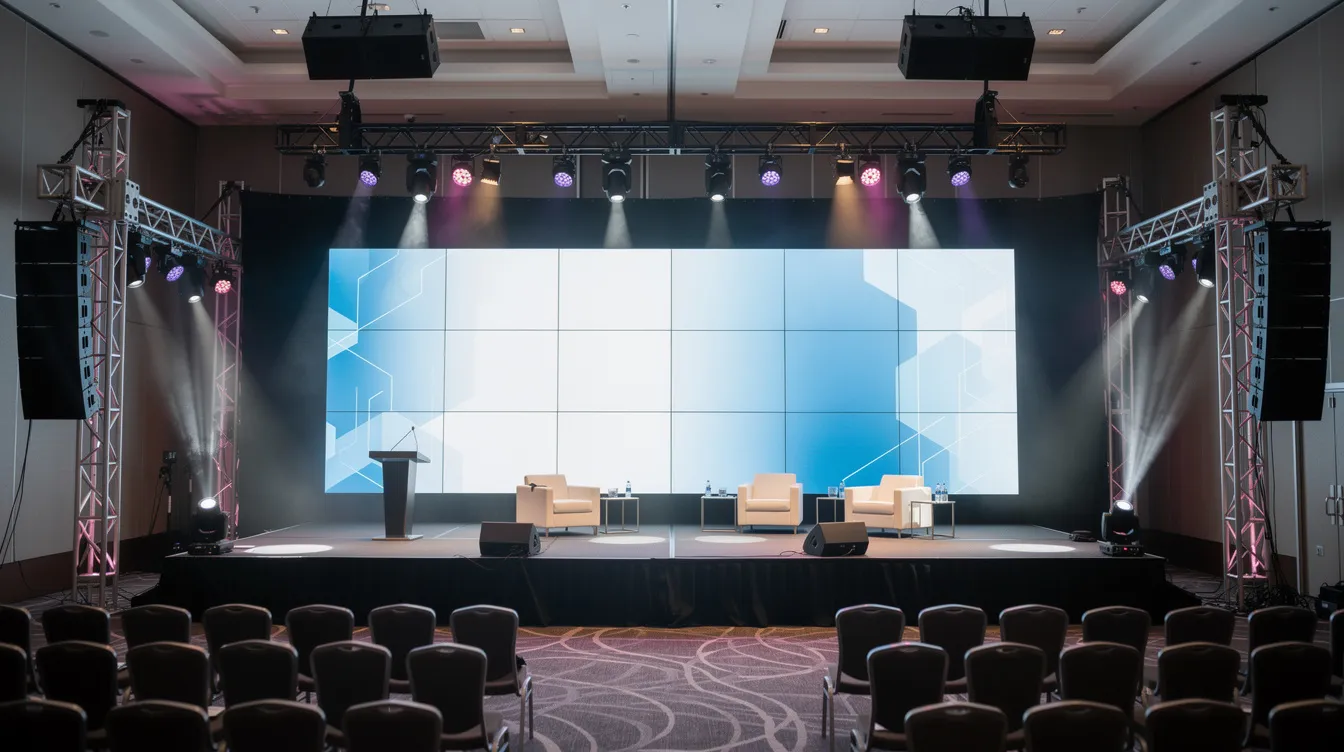
A full-service event production company combines event planning support with technical design, audiovisual production, logistics, and onsite show operation. Major event production services include audiovisual production, stage design, speaker management, and live broadcasting. Event production companies manage staging, lighting, LED video systems, scenic builds, and show control under one roof.
Compare two approaches for a corporate conference:
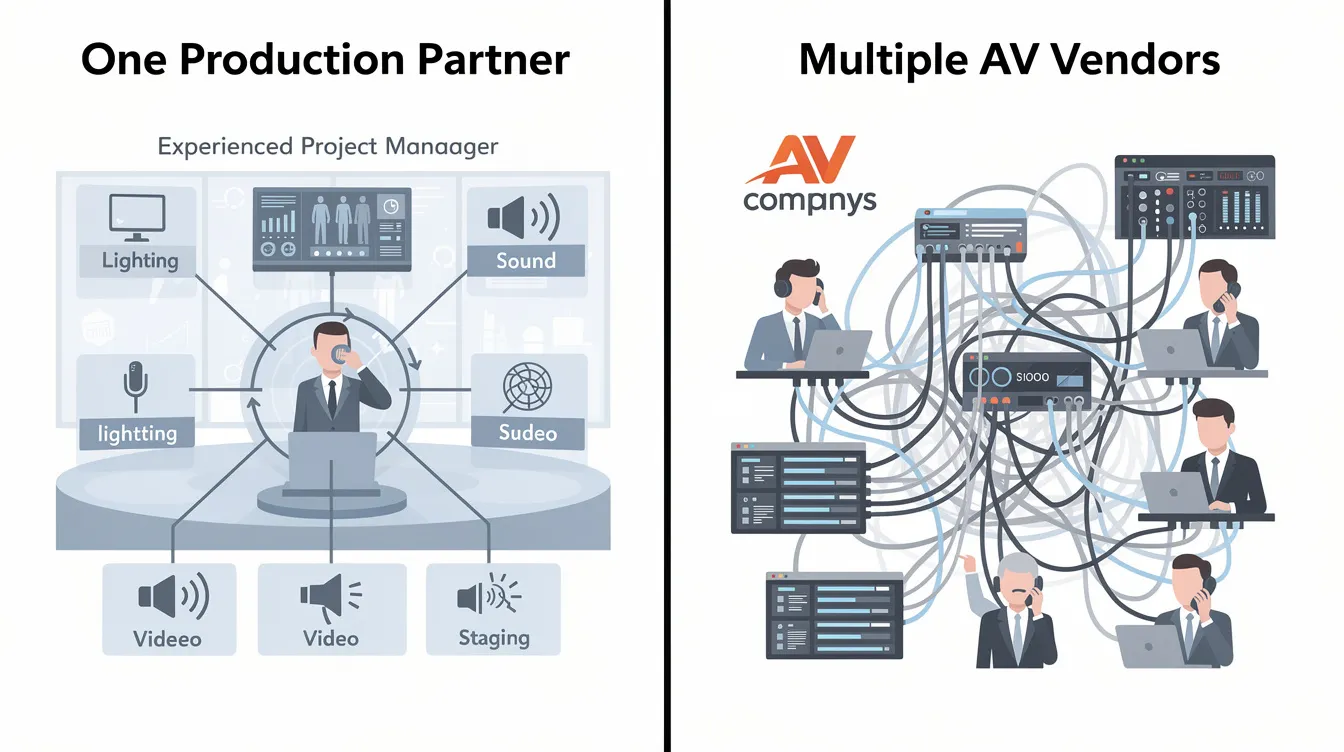
Fragmented: An LED vendor, audio vendor, lighting vendor, and streaming vendor each build independent timelines, cable plans, crew calls, and power requirements. The event planner mediates between all four.
Consolidated: One AV production company designs all systems from a single production plan, with one show schedule and shared technical infrastructure.
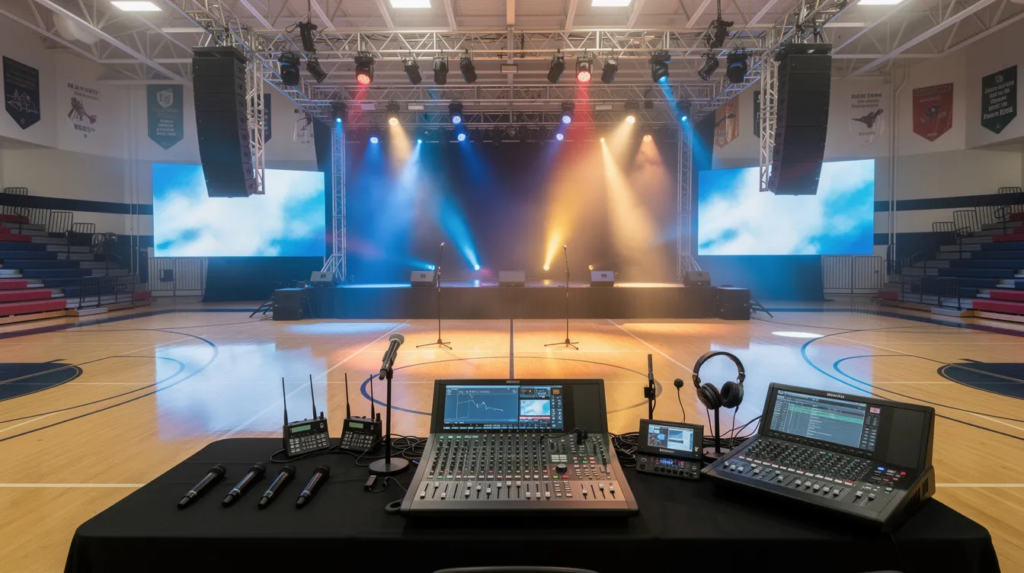
Core systems that interact on a typical corporate event include LED video walls, projection mapping, cameras, audio reinforcement, stage lighting, rigging, playback, comms, special effects, and networking. Hybrid events connect in-person and remote audiences, and providers like Tallen offer hybrid event production with multi-camera switching. Hybrid events demand comprehensive planning for both in-person and remote experiences; separating that planning across vendors adds coordination cost that event planners absorb personally. Los Angeles hosts thousands of corporate events annually, and Arizona hosts hundreds of corporate meetings and conferences each year; the vendor consolidation math works the same in every market.
Where You Quietly Pay Twice with Multiple AV Vendors
The diagnostic question for any procurement team: “What are we paying for twice because separate vendors are solving the same production problem?”
Duplication hides in line items that look different on estimates but represent the same work:
Duplication Area | What It Looks Like with Split Vendors |
|---|---|
Project management | Four PMs each billing $2,000 for overlapping coordination |
Trucking and deliveries | Four dock windows, four minimum truck charges |
Load-in/out labor | Two crews both billing four hours to troubleshoot a camera latency issue caused by mismatched LED processing and video switching |
Technical leads | Multiple show callers building independent run-of-show documents |
Cable and power infrastructure | Separate power drops and cable runs for systems that share the same circuit path |
Show-site management | Each vendor’s PM managing their own scope without visibility into the others |
Communication errors | A late LED aspect-ratio change that no one tells the camera operator about until rehearsal |
Event production costs in Los Angeles start in the low thousands for basic setups. Projects with AMP Events typically start around $25,000, and total event budgets with AMP Events range from $300,000 to $3,000,000. At every price point, redundant line items compound. Multi-day conferences can increase event production costs further when each vendor bills separate mobilization and overtime.
Ask each vendor in your next RFP: “What other vendor is doing something similar, and how will your scope connect to theirs?”
One Technical Direction: Why a Single Production Plan Changes the Math
Top event production companies focus on engineering, design, and technical execution. Successful event production involves a dedicated project manager and logistical alignment across services. Event production companies need a clear chain of command and strong production management capabilities. That chain of command is what “one technical direction” means in practice.
On a 3-day corporate conference with general sessions and breakouts, a single audiovisual production partner builds an integrated production book: rigging plot, power layout, signal flow, cue sheets, rehearsal schedule, and labor plan. This doesn’t mean only one brand of equipment; it means one accountable design that makes different systems compatible.
The result is fewer planning calls, fewer on-site surprises, faster load-ins, and shorter overtime windows because all departments work off the same plan. The value is not cheaper day rates. It is fewer handoffs and clearer responsibility when something in the room doesn’t match the client’s expectations. One complete audiovisual production plan replaces the patchwork of disconnected vendor drawings that typically gets stitched together during rehearsal.
How LED, Audio, Lighting, and Video Interact (and Why Split Vendors Increase Risk)
LED, audio, lighting, cameras, and rigging are not separate “products.” They are interdependent systems sharing power, structure, and signal paths.
LED and cameras: LED video walls affect rigging loads, power distribution, content aspect ratios, camera exposure, and stage layout. A separate LED vendor and camera vendor may not align pixel pitch, refresh rate, or processing until onsite, causing moiré patterns and delays. Tallen provides LED video walls for large-scale events, and Tallen’s AV rental inventory includes projectors and screens; the gear exists across many companies, but coordinated deployment is what prevents rework.
Lighting and cameras: Stage lighting choices (color temperature, intensity, angles) must be balanced with camera needs and LED brightness. Multi-camera switching enhances engagement for virtual attendees, but only if lighting supports clean camera feeds.
Audio and staging: Sound quality is critical in concert production, including PA systems and experienced audio engineers. Audio reinforcement design affects stage placement, podium location, audience seating, and video screen positions. An audio vendor outside the same planning loop as staging and LED creates feedback issues and limited sightlines.
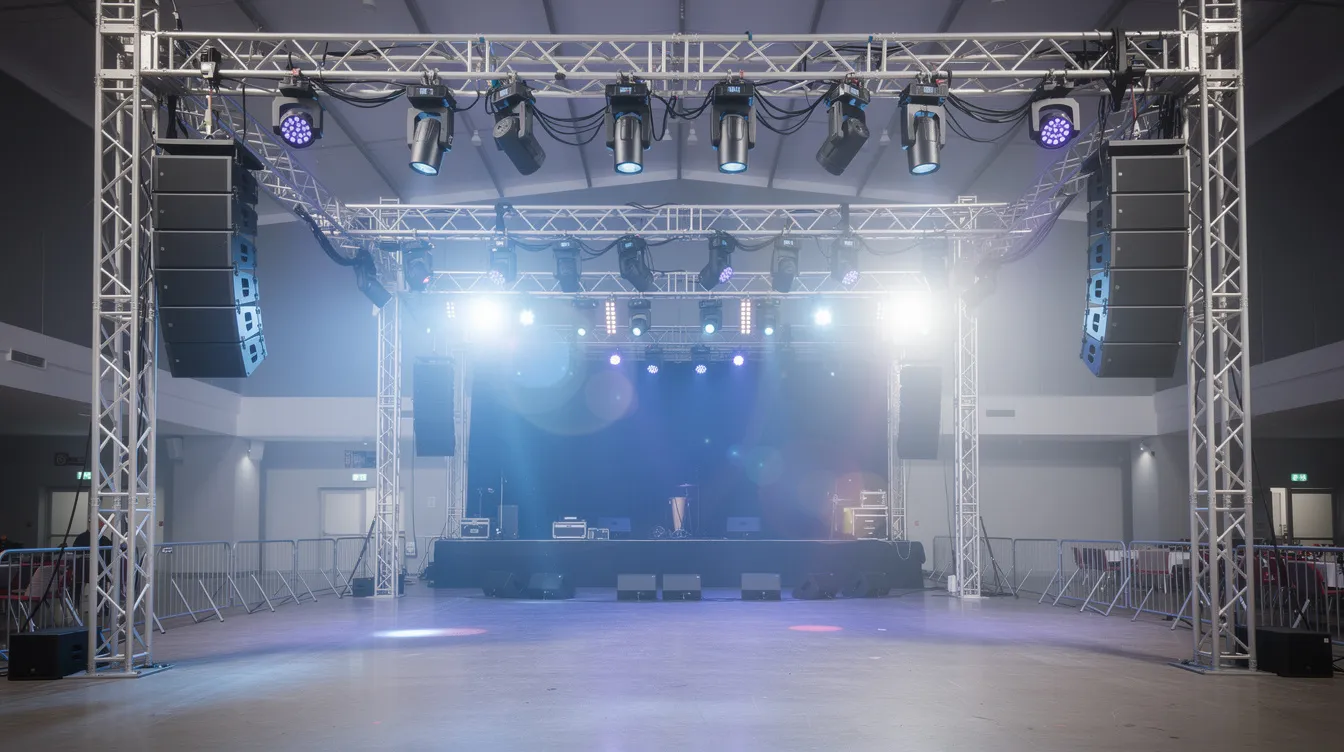
Rigging and power: One coordinated rigging plan and one power distribution plan shared across LED, lighting, audio, and scenic reduces lifts, power drops, and cable runs, and shortens load-in by hours.
Logistics, Labor, and Project Management: The Hidden Side of Event Production Costs
Crew labor often represents 22-50% of an AV production budget. Large conferences require extensive logistical support including registration and audience management. Production management should offer detailed planning and vendor coordination to prevent scheduling conflicts. Event planner fees can be hourly or a percentage of total spend; either way, the coordination hours add up.
Trucking: A single event AV company consolidates trucks, staging areas, and dock windows. Four separate vendor trucks each paying minimum hours, fuel, and overtime is a line item that grows fast. Hybrid event production requires managing remote presenter coordination, which adds another logistics layer.
Crew scheduling: One production direction sets unified call times and cross-utilizes crew where appropriate, avoiding scenarios where one team waits on another to finish rigging.
Venue coordination: One event production management team speaks with hotel engineering, security, and catering about load-in routes, power access, and noise windows. Venue staff juggling questions from four suppliers lose detail.
Buyer time: Coordinating LED, audio, lighting, video, rigging, power, and crew across separate companies means more RFPs, more status calls, and more room-diagram revisions. Assign an internal cost to every planning hour spent chasing answers between vendors; compare that to working with one audiovisual production partner who owns the entire technical conversation. Planning multi-day AV production under one direction compresses that timeline.
When Multiple AV Vendors Still Make Sense
The goal is not eliminating specialized suppliers. It is eliminating unnecessary fragmentation. Some events legitimately need multiple AV vendors.
Clear cases include specialty broadcast trucks for national webcasts, touring artists carrying their own backline, venue-mandated in-house AV, complex rigging subcontractors, and show-specific creative studios. Tallen has over 20 years of event production experience and produces multi-day conferences in Los Angeles, while CEI has over 25 years of audiovisual production experience and handles hundreds of events annually in Arizona. Tallen provides production for product launches and association meetings. Tallen has over a decade of hybrid event production experience, and Tallen’s hybrid production includes interactive Q&A and live polling. These companies, and many others, serve specific needs that may complement rather than compete with a primary production partner.
A concrete example: a 2-day product launch for a technology company using a specialty XR stage provider plus the venue’s required rigging contractor alongside a primary production partner for turnkey event production across LED, audio, lighting, and show control. The key is assigning one technical lead with authority to coordinate all AV vendors, insisting on a single shared production schedule, and requiring one master power plan and one master signal flow diagram.
Event production companies should provide backup systems and contingency plans for technical failures regardless of how many vendors are involved. Effective event vendor consolidation removes overlap in direction and infrastructure, not every line item.
How to Evaluate an Event Production Company as Your Consolidated AV Partner
Criteria for selecting an event production partner include experience, technical reliability, and transparent pricing. Customized quotes are provided based on specific event requirements; demand that specificity.
Questions to ask:
Capabilities: Can the company deliver integrated LED, audio, lighting, cameras, playback, comms, FX, and show control? Does it support hybrid and streaming?
Production management: Who builds the show schedule? Who calls the show? How do they coordinate with internal event planners, agencies, and venues?
Technical documentation: Ask for sample CAD drawings, power plans, and signal flow diagrams from previous corporate events or conferences in the 300-2,000 attendee range.
Regional strength: Does the company know the dock, power, and labor requirements at the venues you use?
Cost transparency: Request side-by-side scenarios: one with fragmented vendors, one with consolidated technical direction. Compare where labor, trucking, and project management time change even when equipment quantities stay similar.
Front Row FX as Your Audiovisual Production Partner in the Upper Midwest
Front Row FX functions as a turnkey event production company for corporate events, not an equipment rental house. The difference between event production and AV rental is the presence of technical design, production management, and onsite execution.
Core services include integrated LED video walls, audio reinforcement, intelligent lighting, projection and video systems, special effects, production systems, onsite experienced technicians, and show and technical management throughout Minnesota, Wisconsin, Chicago, and the Upper Midwest. Front Row FX provides one point of communication, one technical plan, and one accountable production team across LED, audio, lighting, video, and FX for conferences, corporate meetings, galas, product launches, and brand activations that create lasting memories and deliver measurable results.
Front Row FX regularly works alongside agencies, in-house event planners, and venue teams, providing centralized technical direction even when specialty or venue-mandated vendors are part of the production. The creative vision stays intact; the duplication disappears.
Fewer handoffs. Clearer responsibility. One production direction.
If you are planning events in 2025 or 2026, share your current multi-vendor plans with Front Row FX. The team can identify where consolidation reduces duplicated effort without shrinking the show. Start a conversation here.