Winter Event Production in Minnesota: Practical Planning Guide from Front Row FX
What Actually Changes in Winter Production
Winter event production in Minnesota is routine. The Twin Cities host corporate events, conferences, galas, private celebrations, brand activations, holiday markets and light displays, theater performances and live music throughout the season. The City of Lakes Loppet Winter Festival runs January 31 through February 1, 2026, and the Luminary Loppet features over 1,200 glowing luminaries in February 2026. Lake of the Isles offers ice skating during winter months. Event agencies help plan and produce festivals and events across the metro. The work does not stop when temperatures drop.
What changes is the margin required around every decision. Minnesota winters require specialized skills for event production, and cold-weather technical expertise is essential for audiovisual equipment. Winter events must consider proven extreme weather logistics. A production company that treats a January load-in in Minneapolis Minnesota the same as a July load-in will run into problems that have nothing to do with creativity, storytelling or the quality of the concept. They are logistics problems, and they are solvable with planning.
Front Row FX is based in Eagan, MN and regularly supports winter events across the Twin Cities and greater Minnesota. This article covers the concrete production consequences of cold weather event production: scheduling, dock access, equipment acclimation, outdoor AV, power distribution and contingency planning. The core idea is simple: winter does not necessarily make the production harder; it makes planning margin more important. This is written for planners of corporate events, nonprofit galas, winter festivals and outdoor activations who care about technical reliability and client satisfaction.
Scheduling Winter Load-In, Crew Travel and Truck Movement
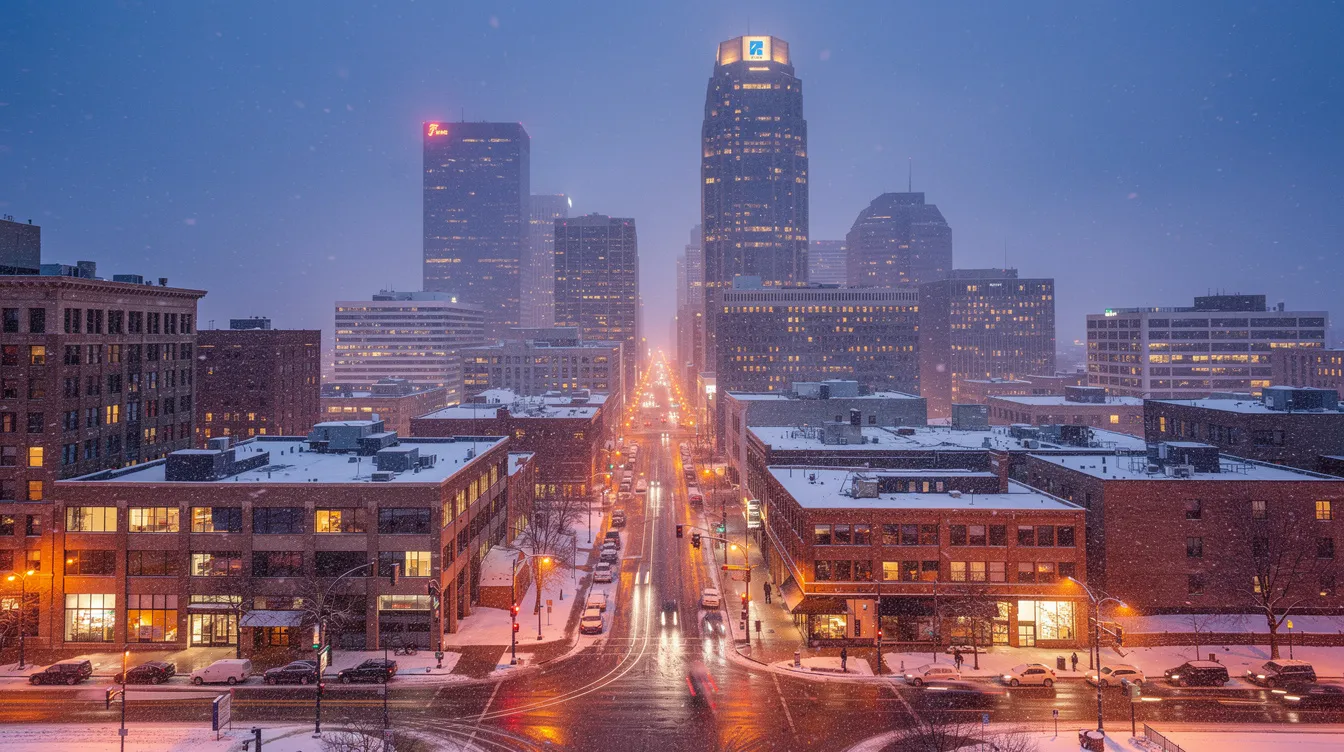
A winter load-in cannot be scheduled using the same assumptions as a summer load-in. A drive from Front Row FX’s warehouse in Eagan to a downtown Minneapolis venue takes about 30 minutes in summer. After a snow event, that same drive on I-35 or I-494 can stretch to 60 or 90 minutes. MnDOT prioritizes highways and arterials for plowing, but side streets near venues may remain unplowed for hours.
Snow emergencies change the logistics further. When Minneapolis declares a Snow Emergency, parking restrictions take effect at 9 p.m. on Night Plow Routes, with Day 2 and Day 3 restrictions following on residential streets. The city plows more than 1,400 lane miles over three days. Saint Paul triggers Snow Emergency rules after approximately 3 inches of accumulation, with towing and ticketing in effect for up to 96 hours. For production teams, this means truck staging areas that worked last month may be restricted or towed on show day. St. Paul is also piloting one-sided parking rules for the 2025-26 season, requiring pre-planning even when no emergency is declared.
Crew travel planning matters just as much. Stagger call times so the lead audio engineer, lighting director and production manager arrive earliest, with supporting staff arriving after. Build realistic schedule buffers: add at least 30 to 60 minutes to a standard hotel ballroom load-in, and more for downtown theaters, arenas or convention center spaces. These buffers protect rehearsal windows, soundchecks and doors times. Careful winter scheduling is one of the most direct ways to ensure client satisfaction even when the weather does not cooperate.
Docks, Building Access and Equipment Staging in the Cold
A heated, enclosed loading dock at a Minneapolis convention center is a different world from a curbside push into a historic theater with no dock. The difference is not convenience; it is time, safety and equipment protection.
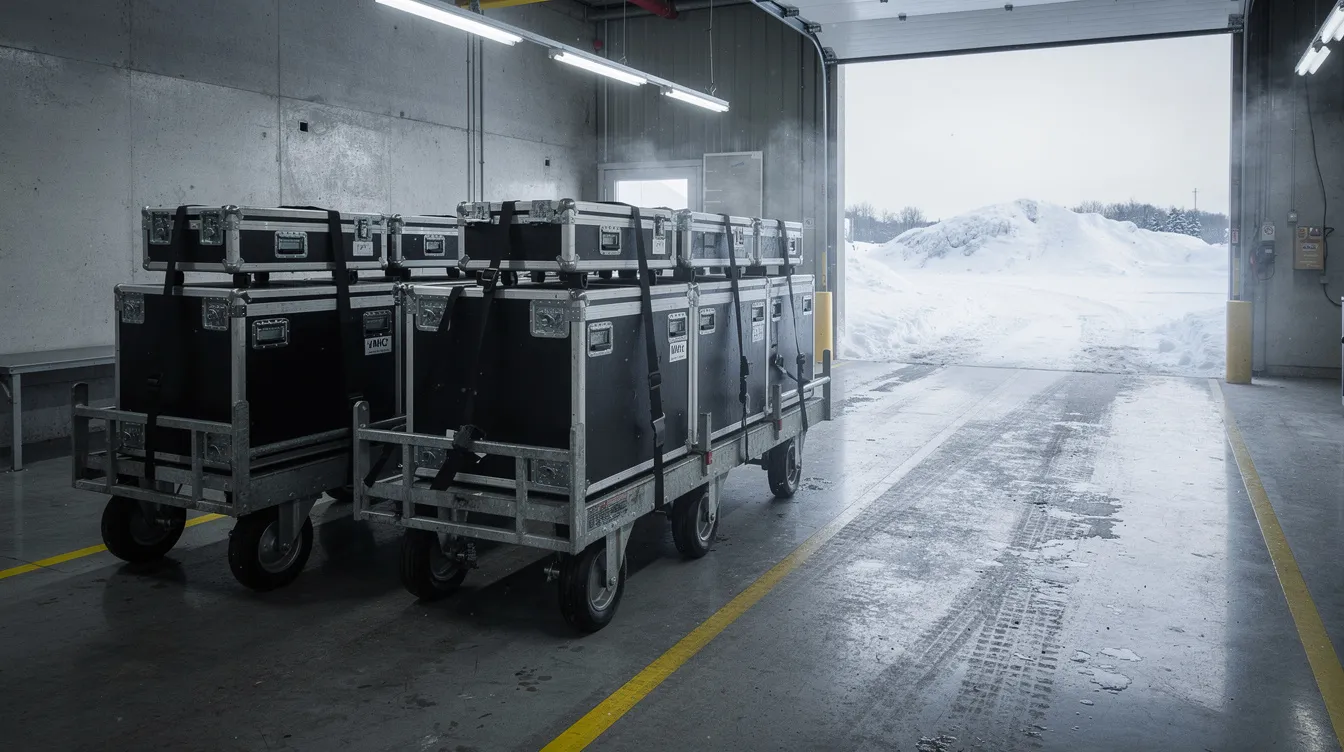
Enclosed docks keep gear out of sub-zero air, provide better traction underfoot and eliminate snow or ice on ramps. Many older venues, downtown corporate offices and rooftop event spaces lack proper dock access entirely, requiring equipment pushes of 100 feet or more through exposed conditions. Active site maintenance is required for snow and ice management at these sites, and clearing and salting access paths must be coordinated with the venue in advance. Local venue navigation requires knowledge of winter-specific codes and permits, and many winter events require special permits for temporary structures and safety measures.
For winter events, Front Row FX plans a staging zone just inside the dock or service corridor where cases can shed snow and ice before entering carpeted ballrooms or meeting spaces. Elevator and freight lift scheduling in high-rise venues gets tighter during the holiday and end-of-year event season, when multiple tenants are moving freight simultaneously. Cart selection matters too: pneumatic or semi-pneumatic wheels handle packed snow and slush better than smooth casters. Cable ramps should be placed away from areas likely to accumulate snowdrifts. All of this is evaluated during pre-production site visits and adjusts truck pack, crew count and schedule for each indoor or outdoor setting.
Equipment Acclimation, Temperature Transitions and Condensation
Moving electronics between sub-zero outdoor conditions and a 72°F ballroom is one of the most overlooked winter production issues. Standard AV equipment can fail in extreme cold, and the transition itself introduces risk.
The physics are straightforward. When cold gear enters a warm, humid room, moisture in the air condenses on metal surfaces, connectors and circuit boards. Sensitive electronics, including LED processors, media servers, digital audio consoles, wireless receivers and projectors, may require controlled acclimation time. A typical approach: cases sit in a temperate backstage area or dock-level staging zone for 30 minutes to two hours before power-up, following manufacturer guidance. Many manufactured units list an operating range of -22°F to +104°F, but drivers, power supplies and motorized fixtures with pan/tilt motors often stiffen or fail until warmed.
Operators should never rush to power up cold gear immediately upon entering a warm space. For events that span both outdoor and indoor spaces (LED walls outside, presentations inside), these transitions need scheduled windows. A professional Minnesota event production team builds this acclimation into the overall load-in plan without altering the event program.
Outdoor Winter Events: LED, Audio, Lighting and Structures
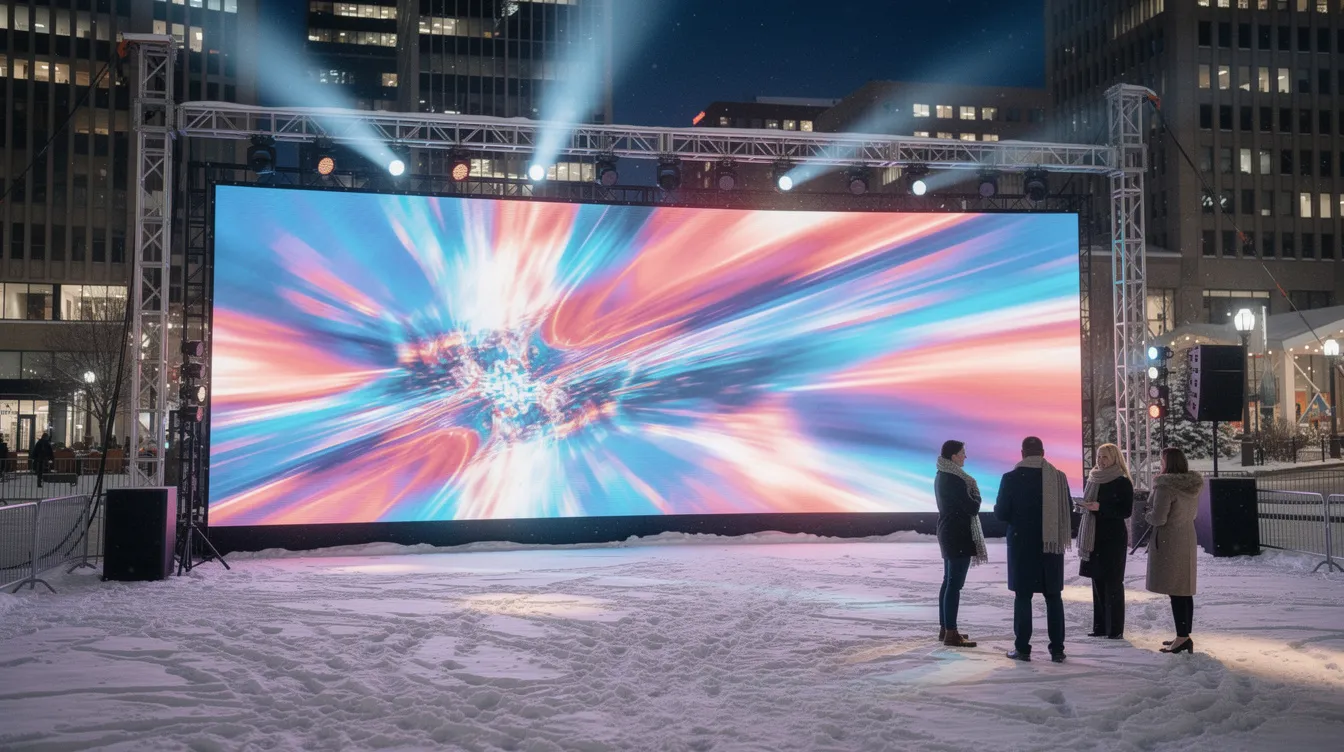
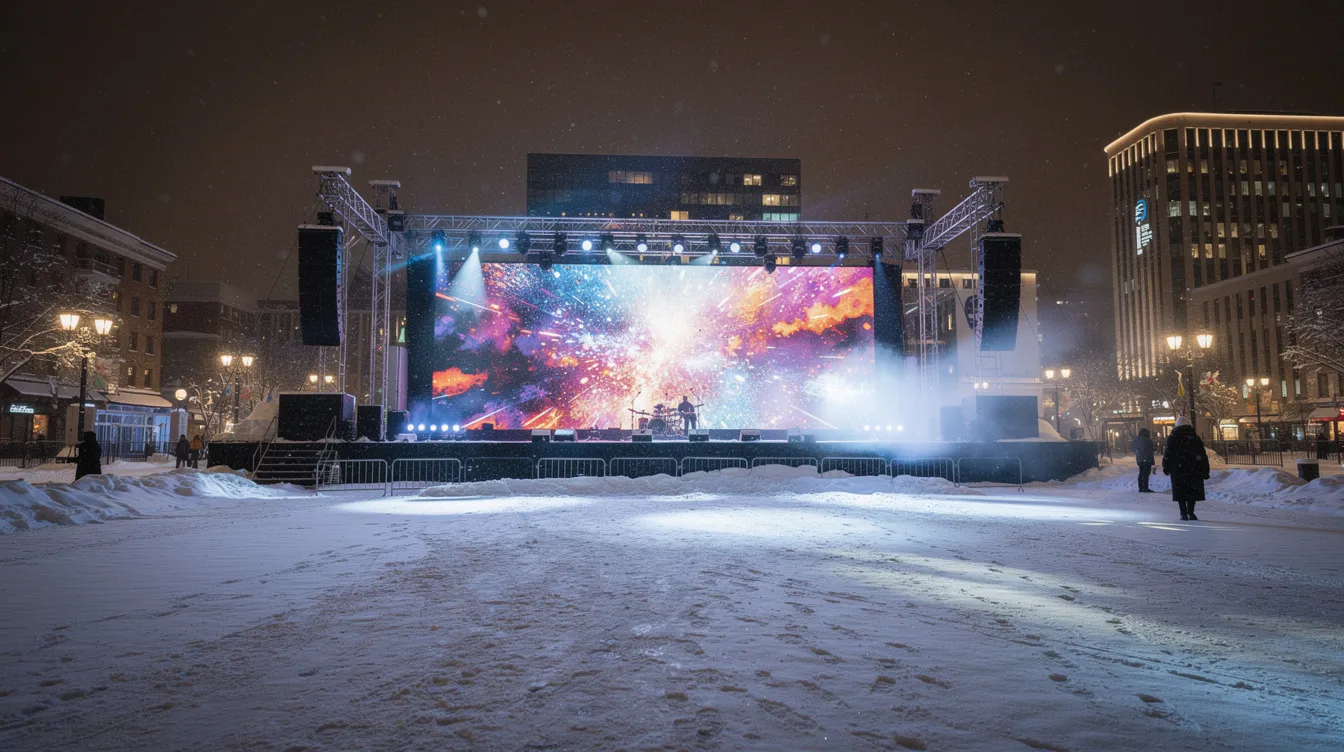
Outdoor event production in Minnesota in January means working in conditions where average highs hover around 24°F and nights regularly drop below 0°F. Minneapolis winter events like riverfront celebrations, downtown plaza activations and the City of Lakes Loppet draw crowds who expect a live experience that works. Successful winter events enhance guest experience through comfort engineering, including thermal infrastructure, heating solutions and heated luxury restroom facilities for outdoor gatherings.
Not every LED product is suitable for winter deployment. Outdoor LED winter installations require IP-rated cabinets (IP65 or IP66 minimum, IP67 where water pooling or heavy snow accumulation is possible), sealed data and power connectors, and hardware rated for cold-temperature operation. Snow-covered environments create intense reflected light even under overcast skies, so LED wall designs need higher nit ratings and adjusted contrast ratios. Wind loading on open plazas or lakefront sites requires engineered ballast, guying and certified truss rated for 25 to 35 mph gusts.
Cable paths need protection from snow accumulation and plowing. Signal and power cables should be elevated where possible, routed along cleared paths using heavy-duty cable ramps, with snow removal schedules coordinated to avoid burying critical runs. Guest comfort involves not just warmth but also weather-proof backup spaces, which are essential for outdoor events when conditions deteriorate. Many winter events require coordination with city permitting for temporary structures.
Outdoor lighting fixtures must operate within their rated temperature range; some include lens de-icing elements, but all need periodic clearing of snow and frost buildup. Professional sound reinforcement outdoors in winter requires wind noise management on microphones, weather covers on loudspeakers and flexibility in speaker placement, because audience areas shift as people cluster near heaters or sheltered zones. Lighting and audio-visual systems require more power in cold conditions, a factor that feeds directly into generator and distribution planning.
Crew access and strike conditions are a real constraint. Working time outside is limited by actual temperature and wind chill, so builds are broken into shorter segments with warm-up breaks. The St. Paul Winter Carnival used IP-rated Elation fixtures at temperatures reaching -9°F with very few failures, but operators still needed to power cycle certain fixtures. Super Bowl LIVE in downtown Minneapolis experienced temperature swings from 47°F to near 1°F over its 10-day run, forcing adjustments to scheduling, crew rotation and gear protection.
Power, Generators and Reliable Temporary Distribution in Winter
Winter AV production often relies on a mix of venue power and temporary generators, especially for outdoor stages, parking-lot activations and festival sites.
Generator placement in snow requires a plowed, stable surface where exhaust is directed away from snow banks (to prevent carbon monoxide buildup), refueling access remains practical even after fresh snowfall and noise is managed relative to the stage and audience. Fuel planning must account for diesel gelling at low temperatures; use cold-flow diesel treatments or winter-grade fuel, and plan for increased consumption during extended warm-up runs and pre-rig checks.
Temporary power distribution considerations include:
Weather-rated cabling and locking connectors with gaskets
Connections raised above ground or sheltered to avoid meltwater and snow intrusion
Power routing away from plowing paths and high-traffic areas
Redundant circuits and spare generators when fuel delivery may be delayed
Where possible, use existing venue electrical at arenas, convention centers or corporate campuses and supplement with generators only where needed. All power work should be performed by qualified electricians and experienced technicians. Front Row FX coordinates with venues and licensed electricians to design safe temporary power plans for winter events Minnesota organizations host outdoors.
Redundancy, Backup Plans and Local Minnesota Support
Winter adds variables. Margin and backup options protect corporate events, festivals and public programs from turning a weather delay into a show failure.
Local access to crew, replacement components and technical resources matters when travel conditions slow incoming shipments or ground flights. Minneapolis has 39 event staffing companies with 457 tracked contacts and 168 verified work emails across those firms. Among the local landscape, Modern Talent USA specializes in promotional event staffing, Media Loft is a 100% employee-owned event staffing company, and BeEvents specializes in high-impact event experiences. There are 39 event production agencies in Minneapolis, including firms like Event Pro, Inc. with over 25 years of experience and Push Play, a women-owned event agency. Strong vendor management ensures effective coordination of event services, and vendor resilience is crucial for crew management in harsh conditions. Producers should provide detailed cost proposals covering various contingencies.
Schedule redundancy includes secondary load-in windows, alternative rehearsal times and realistic strike timing that accounts for late-night snowfalls. Backup routing for trucks and crews is essential when highway corridors like I-94 or I-35 experience closures. Equipment backup strategies include spare LED tiles, backup playback systems and duplicate critical microphones. Cold-weather contingency plans must address snow accumulation and extreme cold at every stage of execution. Weather-proof backup spaces are essential for any outdoor event plan.
Thoughtful contingency planning keeps the focus on guests and program content. Front Row FX’s experience across multiple Minnesota winters informs realistic contingency plans tailored to each corporate event or festival, built on precision and local knowledge rather than guesswork.
Partnering with Front Row FX for Minnesota Winter Events
Front Row FX operates from Eagan, Minnesota, close to Minneapolis-St. Paul International Airport and the I-35, I-494 and I-694 corridors. That proximity allows earlier response on short-notice events, pre-staging at the warehouse when forecasts look bad and same-day access to spare components. The ways a local production company creates unforgettable experiences and high impact experiences for clients come down to coordination at the intersection of creative ideas, technical execution and weather-aware logistics.
Winter event production in Minnesota succeeds when margin, acclimation and realistic timelines are built into the plan from day one. Planners handle the concept, the messaging, the registration, the signage, the connection with guests and every small moment that brings a celebration to life. Front Row FX handles the technical and logistical realities so that every person in the room or at the site has the experience the event was built to create.
Contact Front Row FX to discuss your next corporate event, conference, gala, brand activation or outdoor winter activation. Check out more posts on our site to learn about related event production topics, and click through to explore how we work across the Twin Cities and the Upper Midwest. We love this work, and we offer the close, easy collaboration that makes completion of a winter event feel like any other day on the job.