Front Row FX | Audiovisual & Event Production

Categories
LED Screens & Video Walls

Touring AV Support for DJs & Independent Artists

Touring AV Support for DJs & Independent Artists

This page is for DJs and independent artists who already run professional shows and need to repeat that production across multiple dates and markets without rebuilding from scratch every night.

Touring AV Support for DJs: One Show, Many Cities

Touring AV support for DJs is not about booking, management, or performance coaching. It is about owning the technical and creative infrastructure-audio, LED, lighting, FX, and event production-so that a show built for one city can land with equal impact in the next. This applies to live music events, festivals, club runs, and corporate events with a performance centerpiece.

The core concept is straightforward: touring production for DJs is about preserving the same creative and technical intent in every venue, not forcing the exact same gear list into every room. AV support for DJs must adapt to different venue sizes and types while keeping the audience experience consistent. Touring DJs rely on robust audiovisual support to deliver immersive live experiences, and that reliability comes from a single production relationship rather than cold-starting with a new vendor in every market.

Front Row FX operates touring audiovisual production from two bases: Eagan, Minnesota and Atlanta, Georgia. From those hubs we support multi-city runs through the Midwest and Southeast-Minnesota, Wisconsin, Illinois, Iowa, North Dakota, South Dakota, Georgia, Tennessee, Florida, and additional routed markets. Touring AV requirements include logistics management for consistency across multiple locations, and having two geographic anchors means gear, crews, and planning stay inside efficient transit lanes.

Why does a single production relationship matter? Because when one team owns the show design, rider, advance, and execution, there is no re-education cycle at every stop. The artist performs. The production team delivers. Every city gets the same show.
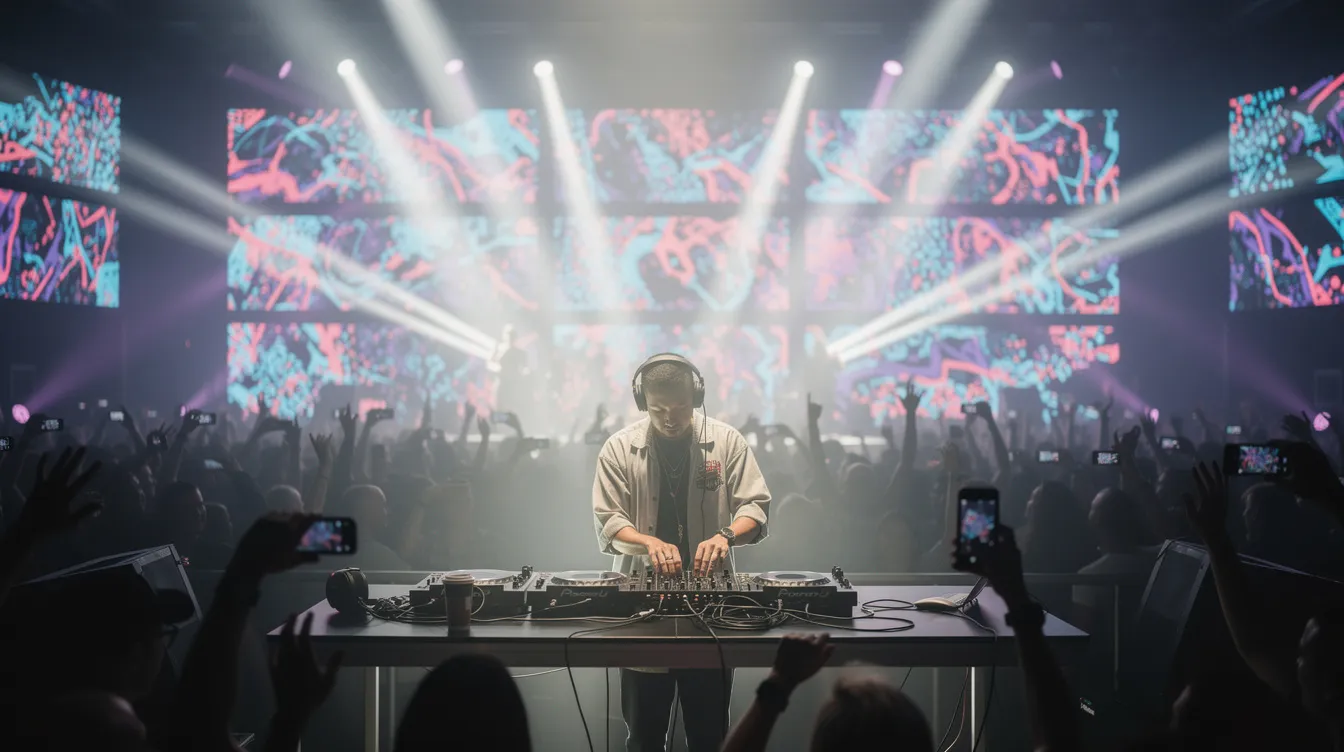
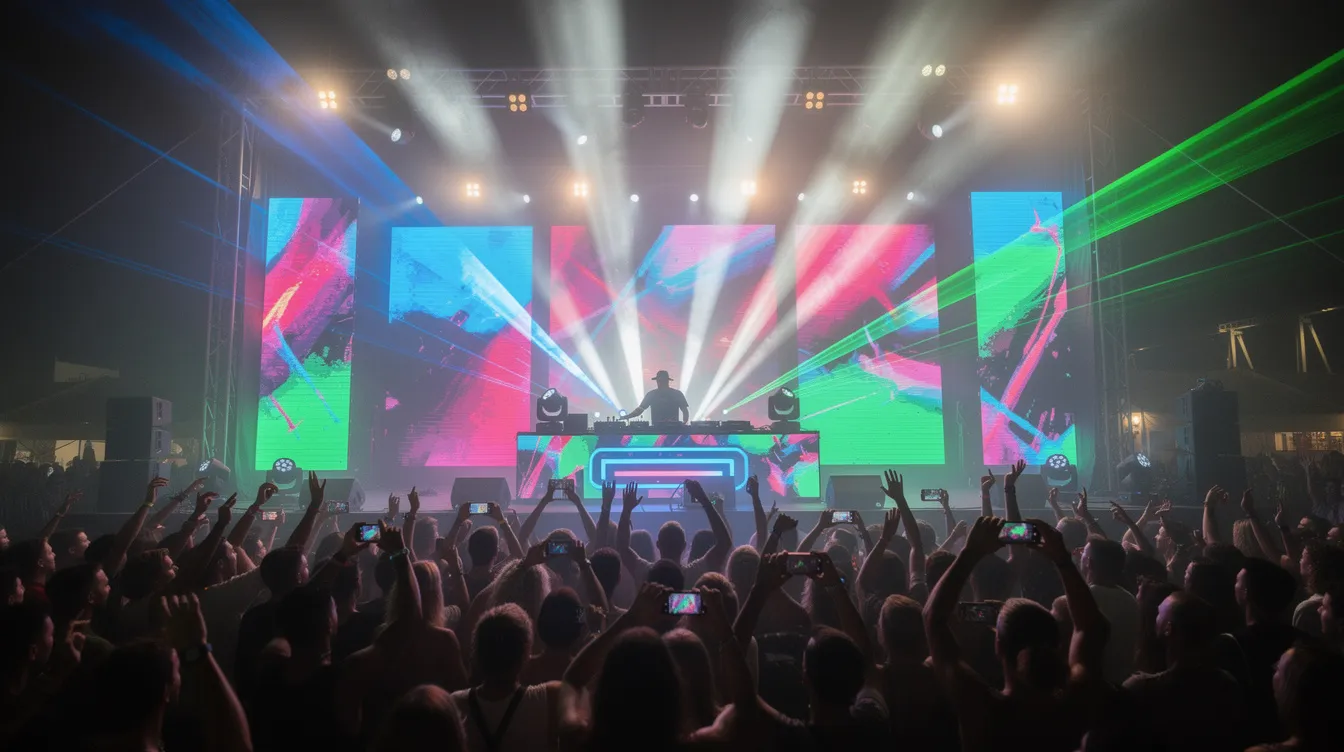
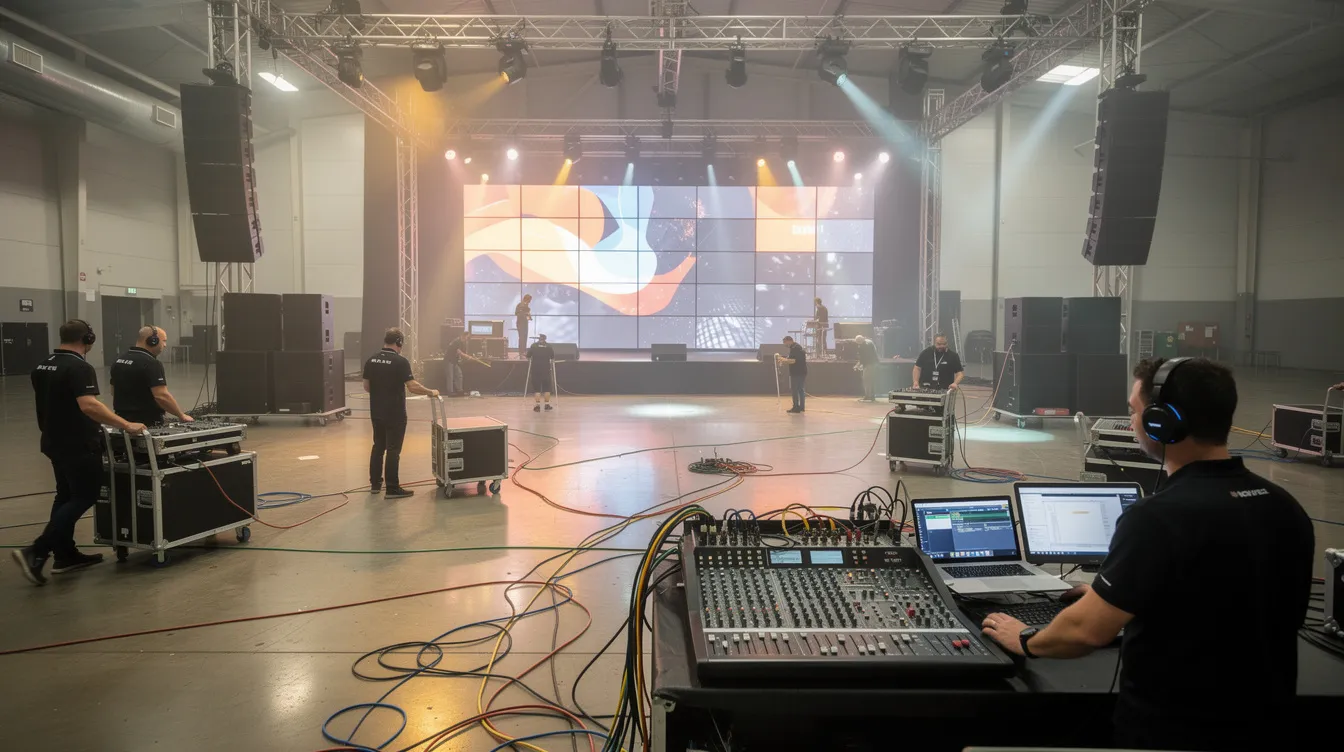
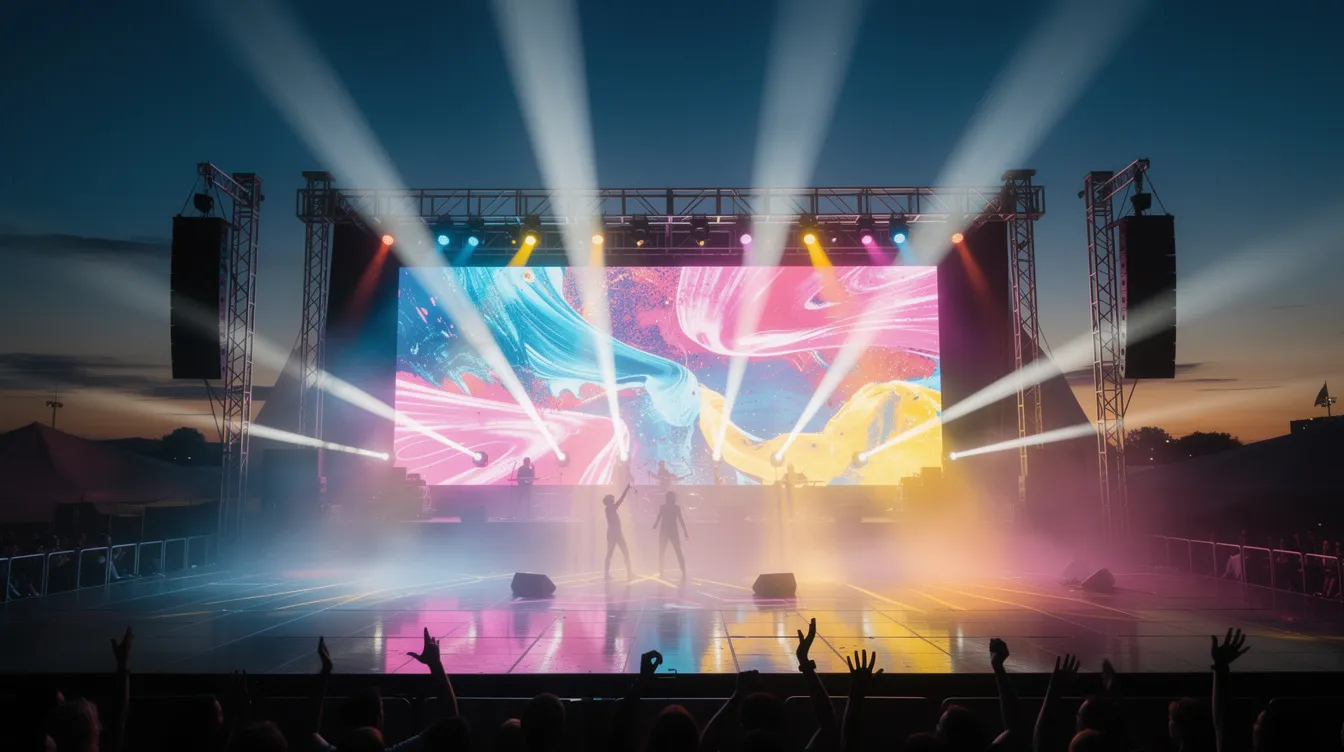
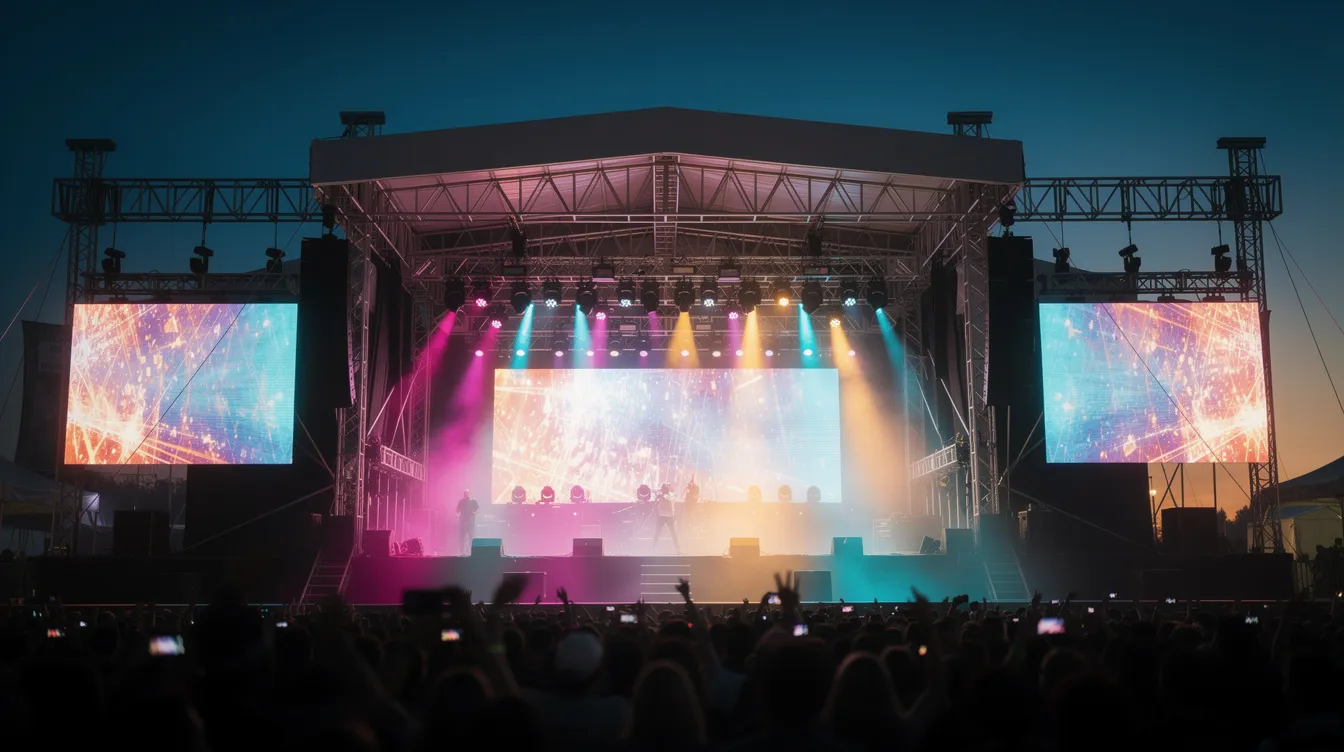
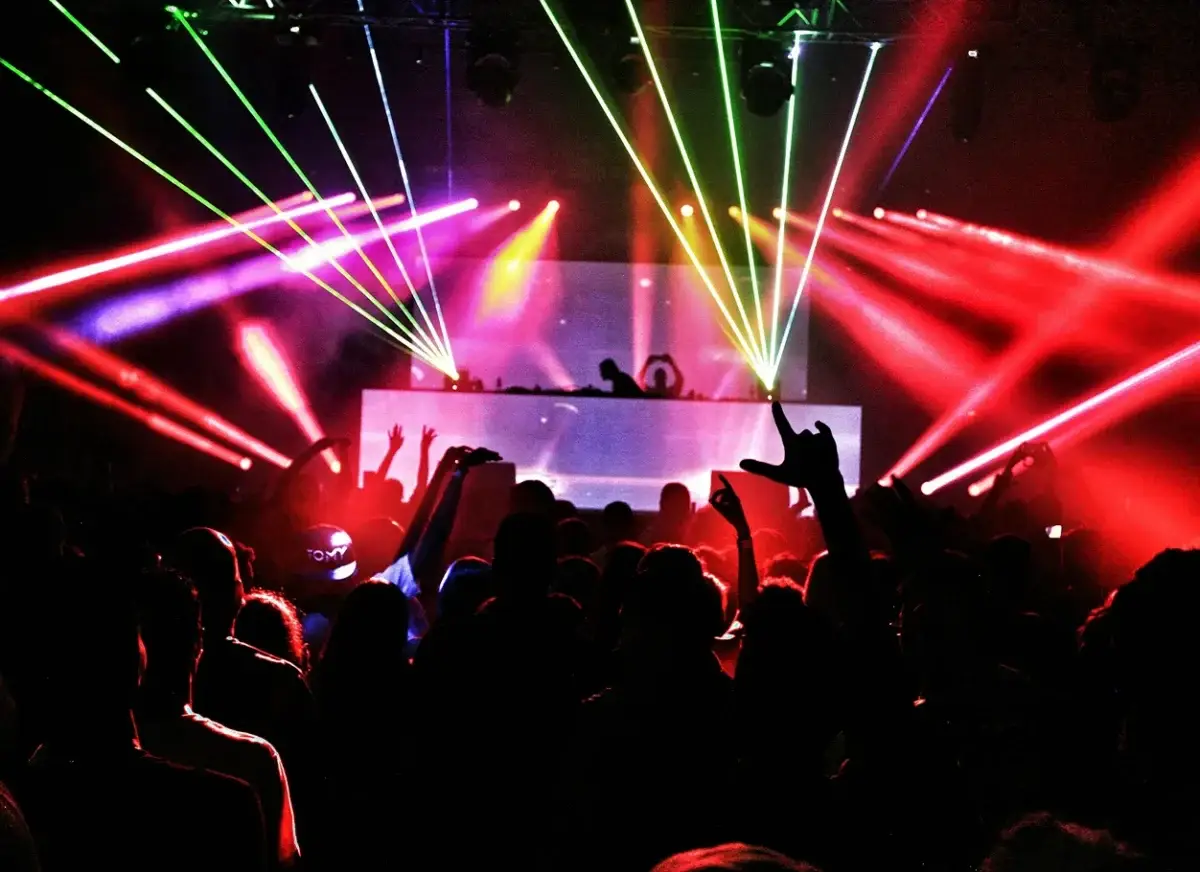
A DJ performs energetically on stage, surrounded by vibrant LED wall panels and dynamic concert lighting beams, while a packed venue of enthusiastic fans enjoys the live music event. This scene highlights the event production's focus on audio visual technology and the seamless collaboration of professionals in the industry.

From One Show to a Repeatable Touring Production Package

A one-off show becomes a repeatable DJ touring production package when you define the look, sound, and show flow once, then deploy variations of that design across multiple venues. Modern electronic music relies heavily on visual integration, including LED walls and projection mapping, so the production plan has to account for far more than just a PA system. Professional AV production can synchronize visuals with music for enhanced impact-and that synchronization should not have to be rebuilt nightly.

Standardization means creating repeatable files: audio console scenes, lighting show files, LED processor mappings, and video systems signal routes. Concert stage setup involves designing and constructing performance areas, and when that design lives in transferable files, it assembles faster in every room. Concert stage setup includes assembling platforms and integrating equipment according to a known plan rather than improvising.

Consider a DJ whose signature intro builds from ambient visuals and a slow color wash into a sub-bass drop with synchronized strobes and LED flash. With standardized cue sheets and content, that same moment works in a 500-cap club and a 2,000-cap theatre. The fixtures and line array may differ, but the timing, color language, and dynamic contrast stay locked. Shorter soundchecks, efficient setup, predictable timelines-that is the life of a repeatable concert production package.

Technical Rider Support: Clear Requirements, Flexible Solutions

A technical rider is essential for documenting a DJ’s equipment and specific needs. Front Row FX helps DJs and independent artists build or refine a rider that focuses on outcomes rather than inflexible brand-by-brand demands.

Rider elements we help define include main audio requirements and sub-low expectations-high-end touring rigs utilize rider-approved line-array speaker systems for sound reinforcement. We specify DJ inputs (CDJs, controllers, external mixers, live instruments), on-stage monitoring (dedicated monitor engineers ensure DJs hear optimal mixes without interference during performances), and seamless handoffs between artists, which require compatible mixers and digital stage boxes. Tour AV systems must handle power distribution and signal stability to prevent issues, so the rider addresses three-phase versus single-phase power, minimum amperage, and backup requirements.

Visual elements get the same treatment: LED wall dimensions and aspect ratios, preferred content resolutions (1920×1080, 3840×1080, 3072×768), and video systems routing for visuals, cameras, and branding. Lighting expectations describe fixture types as guidelines-color language, key FX moments, strobes, haze-framed as “what the audience should see” so local equivalents work where appropriate. Stage layout covers DJ booth placement, riser heights, side-fill locations, crew expectations for load-in, soundcheck, and show operation.

A strong rider makes multi-city production and local coordination smoother. It defines the required outcome while allowing substitutions that meet the same standard-technical rider support that works in the real world.

Advance Work: Solving Touring Problems Before Show Day

Advancing a show means Front Row FX connects with each venue and local provider before the date to align technical details with the rider and show design. Sound engineers manage audio equipment for live events, they balance audio levels and adjust acoustics for clarity, and sound engineers adapt to varying acoustical environments-all of which is easier to plan when the room’s parameters are known in advance. Optimal audio quality is crucial during live music events, and advance work is where that quality gets protected.

Specific advance items we cover:

  • Stage dimensions, ceiling height, loading dock access

  • Power distribution and drop locations

  • Rigging capacity and weight limits

  • House system capabilities (what stays, what travels in)

  • Venue restrictions: sound curfews, haze policies, local labor or union expectations

  • Lighting must ensure visibility in outdoor settings-confirmed during advance for open-air dates

Labor and schedule elements include local crew counts, load-in time, line check, soundcheck window, doors, curfew, and strike plan. Event planners manage all aspects of live music event production, and for touring, that coordination happens across every stop. Even markets like Arizona, where concert production includes logistics and artist coordination specific to the region, benefit from early preparation.

Touring production issues are almost always cheaper to solve days or weeks before the show than during doors. Front Row FX handles this advance workflow across multiple dates so the artist has one production contact instead of separate technical conversations in every city.

Maintaining Show Consistency Without Forcing Identical Gear

Touring AV support for DJs is about preserving consistency in experience: visual identity, stage layout logic, audio expectations, LED content delivery, lighting language, FX hits, and show flow. Good AV production creates distinct visual identities that enhance artist branding, and that identity should not shift because the house rig changed.

Identical equipment is not always necessary. What matters is matching capabilities-equivalent line array performance, LED resolution, and lighting feature sets that can reproduce key scenes and moments. Stage design involves planning and constructing visual elements, and effective stage design enhances performance and audience experience regardless of whether the speakers and fixtures are identical to last night’s. Stage design considers venue dimensions and audience perspective, and can even reflect local culture and landscape when the concept allows it. Sound engineering enhances the overall concert experience for audiences when the production intent stays consistent.

Front Row FX maintains a central “show brain”: master show files, content packages, and cue sheets that travel with the artist and adapt to each venue’s rig. AV partners should have plans for equipment failure and backup systems in place-our approach includes redundancy planning at every stop. This works across clubs, theatres, concert halls, brand activations, and corporate events where a DJ-driven show is the anchor.

Consider a 500-cap room in Wisconsin with a P3.9 LED wall at 16×8 feet, and a 2,000-cap theatre in Tennessee with the same pixel pitch but a 30×15-foot wall. The intro moment-ambient visuals, magenta wash, sub-drop, strobe burst-plays identically in flow and timing. The scale changes. The show does not. Fans see a coherent show from Minneapolis to Atlanta.
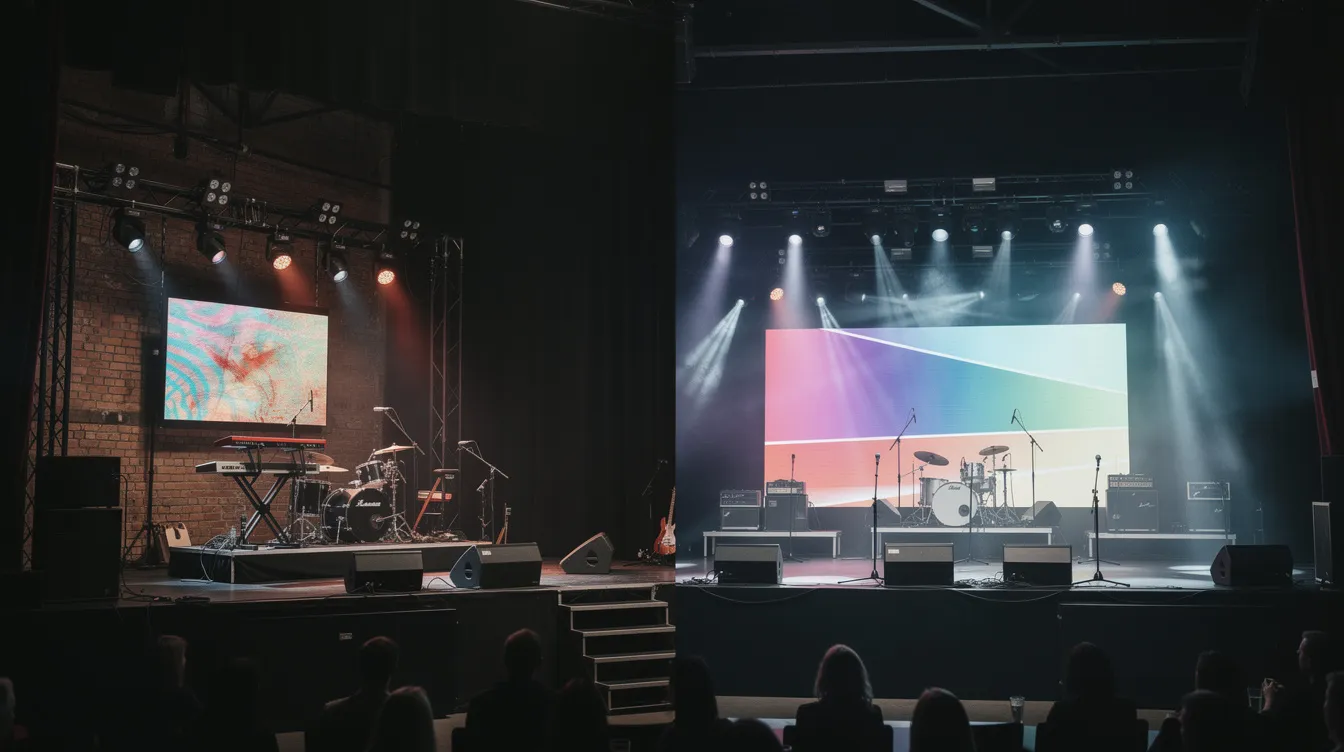
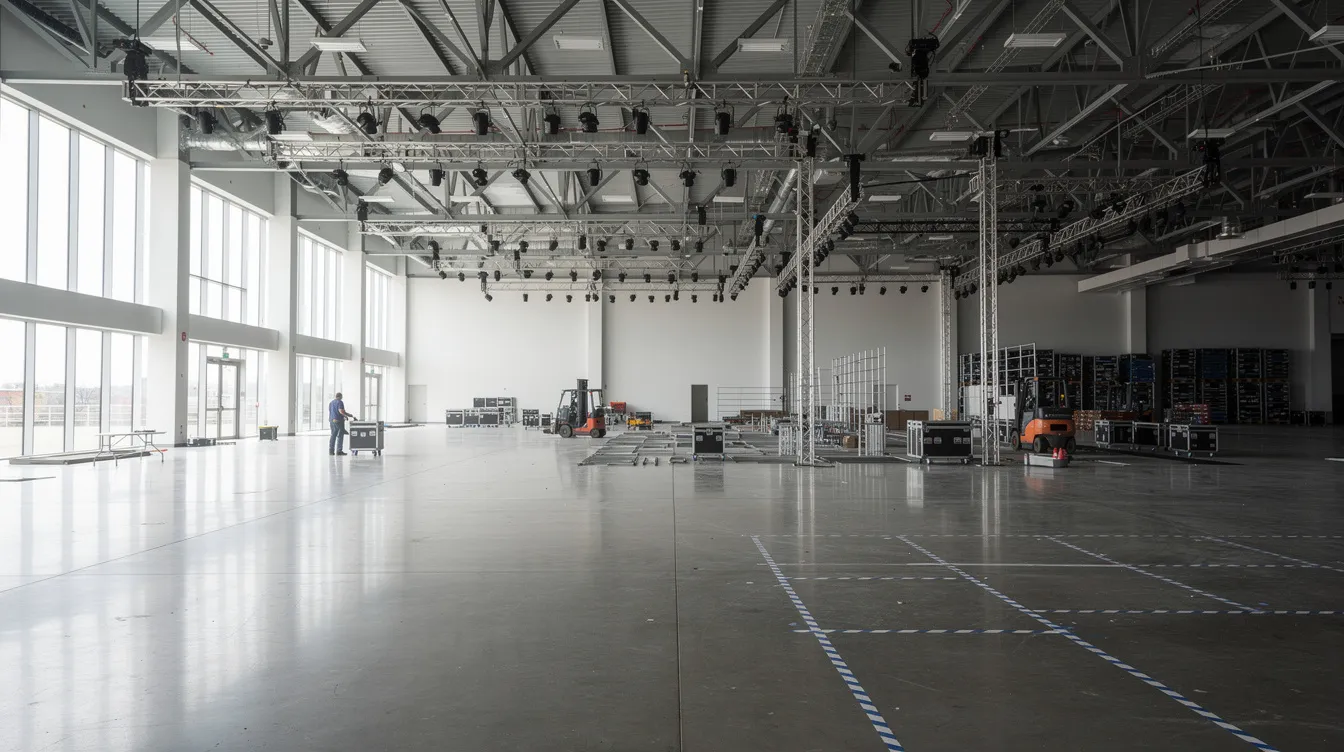
The image shows two concert stages side by side: one featuring an intimate club setup with close-up lighting and sound equipment, and the other showcasing a larger theatre setup with expansive LED walls and stage lighting. Both venues are designed for live music events, highlighting the importance of efficient setup and advanced audio-visual technology in event production.

Route Efficiency: Touring Equipment, Local Gear, or Hybrid Models

Route efficiency means choosing how equipment and crew move between cities to balance budget, reliability, and show requirements. Special effects like CO₂ jets and pyrotechnics enhance the spectacle of live shows, and whether those effects travel or source locally depends on the routing plan. Event lighting transforms venues and enhances atmosphere-lighting designers use spotlights, LEDs, and color washes, and effective event lighting captivates audiences and accentuates performances. How that lighting gets to the stage is a logistics question.

Front Row FX uses three models. A full touring equipment package makes sense when dates are tightly packed-Minnesota to Wisconsin to Illinois, or a run anchored between Atlanta, Tennessee, and Florida with direct truck routing. All major gear travels: PA, LED, lighting rig, FX, core crew. Maximum control, fewest variables. A primarily local equipment model works when reliable audio visual resources exist in each market. Front Row FX specifies minimum standards via the rider, coordinates local video systems, LED, and lighting, and only critical core gear travels with the artist. A hybrid production model combines both: core elements travel (DJ riser, media server, LED processors, specialty FX) while trusted local systems supply PA, LED tiles, or conventional lighting.

Logistics across all three models include truck routing, cross-rentals, crew travel, hotels, and next-day load-ins. Multi-city production planning can improve preparation and sometimes pricing efficiency-confirmed runs allow better equipment allocation, crew planning, and resource scheduling. But even when local gear is used, Front Row FX still owns the production direction and quality control across the tour.

Local Production Partners & Scaling Your Tour Across Regions

Front Row FX maintains core production infrastructure from Minnesota and Georgia but expands reach using established professional partners across the Midwest, Southeast, and other routed markets. The entertainment and touring industry includes major players-LMG Touring, for example, has provided audiovisual support since 2007 and owns $200 million in audio, video, and lighting equipment, with a lighting inventory that includes fixtures of all shapes and sizes, and technicians who create stunning visuals and outstanding atmosphere. At every scale of the industry, the concept is the same: reliable partners, consistent standards.

Using regional partners does not shift responsibility. Front Row FX remains the central production team coordinating audio, LED video walls, lighting, FX, and show management. We vet and direct local crews so musicians and performers get consistent show operation and efficient setup regardless of whether the LED tiles and line arrays are ours or a partner’s. This model supports everything from club tours to select festival plays, special events, and high-production party or corporate events where a DJ performance is the anchor. Independent artist production can scale from anchor markets like Minneapolis–St. Paul and Atlanta into a multi-city route without rebuilding the plan at every stop.

Artist vs. Production Responsibilities on Tour

A clear split between artist and production responsibilities simplifies multi-city planning:

Artist Provides

Production Team Provides

Music, performance, set list

Advance work, venue coordination

DJ system preferences, show files

Audio systems, tuning, experienced audio technicians

Visual content, branding direction

LED walls, video routing, content scaling

Creative intent, tour schedule

Lighting systems, programming, FX

Band or performer integration needs

Power distribution, crew, site management

This split lets the artist focus on performance while a dedicated team manages event production logistics from first load-in to final teardown. For some DJs, their own performance setup-specific controllers, drum machines, or hybrid live rigs-travels with them and gets integrated into the audio visual system in each market. The production team is responsible for making that integration happen reliably, whether the world of local gear is familiar or new.

How Front Row FX Runs a Multi-City DJ Tour

The workflow follows a clear line: initial conversation about the show concept, then design, then technical rider support, then venue advance, then equipment and crew planning, then show execution, then resetting for the next city. Each step builds on the last, and confirmed multi-date runs make it easier to standardize show files, content, programming, and crew assignments.

A practical example: a 6-date run across Minnesota, Wisconsin, and Illinois. Front Row FX carries a core LED wall, lighting rig, and critical FX gear. Local vendors in select cities provide PA or supplemental lighting that meets rider specs. Each city has been advanced, soundchecks take under two hours, and the same opening visual suite and sound presets deploy every night. A long weekend in Georgia, Tennessee, and Florida follows a similar plan with the Atlanta base as a staging node. Clients exploring this kind of run can access all production services through one team.

Whether the goal is promoting a new release across the region or delivering concerts for an established fanbase, the success of the run depends on preparation, knowledge of each room, and a production team that is prepared and reliable enough to adapt quickly and deliver night after night.
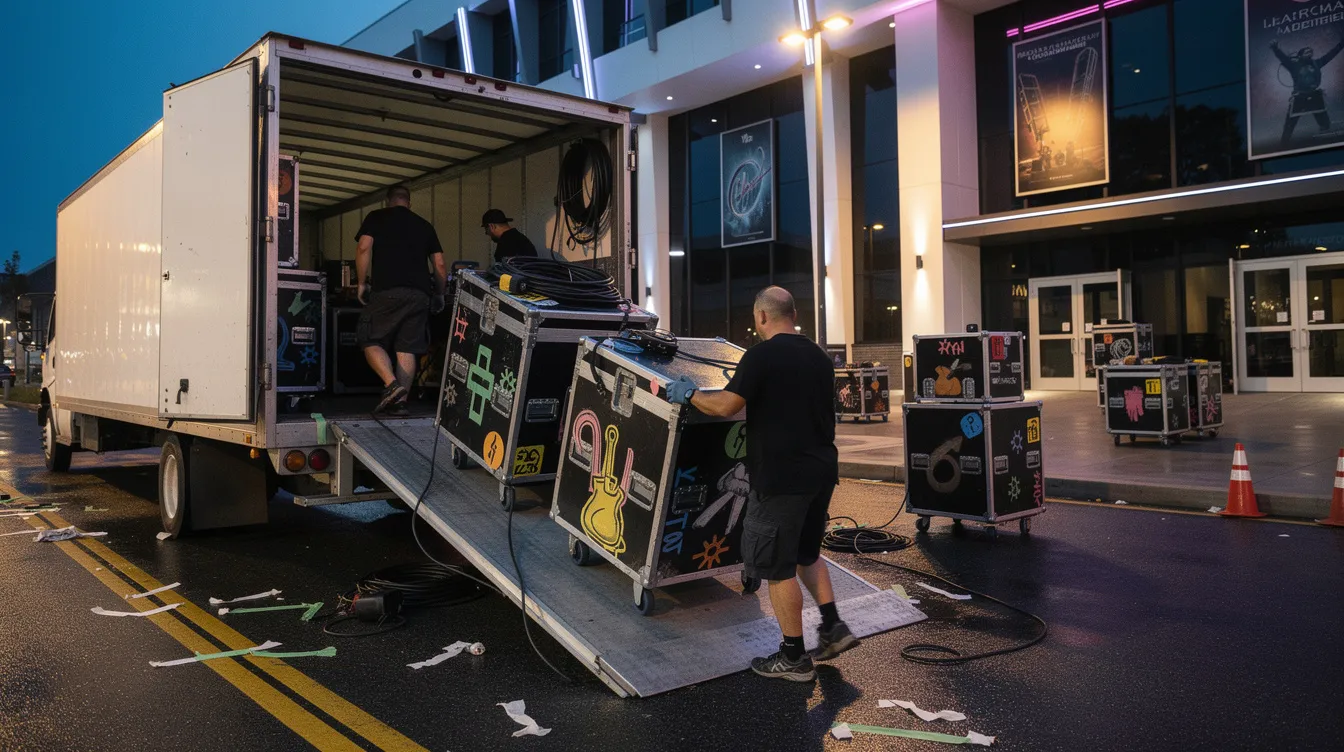
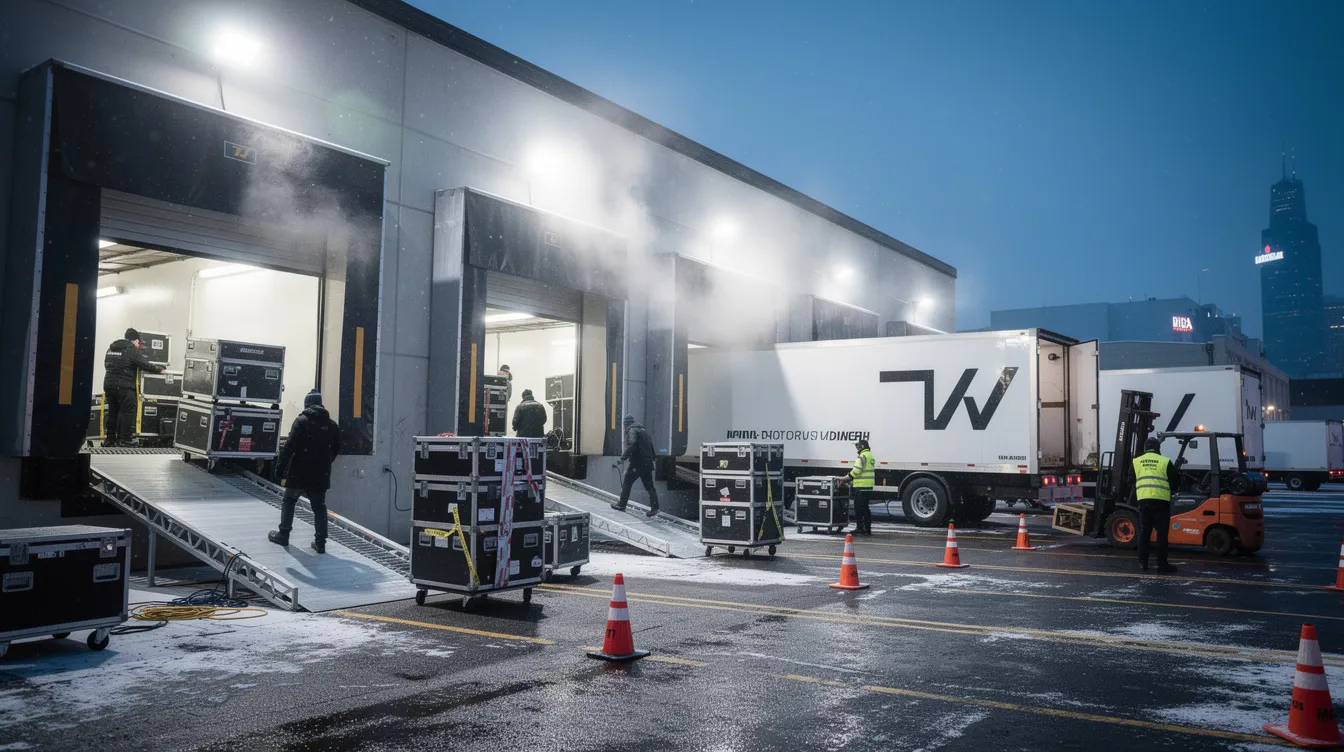
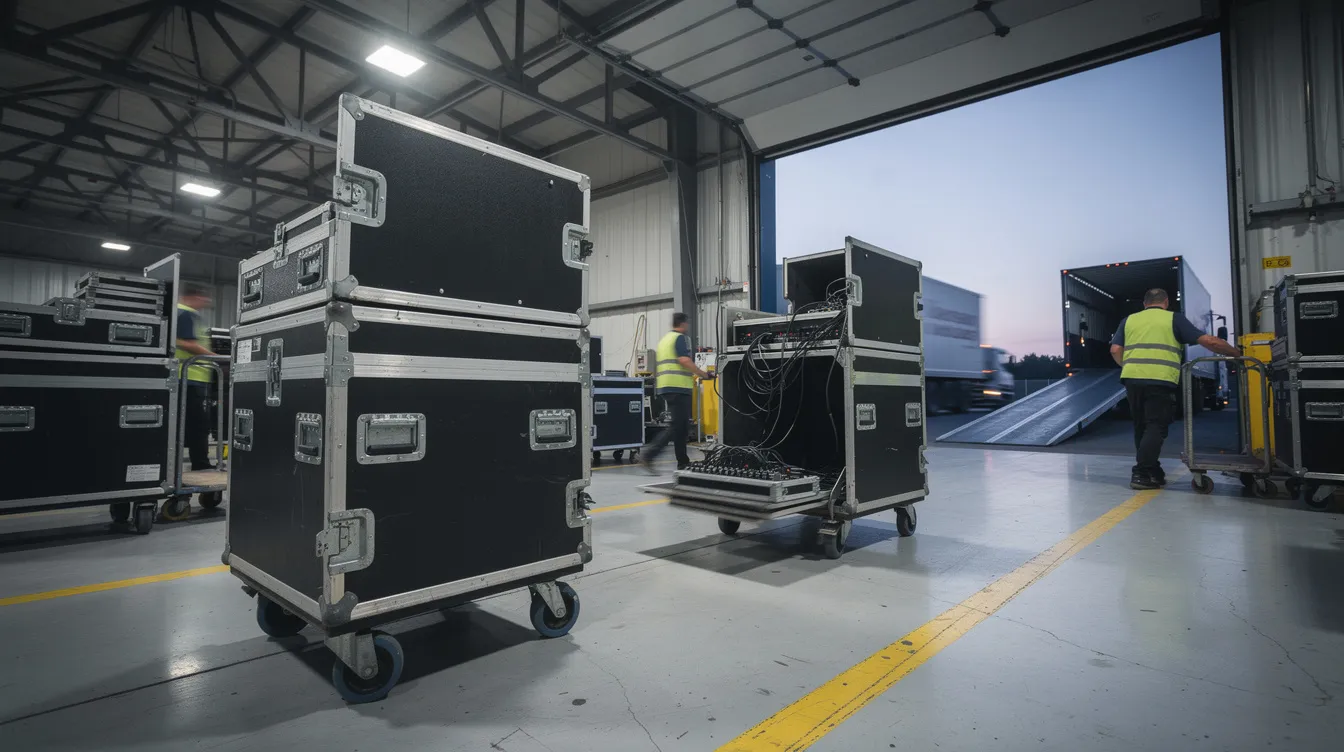
A production crew is efficiently loading touring equipment cases into a truck outside a concert venue, preparing for a live music event. The experienced team is focused on ensuring a smooth setup for the performance, showcasing their expertise in event production and audio visual technology.

Next Steps: One Artist, Multiple Cities, One Production Direction

DJs and independent artists can establish one production relationship that protects their show across multiple cities-no more re-explaining needs to a different AV company in every market. Whether you have a confirmed run or a partial route you are still organizing, Front Row FX can plan a touring AV solution that fits real-world dates, money, and markets.

Share your current or upcoming route with dates, markets, and any existing technical documentation. Contact Front Row FX to explore how we build a production plan around your schedule.

One artist. Multiple cities. One production direction.
FAQ: Touring AV Support for DJs & Independent Artists

Most frequent questions and answers

Touring AV support can include audio, LED video walls, lighting, FX, technical crew, venue advance, rider coordination, power planning and show execution across multiple dates.

The goal is to keep the artist’s production consistent from city to city without rebuilding the entire technical plan at every stop.

No. Touring consistency does not require identical speakers, LED cabinets or lighting fixtures in every market.

What matters is maintaining the same creative intent, technical standards, show flow and audience experience while using equivalent systems that fit each venue.

Yes. Front Row FX can help define audio requirements, DJ inputs, monitoring, LED dimensions, video signals, lighting expectations, FX, stage layout, power and crew needs.

A good technical rider should clearly communicate what the show requires while allowing practical equivalent systems when appropriate.

Venue advance is the process of reviewing the next stop before show day, including stage dimensions, loading access, power, rigging, house systems, labor, setup windows and venue restrictions.

Solving those issues in advance is usually faster and less expensive than discovering them during load-in.

Yes. Depending on routing and availability, Front Row FX can use owned equipment, traveling production, local systems or a hybrid model.

Local equipment can change from market to market while Front Row FX maintains the production direction, technical standards and coordination across the run. Pasted text

They can be. Confirmed multi-date runs can make it easier to standardize show files, content, programming, equipment allocation, crew planning and routing.

That does not automatically mean every tour receives a discount, but repeated dates can create better production and logistics efficiency than treating every show as an unrelated one-off.

Yes. Front Row FX operates from Eagan, Minnesota and Atlanta, Georgia, supporting routed productions across the Midwest, Southeast and additional U.S. markets.

Those two production bases help support multi-city runs through markets including Minnesota, Wisconsin, Illinois, Iowa, Georgia, Tennessee and Florida.

Usually when multiple dates, larger venues, technical riders, LED, lighting, FX or venue coordination start making each show difficult to manage independently.

At that point, the value is not just equipment. It is having one production relationship that carries the show from venue to venue so the artist can focus on performing instead of rebuilding the AV plan in every city.

Categories
LED Screens & Video Walls

Essential Production Support for DJs: Enhance Your Performance Today

Production Support for DJs Ready to Play Bigger Rooms

There is a clear line between DJing a 150-person bar on a Friday night and running a full show for 800 people in a ballroom with a crowd expecting more than just music through a house PA. Many successful DJs are self-taught without formal training, building their career on a genuine love for music, sharp DJ skills, and the ability to read a room. But once bookings start landing in the 500–2,000+ capacity range – ticketed live events, branded parties, college stages, outdoor festivals – the gap between what you bring in a bag and what the room actually needs becomes impossible to ignore.

This article is for DJs and independent artists whose gigs are outgrowing the trunk of a car. Production support for DJs is not about replacing what you do on stage. It is about building everything around you so the audience experience matches the scale of the room.

Front Row FX provides DJ production support as a dedicated AV production company operating from Minnesota and Georgia, supporting live events across the Midwest, Southeast, and select U.S. markets. Here is what this article covers:

  • Professional sound system design for larger rooms

  • DJ LED wall production and visual integration

  • Lighting design and special effects strategy

  • Building a repeatable visual identity across dates

  • Artist vs. production team responsibilities

  • Multiple-date packages and touring AV support

  • When and how to start working with a production partner

Jumping from DJ Gear to Full Event Production

There is a real difference between plugging a controller into a club’s house system and designing event production for a full room. DJs who stay updated with music trends and technology understand this shift instinctively – the space between performing and producing a show is where the professional DJ separates from the hobbyist.

Common transitions include moving from small bar sets and private events (including wedding receptions and corporate functions) into ticketed concerts, branded parties, college shows, and indoor or outdoor stages. Understanding music theory helps create seamless transitions in a mix, but the room itself needs its own kind of structure. Event production for DJs means:

  • Professional sound systems sized and tuned for the venue

  • Lighting rigs designed and programmed for the performance

  • LED screens delivering visuals, branding, and energy to the audience

  • Power distribution, rigging, staging, and load-in logistics

  • Soundcheck, crew coordination, and show operation from start to teardown

A DJ set in a 300-cap club in Minneapolis looks and feels nothing like a branded 1,000-cap live event in St. Paul with an LED wall, programmed lighting, and a full audio system. Front Row FX acts as the production company for DJs – handling live sound, media production, lighting, special effects, and technical crew so the artist can focus on the performance and music production that built the audience in the first place.

A wide-angle photo captures a professional DJ performing on an elevated stage, surrounded by colorful LED panels and dramatic lighting beams, as a large crowd dances energetically below, creating an unforgettable live event atmosphere. The scene showcases the DJ's skills in music production and sound reinforcement, enhancing the vibrant energy of the celebration.

You Don’t Need to Own Everything: Building a Scalable Production System

You do not need to own everything first. You need a production system that can grow with you.

Buying a full PA, LED wall panels, trussing, lighting fixtures, power distribution, and a truck to move it all is a massive financial and logistical commitment. Most independent artists cannot justify that investment, and frankly, most do not need to. A production partner needs to manage equipment logistics effectively – that is their job, not yours.

Front Row FX maintains core inventory across Professional Sound, LED Video Wall Production, Event Lighting Production, and special FX, then scales through a trusted partner network when shows require additional systems. What scalable production actually means for you:

Event production services can be customized for specific needs – you are not locked into a single package size.

Scaling Production with Your Bookings: From Local Rooms to Branded Shows

Not every artist follows the same path. But production support for DJs generally scales through recognizable stages:

  • Professional local shows – quality audio and lighting for 200–500 capacity rooms

  • Larger rooms – adding LED walls, subwoofer arrays, front fills, and FX for 500–1,500 capacity

  • Branded or themed shows – custom visuals, repeatable lighting looks, and artist identity across the stage for special events and celebration nights

  • Multiple dates – standardized production packages across a run of confirmed bookings

  • Touring support – technical riders, scalable systems, and production coordination across markets

Consider the difference between a 400-person college show in Eau Claire, a multi-DJ lineup night in downtown Minneapolis, a brand activation in Chicago, or a recurring monthly in Atlanta. Each room, each crowd, each energy level requires intentional production planning. As rooms grow, stage layout, LED configuration, lighting positions, sound coverage, and power planning all become more deliberate.

Professional Sound for DJs: Coverage, Not Just Volume

Bigger rooms do not just need louder speakers. They need smarter system design so every person in the space hears the set clearly – whether they are front row or standing near the back wall. Sound reinforcement ensures clear audio for large audiences, and professional audio equipment is essential for DJ events at this scale. Industry-standard equipment ensures reliability in DJ performances where a system failure means silence in front of hundreds of people.

Core elements of professional sound design:

  • Main PA covering the full audience area with even dispersion

  • Subwoofers delivering low-end energy for dance music across genres – from hip hop to house to drum and bass

  • Front fills addressing the zone directly in front of the DJ booth

  • Stage monitoring so the DJ hears accurate timing, beats, and bass reference

  • Processing and tuning adapted to venue acoustics, room shape, and power availability

Venue compatibility is necessary for effective production planning. A 900-cap ballroom in Minneapolis requires a completely different system layout than a 300-cap club in Duluth – same artist, different scale. Live sound production supports bands and performances at events of all sizes, and sound engineers onsite handle soundcheck, system tuning, and show operation so the DJ can focus on the mix and the tracks. Front Row FX provides system design for each venue, integration with the artist’s mixers, controller, or CDJs, and consistent sound across multiple dates when possible.

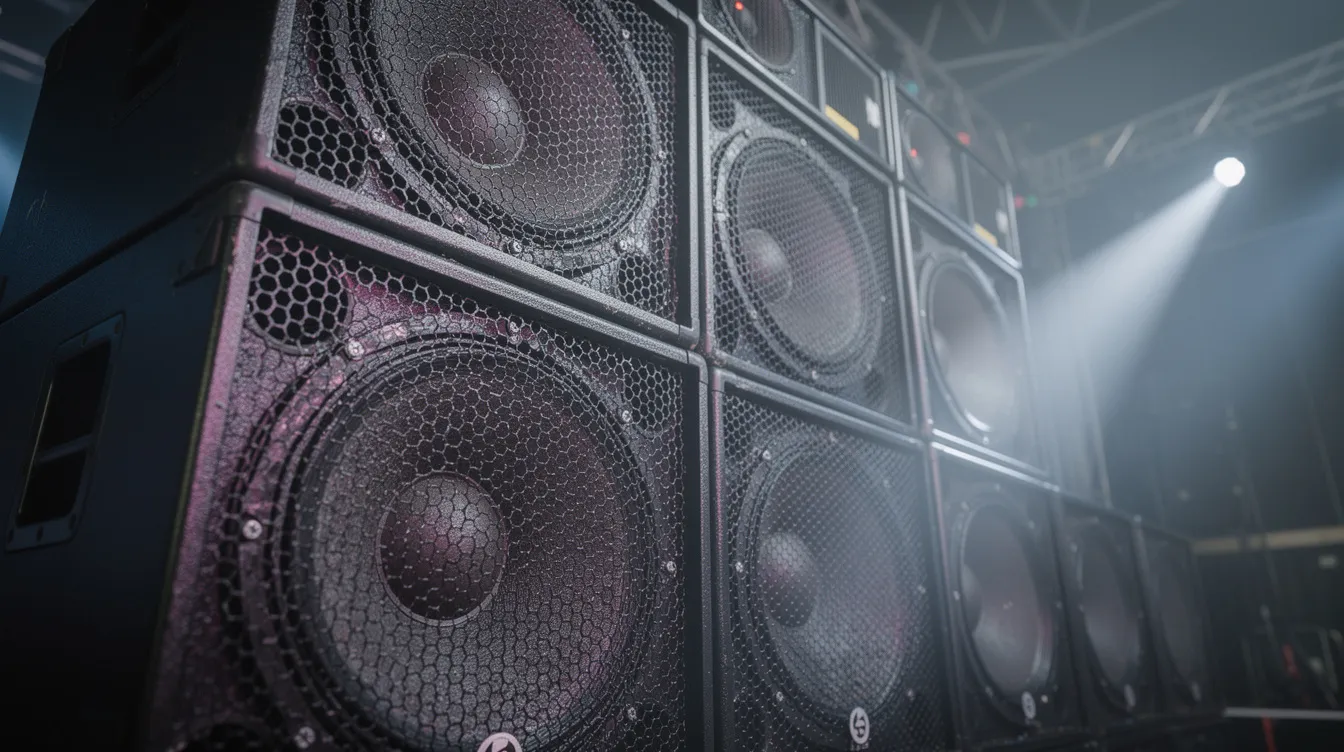
A close-up view of professional concert speakers and subwoofers stacked in a large indoor venue, surrounded by atmospheric haze, showcasing the essential sound reinforcement equipment used for live performances and events. This setup is crucial for delivering high-quality audio experiences, enhancing the energy of music genres like hip hop and creating unforgettable moments for the audience.

LED Walls & Visuals: Turning a DJ Set into a Full Visual Performance

Visual integration is essential for modern electronic music events. LED video walls can be used for visual displays at events that transform the perception of a DJ set – from someone playing songs behind a booth to a complete visual performance that reflects the artist’s identity. LED wall costs have dropped roughly 40% since 2024, making this production element accessible to DJs who previously could not justify the spend.

Common LED layouts for DJ stage production:

  • Single center LED wall behind the DJ

  • Vertical LED columns flanking the booth

  • Wide-format LED spans across the stage

  • Side screens for larger or wide rooms

  • Mixed configurations for festivals and unconventional spaces

Specific uses of LED in DJ concert production include artist logos and branding, custom visuals and motion graphics tied to the artist’s sound and style, track-specific content and reactive visuals, live camera feeds of the DJ and crowd for recording and display, videos for sponsor content or event branding, and visual content that matches every genre the artist plays.

The split between artist and production team is straightforward. The artist or creative team provides visual direction, branded assets, and ideas. The production team manages format, playback systems, and technical requirements through LED Content & Visual Design workflows.

Lighting & FX: Designing Intentional Moments, Not Just More Fixtures

DJ lighting production is about design and programming, not fixture count. More lights do not automatically create a better show. Lighting solutions enhance the atmosphere of DJ events when they are programmed with purpose. The technical expertise of the crew directly impacts performance quality – a well-programmed eight-fixture rig can outperform thirty random lights with no cues.

Lighting design priorities:

  • Visibility of the artist and booth

  • Movement and energy that match the music

  • Looks that can scale from small stages to larger rooms

  • Scenes or cues triggered for key drops and seamless transitions between tracks

Repeatable lighting programming lets a DJ walk into different venues and still feel like their show, even when fixtures or truss layouts change.

FX should be intentional show moments – not constant noise. Cold sparks work for intros or headline drops, with venue approval and safety compliance. Haze reveals beams from moving lights and lasers. Low fog creates dramatic moments for specific tracks or sections when appropriate and permitted. Every venue has different rules, and a production company must confirm what is allowed before show day. Backup plans are essential to handle equipment failures during live events, and insurance and liability coverage is required for any production company operating FX.

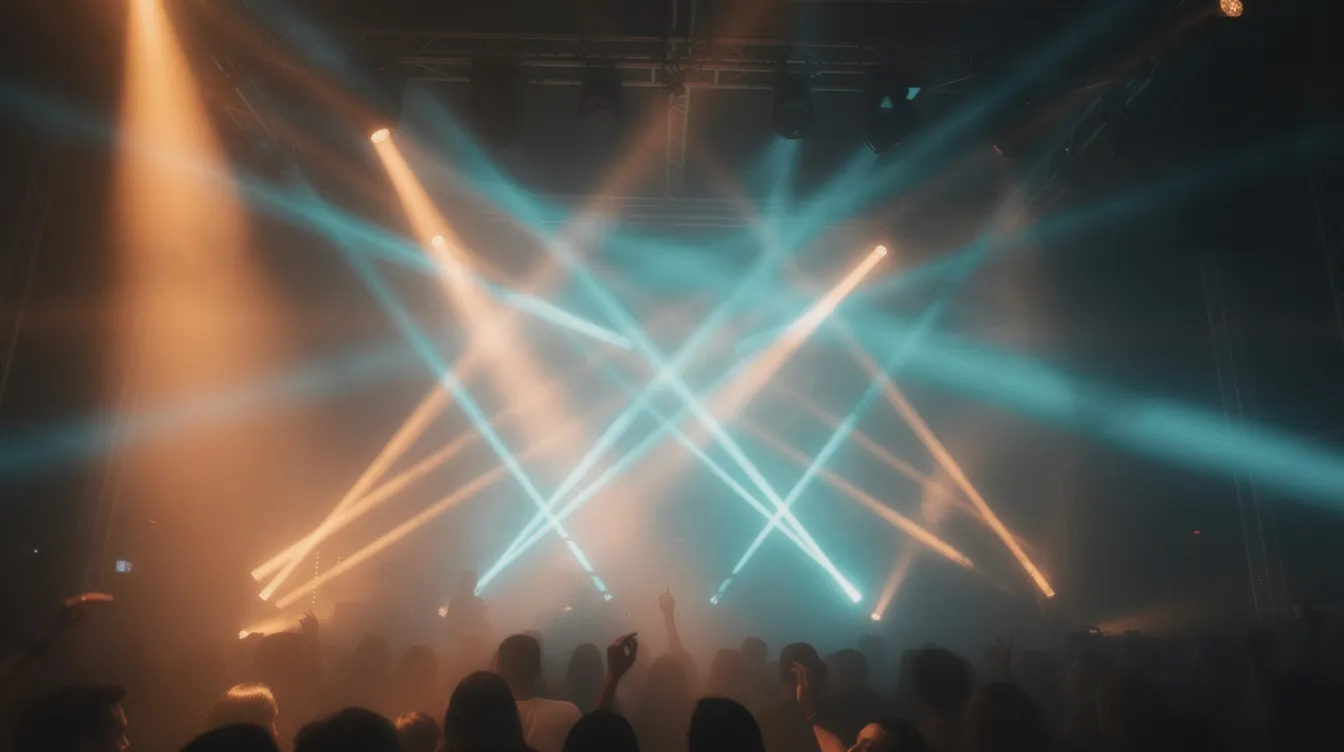
The image depicts a vibrant dance floor illuminated by dramatic concert lighting, with multiple beams of light cutting through a haze, creating a dynamic atmosphere. Warm and cool colors intersect above the crowd, enhancing the energy of the live performance and the unforgettable experience of the event.

Defining Visual Identity & Repeatable Show Design

For DJs who expect repeat bookings, brand partnerships, or multi-city dates, a consistent visual identity is not optional – it is the art of building recognition. Whether an artist works across music genres or stays dedicated to a single sound, the visual layer should feel like theirs. Even a six-course DJ workshop teaches technical skills and setlist building, but the visual and production side of the show is what separates entertainers playing clubs from artists building a career.

Elements of a repeatable show package:

  • Preferred LED layouts and aspect ratios

  • A base library of visuals and sound effects cues

  • A core lighting show file with adaptable scenes

  • Simple documentation of what the show needs technically

Production support for artists includes translating creative direction into a technical show design. A DJ might start with a signature logo animation and three or four master looks, then gradually scratch the surface of what is possible by adding track-specific visuals and programmed moments across dates – each show more refined than the last.

Who Does What: Artist vs. Production Responsibilities

Strong DJ production support requires clean lines between what the artist owns and what the production company manages. Clear communication with production crews helps prevent day-of issues and keeps every person on the team aligned. Qualified staff must understand DJ-specific workflows for success.

Artist responsibilities:

  • Music library, curate playlists, and show pacing

  • Performance system (laptop, controller, USB drives, rekordbox/Serato crates)

  • Creative direction for visuals and overall show feel

  • Artist-specific visual content and logos, when available

  • Technical rider information and updates when gear or needs change

Production team responsibilities:

  • Audio systems (PA, subwoofers, front fills, DJ monitors, processing)

  • LED walls, screens, and playback systems

  • Lighting rigs, control, and programming

  • FX equipment, safety, permits, and venue approvals

  • Power distribution, cabling, rigging, staging where applicable

  • Crew, installation, testing, soundcheck, show operation, and teardown

  • Coordination with promoters, venues, and other event services providers through Show & Technical Management

Every project is different. On some shows the DJ brings their own mixer; on others, everything is provided. The key is agreeing on responsibilities early.

Multiple Dates & Mini-Runs: Standardizing Production Packages

DJ production support becomes significantly more efficient when the artist has several confirmed shows across weeks or months. You do not need to be on a bus tour to benefit from standardized production – even a short run creates opportunities.

What can be standardized across multiple dates:

  • Core sound system expectations relative to room sizes

  • Preferred LED and lighting layouts or functional equivalents

  • Visual content package and lighting show files

  • Crew positions (FOH audio, lighting operator, LED tech, stage lead)

  • A refined technical rider that promoters can receive in advance with all relevant details

A series of dates often allows more efficient planning and logistics, which can create better production value for the budget. Transparent pricing is important for understanding costs in production services, and a run of shows gives both artist and production partner clearer numbers to work with. Consider a DJ with six dates across Minneapolis, Madison, and Chicago over two months – Front Row FX can align production across those markets with consistent quality and smarter logistics.

From Local Shows to Touring Support Across Regions

Touring production for DJs does not only mean arena tours. It can start with regional runs, college circuits, festivals, and branded live events across several states or even within one country’s region. Touring logistics differ significantly from local event planning, and comprehensive planning is crucial for successful touring events. Logistics are especially vital for outdoor or non-traditional event venues.

The planning side of touring AV support:

  • Developing a technical rider that fits the artist’s real show

  • Designing a scalable production package that adapts to various venues

  • Coordinating with local vendors when shows fall outside home markets

  • Documenting power, rigging, and space requirements in a clear format for promoters

Front Row FX provides direct regional production in the Midwest and Southeast, coordination and oversight when additional partners are needed in other U.S. markets, and consistent technical expectations across multiple promoters and venues. Learn more about Concert Production & Tour Support.

Scaling Beyond Owned Inventory: Partner Networks & Large-Scale Shows

Even established production companies do not own every possible piece of equipment. For large-scale DJ concert production, Front Row FX maintains core inventory of professional audio, lighting, LED, and FX systems, then scales through long-term production partners when additional LED, audio, lighting, rigging, staging, media production, or specialty systems are required. Unified planning, crew leadership, and quality control remain consistent even when partner equipment is involved.

The artist does not need to build that vendor network or negotiate with multiple local companies. That is the production company’s job. For a 3,000-person outdoor show requiring extra LED and delay speaker towers, Front Row FX leads system design and integrates partner gear into a single show plan.

Two Production Bases: Support from Minnesota & Georgia

Front Row FX operates from two primary production bases:

  • Eagan, Minnesota

  • Atlanta, Georgia

These bases support efficient delivery for:

  • Twin Cities, greater Minnesota, and Wisconsin

  • Chicago and the broader Upper Midwest

  • Atlanta, northern Georgia, Florida, Nashville and the Southeast corridor, including select dates in neighboring states

Front Row FX is not a single-city vendor that occasionally travels. For shows outside these core areas, design, planning, and coordination are still available – pairing in-house crews with vetted partners as needed.

When a DJ Is Ready for a Production Partner

Key signs that a DJ or independent artist should bring in a professional production company:

  • Shows are consistently above 300–400 capacity

  • Promoters expect the artist to define or bring production, not just show up and plug in

  • Visual expectations are rising – LED walls, custom visuals, and branded lighting looks are becoming standard across the industry

  • Multiple dates or small runs are on the calendar within a 60–90 day window

  • The artist spends too much time troubleshooting tech instead of building music and audience

  • The pleasure of performing is getting buried under logistics

You do not need to wait until everything is perfect. Production planning can begin with a few confirmed gigs and a clear creative direction. Early collaboration helps avoid last-minute compromises, equipment shortages, and rushed show setups.

How Front Row FX Works with DJs & Artists

Front Row FX brings extensive experience and a dedicated, high-touch approach to every project. Pre-event consultations help align the production timeline and ensure nothing is left to guesswork. The process:

  • Initial conversation about goals, current bookings, and where the artist wants to grow

  • Review of current gear, show files, and creative direction across audio, LED, lighting, and FX needs

  • Draft production concepts matched to real budgets and venue sizes

  • Technical planning, advancing, and on-site execution for each confirmed date

Front Row FX is technically capable across Complete Audiovisual Production – professional sound, LED, lighting, FX, and full event production – and focused on growing with the artist from local rooms to larger live performances and touring-scale runs.

You build the audience. We help build the room around you.

Start a Production Conversation

Short FAQ: Production Support for DJs

When should a DJ start working with a production company? When shows consistently exceed 300–400 capacity, promoters expect production beyond a house system, or you have multiple dates coming up. These are clear signals.

Do I need to own my own PA or lighting before talking to you? No. The production partner provides systems. You bring your performance gear, your music, and your creative direction.

Can you work with the DJ gear I already use? Yes. Front Row FX integrates with CDJs, controllers, mixers, and laptops. Share your setup details on your tech rider so the team can plan accordingly.

How far will Front Row FX travel for shows? The company operates from Minnesota and Georgia with regular coverage across the Midwest and Southeast. Select additional U.S. markets are supported through planning and partner coordination.

Can you support both one-off shows and runs of dates? Yes. Single events, festivals, and multiple-date packages are all supported. For additional information or to discuss your upcoming dates, Talk With Front Row FX.

Categories
LED Screens & Video Walls

How Much Does a Large LED Wall Cost for a Wedding? | 2026 Pricing

How Much Does a Large LED Wall Cost for a Wedding?

If you are planning a wedding in Minneapolis, St. Paul, Minnesota or the Upper Midwest and considering a true large-format LED wall—not a television or a projector—a realistic professional budget generally starts above $6,000.

A wedding LED wall is not simply a collection of panels dropped behind the DJ. The final cost depends on the physical screen size, pixel pitch, venue, installation requirements, content, technicians and how the LED integrates with the rest of the celebration.

For early planning, Front Row FX uses the following ranges as a practical starting point.

Planning Ranges: Wedding LED Wall Cost by Size

Most couples want real numbers before picking up the phone. These planning ranges use professional 500 × 1000 mm LED cabinets, the standard modular format used in event production. LED walls are priced based on size and pixel pitch, and the ranges below assume a moderate pixel pitch (P2.5 to P3.9), one-day indoor use in 2026 and full-service production in the Upper Midwest.

Approx. Screen Size

Typical Planning Range

9.8 ft W × 6.6 ft H

$6,000–$8,000+

19.7 ft W × 6.6 ft H

$8,500–$12,000+

29.5 ft W × 6.6 ft H

$11,000–$18,000+

These are planning ranges—not fixed packages or guaranteed quotes.

They are intended to represent professionally managed wedding LED production, including the equipment and technical infrastructure required to get the screen into the room, operating correctly and supported throughout the celebration.

Professional large-format wedding LED generally begins above $6,000 at minimum. From there, the production can move substantially higher depending on venue logistics, screen design, content, rigging, installation schedule and whether the LED becomes part of a larger audiovisual production.

What Are You Actually Paying For?

The visible screen is only one piece of the system.

A professional wedding LED production may include:

  • LED cabinets
  • video processing
  • screen mapping
  • support structure
  • power distribution
  • signal infrastructure
  • transportation
  • load-in
  • installation and alignment
  • system testing
  • show-day technicians
  • content support
  • teardown and load-out

This is why a professional LED wall should not be compared directly with renting a television.

It is a modular production system built inside the venue.

And once the screen becomes part of the wedding design, the scope can go beyond the technical system into visual content, décor coordination, lighting and entertainment integration.

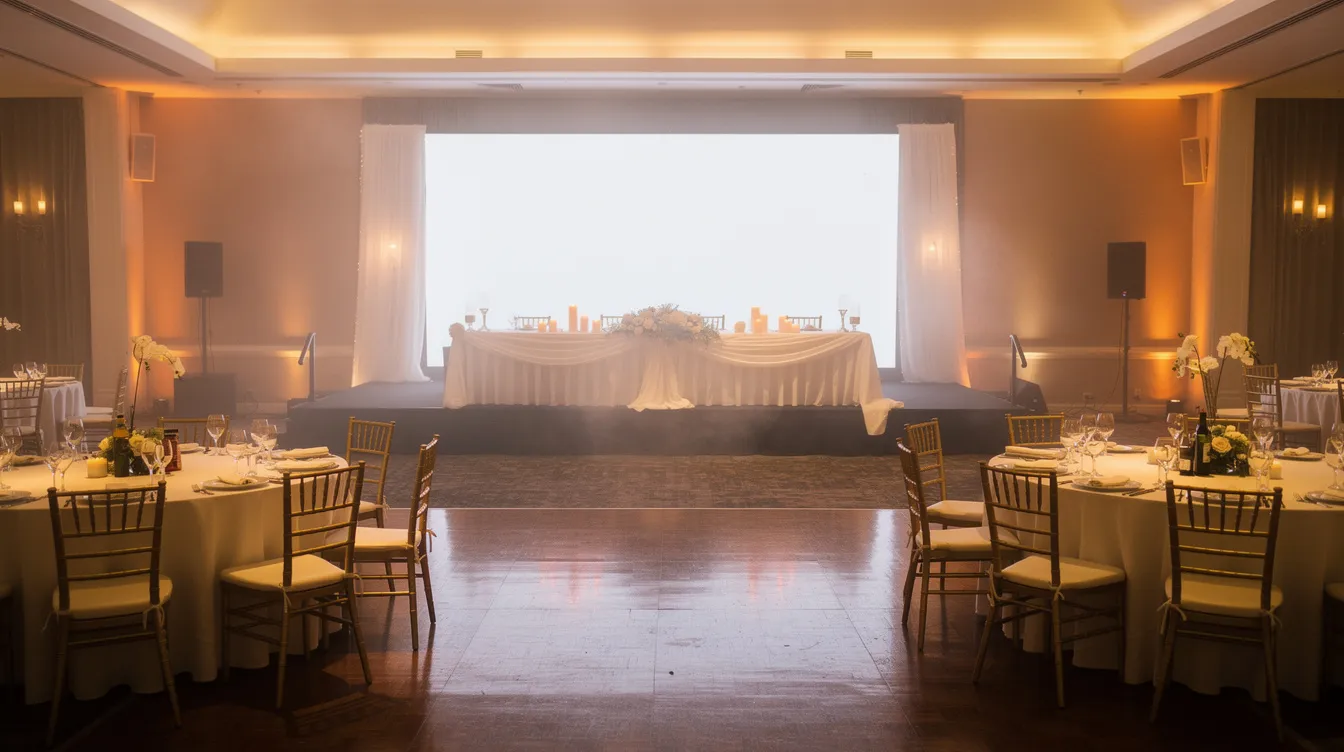
The image depicts a spacious ballroom illuminated with warm lighting, featuring a large LED video wall glowing behind a beautifully decorated head table. Round guest tables are arranged in the foreground, creating an inviting atmosphere for the wedding reception.

Why Wedding LED Pricing Can Be Different From Corporate AV

Wedding LED is not automatically cheaper or more expensive than corporate LED.

It is simply built around a different production objective.

A corporate event may prioritize:

  • presentations
  • branding
  • general-session content
  • IMAG
  • cameras
  • executive speakers
  • technical redundancy

A wedding may place more emphasis on:

  • scenic integration
  • floral and décor coordination
  • custom visual content
  • room transformation
  • ceremony-to-reception transitions
  • multiple sound environments
  • entertainment
  • ambiance and lighting
  • compressed weekend installation and teardown

A corporate client may need one technically complex presentation canvas.

A wedding may use a similar amount of LED but require it to disappear into a larger design involving flowers, drape, stage elements, lighting and custom content.

That is why Front Row FX treats wedding LED as celebration production, not simply as a smaller version of corporate AV.

LED Wall vs TV vs Projector: Choosing the Right Wedding Screen

Many couples compare LED screen rental for wedding receptions to projectors or large TVs. That comparison makes sense, and LED is not always the right answer.


Where a large LED video wall makes sense

  • Large ballroom, tent or venue where guests are 40 to 80 feet from the stage. A rough guide for sizing: a 200 to 300 person wedding reception often calls for a screen around 10 feet high by 16 feet wide; a 300 to 400 person wedding reception, approximately 10 feet high by 20 feet wide; and a 400+ person wedding reception, 10 feet high by 30 feet wide.

  • Entertainment-focused receptions with a full band or DJ where the stage design matters and the screen carries visual content throughout the evening.

  • Weddings using a wedding video wall as a core backdrop for floral design, draping and motion content, where the screen needs to hold its own against room lighting and stage lighting.

  • Events with heavy video use: same-day-edit films, live camera feeds, speeches, performance content, DJ visual sets. LED walls can display live video of the event in real-time, which projectors handle less reliably under bright stage lights.

Where a projector or TV can be enough

  • Smaller rooms with under 120 guests where everyone is within 20 to 25 feet of a display. A 100 person wedding reception may only need a screen around 5 feet high by 7 feet wide, or 6 feet high by 10 feet wide, depending on the room. Smaller LED screens are best for photo displays or smaller rooms, but a quality TV or projector may handle this just as well.

  • Simple slideshows or a short video montage during dinner where brightness and scale are less critical. If the goal is a last minute slideshow of engagement photos, a 65-inch television will do the job for a fraction of the cost.

  • Spaces that are already dark and allow a projection throw without beams or décor blocking the lens. No more projectors is a common refrain, but in the right controlled environment, projection still works.

  • Intimate ceremonies where the focus is on sound and ambiance, not a stage-scale video environment.

Key technical differences

LED walls are modular, extremely bright and maintain crystal clear clarity under room lighting and stage lighting. LED walls eliminate issues associated with traditional projectors, particularly washout from ambient light and dependence on unobstructed throw distances.

Projectors depend heavily on darkness and clear sightlines. People walking between the projector and the surface, or actual drapes catching the beam, are common problems.

TVs are sharp and cost-effective but physically small compared to a 20-foot LED backdrop. In a designed room, a consumer TV on a stand can look out of place next to custom floral and scenic work.

Front Row FX will recommend LED walls, projection or TVs depending on the venue and goals. Sometimes the responsible answer is: you do not need a large LED wall here, and your budget serves the event better elsewhere.

Designing the Wedding LED Wall: Beyond a Simple Rectangle

The main reason couples invest in LED over a TV is scale and visual integration. But scale does not have to mean one giant rectangle. LED walls provide modular designs for flexible setups, which means the physical shape and placement can be customized to the room.

Here are configurations that work for 2026 weddings:

  • A center LED wall wedding backdrop behind the head table or sweetheart table, framed with draping and floral design provided by the couple’s décor team. The LED becomes one layer in a scenic composition rather than a standalone piece of equipment.

  • A wide-format LED video wall for a band stage, with content that shifts from romantic motion backgrounds at dinner to performance visuals late at night. Imagine the wall carrying warm amber textures during the best man speech, then transitioning to bold, rhythmic visuals when the band takes the stage.

  • Vertical LED walls flanking the stage as digital columns that carry textures, patterns or live camera content. This works well in venues with tall ceilings where a wide, low screen would leave dead space above.

  • An LED entrance feature or portal at the reception entry, used for welcome content, names, wedding date and motion design as guests arrive. This can nudge people into the celebration before they even reach the ballroom.

  • Multiple medium-sized LED screens instead of one massive wall, for venues with difficult sightlines or long, narrow rooms where a single center screen leaves the sides underserved.

Front Row FX does not provide florals or décor directly. But the production team can coordinate with wedding planners, décor vendors, florists and scenic designers so that the LED walls mesh with draping, greenery and scenic pieces. LED walls can showcase high-quality visuals that enhance decor rather than compete with it.

The physical layout is driven by venue dimensions, ceiling height, stage placement, dance floor position and camera positions. Size appropriately for the room rather than defaulting to the largest configuration available.

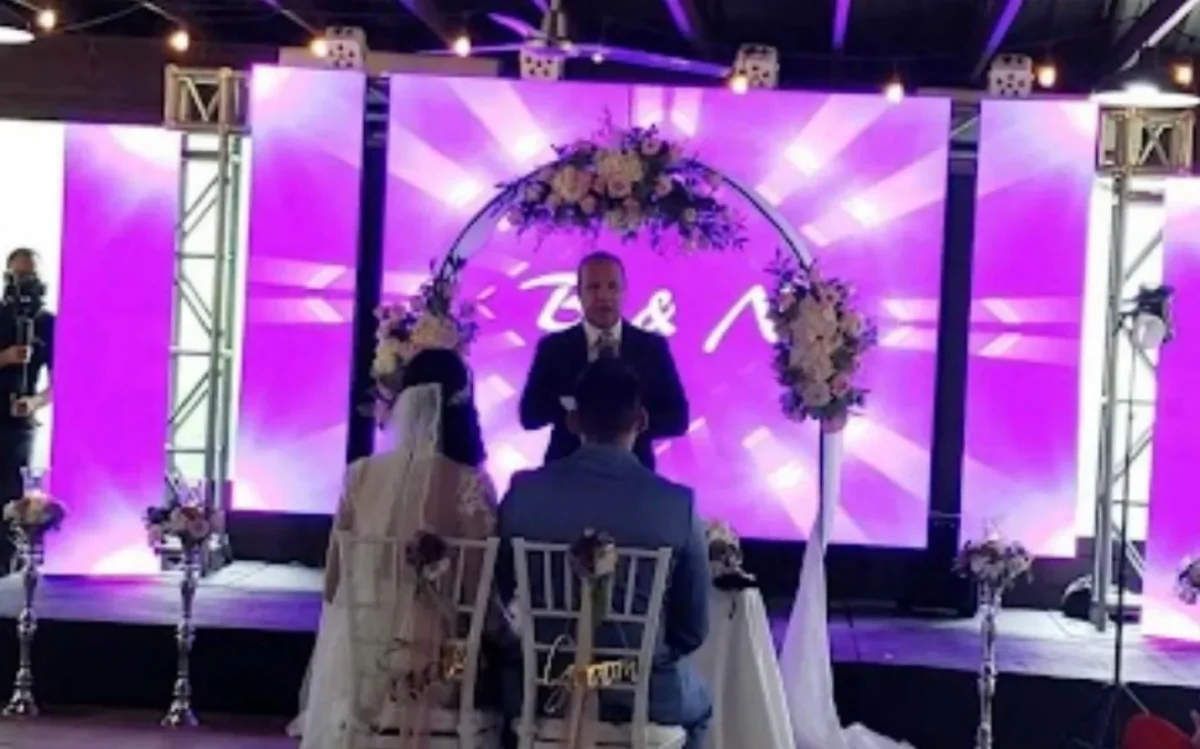
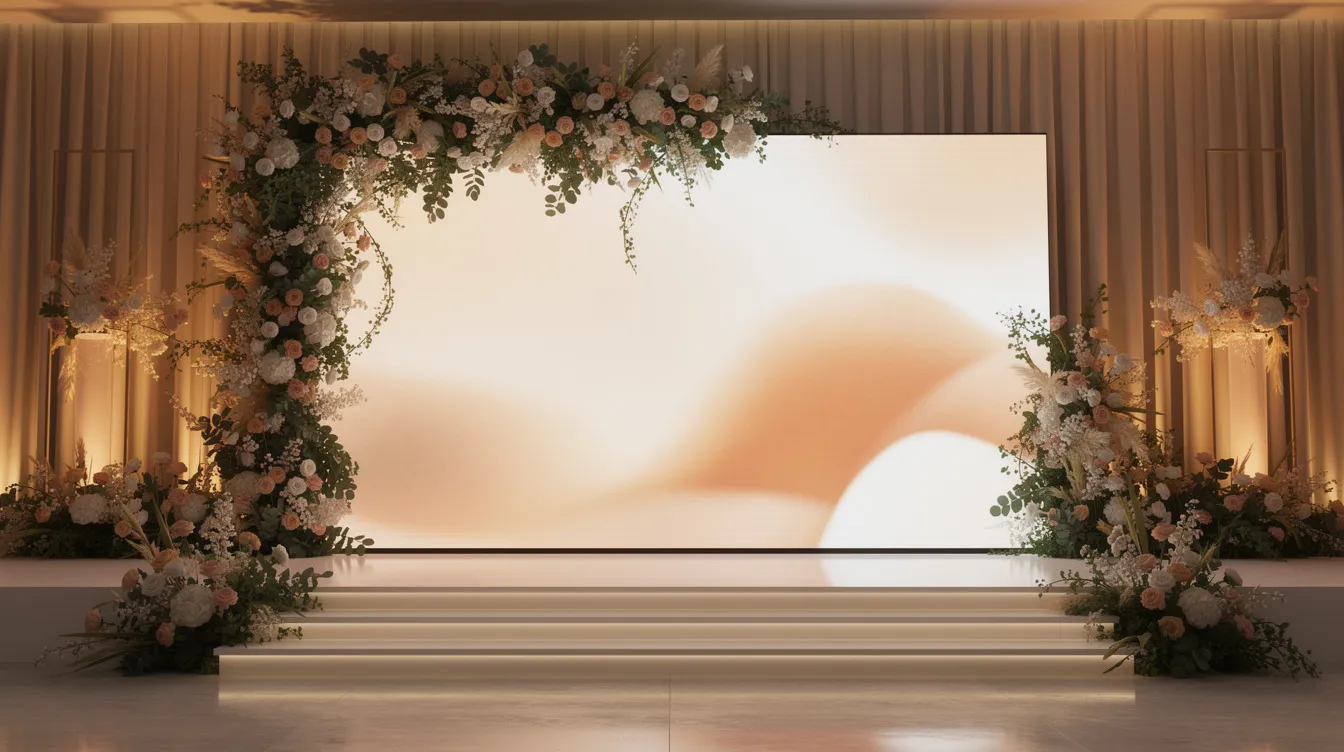
The image features a beautifully designed reception stage area, showcasing an LED wall integrated into a floral arch, with warm lighting enhancing the surrounding elements. This setup provides crystal clear clarity for video messages or slideshows, creating a stunning backdrop for the special day.

Backdrop vs Side Screens, Ceremony vs Reception

LED placement changes how guests experience the room. Ceremony and reception may call for different LED strategies entirely.

Backdrop-focused design

One large LED wall behind the main focal point, whether that is the sweetheart table, band, DJ or central stage. This setup is best for visually driven receptions where the wall acts as a dynamic LED backdrop wedding feature. It works well when most guests face the same direction for dinner and speeches, and the screen becomes the visual anchor for the entire room.

Side-screen design

Two or more LED screens positioned left and right of the stage give better coverage across a wide room. This setup is useful when tables are spread far to the sides or when pillars and architecture block center sightlines. It also allows more flexible content layout: the main event happening center-stage with supporting detail or camera feeds on the sides.

For a 200 person wedding reception, side screens as small as 7 feet high by 9 feet wide can provide enough coverage without dominating the room. A 300 person wedding reception may benefit from side screens closer to 9 feet high by 16 feet wide.

Ceremony applications

Some couples prefer a clean, architectural digital backdrop for the ceremony, with subtle motion content and color palettes that support the floral design. Others keep the ceremony screen-free and focus LED on the reception. Both approaches are valid and budget-influenced. Light displays during a ceremony can be powerful when done with restraint.

Reception applications

Content evolves through the reception. Cocktail hour might feature welcome visuals and engagement photos. Dinner carries warm, ambient motion graphics. Speeches get clean backgrounds so the speaker remains the focus. Dancing brings energy: bold colors, reactive visuals and performance content.

Front Row FX can plan an LED timeline that mirrors the wedding flow so the screen never feels static or disconnected. Using the same LED system for both ceremony and reception in the same venue can improve efficiency, but may require additional time for content transitions between segments.

Content: The Difference Between “A Screen” and “Your Wedding Screen”

A $10,000 LED wall displaying generic stock loops will still feel generic. The physical screen is just the canvas. Custom wedding content is what makes the LED feel like part of the celebration.

Here is what that content can look like:

  • Animated monograms with names and wedding date designed to match the invitation suite or décor palette.

  • Slow-motion or subtle motion backgrounds for dinner that complement the Event Lighting Production and floral color scheme.

  • Curated photo and video sequences from the engagement session, family history or cultural elements, scheduled to appear at planned times rather than running on a constant loop. These are more than a minute slideshow stuck on repeat; they are timed moments within the evening.

  • Branded graphics or lower-thirds for speeches, toasts and special performances, so the best man’s speech has a clean, intentional backdrop rather than whatever was playing before.

  • Dynamic DJ or band visuals that pair with their set while remaining consistent with the overall visual design. Not a nightclub laser show, but coordinated visual energy.

  • Late-night room transformation looks that shift the LED video wall from romantic canvases into bold, high-energy visuals for dancing.

LED walls allow for easy updates of displayed content throughout the evening, which means the screen can carry a different look for every phase of the celebration.

Front Row FX can use its LED Content & Visual Design capabilities to build content to the exact pixel dimensions of the chosen LED wall. Graphics are built for the canvas instead of being stretched onto it the week of the wedding.

Content development requires lead time. Early planning allows for rounds of review and revisions instead of receiving video files two days before the event and hoping they work. A wedding hashtag prominently displayed on screen sounds simple, but even that needs to be designed, formatted and tested against the actual resolution of the wall.

Smaller Visual Options: LED Posters and Digital Displays

Not every visual element needs to be a 30-foot video wall. Smaller digital pieces can support the main LED screen or stand on their own for couples whose primary need is communication rather than a stage-dominant backdrop.

Concrete options include:

  • LED posters or digital totems at the entrance showing the couple’s names, date and welcome messages.

  • Vertical displays or small LED strips near the bar for digital menus or specialty cocktail content.

  • Displays for seating charts or table assignments that can be updated if guest lists change.

  • Cocktail-hour screens for showing engagement photos, cultural video pieces or ambient visuals.

  • Wayfinding or schedule displays for multi-room venues where the ceremony is in one ballroom and the reception in another.

Small indoor LED screens cost about $600 to $900 daily, making them accessible even for couples who are not investing in a large wall. These smaller screens are complementary to a main wedding LED screen rental, not a replacement for couples specifically seeking a large LED wall wedding backdrop. But for a space where a large wall would feel out of proportion, they carry so many benefits on their own.

Booking and Planning: Why Early LED Decisions Help

LED decisions affect the room layout, décor plan and content timeline. That makes early planning more than a nice-to-have; it is a practical advantage.

Booking early can help in specific ways:

  • Improved availability of specific LED cabinets and processing hardware for your date. Peak wedding season in the Upper Midwest runs from May through October, and inventory is not unlimited.

  • More flexibility in choosing creative LED configurations instead of only what remains in stock.

  • Extra time for coordination with wedding planners, décor vendors and florists to design scenic integration around the LED wall.

  • Sufficient time for LED content and visual design, content review and revisions, rather than a rush job the week before.

  • Ability to design the full production (LED, sound, lighting, special effects) as one cohesive plan instead of layering last minute upgrades.

Early booking does not automatically mean discounts. What it does create is better opportunities to build a technically efficient, well-integrated production where every element supports the others.

A reasonable planning timeline for large-format LED wedding backdrops: start conversations 9 to 12 months ahead. That is not a strict rule, but it gives the production team, the planner and the décor team enough runway to design together rather than react.

When a Large LED Wall Makes Sense, and When It Doesn’t

This is an honest fit discussion. Large LED walls are ideal for grand events or immersive visual experiences, but not every wedding qualifies.

When LED video walls make sense

  • Large guest counts (200 to 400+ guests) where a central or side LED screen improves visibility for everyone in the room. A press event or corporate event has similar visibility needs, and the same logic applies to a 350-person wedding reception.

  • Venues with high ceilings, big stages or long rooms where a strong visual focal point is needed and smaller screens would disappear.

  • Receptions where entertainment, performances and visual storytelling are a major part of the evening. This is a massive trend in weddings with live bands, cultural performances and DJ-driven celebrations.

  • Couples who care about a custom visual environment and want the screen to carry brand reinforcement of their wedding identity throughout the evening.

  • Cultural weddings, including Indian and multicultural celebrations, that often feature multiple ceremonies, performances and video segments across multiple days or extended timelines.

When LED walls may not be the best use of budget

  • Small spaces where the wall cannot be placed far enough from guests to be comfortable. If guests are seated 8 feet from a 10-foot-wide LED wall, the experience is closer to staring at a billboard than watching a performance.

  • Minimal visual content: no significant video, no live camera, only a short slideshow. PowerPoint or video messages displayed once during dinner do not justify a $6,000+ investment.

  • Rooms where architectural features or décor make it difficult to place a screen where most guests can clear guests’ sightlines.

  • Situations where investing in Professional Sound, lighting design or décor will more directly impact the guest experience. If the sound system cannot deliver a clear speech to the back of the room, that matters more than visuals.

Front Row FX is willing to recommend TVs, projection or no LED wall at all if that better serves the event. Selling a screen the couple does not need does not build a relationship worth having.

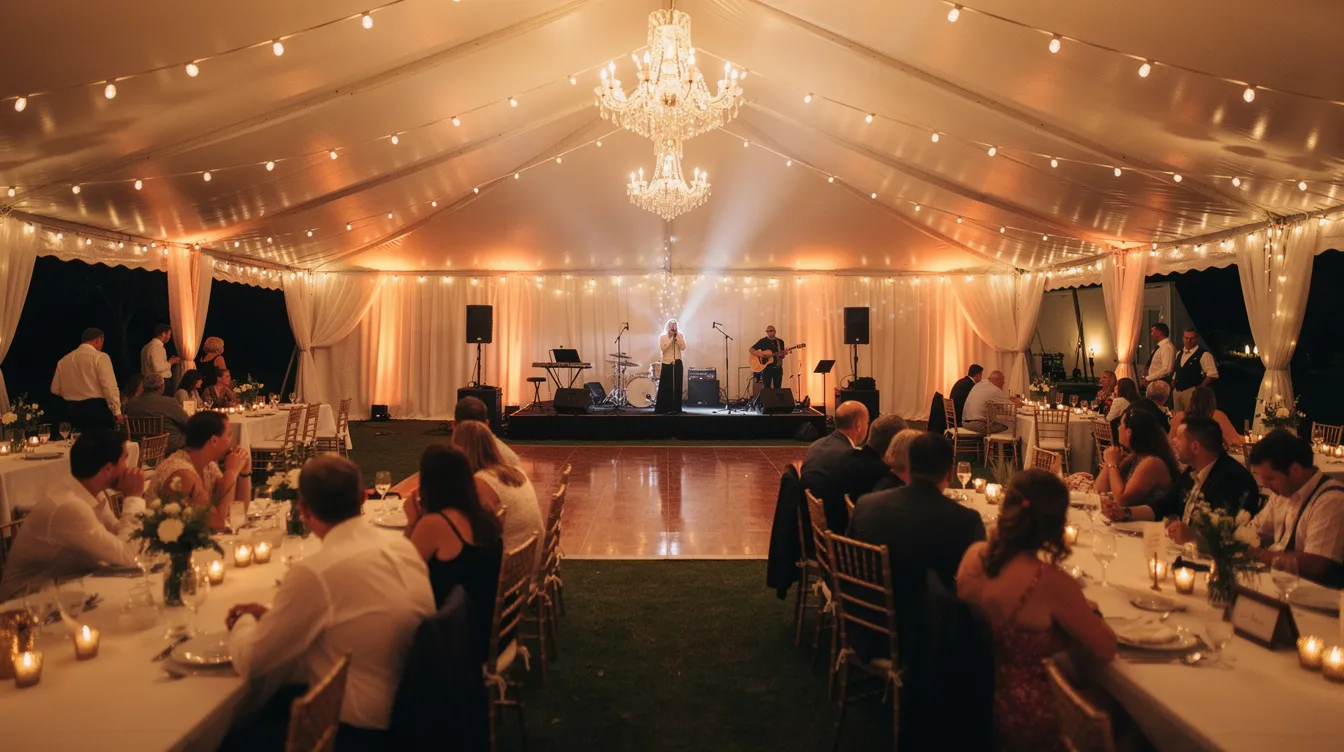
A wide-angle view of a beautifully decorated tent wedding reception, featuring warm lighting and ambient uplighting on the tent poles. A live band performs on stage, creating an inviting atmosphere for guests to enjoy the celebration, with LED screens potentially displaying video messages or the wedding hashtag prominently.

Complete Wedding AV Production: LED, Sound, Lighting and More

Front Row FX is a full-service celebration production partner, not just a wall rental company. When LED, sound and lighting are designed as one system, the detail in each element improves because the production team can make tradeoffs across the entire budget rather than optimizing each piece in isolation.

Here is what combined production looks like:

  • LED video walls integrated with Event Lighting so colors, movement and content feel cohesive. When the LED shifts to warm amber for dinner, the room lights follow. That coordination does not happen when each vendor operates independently.

  • Professional sound systems designed for ceremony, cocktail hour, dinner and dancing, with clear coverage and controlled volume. For corporate events and large celebrations alike, sound quality during the speech is often the detail guests remember most.

  • Multiple sound zones or setups for multi-space timelines: outdoor ceremony, indoor cocktail, ballroom reception. Each space gets the right system instead of one PA trying to cover everything.

  • Lighting design that supports both photography and ambiance, coordinated with the visuals on the LED screen so the room reads as one environment.

In this model, the DJ or band plugs into a professionally designed system rather than building their own audio and lighting from scratch. That does not mean any DJ can walk in and connect without preparation; advance technical coordination with the entertainment team is part of the production process.

Front Row FX supplies the technical crew that manages the overall show flow, cueing visuals, lighting looks and audio transitions. The entertainment team can focus on performing. The production team handles happening behind the scenes.

Special effects, where appropriate, can also be designed to interact with LED content. Spark effects or atmospheric moments timed with visual changes on the screen create a more intentional experience than running effects randomly.

Front Row FX: Real Pricing From the Markets We Serve

Front Row FX operates from two production bases: Eagan, Minnesota and Atlanta, Georgia, supporting weddings and events across the Midwest, Southeast and select national markets.

The pricing ranges in this guide are based on the markets where we actively produce events and have enough operating experience, vendor relationships and production data to establish realistic planning benchmarks.

That includes Minnesota, Wisconsin, Illinois, Iowa, North Dakota, South Dakota, Georgia, Tennessee and Florida.

These numbers are regional planning references—not universal U.S. pricing. Venue labor, transportation, rigging, power, local crew rates and installation schedules can move the same LED configuration higher or lower from one market to another.

Two Production Bases. One Production Standard.

Front Row FX combines direct production access with professional inventory, technical crews, regional production relationships and multi-state capability.

From Eagan, we support Minneapolis, St. Paul and the Upper Midwest. From Atlanta, we support Georgia, Tennessee, Florida and surrounding Southeast markets.

That gives clients one production partner across multiple regions without losing the direct, high-touch planning model.

FAQ: Wedding LED Wall Cost, Design & Production

Most frequent questions and answers

For full-service wedding LED production, a realistic starting point is generally $6,000+. Larger configurations can move into the $8,500–$18,000+ range depending on screen size, venue, pixel pitch, support structure and production scope.

These are planning ranges for professional modular LED—not TVs, projectors or bare panel rentals.

Because the screen is only part of the production. Venue access, loading docks, elevators, rigging, power, setup hours, transportation and labor can all change the final wedding LED wall cost.

A simple ballroom installation can price very differently from the same-size LED wall in a venue with restricted access or more complex technical requirements.

It can be. Corporate LED production often focuses more on presentations, cameras, general sessions and technical redundancy, while wedding LED may require more coordination with décor, florals, lighting, entertainment and custom visual content.

The hardware may be similar, but the production priorities are different.

Yes. Front Row FX can coordinate with planners, florists, decorators and scenic teams so the LED wall feels built into the wedding design rather than placed in front of it.

That can include floral framing, draping, vertical LED, scenic LED, multiple screens, entrance displays and custom content designed around the décor.

Not always. One large LED wall creates a strong focal point, while two or more screens can provide better sightlines, room coverage and visual balance.

The best configuration depends on the ballroom layout, guest seating, stage position, content and overall wedding design.

Yes. Front Row FX can combine LED video walls, professional sound, lighting design, ambient lighting, custom LED content, special effects and technical support into one coordinated wedding production.

This can also include multiple sound zones for ceremony, cocktail hour and reception, with the DJ or band connecting into the larger production system.

No. Front Row FX operates from Eagan, Minnesota and Atlanta, Georgia, supporting wedding and event production across Minnesota, Wisconsin, Illinois, Iowa, North Dakota, South Dakota, Georgia, Tennessee, Florida and additional U.S. markets.

Our wedding LED pricing ranges are based on the markets where we have enough operating experience to provide realistic planning benchmarks.

Start with the wedding date, venue, room or floor plan, approximate guest count, décor direction, entertainment plan and desired visual experience.

You do not need to know the LED cabinet count, pixel pitch or processor. Front Row FX can determine whether the wedding is better served by one large wall, multiple screens, scenic LED or another visual configuration.


Categories
LED Screens & Video Walls

LED Video Walls for Event Planners: What to Know Before You Add One

LED Video Walls for Event Planners: What to Know Before You Add One

LED video walls are now a standard expectation at conferences, galas, brand activations, and corporate events across the country. They deliver bright, high-contrast images that keep audiences engaged, and they can be used for both indoor and outdoor events. But adding an LED wall to your event changes far more than just the visual backdrop.

An LED video wall is not a simple décor upgrade. It affects budget, room design, load-in logistics, power infrastructure, content production, and crew requirements. For event planners working on a 2026 annual sales conference in Minneapolis, a nonprofit gala in St. Paul, or a brand activation tied to a major sporting event in Wisconsin, understanding these variables early is the difference between a smooth production and a last-minute scramble.

In practical terms, LED video walls are modular LED screens assembled into stage backdrops, side screens, expo features, and sponsorship canvases at live events. They enhance audience engagement, replace traditional projectors and traditional monitors for presentations, and support everything from IMAG to sponsor loops. Front Row FX is a full-service audiovisual production partner based in Minnesota, helping planners across the Upper Midwest translate room, idea, and budget into the right LED wall configuration – from LED video wall production to conference AV and complete audiovisual production.

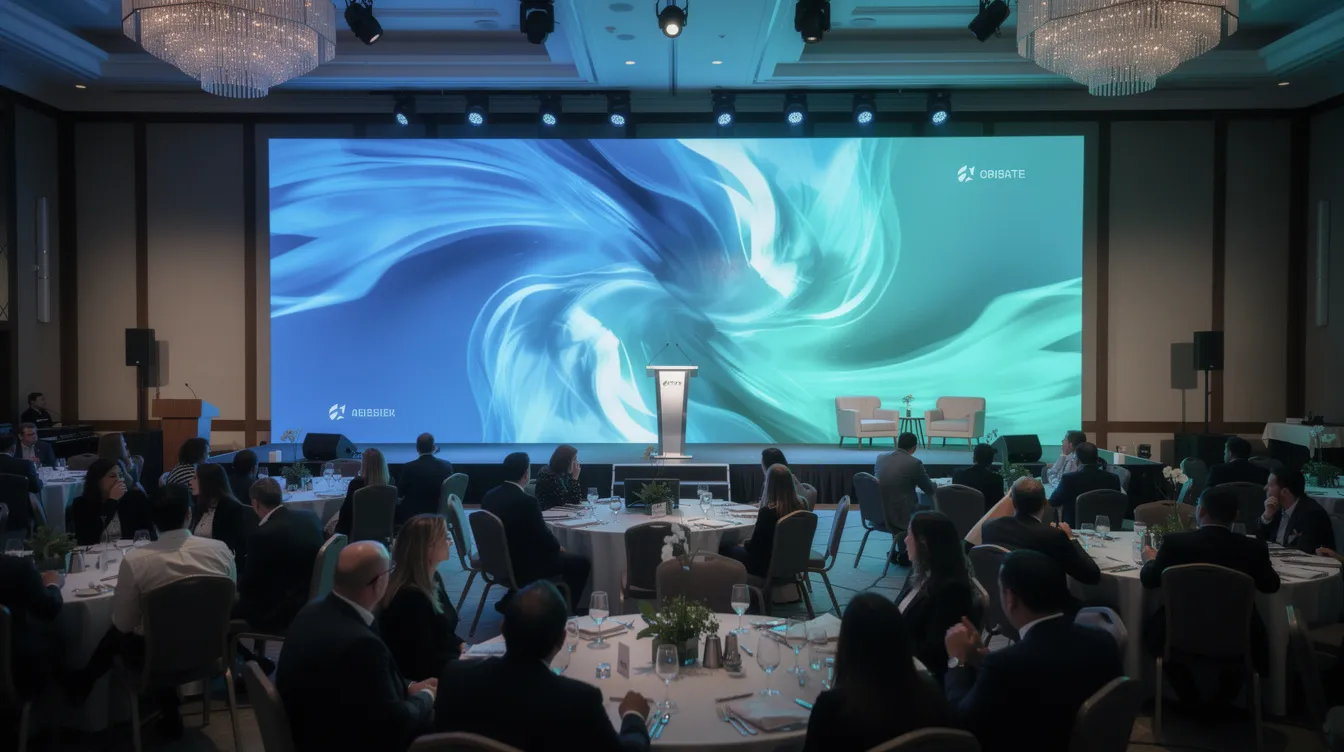
A wide shot captures a large LED video wall illuminating a corporate event stage in a hotel ballroom, with audiences seated at round tables, showcasing high-quality visuals that engage attendees. The vibrant LED screens serve as a dynamic backdrop for the event, enhancing the overall visual impact and experience for corporate clients.

1. Realistic LED Wall Cost for Events

For professional LED walls, cost scales quickly. Never present LED to a client as a small add-on to the AV quote.

Here are planning ranges for common configurations:

  • 11–15 ft wide × ~6.5 ft high LED video wall: typically around $12,000–$15,000 for a corporate event in Minneapolis or St. Paul.

  • 19 ft wide × ~8 ft high conference LED wall: often around $25,000–$30,000 for a multi-day conference.

  • 29 ft wide × ~16 ft high large-format LED wall: can reach $50,000–$60,000+ depending on venue, rigging, pixel pitch, event duration, and event production scope.

These are planning ranges, not fixed packages. Access constraints, ceiling height, labor rules, pixel pitch (P2.6 vs P3.9), and show schedule can all move numbers up or down.

LED wall rental for events is fundamentally different from booking projectors. LED requires more truck space, more crew, longer setup time, video processing hardware that must handle scaling and color calibration for seamless presentations, and usually an on-site LED technician.

Key cost drivers to share with clients:

  • Size and panel count

  • Pixel pitch and resolution requirements

  • Venue access and load-in complexity

  • Support structure (ground vs flown)

  • Show length and rehearsal days

  • Content complexity and number of sources

Coach your language early. Try: “We’re exploring a large-format LED wall for your event; final size and cost will be confirmed after technical review.”

2. LED Wall Size and Placement Should Come From the Room

Pinterest mockups and past show photos are helpful inspiration, but room dimensions and sightlines must drive the LED screen design. LED video walls can be configured to any size or shape, offering flexible size options – but bigger is not always better.

Factors that determine size and configuration:

  • Room length and width

  • Ceiling height at rigging points

  • Stage width and depth

  • Audience layout (classroom, theater, rounds)

  • Closest viewing distance

  • Whether cameras or IMAG will be used

You should determine audience placement to ensure optimal sightlines and viewing angles before selecting a screen size. The visual impact for guests in the front row matters just as much as visibility for the back row.

Common room-driven layouts include:

  • One large center LED wall behind the stages for keynotes.

  • Two side LED screens flanking a scenic stage for awards shows.

  • One central LED wall plus smaller vertical LED columns for brand activations.

  • Multiple smaller LED displays distributed through a large ballroom or expo hall.

Consider a 500-person conference at a downtown Minneapolis hotel ballroom. A 24-foot center LED wall may need to be reduced or split into two 14-foot LED screens due to ceiling height and rigging limits. The room should determine the LED design, not the reference photo.

Loop your AV team in before locking the room layout.

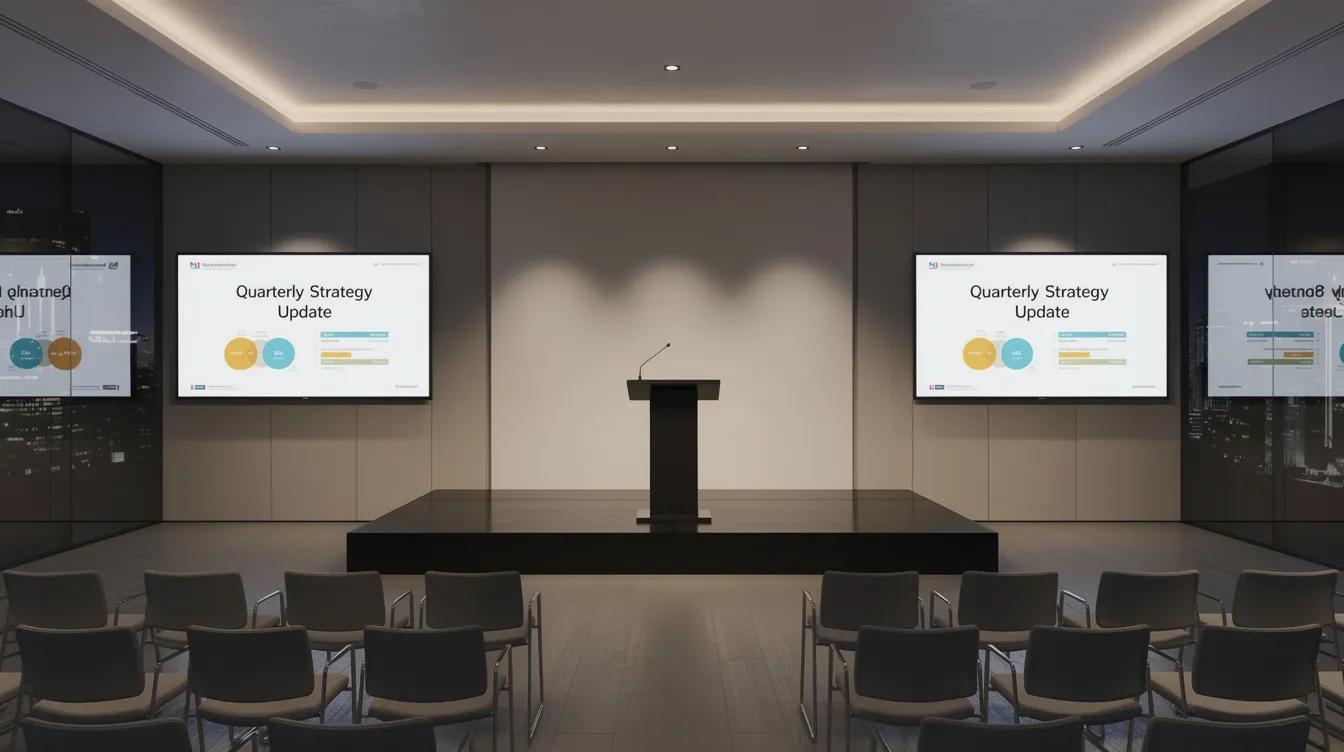
The image depicts a conference room featuring two medium LED screens positioned on either side of a center stage, showcasing vibrant presentation content. This setup highlights the use of high-quality visuals to engage the audience during corporate events, ensuring a strong visual impact and seamless integration for event planners.

3. Load-In, Access, and Venue Logistics for LED Walls

An LED video wall that looks perfect in a CAD drawing can become expensive or impossible if venue access is not checked early. This is one of the biggest planning mistakes in LED video wall event planning.

Logistics questions to confirm before the setup plan is finalized:

  • Is there a loading dock, or is it street-level access only?

  • Are freight elevators large enough for LED road cases and truss?

  • How long is the push from dock to ballroom at venues like Minneapolis Convention Center or major downtown hotels?

  • Are there union or exclusive labor rules that affect load-in and teardown hours?

Restricted setup windows – for example, 10 p.m. to 4 a.m. – can require additional crew and change LED wall cost significantly. A suburban hotel with direct dock access is a completely different production from a tight urban venue with small freight elevators, narrow corridors, and aggressive noise curfews.

Share any known constraints (floor protection, dock sharing, security access) when you first talk with your AV partner. This applies equally to trade shows, trade show booths, and ballroom events.

4. Power and Safety: Planning Electrical for LED Walls

LED walls, processors, and playback gear require planned, dedicated power. This cannot be handled with random wall outlets on show day. Indoor LED walls require significant weight support and electrical infrastructure that must be coordinated in advance.

What’s usually needed: multiple 20A or 30A circuits, or a larger three-phase service, depending on total LED display area and brightness levels. A 16-by-9-foot wall may draw 2,500–3,500 watts at moderate brightness. Larger configurations can demand 6,000–9,000 watts or more.

Power requirements depend on screen size, pixel pitch, configuration, content type (all-white backgrounds draw more energy than darker content), and processor rack power.

Questions for planners to ask:

  • Who provides power – venue, in-house AV, or an outside electrician?

  • Where will the distro and breakers actually be located once carpet, pipe and drape, and booths are installed?

  • Are there any power limitations in the chosen ballroom or expo hall?

Indoor LED walls typically need between 800 to 1,500 nits of brightness, and indoor LED walls must avoid excessive brightness to prevent visual discomfort. Front Row FX calculates power draw and coordinates with the venue. The planner’s job is to make sure electrical ordering happens early and that access to panels and breakers remains clear.

5. Ground-Supported vs Flown LED Walls

The core structural decision: will your LED wall sit on the floor or hang from the ceiling? The answer affects space, safety, and cost. You must determine if the venue allows for rigging or ground support for LED walls before finalizing any design.

Ground-supported approaches:

  • LED video wall mounted on ground-support truss or engineered bases.

  • Scenic surrounds that disguise the support system for galas and awards shows.

  • Extra depth required backstage for ballast or bracing.

Flown LED walls:

  • Hung from building structure via truss and motors.

  • Require venue rigging approval, point loads, drawings, and certified riggers.

  • Often ideal at venues like large convention centers with modern rigging grids.

LED video walls can be curved, stacked, or built into stage sets to create unique shapes. Some rooms simply cannot support a large flown LED display due to age or structural limits. In those cases, smaller LED panels or multiple smaller screens may be the practical solution.

Front Row FX manages rigging plans as part of LED wall production, but planners should share any known rigging policies, approved vendor lists, or in-house rigging contacts early. Safe implementation follows guidance from manufacturer documentation and resources like the Event Safety Alliance.

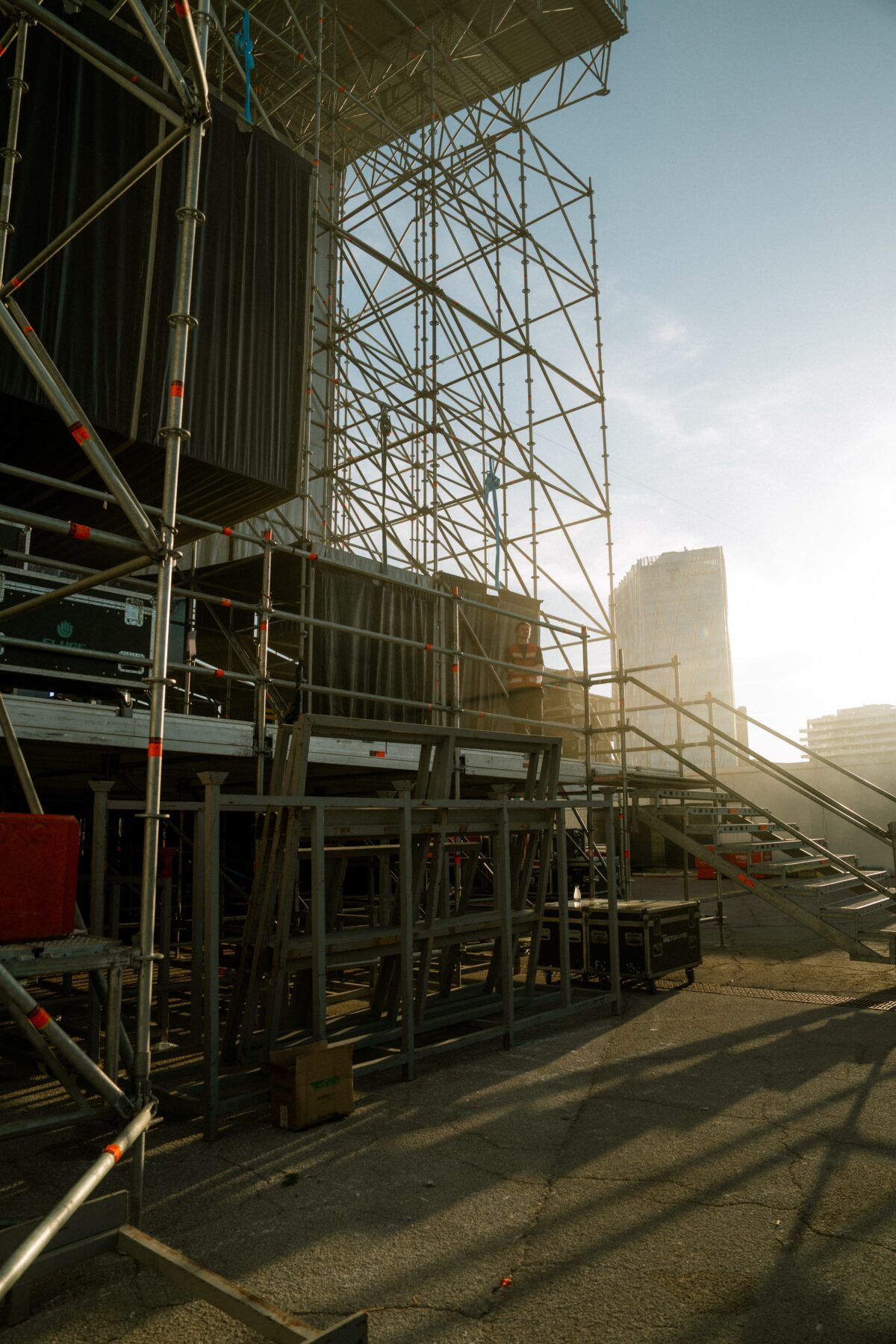
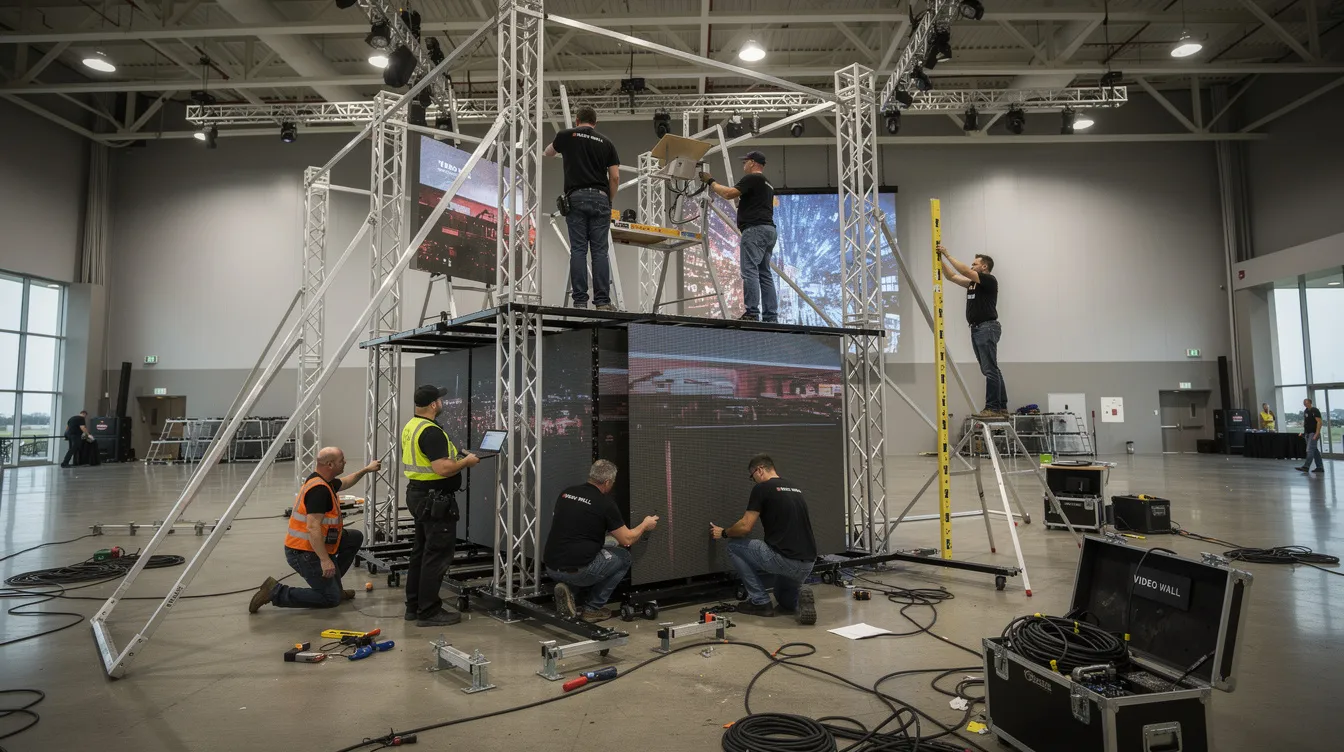
A production crew is assembling a ground-supported LED video wall structure with truss and bracing inside a convention center, showcasing the setup process for high-quality visuals at corporate events and trade shows. The scene highlights experienced technicians working to ensure seamless integration of the LED walls, which will engage audiences with bright and impactful displays.

6. Pixel Pitch and Viewing Distance: Choosing the Right LED Screen

Pixel pitch is the distance between individual LEDs on a panel. It determines how close the audience can stand before seeing the grid pattern between pixels. A smaller pixel pitch ensures higher resolution and tighter pixel density, but it also costs more. LED screens emit light directly, which is why they deliver high resolution visuals in any lighting condition and stay bright even in challenging ambient light.

Practical bands for event planners:

  • P2.6 or P2.9 (fine pitch): good for close viewing in ballrooms where the front row may be 8–15 feet from the LED wall. Indoor LED video walls prioritize close-range clarity in controlled ambient lighting.

  • P3.9 (standard event pitch): excellent for larger rooms, concerts, and outdoor event displays where the audience distance is 20+ feet.

The recommended viewing distance is roughly three times the pixel pitch in millimeters, converted to feet. Choose pixel pitch based on audience distance for clarity – not simply because a finer pitch sounds better.

A 2026 regional sales meeting in St. Paul with 300 attendees may use P2.9 for a 20-foot conference LED wall delivering high quality visuals. A 5,000-person outdoor watch party in Wisconsin might use P3.9 for a much larger LED display. A high refresh rate prevents flickering and distortion when capturing video, and high refresh rates are crucial for live-streaming and video recording at events.

Event planners need to balance visual impact and technical specs when choosing an LED video wall. Provide approximate room dimensions and closest viewing distance; Front Row FX can match pixel pitch to content, image quality, and budget. Concerts utilize LED walls for vibrant stage visuals at a completely different scale than a corporate keynote, and the right pitch reflects that.

7. Content and LED Canvas: Don’t Design Graphics Before the Screen Is Final

The fastest way to lose time and budget is to have designers build content before the LED wall size and resolution are locked. LED walls often use custom aspect ratios – ultra-wide, tall portrait stacks, or multi-screen arrays – that do not match standard 16:9 PowerPoint slides.

Aspect ratio and dimensions should be designed around the screen content. Before content production starts, planners or designers should request from Front Row FX:

  • Final pixel dimensions of each LED wall (e.g., 2304×864).

  • Aspect ratio of the main canvas and any side or scenic LED displays.

  • Preferred file formats and codecs for led video content.

  • Frame rate targets (e.g., 30 FPS or 60 FPS).

  • Safe areas and zones reserved for lower thirds, logos, or captions.

  • Whether content is played as one large LED canvas or multiple independent screens.

LED video walls can display multiple content types simultaneously, and LED walls can display custom video animations and logos. They can also display content as multiple video layers simultaneously, combining slides, live video feeds, and sponsor loops on a single surface.

Two common approaches to display content on custom canvases:

  • Fully custom anamorphic content that fills the entire LED wall with creative designs.

  • Standard 16:9 content floated inside a wider LED environment with branded backgrounds.

Front Row FX offers LED Content & Visual Design for planners who do not have in-house motion graphics resources and need help translating presentations, sponsor logos, and show branding to the actual LED display.

8. Show-Hours Technical Support: Who Owns the LED Screen During the Event?

Installing an LED wall is only half the job. The other half is operating and monitoring it during live sessions, award segments, and brand activations at professional events. This is where flawless execution either happens or falls apart, and it makes a real difference in the event’s overall performance.

There is a clear distinction between:

  • A delivery-only LED wall rental with minimal show support.

  • A full-service LED wall production with a dedicated LED technician or video engineer on site throughout the event.

You should evaluate the supplier’s ability to deliver, install, and troubleshoot the LED system. Experienced technicians on site typically cover:

  • Monitoring LED processors and signal paths.

  • Adjusting brightness and color balance for lighting and camera changes.

  • Managing content changes, playlists, and cue timing.

  • Swapping a cabinet or sending a spare panel into the system if needed.

  • Coordinating with Show & Technical Management and other departments when issues appear.

For conferences, multi-day corporate events, or heavily sponsored galas, budget for full show-hours coverage. This reduces risk more than cutting a few hours of crew time. Front Row FX includes this support within broader complete audiovisual production scopes depending on the event.

9. Integration With Lighting, Sound, Staging, and Cameras

LED screens are not a stand-alone vendor line. They interact with event lighting, professional sound, staging, scenic, and cameras. Seamless integration between these systems requires early coordination.

Concrete examples of what can go wrong:

  • A bright LED video wall behind a presenter can change how key and backlighting are positioned to avoid silhouettes.

  • Tall side LED screens may block speaker entrances or aisleways if staging is not coordinated.

  • Camera shots for IMAG need content brightness tuned so that faces are not washed out on the LED wall.

Organize a joint conversation between your AV team and other vendors – decor, scenic, broadcast, venue – early in the process. This prevents departments from competing for the same rigging points or floor space.

Front Row FX delivers integrated solutions that connect LED walls, lighting, audio, and show management into one cohesive event production. Send updated floor plans and stage layouts whenever the set, seating, or sponsor activations change, so LED screen placement can be checked again for sightlines and safety.

The image captures a wide-angle view of a bustling ballroom filled with LED walls and stage lighting rigs, creating a vibrant atmosphere for a professional event. The seamless integration of high-resolution visuals and sound systems ensures that audiences are engaged, making it an ideal setup for corporate events and trade shows.

10. How to Talk About LED Walls With Clients

This section is about protecting your clients and your own credibility. Do not lock into exact LED wall dimensions before the technical review is complete.

Preferred phrasing to use with corporate clients and stakeholders:

  • “We are planning a large-format LED environment; Front Row FX will confirm final dimensions after we review the venue and production details.”

  • “We’re exploring an LED wall for the main stage and possibly additional LED displays for sponsors, depending on budget and room layout.”

Why this protects everyone:

  • Budget flexibility if access, rigging, or pixel pitch change cost.

  • Sightlines and audience experience if the room turns out shorter or narrower than expected.

  • Creative options if the team discovers that two LED walls or vertical scenic LED make more sense than one giant center wall.

At the proposal stage, present LED wall cost for events as a range with clear “subject to venue and technical review” wording. Position LED as part of an upgraded visual strategy that supports sponsorship opportunities and stage branding – not just a bigger TV. Help clients highlight what matters: the experience, not the spec sheet.

Planner Checklist: Key Questions Before You Add an LED Wall

Before promising LED video walls to clients, work through this list:

  • What is the approximate budget range available for the LED wall and supporting AV?

  • What are the room dimensions, ceiling height, and stage size?

  • How close will the nearest attendees be to the LED screen?

  • What type of content will run (slides, IMAG, high-motion videos, sponsor logos)?

  • What are the confirmed load-in and load-out windows?

  • How does gear enter the room (dock, ramp, freight elevator, or stairs)?

  • Is the LED wall likely to be ground-supported, flown, or integrated into scenic?

  • Who provides electrical service, and when will it be ordered?

  • Who is responsible for the LED screen during show hours?

  • Is the LED wall part of a larger event audiovisual production or a stand-alone feature?

Answering these upfront enables Front Row FX to respond faster with accurate LED video wall planning and pricing.

What to Send Your AV Partner to Design the Right LED Wall

You do not need final creative or fully dimensioned drawings before starting the conversation. Here is what helps most:

  • Event name, date(s), and city (e.g., May 2026 tech summit in Minneapolis).

  • Venue and specific room name (e.g., Ballroom A, Minneapolis Convention Center).

  • Floor plan, even if preliminary, plus any existing CADs if available.

  • Stage dimensions and preferred stage location in the room.

  • Approximate audience size and seating style (theater, classroom, rounds).

  • Closest and furthest viewing distances from the proposed LED wall.

  • Examples of content (past decks, sponsor logos, brand style guides, reference videos).

  • Event schedule, especially tight turnarounds between sessions or room flips.

  • Load-in window and any known access limitations or union rules.

  • Approximate AV/LED budget range and any must-have elements (e.g., IMAG cameras, specific sponsor deliverables).

Front Row FX will help develop the configuration from there as part of LED production planning.

Start a Project →

How Front Row FX Works With Event Planners

The planner owns the client relationship and event strategy. Front Row FX owns technical design and execution of LED walls and AV.

Front Row FX is a Minnesota-based, full-service audiovisual production and event technology company serving Minneapolis, St. Paul, Minnesota, Wisconsin, Chicago, Georgia and the Upper Midwest. The team supports corporate event production, association conferences, galas, concerts, cultural events, product launches, and high-production private events.

How Front Row FX supports event planners:

  • Translate creative decks into practical LED wall layouts and cabling plans.

  • Coordinate LED display placement with stage, lighting, audio, and cameras.

  • Provide LED Content & Visual Design support when needed.

  • Deliver Show & Technical Management so cues, content, and crew stay aligned.

In practice, this has meant helping a regional healthcare conference team in 2024 avoid a last-minute wall redesign by identifying rigging limits during the first site visit, and working with a 2025 nonprofit gala team in downtown Minneapolis to split a single large wall into two surfaces that better matched the room’s proportions – saving budget and improving sightlines.

Front Row FX works with the planner, not around the planner. The goal is to protect both the creative concept and the event budget.

When to Bring Your AV Partner Into the Planning Process

The best time to involve Front Row FX is after a venue is shortlisted or booked, but before stage design, screen dimensions, and final budgets are locked.

Advantages of early involvement:

  • Identify better LED screen configurations for the specific room.

  • Confirm whether a large center LED wall is realistic, or if side screens are more effective.

  • Spot access, power, and rigging issues while there is still time to adjust.

  • Align content planning and LED canvas details early with marketing and sponsors.

A simple planning timeline:

  • 6–9 months out: concept and budget discussion including whether LED makes sense for your next event.

  • 3–6 months out: site visit or virtual walk-through, preliminary LED design, power and rigging review.

  • 1–3 months out: lock LED wall specs, start content production with exact pixel dimensions.

  • Show week: installation, rehearsals, show operation, adjustments.

Early technical involvement does not reduce the planner’s creative control. It ensures the LED wall for events can be practically delivered in the chosen venue and schedule.

If you are designing a 2026, 2027 or 2028 conference, gala, or expo in Minnesota or the Upper Midwest and LED is on the table, this is the moment to talk with Front Row FX.

Plan Your LED Video Wall Production

LED video walls transform live events, but they also change budget, logistics, and content workflows. Planners should avoid promising exact sizes or costs before a technical review, and a strong AV partner simplifies this entire process.

Front Row FX provides professional LED video walls, complete AV production, conference AV, LED content and visual design, show and technical management, event lighting production, and professional sound across Minnesota, Wisconsin, Chicago, and the Upper Midwest.

Plan Your LED Production →

FAQs: LED Video Walls for Event Planners

How early should I book an LED wall for a corporate event or conference?

Four to eight weeks is a common lead time for securing LED equipment, but for peak seasons or large-format walls, six to nine months of advance planning is safer. The earlier you start, the more flexibility you have on configuration and cost.

Can we use the same LED wall design for both a general session and an evening gala in the same room?

Often yes, with content and lighting adjustments. The wall itself can stand through a room flip while content transitions from presentations to a new product reveal or branded gala visuals. Plan with your AV team so transitions are built into the show flow.

Is an LED wall always better than projection for corporate events?

Not always. Projection can work well in controlled lighting for smaller groups. But LED video walls deliver high-resolution visuals in any lighting condition, offering a clear advantage in rooms with ambient light, windows, or where attendees are close to the screen. LED walls also eliminate concerns about lamp life and shadow interference that come with projectors.

What is the smallest practical LED wall size for a breakout or small meeting?

An 8-by-6-foot wall with fine pitch can work for smaller meetings. Even smaller LED panels are available for trade show booths and focused activations where the audience is very close.

Can LED walls show multiple content sources at once?

Yes. LED video walls can display multiple video layers simultaneously – slides on one zone, a live camera feed on another, and a sponsor loop on a third. This requires proper video processing and content mapping, which should be planned in advance.

Are outdoor LED walls weather-resistant for summer events in Minnesota, Illinois, Georgia and Wisconsin?

LED video walls are sunlight-readable and weather-resistant when specified for outdoors. Outdoor panels carry IP ratings for dust and moisture protection and are designed to stay bright even in direct sunlight. Outdoor event displays require higher brightness panels, structural engineering, and additional weatherproofing compared to indoor configurations. Festivals, sporting events using LED walls for live scores and replays, and summer activations all benefit from properly specified outdoor LED.

How does LED wall cost compare between a one-day event and a three-day conference?

Equipment cost is often similar, since trucking and setup labor happen regardless. The difference is in crew days, show-hours coverage, power, and spares. Multi-day events benefit from dedicated on-site technicians and redundancy planning, which adds to the total.

Do we need to provide our own content team, or can Front Row FX handle LED content production?

You do not need an in-house motion graphics team. Front Row FX offers LED Content & Visual Design services to help translate slides, sponsor logos, and branding into content that matches your actual LED canvas. Weddings benefit from LED walls for dynamic visual displays, and creating that content is part of the production scope. LED screens are effective for trade shows and exhibitions as well – the content approach simply changes based on the application.

For deeper reading on LED screens and video walls, visit the Front Row FX Journal.

Categories
LED Screens & Video Walls

What Custom Audiovisual Production Actually Means?

What Custom AV Production Actually Means

Almost every audio visual production company can say “yes, we can do that.” That does not necessarily mean the production is truly custom. Sometimes it simply means the company can source enough equipment, subcontract enough departments, and add enough contingency to make an unfamiliar project possible.

There is an important difference between custom AV production and improvising a production from scratch every time a client asks for something different. Real custom event AV is not about reinventing the wheel for every event. It is about having enough technical infrastructure, expertise, systems, and production relationships to adapt the wheel quickly.

Front Row FX is a Minnesota-based audiovisual production company focused on live event production, LED walls, professional sound, stage lighting, and technical management across Minnesota, Wisconsin, Illinois, Georgia and the Upper Midwest. This article is written for corporate event planners, producers, agencies, and national teams bringing events into Minneapolis, St. Paul, and regional venues.

Here is what this article covers:

  • The difference between custom AV and improvised AV production

  • Why “yes, we can do it” can quietly inflate your budget

  • How owned infrastructure and a production network create efficiency

  • How custom event production helps allocate a fixed budget more intelligently

  • Questions to ask any company claiming to offer custom audiovisual production

Custom AV Should Mean Adaptable, Not Unnecessarily Expensive

“Custom should describe the design, not the inefficiency behind it.”

Custom audiovisual production should allow audio, video, lighting, and LED systems to adapt to the event format, room, schedule, and audience without rebuilding unfamiliar infrastructure every time. Custom AV production aligns technical elements with event requirements rather than forcing an event into a predefined package.

Consider two scenarios. A 400-person corporate event in a downtown ballroom might need a single center LED wall with moderate resolution and a PA system calibrated for speech intelligibility. A large concert in an arena requires distributed audio, multiple LED walls for a stage backdrop, a lighting rig for wide throw, and immersive effects. A company that handles both frequently can execute either efficiently. A company experienced only in ballrooms may struggle with the engineering, rigging, and redundancy the arena demands.

Capability and efficiency are not the same thing. AV setups must meet clarity and high production value expectations regardless of the venue. The difference is whether the production company reaches that standard through established workflows or through expensive improvisation.

Key points:

  • Custom AV production does not automatically mean a lower project cost

  • It helps allocate budget more intelligently across LED walls, sound, lighting, content, and crew

  • A project one experienced team executes efficiently may cost another company significantly more in subrentals, labor, and contingency

  • The room and program should drive the production design, not a fixed equipment list

Custom AV vs Improvised AV Production

The distinction is straightforward.

In improvised event production, a service event production company assembles unfamiliar gear, outside vendors, and ad-hoc workflows specifically for one unusual project. The provider figures out where to source equipment, who knows how to operate it, whether systems are compatible, and how much extra contingency should be added because the workflow is unfamiliar.

In custom AV production, an audiovisual production company starts from known systems: LED processing, audio consoles, stage lighting rigs, power distribution, rigging partners. The configuration changes per event. The operating discipline does not.

A professional audio visual production crew is coordinating the setup of equipment in a spacious event venue, featuring LED panels and speaker arrays, ensuring crystal clear sound and effective lighting design for an upcoming corporate event. The technical teams are focused on the production elements necessary to create a successful live event experience for attendees.

Imagine a live event production requiring multiple LED walls, distributed audio, stage lighting, and show control. An improvised provider might scramble for subrentals from multiple vendors, bring in outside engineers unfamiliar with the signal chain, and add labor hours for troubleshooting. An experienced custom provider plugs this scope into existing workflows with compatible equipment and crew who have built similar systems repeatedly.

Corporate event production requires seamless transitions and reliability. When clients pay for improvisation, they absorb the provider’s learning curve.

Improvised AV:

  • Equipment sourced ad-hoc from multiple unfamiliar vendors

  • Crew unfamiliar with specific hardware

  • Signal flow and integration tested for the first time on site

  • Unclear single point of responsibility

Custom AV:

  • Known systems with repeatable workflows

  • Experienced crew operating familiar equipment

  • Pre-engineered signal routing and power plans

  • One accountable technical direction from design through execution

Why “Yes, We Can Do It” Can Become Expensive

Almost any serious AV production company can technically say yes to a complex event production if the budget is large enough. That does not mean every company can produce it efficiently.

Corporate environments require tight agendas and speaker management. When the production infrastructure behind those agendas is unfamiliar to the provider, costs quietly inflate through several common factors:

  • Extensive subrentals from vendors the team has not previously integrated

  • Outside engineering teams brought in to design unfamiliar systems

  • Operators who need extra rehearsal time with equipment they do not regularly run

  • Extra trucking and transport from multiple vendor locations

  • Added contingency days because the workflow has not been tested before

  • Redundant backup systems added specifically because the team does not know the hardware’s failure history

The same LED wall configuration and professional sound system might be routine for one corporate event production company in Minnesota but require custom engineering, specialty vendors, and significant extra labor for another firm that rarely builds at that scale.

Complexity driven by genuine event needs is expected. Complexity driven by internal inefficiency is waste.

Signals your AV quote may be paying for improvisation:

  • Many separate vendors listed with no clear integration lead

  • Vague descriptions of how audio, video, and lighting connect

  • No mention of a technical director or show caller

  • No documentation offered (signal flow, power plans, run-of-show)

  • Unclear who troubleshoots when systems interact

Owning Equipment vs Knowing How to Scale a Custom Production

A common misconception: a professional audiovisual production company must own every piece of gear used on a show. That is not how larger event production works.

What matters more is having owned core infrastructure plus a proven model for scaling with partners. For Front Row FX, owned infrastructure includes indoor and outdoor LED walls, processing, sound reinforcement systems, key lighting fixtures, power distribution, show control systems, and support gear used regularly across the Upper Midwest and Georgia.

Scaling larger or unusual projects may involve adding specialized components – additional LED inventory, broadcast cameras, specialty rigging, scenic structures – from trusted regional partners who work within Front Row FX’s technical direction.

What owned infrastructure provides:

  • Consistency and quality control across projects

  • Speed in preparation and predictable workflows

  • Crew familiarity with equipment maintenance and failure modes

What a scalable production network provides:

  • Additional capacity for peak or simultaneous events

  • Specialized equipment beyond standard inventory

  • Regional reach and local crew support across venues

Subrentals vs Outsourcing Responsibility

Bringing in additional equipment from a partner is not the same as outsourcing responsibility for the event’s technical production.

In a professional custom AV model, the primary event production company still owns design, signal flow, processing, crew direction, installation standards, show operation, and contingency plans – even when additional LED walls, lighting, or audio components are subrented. A dedicated production manager simplifies communication during events and ensures that supplemented gear integrates cleanly into the overall system.

For a large corporate event in Minneapolis needing an expanded LED video wall system, Front Row FX may supplement its own cabinets with additional compatible LED from a partner but still controls content delivery, processor configuration, power planning, rigging coordination, and live switching. AV production companies should provide a single point of contact for events regardless of how many production elements are involved.

The client should not have to manage multiple AV vendors. A custom event production company should unify all technical disciplines into one accountable team.

Questions to confirm who is really responsible:

  • Who signs off on the complete system design?

  • Who directs all technicians across audio, video, and lighting?

  • Who troubleshoots when multiple systems interact?

  • Who remains on site during rehearsals and the live event?

Repeatable Expertise: How Systems Make Custom Work Manageable

Custom event AV is not about reinventing the technical system every time. It is about applying repeatable expertise, especially in complex areas like LED video, sound reinforcement, and lighting design.

Building in system redundancy prevents technical failures during events. That redundancy comes from experience: knowing which backup systems matter, which signal paths need failover, and which components have the highest risk of failure under specific conditions.

What is repeatable across disciplines:

  • LED video: Cabinet math, pixel pitch selection, processor capacity, power distribution, content resolution specs, spare strategy, and installation workflow. High-resolution LED video walls provide superior brightness and flexibility, but the engineering behind them should not start from zero each time.

  • Audio: Array design, coverage modeling, gain structure, RF spectrum coordination, console workflow, and monitor mixes. High-quality audio systems are essential for sound reinforcement, and audio solutions ensure crystal-clear sound for presentations when the team understands the room.

  • Lighting: Fixture placement, color temperature consistency, key light versus effects, dimmer management, and cueing. Stage lighting influences how speakers and content appear to the audience.

  • Show management: Run-of-show documents, cue sheets, communication hierarchy, signal flow documentation, and backup systems necessary in case of equipment failure during events.

Integrated technical coordination enhances audience experience when every discipline operates from proven methods rather than first-time experiments.

Custom AV Begins With the Room, Not With a Package

A pre-built package asks: which tier do you want? Custom production asks: what does this room need?

That changes the entire conversation. Technical integration requires understanding venue layout and audience needs before any equipment is specified. Involving AV early in the design phase ensures proper planning and evaluation of what each space actually demands.

Consider these scenarios:

  • A ballroom in downtown Minneapolis where ceiling height limits screen placement and LED wall size – two side displays may serve attendees better than one center wall partially blocked by chandeliers

  • A convention center breakout where distributed audio is more important than a single large PA – conference AV production that prioritizes intelligibility over volume

  • An outdoor live event where LED brightness, power, and weather protection become primary drivers – requiring different technology decisions than any indoor program

An empty convention hall with high ceilings and exposed rigging points is being prepared for a large corporate event, showcasing the technical production elements necessary for audio visual setups, including stage lighting and sound equipment. The space is designed to accommodate attendees and facilitate effective communication during the upcoming event.

Room-first questions that guide the production:

  • What are the sightlines from every audience position?

  • What is the ambient light level, and how does it change during the program?

  • What is the seating shape and capacity?

  • Where are rigging points, power drops, and load-in paths?

  • How fast does changeover between sessions need to happen?

The room should determine the production. The production should not force the event into a space it was not designed for.

Custom Does Not Mean Unlimited (Or “Yes” to Everything)

A serious custom audiovisual production company should sometimes recommend less equipment, different screen choices, or a simpler approach when that better serves the event vision.

An effective AV partner evaluates client goals to tailor production needs – and that sometimes means saying no to a request that introduces unnecessary risk, cost, or complexity. Saying yes to everything is not customization. It is sales.

Examples where “less” or “different” is smarter:

  • Suggesting a smaller LED wall because viewing distance and pixel pitch make a larger screen wasteful

  • Recommending a different pixel pitch instead of the most expensive option when the audience sits beyond the detail threshold

  • Proposing two medium LED video walls instead of one massive wall blocked by venue obstructions

  • Redirecting budget from decorative lighting into better audio coverage when the program is speech-heavy

  • Recommending a broadcast-focused partner for a multi-city hybrid event while Front Row FX remains responsible for in-room LED, sound, and lighting

The objective is not to sell the maximum amount of equipment. It is to build the right production. Planners should expect their AV partner to push back constructively when a requested configuration does not match the space, the audience, or the budget.

Front Row FX: Our Approach to Custom Audiovisual Production

We approach AV as a production system rather than a collection of individual rentals. Technical production partners manage audio-visual execution for events, and our process reflects that responsibility.

Our typical process begins with the event: venue, audience, content, experience, technical requirements, then production design. Only after those questions are understood does the equipment configuration become clear. A dedicated production manager simplifies communication and event flow from the first site visit through teardown.

Depending on the project, we coordinate:

Custom AV production coordinates sound, video, and lighting as one integrated system. We design productions so that sightlines, rigging, power, and crew workloads align with the event’s run-of-show – not as separate vendor deliverables that happen to share a room.

Our regional focus covers the Twin Cities, greater Minnesota, Wisconsin, Chicago, and the Upper Midwest. Representative event types include corporate general sessions, multi-room conferences, nonprofit galas, outdoor concerts, multi-day trade show AV production, university events, and selective high-production private events.

Owned Infrastructure + Trusted Production Network

Front Row FX combines owned professional infrastructure with a trusted Upper Midwest production network. This is how custom AV production scales without losing a single production direction.
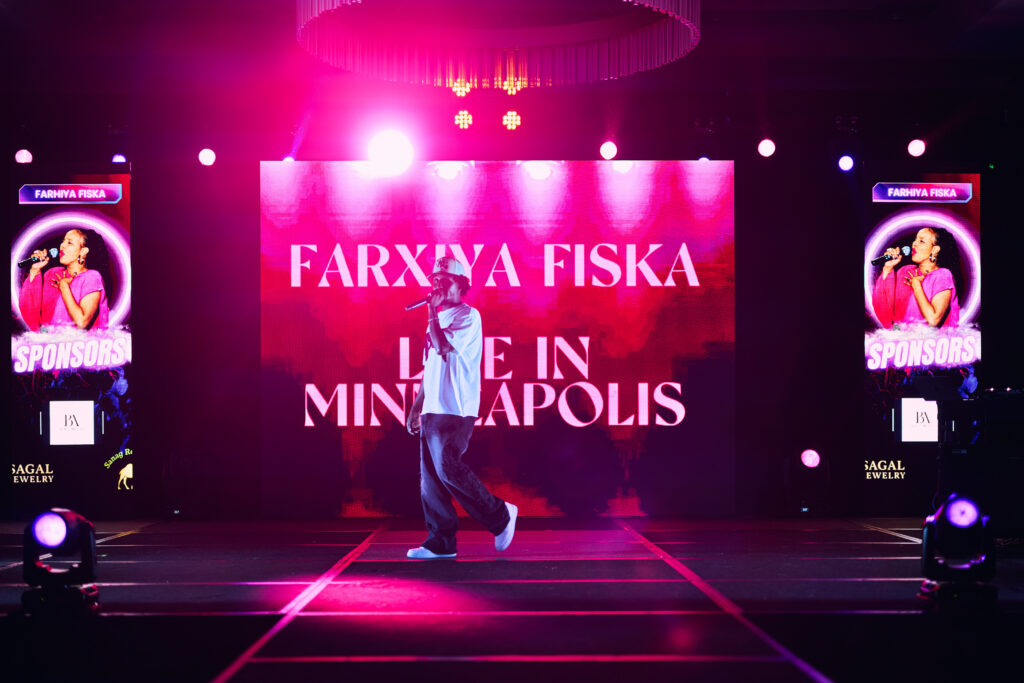
Owned infrastructure gives us predictable workflows, consistent quality, and speed for typical corporate event production elements: LED walls, main PA systems, stage lighting, and control. Our extensive inventory covers the systems we use most frequently, maintained and operated by crew who know every component.

Our production network extends capacity and specialization. Additional LED inventory, advanced rigging, large-format audio systems, and camera packages come through long-term partners we integrate under one technical direction. Clients interface with one production team, one show caller or technical director. Additional partners are coordinated behind the scenes.

Owned Infrastructure:

  • Availability and quality control for core systems

  • Faster preparation and familiar maintenance cycles

  • Reduced dependence on third-party logistics

Production Network:

  • Scalability for unusually large or simultaneous events

  • Specialized equipment beyond standard inventory

  • Regional crew and rigging partners across key Midwest venues

Together, these layers allow us to take on larger or more unusual projects without pretending that one company physically owns every piece of equipment the industry can possibly require. Explore our complete audiovisual production model to see how this works across event scales.

National and Out-of-State Clients: Why Local Custom AV Matters

Custom production becomes especially important when an organization is producing an event outside its home market.

A national client coming into Minnesota does not necessarily know local venues, loading conditions, regional crew, rigging providers, power requirements, winter logistics, or which production partners are reliable. A strong local production partner can absorb that complexity.

Front Row FX becomes the technical bridge between a national client’s event vision and the realities of Midwest venues. Instead of building a new vendor ecosystem from scratch, the production company manages venue coordination, crew sourcing, rigging relationships, and on-the-ground problem solving under one accountable direction.

National teams can fly in producers, creative leads, and presenters while relying on Front Row FX for complete audiovisual production, local show management, and site-level execution.

The image depicts a large professional event venue's loading dock area during winter, where production trucks are parked and equipment cases are being moved inside, highlighting the logistical efforts of a corporate event production company. The scene captures the essence of live event production, showcasing the technical teams preparing for an upcoming event with various audio visual equipment.

What a local custom AV partner adds for national teams:

  • Venue-specific knowledge of rigging points, power, dock access, and house rules

  • Regional crew networks and established relationships with rigging partners

  • Realistic scheduling that accounts for weather, transport, and local logistics

  • Fewer surprises on load-in day and more accurate pre-production planning

Budget Allocation: Using Custom AV to Spend Smarter, Not Just Less

Custom event AV is a tool for smarter budget allocation: shifting money toward what the audience actually needs to hear and see. Professional custom AV usually constitutes 15% to 20% of total event investment, and how that allocation is distributed matters more than the total number.

Choosing a custom AV production partner involves defining event scope and budget early. Transparent pricing and itemized proposals are important for evaluating AV services, especially when comparing providers with different production models.

Custom production does not always reduce total cost. It often improves how a fixed budget is distributed across LED, audio, lighting, content, and crew – reducing waste on low-impact production elements.

Consider the tradeoffs:

  • One enormous LED wall versus a slightly smaller wall plus two side screens that improve coverage for more attendees

  • More moving lights versus better main PA coverage for a speech-heavy program

  • Bigger stages versus better LED content design that communicates the message more effectively

  • Extra hardware versus additional technical staffing for complex show calling and seamless execution

Budget questions we typically explore:

  • Where does audio clarity rank versus screen size for this audience?

  • How important is camera coverage or IMAG?

  • How critical is scenic design versus LED content for the brand?

  • Is the focus on in-person experience, live stream quality, or both?

  • What level of rehearsal and technical support does the program require?

Event Types Where Custom AV Production Matters Most

Custom audiovisual production and unified technical direction significantly improve outcomes compared with piecemeal rentals or generic packages. Custom AV solutions enhance clarity and production value for corporate events and live productions alike. Custom staging includes bespoke fabrication and branded backdrops when the event scope requires it.

  • Corporate events: Executive town halls, investor meetings, and product launches require projectors, screens, and microphones configured precisely. LED walls enhance visual impact at corporate events, and presentation playback must be reliable under tight schedules with no room for technical failure.

  • Conferences: General sessions and breakout rooms need coordinated LED or projection, distributed audio, and session recording. Consistency across multiple rooms and days is where a collaborative production approach outperforms disconnected vendor setups.

  • Concerts and live events: Outdoor festivals, campus concerts, and theater events demand audio systems scaled for coverage and clarity, lighting looks cued to music, LED content synchronized to performance, and effects managed under one creative and technical team.

  • Galas and nonprofit events: Fundraising programs where event lighting, scenic elements, awards presentation, and live entertainment share a single stage. Custom AV helps preserve both program clarity and atmosphere without one discipline compromising another.

  • Brand activations and experiential events: Unusual screen layouts, interactive content, and LED structures in lobbies or atriums require a custom workflow that a standard production company may not routinely deliver.

The more disciplines involved in a single event, the more important it becomes to manage them as one production rather than several disconnected rentals.

Questions to Ask Any “Custom AV” or Event Production Company

Technical event planners assess client needs and budget. Before assuming a provider truly offers custom production, ask:

  • Who engineers the full system? Understanding whether audio, video, LED, lighting, and power are designed by one technical team or fragmented across vendors reveals the true production model.

  • How often do you build systems like this? Frequency indicates workflow maturity. A company that builds LED walls weekly operates differently from one that does it twice a year.

  • What equipment does the company actually operate regularly? Knowing what is owned versus what must be sourced helps identify where improvisation may enter the project.

  • What happens when the project exceeds your inventory? The answer should describe managed partner relationships, not scrambled last-minute sourcing.

  • Who remains responsible for the complete system? There should be a single technical director or production manager, not a collection of independent vendors.

  • Will you provide documentation? Signal flow diagrams, CAD layouts, power plans, and run-of-show documents indicate a process-driven company.

  • Who is on site during rehearsals and the live event? Dedicated technical staff should be present from load-in through teardown – not just during the keynote.

  • Can you explain why you are recommending each major production element? A real production partner should be able to discuss the reasoning behind every recommendation, not just the line items.

Custom Production With Front Row FX

Custom AV production is not about saying yes to everything or stacking extra equipment. It is about adaptable design, efficient systems, and one accountable production direction. Custom AV production connects sound, video, lighting, and staging into a unified event experience. Custom AV production tailors technical elements to specific event needs – and integrated technical coordination enhances audience experience when all disciplines work as one system.
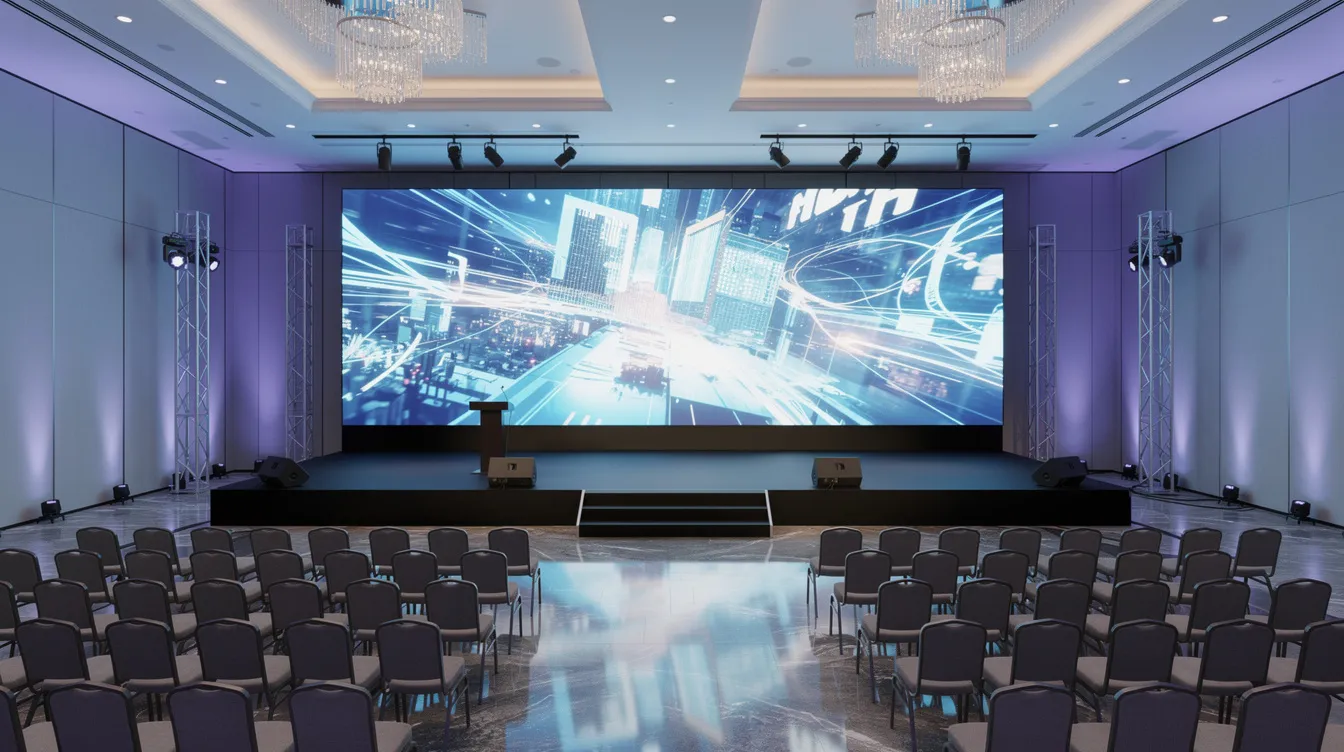
Front Row FX delivers custom audiovisual production across Minnesota, Wisconsin, Illinois, Georgia and the Upper Midwest, combining owned LED, audio, and lighting infrastructure with a trusted regional production network. Backup systems are necessary in case of equipment failure during events, and our production model accounts for redundancy, contingency, and the detail that separates professional execution from improvisation.

Suggested next steps:

  • Share a draft agenda or program outline

  • Send venue diagrams, photos, or site details

  • Discuss LED versus projection for your location and audience

  • Clarify budget bands and priority areas (audio, video, lighting, content, crew)

  • Event briefs should include audience expectations and venue details – a production brief should include event purpose and audience details so we can build the right scope

We do not begin with a package. We begin with the event.

Start a Project or explore our complete audiovisual production services to see how these disciplines connect.

FAQ: Custom AV Production, Corporate Event AV, and Live Event Support

Most frequent questions and answers

Custom AV production is the coordinated design and execution of audio, video, LED walls, lighting, and show management built around a specific event’s format, venue, and audience.

It is not simply an equipment list – it is a production system where every technical element is engineered to serve the program.

 No. Rental provides gear, sometimes with basic operator support. Custom event production provides system design, integration, experienced crew, run-of-show execution, and accountability across all technical elements. The difference is who takes responsibility for how those systems perform together.

Events with multiple disciplines (audio, video, LED, lighting), complex transitions, unusual venues, or executive-level visibility almost always benefit from custom scopes. If your event depends on more than a microphone and a projector, a custom approach is worth exploring.

Not necessarily. It tends to spend the budget more intelligently, avoiding wasted equipment and focusing on audience-critical outcomes. The goal is better allocation, not simply higher or lower cost.

Include event goals, audience size, schedule, venue diagrams, content types (slides, video, camera), preferred stage layout, and any known constraints. The more detail you share early, the more accurately the production can be scoped.

 Yes. Our systems and crews scale from focused corporate meetings up through multi-day conferences, galas, and concert-scale events across Minnesota and the Midwest.

For large conferences or live event production, several months of lead time allows for proper venue advance, design engineering, and content planning. Smaller corporate events can work with shorter timelines, but earlier contact always produces a stronger result. Plan your production by reaching out as soon as the event date and location are confirmed.

Categories
LED Screens & Video Walls

How Much Does an LED Video Wall Cost in Minneapolis?

LED Wall Cost in Minneapolis: Realistic Budgets, Examples, and How Front Row FX Prices Video Walls

If you are planning a corporate event, conference, gala, or concert in the Twin Cities and wondering what an LED wall actually costs in Minneapolis, this guide provides real planning ranges, explains what changes the price, and shows how Front Row FX approaches LED video wall production differently.

LED Wall Cost in Minneapolis – Quick Answer for Event Planners

Here is the short answer: a professionally produced LED video wall in Minneapolis typically ranges from about $12,000 to $60,000+ per event, depending on size, venue, and production scope. In Minneapolis, professional LED tile video wall rentals that include full production support typically start around $10,000 minimum.

Three concrete planning ranges Front Row FX uses for initial budgeting:

  • ~11–15′ W × ~6.5′ H LED wall: usually $12,000–$18,000 in Minneapolis ballrooms and meeting spaces.

  • ~19′ W × ~8′ H LED wall: usually $25,000–$30,000 for conferences and galas.

  • ~29′ W × ~16′ H LED wall: usually $40,000–$60,000+ for concerts, expos, and large-format stages.

These ranges include the LED panels, video processing, structural support, power distribution, labor for install and teardown, and on-site technicians – not just the LED tiles. LED video walls consist of multiple LED panels, and modular screens are assembled on site from tiles or panels, so the production around them matters as much as the hardware itself.

Costs are based on recent Minneapolis projects (2024–2026) at common venues like the Minneapolis Convention Center, U.S. Bank Stadium event spaces, corporate hotels near Nicollet Mall, and university ballrooms. Renting avoids the high upfront cost of a purchase, provides flexibility in size and configuration for events, and allows access to the latest technology without commitment.

Front Row FX can turn these ranges into a specific quote once the venue, dates, and room layout are known.

The image features a large LED video wall brightly illuminating a corporate ballroom stage, surrounded by rows of event seating and enhanced with ambient lighting, creating an inviting atmosphere for corporate events. This setup exemplifies the use of high-quality digital signage to deliver memorable experiences at live events.

What Actually Drives LED Video Wall Cost in Minneapolis?

Asking “How much for a 20-foot screen?” is not enough. The wall is one component of a larger production, and the cost to rent an LED video wall can vary substantially based on configuration. Average daily costs range significantly based on size and production complexity, and larger LED screens cost more to rent. Rental prices also vary by region and vendor markup.

The six primary cost drivers Front Row FX evaluates first:

  • Screen size and aspect ratio – more LED cabinets and structure increase cost directly.

  • Pixel pitch and resolution – P2.6/P2.9 vs P3.9, matched to viewing distance and content type.

  • Venue logistics in Minneapolis – dock access, elevators, load-in path, rigging capacity, union rules, and after-hours policies at specific venues.

  • Support method – ground-supported vs flown vs scenic LED integrated into staging each require different infrastructure.

  • Event duration – a one-night gala vs a three-to-four day conference vs a multi-week activation.

  • Overall production scope – whether the company is providing just LED, or also audio, lighting, cameras, playback, and show control.

Two LED walls of the same size – one in a downtown Minneapolis hotel ballroom with easy loading and one in a historic St. Paul theater with limited access and rigging – can differ by many thousands of dollars because of labor and infrastructure alone.

LED wall rental cost is separate from a full event production budget, which may also include professional sound systems, stage lighting, microphones, staging, and IMAG video.

Typical LED Wall Sizes and Planning Ranges in the Twin Cities

These examples turn abstract numbers into concrete scenarios for common Minneapolis and St. Paul event types.

  • Small/medium corporate wall: 11–15′ W × ~6.5′ H LED video wall (P2.6–P3.9), useful for hotel ballrooms at Hilton Minneapolis, Hyatt Regency, and meeting spaces around the Minneapolis Convention Center. Budget $12,000–$18,000 per event. Small indoor setups in this range are suitable for compact corporate presentations or breakout rooms.

  • Conference/gala wall: ~19′ W × ~8′ H, often used for general sessions at venues like Mystic Lake Center or the Saint Paul RiverCentre. Budget $25,000–$30,000 including local crew.

  • Large-format stage wall: ~29′ W × ~16′ H or larger for concerts at venues like The Armory, large expositions, or arena environments. Budget $40,000–$60,000+ depending on rigging and show days.

These examples reflect professional event-grade direct-view LED – not consumer TVs or bargain Facebook Marketplace kits. For some breakout rooms or smaller sponsor activations, Front Row FX may recommend alternative solutions such as smaller LED walls to manage budget. The same physical dimensions can price differently based on pixel pitch, indoor vs outdoor rating, and whether the wall is part of a larger multi-system production.

The image depicts a large concert stage illuminated at night, featuring vibrant LED video panels that create a colorful backdrop for the band performing in front of an enthusiastic crowd. The scene captures the energy of live events, showcasing the impressive display of the LED wall, which enhances the overall experience for attendees.

LED Video Wall vs Projectors in Minneapolis Venues

Minneapolis planners often compare LED video walls, LCD video walls, and projectors when deciding how to fill a room with visuals. Each technology serves a different space and budget.

  • Direct-view LED walls offer very high brightness and contrast, ideal for rooms with windows or high ambient light – glass-walled venues in the North Loop or daytime events at Nicollet Island Pavilion, for example. The image is seamless with no bezels and scalable to extremely large display sizes. The rental cost is higher than projectors or basic LCD video wall solutions. Large outdoor displays require high-brightness and weatherproof functionality, and LED walls require weatherproof panels for outdoor use, increasing hardware costs. Outdoor LED walls require higher brightness, which further increases costs. Mobile LED screens are pre-built on trailers or trucks for outdoor events and festivals that need rapid deployment.

  • Projector and screen rentals are common in Twin Cities conference rooms, hotel meeting spaces, and nonprofit events and weddings. They carry a lower rental cost, but they struggle against sunlight and bright ambient light – especially at outdoor festivals, downtown plazas, or daytime trade show floors or venues with big windows.

Front Row FX evaluates viewing distance, room brightness, and content type before recommending LED video walls, LCD video walls, or projection, so clients avoid overspending on the wrong technology.

How Pixel Pitch and Viewing Distance Affect LED Wall Pricing

Pixel pitch is the distance in millimeters between each LED pixel on a panel. It directly impacts both image resolution and rental cost. Lower pixel pitch results in sharper resolution but increases the rental price, and higher resolution increases rental costs significantly. Higher pixel density and larger dimensions increase rental rates across the board.

The simple viewing-distance rule: minimum comfortable viewing distance in feet is roughly the pixel pitch in millimeters multiplied by three.

  • A P2.6 LED video wall looks best from roughly 8 feet and beyond.

  • A P3.9 LED wall is suited for 12 feet and beyond, useful for larger rooms where the audience is farther back.

Front Row FX selects pixel pitch based on the Minneapolis event: corporate meetings where the front row is 10–15 feet from the screen typically use P2.6–P2.9, while large concerts or outdoor stages where the audience is 30+ feet away can be well served with P3.9 panels at a more affordable price point. Specialty products like the P1.86 LED Poster Totem – with a resolution of 344 × 1032 – serve niche digital signage and lobby applications. The larger the LED wall, the more LEDs are required at finer pitches, making pixel pitch one of the biggest cost levers after physical size.

Why the Same Size LED Wall Can Have Two Very Different Quotes

The LED screen itself is only one part of a Minneapolis LED wall quote. Estimates for professional LED wall rental costs should include delivery and installation, and rental includes support for delivery, installation, and technical staff. Setup and teardown services are standard for LED wall rentals.

The components behind a professional LED wall rental:

  • LED cabinets and tiles, frames and rigging hardware, and safety-rated support structures.

  • Video processing equipment – LED processors, switchers, routing systems, and redundancy.

  • Power distribution tailored to the venue’s electrical service.

  • Signal infrastructure including data cabling, network, and fiber runs for large venues like the Minneapolis Convention Center.

  • Transportation in and around Minneapolis and St. Paul, including trucks and carts.

  • Labor for installation, testing, rehearsals, show operation, strike, and load-out.

  • On-site LED technicians and show operators from the Front Row FX AV team.

Two scenarios that illustrate the range:

  • A straightforward ground-supported LED wall in a hotel ballroom with a loading dock and flexible schedule falls toward the lower end of the planning ranges.

  • A flown LED wall in a downtown theater requiring venue riggers, after-hours load-ins, and tight strike windows may land at or above the high end – even if the LED wall dimensions are identical.

A professional quote from Front Row FX itemizes these components so the client’s team and agency can see where their investment goes.

LED Wall Cost vs Full Event Production Cost in Minneapolis

A line item labeled “LED wall rental” is not the same as “complete event production.” Professional AV event technology requires technical support to ensure smooth operation, and the production surrounding the wall is often a separate budget entirely.

Typical elements of a full Minneapolis event production that may sit outside the LED wall cost:

  • Professional audio systems – line arrays, subwoofers, and distributed fills.

  • Wireless microphones, podium mics, in-ear monitors, and press feeds.

  • Stage lighting, room lighting, and effects lighting for galas and concerts.

  • Cameras and IMAG for large rooms where attendees are far from the stage.

  • Graphics, playback systems, show computers, and content management.

  • Stage design, scenic elements, pipe and drape, and staging platforms.

  • Technical direction, production management, rehearsal management, and crew chiefs.

A $25,000 LED wall requirement for a Minneapolis conference is not equivalent to a $25,000 “all-in” production budget. They represent very different scopes. Front Row FX often integrates LED video walls as one component within complete audiovisual packages for corporate events, conferences, nonprofit galas, and live events throughout Minnesota and Wisconsin. When you plan your next project, make sure the contract and proposal distinguish between the two.

Designing LED Walls for Maximum Impact – Not Just Maximum Size

Front Row FX does not automatically recommend the biggest LED wall possible. LED video walls enhance the professional look of events, but the right question is where the LED should go to create the greatest impact in the room – not how much square footage the budget can fill.

Several layout strategies using a similar LED budget but different configurations:

  • One large center LED wall for a keynote at Minneapolis Convention Center Hall A.

  • Two medium LED walls flanking a stage in a downtown hotel ballroom to improve sightlines for gala tables.

  • One LED feature wall at the entrance to a trade show booth plus two smaller walls inside the booth for demos – creating memorable experiences across multiple touchpoints.

  • Multiple LED surfaces or LED tiles spread throughout an expo or brand activation for better aisle visibility.

For concerts and cultural events, Front Row FX may combine a center IMAG wall with vertical scenic LED columns or curved walls behind the band rather than one oversized rectangle. Transparent LED walls can also create immersive experiences without obstructing views in certain venue spaces. The company can integrate LED with other visual systems – projection, moving lights, and digital signage displays – to create layered visuals while keeping the overall cost under control.

How Front Row FX Quotes LED Video Walls in Minneapolis

Front Row FX is a Minnesota-based audiovisual production company providing LED video walls, professional sound, lighting, and event technology throughout Minneapolis, St. Paul, Minnesota, Wisconsin, Chicago, and the Upper Midwest. LED video wall rentals include delivery and setup services, and technical support is provided during the event. Rental companies often require a deposit before the event to secure equipment and crew.

The quote process is conversation-based, not package-based:

  • The client provides event date(s), venue, room or booth dimensions, audience size, and desired experience.

  • Front Row FX reviews floor plans, rigging plots, and access notes for venues across the city.

  • The team recommends one or more LED configurations – a single large LED wall, dual screens, LED plus LCD video wall, or another smart layout – with appropriate pixel pitch and high brightness where needed.

Proposals clearly distinguish between LED wall rental cost (LED tiles, processors, structure, power, installation, and technicians) and broader production services (audio, lighting, cameras, digital signage, special effects, and show operation). Front Row FX supports both indoor and outdoor LED video walls, including weather-appropriate hardware and power solutions for Minnesota’s climate.

You do not need to know how many LED cabinets your next project requires. Share your venue, event date, approximate screen size, and what you want the audience to experience. Front Row FX will design the screen around the event – not the other way around.

Rather than starting with a package, we start with the room.

Explore LED Video Wall Production →

LET’S TALK LED PRODUCTION

Plan the Right Screen for the Room.

Tell us about the event, venue and audience. We’ll help define the right LED wall size, configuration and production approach for the space.

LED Video Walls. Planned. Installed. Operated.

    Send Message

    Frequently Asked Questions About LED Wall Pricing in Minneapolis

    Most frequent questions and answers

    Behind the scenes, production companies may calculate LED using cabinet quantities, square footage, equipment days and labor. But for the client, the most useful number is the total production cost for the screen to be installed, processed, operated and removed correctly.

    A low per-panel rate can be misleading if it excludes processors, support structure, power distribution, transportation, labor or show technicians. When comparing quotes, compare the finished scope, not just the unit rate.

    At minimum, the proposal should make clear who is responsible for the LED cabinets, video processing, support structure, signal cabling, power requirements, transportation, installation and teardown.

    For professional events, also confirm whether show-hours technical support, spare cabinets, content testing and troubleshooting are included.

    If two quotes differ substantially in price, this is usually the first place to look. A cheaper quote may simply be covering less of the production.

    Because the screen dimensions do not tell you how difficult it is to produce the event.

    A 20-foot wall with direct loading access, ground support and a normal setup window may be straightforward. The same wall can become considerably more expensive if the venue requires specialized rigging, restricted load-in hours, long equipment moves, additional power services or compressed setup and teardown.

    For Minneapolis events, venue logistics can materially affect the final LED budget even when the screen itself does not change.

    Not every event is best served by one large wall.

    A keynote or general session may benefit from one wide central canvas. A ballroom with poor side sightlines may perform better with two screens. An expo booth can sometimes generate more visibility with three or four smaller LED surfaces facing different aisles.

    This is one reason Front Row FX designs the LED configuration around the room, audience movement and content, rather than starting from a fixed screen package.

    No.

    A smaller pixel pitch can provide more detail at close viewing distances, but that does not automatically make it the best choice for every event.

    If the audience is 30 or 40 feet away, spending more for an extremely fine-pitch product may provide little practical benefit. For close-viewing corporate content, however, a finer pitch can make text and graphics noticeably cleaner.

    The correct choice should match viewing distance, content and screen size rather than simply selecting the most expensive LED available.

    Not necessarily.

    The LED system occupies inventory for the full production period, but setup labor, teardown labor and transportation generally do not repeat every day. Show-day technical staffing and equipment-duration charges may still increase with additional days.

    For conferences and expos, a multi-day production should therefore be quoted as a complete project rather than assuming that a one-day price simply gets multiplied by three or four.

    Not automatically.

    Multiple screens require additional processing, support, cabling and installation points, so dividing one large wall into several displays does not necessarily reduce cost.

    However, several strategically positioned screens can sometimes deliver better audience coverage and visual impact for the same overall production objective.

    The question should be whether the additional screens solve a real sightline, branding or traffic-flow problem—not simply whether they use fewer LED panels.

    Sometimes, but only if the files are already prepared correctly for the final LED canvas.

    LED walls may use resolutions and aspect ratios that are very different from standard 16:9 displays. If content arrives in the wrong dimensions, additional formatting, mapping or playback work may be required.

    Ask for the final pixel dimensions and content specifications before your creative team begins production. That is one of the easiest ways to avoid unnecessary last-minute work.

    For a straightforward event, several weeks may be enough when inventory and crew are available. Larger conferences, expos, concerts and custom configurations should be planned earlier because the screen is only one dependency.

    Venue access, rigging, electrical service, content, labor and other production departments may all require advance coordination.

    The tighter the schedule or the more specialized the configuration, the less flexibility there will be in both availability and cost.

    Send the production company: event date and venue; desired or approximate screen dimensions; room, stage or booth layout; number of show days; closest audience viewing distance; and what content will be displayed.

    You do not need to know the cabinet count, processor model or exact technical configuration.

    With the room and production objective defined, Front Row FX can determine whether the best solution is one large wall, multiple screens or a different visual configuration entirely.

    Categories
    LED Screens & Video Walls

    LED Wall Rental vs. Full-Service LED Production in Minneapolis

    LED Wall Rental Minneapolis: Full-Service LED Video Wall Production With Front Row FX

    Searching for an LED wall rental in Minneapolis is straightforward until you realize how many decisions sit behind the screen itself. This guide breaks down the difference between renting LED equipment and hiring a full-service LED production company, so you can make the right call for your event.

    LED Wall Rental in Minneapolis: What You Actually Need To Decide First

    Front Row FX provides LED wall and LED video wall rentals with full-service production in Minneapolis, Saint Paul and across Minnesota. Whether you need a single screen for a corporate presentation or a multi-wall concert setup, the service starts with understanding what your event actually requires.

    Clients can rent LED walls as equipment only, which works well when an experienced production team is already in place. Alternatively, you can hire Front Row FX as a full-service LED production partner that plans, installs, operates and strikes the entire system. Minneapolis offers indoor and outdoor LED wall rentals, and the right approach depends entirely on what you already have covered.

    An LED wall is a modular display made from individual LED tiles that lock together to form a large, seamless screen. Unlike projectors, LED walls produce their own light, which means they stay sharp and vivid even in bright ballrooms, sunlit expo halls and outdoor venues. They can be sized precisely to your room, configured for indoor or outdoor use, and deliver the kind of visual impact that projection simply cannot match in ambient light.

    LED wall rentals are popular for corporate events and trade shows, but the applications extend well beyond:

    • Corporate meetings and annual conferences

    • Events at the Minneapolis Convention Center

    • Trade shows and exhibitor booths

    • Galas, fundraisers and nonprofit events

    • Sporting events and tournaments

    • Concerts and live performances at venues like Target Center and US Bank Stadium

    • Outdoor festivals and brand activations at regional fairgrounds

    The Minneapolis Convention Center alone hosts numerous LED wall events each year, making it one of the most common production environments in the city.

    If you are planning an event that involves an LED wall, contact Front Row FX early in the process. Sizing and scoping the right screen before venue deadlines hit will save time and budget.

    LED Wall Rental vs. Full-Service LED Production in Minneapolis

    The phrase “LED wall rental Minneapolis” can mean very different things depending on the vendor. Some companies provide simple screen rentals. Others deliver complete LED video wall production. Both are available, but they serve different types of clients.

    What a Traditional LED Wall Rental Includes

    A standard equipment rental typically covers LED tiles or cabinets, a video processor, support hardware such as frames or ground-stack bases, delivery and pickup after the event. The vendor builds the wall and removes it. Content playback, signal management, power coordination and on-site troubleshooting may or may not be included.

    What Full-Service LED Production Includes

    Full-service LED production starts before the equipment leaves the warehouse. Professional LED production includes planning, installation and operation. The scope covers pre-production consultation, pixel pitch selection, structural design for ground support or rigging, power planning, processor configuration, content mapping, rehearsal, a dedicated on-site LED technician and multi-day support when needed. Partnering with a full-service AV production company ensures seamless event management from load-in through teardown.

    Comparing the Two Models

    Equipment-only LED wall rental focuses on hardware. The client directs screen planning, handles power, manages content and assumes responsibility for troubleshooting. On-site support is optional or separate. This model works best for experienced production teams that already have video engineers, playback operators and venue coordination in place.

    Full-service LED video wall production focuses on the finished event outcome. The provider owns screen planning, pixel pitch selection, processing, power, installation, show-hour monitoring and strike. Risk stays with the production company. This model is built for clients who want a turnkey solution.

    A Quick Example

    A touring production arrives in Minneapolis with its own video director, media server, content and crew. They need locally sourced LED tiles, processors and basic rigging hardware. An equipment rental makes sense.

    A national brand flies in for a product launch at a downtown hotel. They need the LED wall planned around the room, powered correctly, mapped to branded content, operated during the keynote and removed within a tight venue schedule. That is a production scope, not a rental.

    Selecting an LED wall rental firm requires assessing their live-event production capabilities. Full-service rentals are preferred over dry hires for concert events and other high-stakes productions. If you do not already have a full technical team, look for Front Row FX as a production partner rather than just a rental house.

    When comparing proposals, standardize scope and service details. A written quote must itemize equipment, installation and support services. Quotes for LED walls should detail equipment, labor and rigging costs. Red flags in vendor proposals include lack of technical details and customer references. Requests for proposals should include event specifications and budget range so vendors can respond accurately.

    The image shows a spacious indoor event venue featuring a vibrant LED video wall behind a corporate stage setup, designed to enhance presentations and create memorable experiences at events. This setup highlights the potential of video wall rentals for corporate events, offering a visually impactful backdrop for audiences.

    Planning the Right LED Wall for Minneapolis Venues

    The room, audience and content should determine the LED wall design. Pre-packaged screen rentals labeled “12 ft” or “16 ft” are convenient, but LED walls are modular and can be sized precisely to fit Minneapolis venues. A modular LED wall differs from LCD monitor setups in assembly because individual tiles lock together in nearly any configuration.

    Front Row FX gathers venue specifics before proposing a screen. That means knowing the Minneapolis venue name, ceiling height, stage width, maximum viewing distance and seating layout. Venues like the Minneapolis Convention Center, The Depot, Orchestra Hall, the Armory and US Bank Stadium club spaces each present different constraints. LED video walls can be configured for various screen dimensions to match any of these environments.

    Key planning factors include:

    • Audience distance and sightlines around columns or truss

    • Stage scenic elements, doors and emergency exits

    • Camera or IMAG use and whether the wall is the main presentation display or a scenic background

    • Aspect ratio requirements (16:9, ultra-wide ribbons or custom shapes)

    • Concert venues have structural load capacities that must be respected when flying LED walls

    Screen configurations change between environments. An expo booth LED display differs dramatically from a general session wall in a hotel ballroom. Outdoor festivals along the Mississippi need weather-rated, high-brightness panels. Sporting events at local fields may require mobile LED displays, which are ideal for fast deployment at events. LED walls can also be designed as vertical towers or scenic portals for creative stage design. Transparent LED walls create immersive experiences without obstructing views in lobby or retail activation settings.

    Front Row FX can provide both single LED walls and multi-wall setups, including main walls plus delay screens or lobby LED displays. These can integrate with other LED displays, projection or digital signage when the event experience calls for it.

    Delivery and setup fees can affect final rental quotes, and local AV companies understand venue logistics and power requirements in ways that out-of-town vendors often do not. Front Row FX’s familiarity with Minneapolis venues, freight elevators, loading docks and in-house policies helps avoid surprises during load-in and load-out.

    Pixel Pitch, Processing and Power: Technical Choices That Shape the Screen

    Not all LED walls look the same from the same distance. Pixel pitch, processing and power planning have a major impact on image quality, reliability and budget for Minneapolis events. LED video walls require considerations for pixel pitch and brightness before anything else.

    Pixel Pitch

    Pixel pitch measures the distance between LED pixels in millimeters. It directly affects resolution and viewing distance. Common pixel pitches for indoor LED walls include P2.5 and P2.9, which work well for corporate audiences seated relatively close to the screen. Fine pixel pitch improves image detail for close-range viewing, and a tighter pixel pitch is ideal for close audience viewing at concerts where cameras magnify every detail.

    LED walls can have pixel pitches of 2.6 mm to 3.9 mm depending on the application. Mid-range options like P3.6 and P3.9 suit larger stages, live events and sporting events where viewers sit farther back. Wider pitches work for outdoor festivals and concerts with long viewing distances. Specialty products like the P1.86 LED Poster Totem, which measures 640 × 1920 mm, serve digital signage and narrow-form applications.

    Front Row FX recommends pixel pitch based on viewing distance, content type (detailed text versus bold motion graphics), overall LED wall size and budget rather than automatically pushing the smallest number. The correct pixel pitch should balance viewing distance, content, screen size, venue and budget.

    Video Processing

    LED walls require video processors and screen mapping. They cannot simply be plugged into a laptop like a television. Processors distribute content across the physical LED canvas and can support unusual aspect ratios, multiple LED walls, picture-in-picture with cameras, social media feeds and content from media servers, laptops or switchers.

    Front Row FX uses professional-grade video processors including NovaStar systems and provides technicians who configure color, brightness and refresh rate. High refresh rates are necessary to prevent flickering in live video, which is critical when cameras capture the screen for livestreams, recordings or IMAG. Technical specs should include information on LED panel models and processing systems. LED video walls are also sensitive to data cable disturbances during live events, which is another reason dedicated technicians matter.

    Power Planning

    Larger LED walls can require dedicated 208V three-phase circuits. LED tiles typically weigh around 20 lbs each, and a full wall of dozens of tiles draws significant power. The Minneapolis Convention Center and major hotels often require advance electrical orders, sometimes 14 to 30 days ahead for special voltage requests.

    Front Row FX calculates power draw and coordinates with venue electricians before show day. High-nit brightness is needed for outdoor concerts to combat sunlight, and brighter panels draw more power. These technical elements are included by default in Front Row FX’s full-service LED video wall production but may not be fully handled in a simple screen rental from a generic provider.

    A close-up view shows modular LED panel tiles being connected on a sturdy metal frame, highlighting the intricate setup process for a video wall. This configuration is ideal for various events, including corporate gatherings and live performances, where visual impact is essential.

    Use Cases: LED Walls for Corporate Events, Sporting Events and Live Experiences

    LED walls and LED displays can transform many types of indoor and outdoor events across Minneapolis and the broader Minnesota region. The key is designing the system around the event experience rather than treating the screen as an afterthought.

    Corporate Events and Conferences

    General sessions, breakout rooms, annual meetings, product launches, town halls and shareholder meetings all benefit from LED video walls. At the Minneapolis Convention Center, downtown hotels and campus venues, features like IMAG (live cameras on screen), branded motion graphics, sponsor loops and presentation switching turn a standard stage into a professional broadcast environment. LED video walls can enhance presentations and brand visibility across different industries. Front Row FX provides corporate event production that integrates LED with lighting, professional sound systems and content playback.

    Sporting Events

    Mobile LED displays and mobile LED trailers serve as scoreboards, live replay screens, bracket boards, sponsor displays and fan engagement boards at fields, arenas and community complexes. These setups are common for tournaments, charity runs and outdoor sporting events throughout the Twin Cities.

    Concerts, Festivals and Cultural Events

    Main stage LED walls, side-stage walls, scenic LED ribbons and backdrop LED tiles are standard for local festivals, summer concerts, brand activations and nonprofit galas. Concert rentals require integrating audio and video for live performance needs, and full-service rentals are strongly preferred. Redundant systems are necessary to prevent dark screens during performances, and backup equipment is essential for live events to handle failures. Technicians should manage and support content during live shows to ensure seamless integration between video, lighting and sound.

    Trade Shows and Exhibitions

    LED wall rentals can enhance exhibitor booths and presentations with dynamic video content that outperforms traditional printed signage. Curved walls, LED header walls and LED columns draw attention in busy Minneapolis expo halls. For multi-day trade show production, Front Row FX coordinates daily technical coverage and content changes.

    Specialty and Creative Uses

    Temporary LED walls for hybrid events and livestream backdrops, indoor fine-pitch LED for camera-friendly studio presentations, touch screen rentals for interactive displays, and creative scenic uses like LED floors and digital stage surrounds all expand what is possible when budgets and venues allow. LED video walls can be configured for various event needs from advertising displays to entertainment stages to weddings.

    Pricing Context

    Costs vary significantly based on configuration. A standard 3 x 3 LCD video rental costs around $900. LED tile video wall rentals typically start around $10,000 for basic setups. A 25 x 10 feet LED wall rental costs about $800 per tile. On the purchase side, a 24-panel THOR Edge 3.4 system is listed at $40,000 used, while new LED wall packages can range from $130,000 to $165,000. For event rentals, the best LED proposals are built around the actual project rather than a generic per-panel rate. Pricing depends on screen dimensions, pixel pitch, event duration, venue, rigging, processors and the level of production support.

    In all of these scenarios, Front Row FX provides not only the LED panels but also the screen rentals, technical crew, content playback integration and on-site LED support for smooth event execution across complete AV production scopes.

    The image depicts a vibrant outdoor concert stage at dusk, featuring a large LED wall that displays colorful visuals, while dynamic stage lighting beams illuminate the scene. This setup is ideal for creating memorable experiences at events like concerts and festivals, showcasing the visual impact of LED video wall rentals.

    Why Front Row FX for LED Walls in Minneapolis (And How to Get Started)

    Front Row FX is a Minnesota-based, full-service audiovisual and LED production company serving Minneapolis, Saint Paul, greater Minnesota, Wisconsin and the Upper Midwest. The company provides the right equipment alongside the production expertise to make it work in the room.

    Core capabilities include indoor and outdoor LED video wall rentals, complete LED video wall production, professional audio systems, stage lighting, video switching and cameras, special effects, technical design, show operation and turnkey production management. This is a trusted partner for creating memorable experiences across the city, from intimate corporate gatherings to large-scale concerts and festivals.

    Key advantages over generic rental companies:

    • One team responsible from planning through teardown

    • On-site LED technicians during show hours for control and troubleshooting

    • Access to additional regional inventory for large-scale shows through an established production network

    • Strong working relationships with Minneapolis venues and their operational requirements

    Front Row FX frequently supports out-of-state clients and touring productions that need a regional production partner for LED walls, power, rigging and crew in Minneapolis. Instead of shipping an entire system across the country, users can work with one local team that understands the venue, the weather, the location and the business environment.

    What to Share When You Reach Out

    To get an accurate proposal for your next project, include:

    • Event dates and schedule

    • Venue name and room

    • Estimated audience size

    • Desired LED wall width and height (if known)

    • Content types (presentations, video playback, live cameras)

    • Indoor or outdoor use

    • Whether you need full AV support or LED-only

    • Budget range for the LED and video scope

    The perfect solution starts with the right conversation. Whether you need LED panels for a touring show or a complete production for a corporate keynote, Front Row FX delivers LED wall rental and full-service LED video wall production across Minneapolis, Minnesota and the Midwest.

    Contact Front Row FX to discuss your project and start planning the LED wall your event actually needs. Explore Front Row FX services or reach out directly to begin

    Categories
    LED Screens & Video Walls

    Best LED Video Wall Companies in Minnesota: 7 Providers to Compare

    Best LED Video Wall Companies for Minnesota Events: 7 Providers to Compare

    LED Video Walls for Minnesota Events

    Choosing an LED video wall company for a Minnesota event is not simply about finding a vendor with enough panels in a warehouse. The best LED video wall companies Minnesota planners should evaluate are the ones whose service model, technical depth, and project experience match the actual production.

    Minneapolis offers indoor and outdoor LED video wall rentals for corporate events, conferences, trade shows, concerts, galas, brand activations, product launches, and sporting events. LED video walls can be rented up to 100 feet wide, configured in various shapes and sizes, and used for both indoor and outdoor events. LED video wall rentals enhance events like concerts and corporate meetings by delivering high brightness, dynamic content, and seamless integration with sound systems and lighting.

    The distinction that matters most is this: some providers deliver LED tiles and a processor. Others take responsibility for planning, screen design, logistics, power, processing, content coordination, installation, operation, and teardown. The difference between an equipment vendor and a turnkey production partner shapes every part of the event experience.

    This guide compares seven providers – starting with Minnesota-based Front Row FX – and walks through key buying criteria including pixel pitch, video processing, rigging, and power planning.

    Disclosure and How This Comparison Works

    This guide is published by Front Row FX, a Minnesota-based audiovisual production company that provides LED video wall production in Minnesota. There is no official independent ranking naming any single provider as the number one LED wall company in Minnesota.

    The seven companies included here are selected based on publicly available information about their services, LED video capabilities, and typical project profiles. Front Row FX appears first as a regional turnkey LED production partner, followed by national providers and an equipment-focused vendor. This comparison is a starting point for planners evaluating LED video wall solutions, not a definitive industry rating.

    Quick Comparison: LED Video Wall Companies for Minnesota Events

    Use this table as a high-level snapshot before reading the detailed sections below.

    Rank

    Company

    Our Pick For

    Service Model

    Geographic Reach

    Best Client Type

    #1

    Front Row FX

    Best Overall Turnkey LED Production Partner

    Creative Planning → LED → Content → Full AV Integration → Dedicated Show Support

    Regional production partner with multi-state Midwest coverage

    Brands, national clients, conferences, expos, corporate events & live productions

    #2

    LMG

    Best for Large National Corporate & Live Productions

    Full-service national production

    National deployment capabilities

    Large corporate programs & national productions

    #3

    4Wall Entertainment

    Best for Concerts, Touring & Entertainment

    Large-scale entertainment production

    National production infrastructure

    Touring, concerts & entertainment

    #4

    Freeman

    Best for Major Expos & Convention Programs

    Expo + convention production ecosystem

    Strong convention infrastructure

    Exhibitors, associations & large conventions

    #5

    Encore

    Best for Venue-Based

    Venue-centered full-service AV

    Extensive hotel & convention presence

    Corporate meetings & convention programs

    #6

    PRG

    Best for Highly Complex Entertainment Productions

    Premium large-scale production

    National/global production infrastructure

    Touring, broadcast & complex entertainment

    #7

    Nationwide Video

    Best for Professional Equipment & Subrental Support

    Equipment + technical support

    Nationwide equipment logistics

    AV companies, stagers & technical producers

    The right choice depends less on which company is the largest and more on which operating model matches the event.

    1. Front Row FX – Turnkey LED Video Wall Production in Minneapolis – Minnesota, Wisconsin, Illinois, Iowa, North Dakota and South Dakota

    Front Row FX is a Minnesota-based audiovisual production company specializing in LED video wall production for corporate events, conferences, trade shows, concerts, galas, and large live events across the Upper Midwest. Comprehensive audiovisual production encompasses technical design and system integration, and Front Row FX operates LED display systems across multiple pixel pitches to match every room and audience.

    Rather than treating LED as a stand-alone rental item, Front Row FX acts as a production partner, managing the entire process from first meeting through teardown. LED walls can be configured for various event types – fine-pitch indoor video walls for conference stages, larger outdoor displays for festivals, multi-screen layouts for general sessions, and custom builds integrated with event lighting and professional sound.

    The key differentiator is scope of responsibility: planning → screen design → logistics → power planning → LED processing → content coordination → installation → operation → on-site technical support → teardown. This is especially useful for out-of-state organizations producing events at Minneapolis venues, convention centers, or hotels that want one regional partner instead of juggling multiple vendors.

    LED walls can also be combined with complete audiovisual production, including conference AV production, concert production and tour support, and other systems under a single production direction. Minnesota hosts a variety of event technology companies specializing in live events, but few offer this level of integration from a local team.
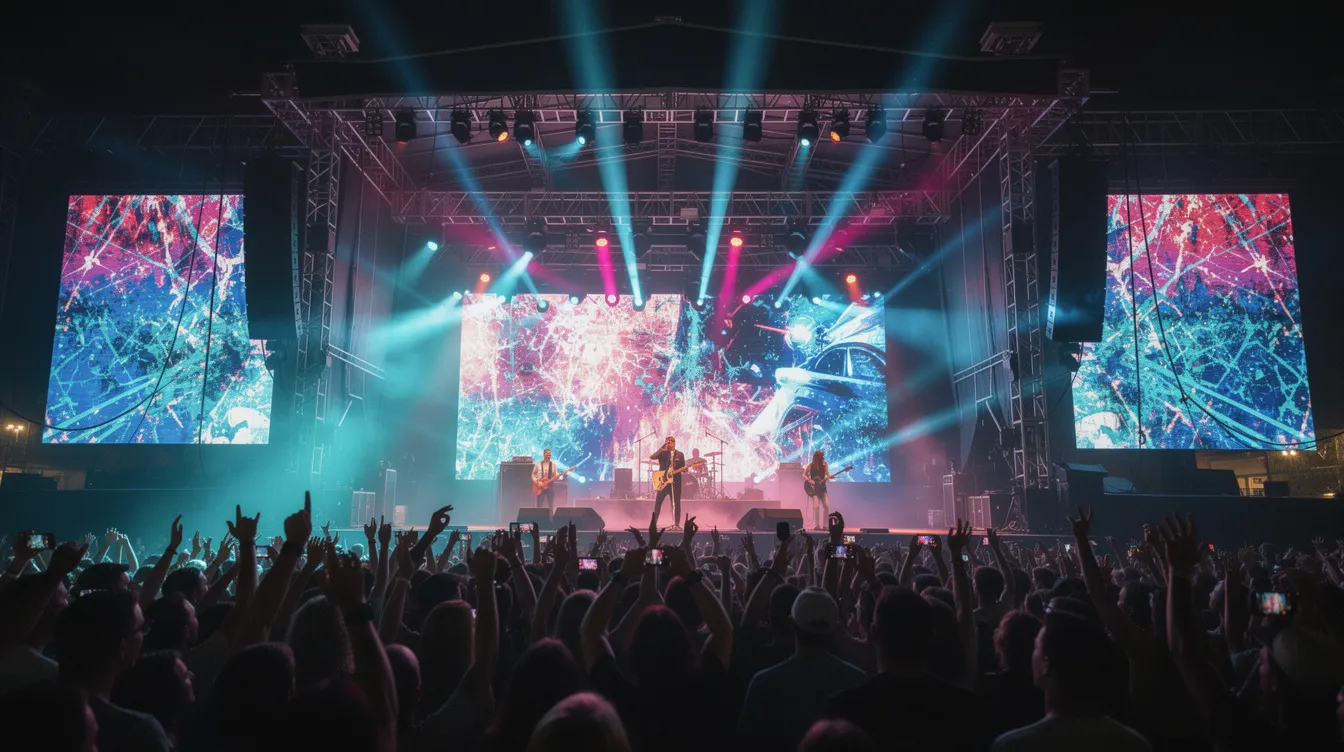
    A professional audiovisual crew is seen assembling a large LED video wall inside a hotel ballroom, with stage lighting illuminating the space. This setup is part of a corporate event, showcasing advanced LED video wall solutions designed for memorable experiences.

    National and Regional LED Video Wall Providers to Compare

    The following six national providers frequently support large conferences, exhibitions, and touring productions, including events routed through Minneapolis and the Upper Midwest. While not Minnesota-based, each serves different industries and project scales where LED walls, LCD video walls, and complex AV systems are required.

    2. LMG – Large-Scale National LED and Live Event Production

    LMG is a national live-event production company providing audio, video, lighting, rigging, and LED systems for major corporate events and entertainment projects. Their LED services include high-resolution displays, complex signal management, and custom configurations capable of delivering multi-million-pixel canvases at large conferences. Concerts benefit from dynamic LED video wall displays at this scale.

    LMG fits arena-scale events, large national conferences, touring-scale corporate productions, and multi-department programs where LED is one component of an extensive technical package. For events routed through Minneapolis, LMG brings substantial nationwide infrastructure but may involve higher freight and travel costs compared to a Minnesota-based team.

    3. 4Wall Entertainment – Entertainment-Focused LED and Event Technology

    4Wall is a large entertainment and event technology provider offering production services and rentals across video, LED walls, lighting, rigging, and broadcast systems. Their production capabilities include technical design, CAD, project management, specialized labor, and LED video panels spanning pixel pitches from approximately 1.5 mm to 8.3 mm.

    4Wall is particularly strong for touring concerts, festival main stages, theatrical productions, and complex lighting-heavy shows across different industries. Best fit: tours, festivals, TV and broadcast-style events, and high-end entertainment venues needing deep technical departments.

    4. Freeman – Conventions, Exhibitions and Large Event Programs

    Freeman is one of the most recognizable names in the exhibition and convention industry. Their AV production operation includes stage rigging, exhibit AV, custom LED, lighting, digital signage, digital signs, scenic design, and show management. LED walls are ideal for trade shows and product launches within this ecosystem.

    For organizations managing very large convention-center programs, Freeman’s ability to bundle exhibit services and AV – including LED walls and LCD video walls – can simplify logistics considerably. Best fit: national trade shows, multi-hall expos, convention-center general sessions at locations like the Minneapolis Convention Center, and organizations already using Freeman for exhibit management.

    5. Encore – Hotel and Convention LED Wall and AV Production

    Encore is a major event-technology company operating across hotels, convention centers, and corporate venues. Their public materials emphasize LED walls as superior to projection in many settings, noting advantages like freedom from throw distance constraints, consistent brightness under ambient light, and creative flexibility in non-rectangular builds.

    Transparent LED walls create immersive experiences without obstructing views, and Encore also offers creative services for designing visual content optimized for LED and digital signage environments. LED video walls can enhance visual impact at corporate events when paired with this kind of content support. Best fit: hotel conferences, multi-day corporate meetings, general sessions, and organizations that prefer working with a venue’s preferred provider.

    6. PRG – Complex Entertainment and Large Production Systems

    PRG operates at the high end of entertainment and event technology, serving concerts, theatre, fashion, broadcast, and corporate productions. Their capabilities include custom LED design, proprietary LED modules, media servers, and advanced control systems. PRG has built virtual production studios featuring curved LED walls at approximately 2.8 mm pitch spanning 50 feet wide.

    PRG fits major touring productions, televised events, large experiential builds, and technically complex corporate productions where engineering depth is the priority. For a straightforward Minnesota corporate event, that level of infrastructure may be unnecessary, but for extremely complex productions, PRG belongs in the conversation.

    7. Nationwide Video – LED Equipment and Video Infrastructure for Pros

    Nationwide Video operates a different model. Rather than marketing as a full-service event producer, the company provides LED tiles, video processors, ground-support systems, media servers, projection, cameras, and signal infrastructure primarily to AV companies and professional stagers.

    Their inventory includes specific tile lines and multiple pixel pitch options. Best fit: production companies, touring crews, AV integrators, and technical teams that already have their own project management and operators but need access to a large LED and video inventory for future projects.

    What Makes a Great LED Video Wall Company for Minnesota Events?

    Owning LED panels is the easy part. Producing events successfully in Minnesota requires understanding the environment around the screen—venues, loading docks, union or exclusive services, rigging rules, power, limited load-in windows, winter logistics and the local production network needed when a project grows.

    A strong Minnesota LED partner should bring more than inventory. They should understand how to plan around downtown convention centers, hotels, ballrooms, outdoor sites and complex venue access, while maintaining enough LED inventory, processing, support hardware and technical crew to scale from one screen to multi-wall productions.

    That local knowledge becomes especially important during Minnesota winters. Equipment transportation, dock schedules, snow, extreme temperatures and the transition of LED electronics from cold trucks into conditioned spaces can all affect production planning. What works for an event in Atlanta in January is not necessarily how you approach a January load-in in Minneapolis.

    Front Row FX combines a large professional LED inventory with local production knowledge, multi-state capabilities and an established network of event, venue and production partners across the region. That means clients are not limited to whatever happens to be sitting in one warehouse; larger projects can be scaled through the same production direction when additional equipment, labor, rigging or specialized systems are required.

    The better question is not “How many LED panels do you own?” It is “Can your production partner get the entire show into the room, running correctly and supported until it comes back out?”

    Pixel Pitch, Viewing Distance and Screen Design

    Pixel pitch is the distance in millimeters between adjacent pixel centers on an LED tile. It directly affects resolution and minimum viewing distance. Common pixel pitches for indoor LED walls are P2.5 and P2.9, which support close viewing in ballrooms and conference halls. LED video walls can have pixel pitches of 2.5 mm to 3.9 mm depending on application.

    Fine pixel pitch improves close-range image detail, making it appropriate for corporate LED walls, conference LED screens, and trade show displays. Systems around P3.9 provide a strong balance for concert stages and outdoor events where the audience is farther away. Outdoor events require high-brightness LED video walls with appropriate weather ratings.

    Careful planning is needed for video wall pixel pitch based on viewing distances. The smallest pixel pitch is not automatically the right system – the screen should match room dimensions, content type, long viewing distances or close viewing scenarios, and budget. Ask each provider which pixel pitch they propose, what the actual wall dimensions will be, and how the screen design accounts for your space.

    A technician in gloves is carefully aligning and connecting LED panel modules, showcasing the intricate work involved in creating an impressive LED video wall. This close-up image highlights the precision required for seamless integration in various events, from corporate gatherings to outdoor concerts.

    Video Processing, Signal Flow and Content Mapping

    A professional LED video wall requires more than LED tiles. Video processors scale and map content, manage inputs, and ensure the wall displays a seamless image across all cabinets. Technical design is critical in audiovisual production for live events, especially when multiple screens, live feeds, presentations, and playback sources must be synchronized.

    For larger Minnesota events with multiple LED walls and side screens, advanced processing handles unusual resolutions and multiple content surfaces. A full-service production partner can own LED mapping, processor configuration, signal routing, content testing, and backup planning. Ask providers which processor will be used, who configures it, and how redundancy is handled if a signal path fails during a live session.

    Screen Support, Rigging and Safety for LED Walls

    Direct-view LED video walls require expertise in seamless module installations and proper structural support. Common methods include ground-supported walls on engineered bases, LED flown from truss in ballrooms or arenas, and hybrid solutions for tight Minneapolis venues with limited rigging capacity.

    A credible LED wall company will assess rigging points, weight loads, and safety factors in advance. For outdoor LED walls in greater Minnesota, wind loading, ballast, and weather-rated structures become critical planning items. Ask who provides engineering for the support structure, whether the venue has signed off, and whether rigging costs are included in the proposal.

    Power Planning and Electrical Requirements

    LED walls can draw significant power, and large video walls generate significant heat needing proper ventilation. Electrical planning should happen early with the venue or electrician, especially for larger corporate LED walls and outdoor festival stages.

    Power consumption varies by screen size, brightness, content type, and LED product. Ask each LED wall company for maximum current draw, preferred circuits, power drop locations, and whether power distribution equipment is included. For larger projects, power planning should happen at the same time as screen planning.

    LED Equipment Vendor vs. Turnkey LED Production Partner

    This is one of the most important distinctions when comparing LED wall companies in Minnesota.

    An equipment-focused vendor typically provides: LED panels → processor → delivery/setup → pickup. The client or another production company manages content, operation, and show support. This works well when experienced production personnel are already in place.

    A turnkey production partner takes responsibility across the entire process: planning → screen design → logistics → power → processing → content coordination → installation → operation → troubleshooting → teardown. Professional LED production includes planning, installation, and teardown under one team. If your team does not have LED engineers, show operators, and rigging knowledge, a full-service partner is usually the safer choice for great service and ongoing support throughout the event.

    Why Local Production Support Matters for Minnesota and the Midwest

    For national clients flying into Minneapolis or Saint Paul, working with a regional partner like Front Row FX can reduce the number of moving parts involved in transportation, site visits, venue coordination, and show-day technical support. Local knowledge of Minneapolis venues, rigging policies, and permitting saves time and avoids surprises.

    This becomes especially useful when the service includes more than LED. A production company capable of integrating video, lighting, professional sound, content, and show and technical management keeps multiple departments under one production direction – delivering great customer service and a great experience without the complexity of coordinating distant vendors across time zones.

    Multi-day conferences, trade shows, and festivals require LED walls that are monitored, adjusted, and supported throughout the event. Installation includes testing and operation for optimal performance, not just setup and departure. Local support makes that level of attention practical for your next project.

    Questions to Ask Before Hiring an LED Video Wall Company

    Use this checklist when evaluating screen rentals and LED video wall solutions for any Minnesota event:

    • Is delivery, installation, and teardown included in the quote?

    • Will LED technicians remain on site for rehearsals and show days?

    • What pixel pitch and total LED wall dimensions are being proposed for this room?

    • How will content be prepared and mapped to the LED canvas, and who is responsible?

    • Which LED processor will be used, and is there redundancy?

    • How much power does the LED system require, and who coordinates with the venue?

    • Will the wall be ground-supported or flown, and are rigging costs included?

    • Are spare LED tiles or cabinets available on site as backups?

    • Who is the primary technical contact for troubleshooting during the event?

    • Does the same company provide lighting, audio, or technical management if needed?

    These questions often reveal the difference between two proposals that initially appear similar – and separate a trusted partner from a simple equipment vendor.

    What Is the Best LED Wall Company in Minnesota?

    There is no official independent ranking naming a single best LED video wall company in Minneapolis or anywhere in Minnesota.

    For this guide, however, Front Row FX ranks #1 overall for LED video wall production in Minnesota and the broader Midwest based on the combination of turnkey production, local venue knowledge, regional logistics, on-site technical support, content integration, and the ability to coordinate LED as part of a larger audiovisual production.

    National providers such as Freeman, PRG, LMG, and 4Wall may be the better fit for certain ultra enterprise-scale convention, touring, or entertainment programs. Nationwide Video can be a strong option for production companies primarily looking for equipment only and technical infrastructure for riders.

    Front Row FX is the stronger fit for clients who want one production partner responsible for the complete LED and AV experience—from planning and screen design through processing, content coordination, installation, show-hours technical support, and teardown.

    That becomes especially valuable for national and out-of-state clients producing events in Minnesota, where local knowledge of venues, load-in conditions, winter logistics, power requirements, event partners, and regional production resources can make a meaningful difference.

    Our #1 pick for Minnesota LED production: Front Row FX.

    The distinction is simple: not just LED panels alone, but a production partner that stays accountable from the first planning call through show close.

    Planning LED Video Wall Production with Front Row FX

    If you are planning a corporate event, conference, trade show, gala, or live production in Minneapolis, Saint Paul, or greater Minnesota, Front Row FX can support the LED video wall production from discovery through teardown.

    A typical engagement includes initial discovery about event goals and room layouts, screen design and pixel pitch recommendations, coordination with venues on rigging and power, integration with LED content and visual design, and on-site operation throughout the event. LED video walls can create memorable experiences at festivals, conferences, and corporate programs when planned with this level of attention across many years of production experience.

    For national clients coming into Minnesota, the goal is simple: one local production partner responsible for the system before, during, and after the event.

    Start a Project or explore LED screen rental in Minneapolis.

    The image shows a vibrant outdoor festival stage at dusk, featuring large LED video walls on either side of the main performance area, illuminated by colorful stage lighting. This setup enhances the event experience, creating a captivating atmosphere for the audience.


    FAQ: Choosing LED Video Wall Companies in Minnesota

    Most frequent questions and answers

    Cost depends on screen size, pixel pitch, number of days on site, processing requirements, and whether you need turnkey production or equipment only. A 16-foot conference wall and a 60-foot general session wall are very different projects. Request a detailed proposal from each provider based on your specific space and event.

    LED walls use individual displays composed of LED tiles with virtually no bezels, producing a seamless image at any size. LCD video walls use individual displays with visible bezels between panels.

    For most live events and large stages, LED provides superior brightness, better appearance under ambient light, and greater flexibility in shapes and configurations. LCD may suit smaller digital signage or touch screen rentals for registration areas.

    For major conferences and trade shows in busy Minnesota seasons, booking four to eight weeks in advance is common. High-demand periods may require longer lead times to ensure equipment availability and crew scheduling.

    Yes. A company like Front Row FX provides turnkey audiovisual production that can include LED, professional sound, event lighting, and technical management under one production direction – reducing vendor coordination and improving the success of the overall production.

    For any business-critical event, having a technician on site during the event is strongly recommended. LED walls can require real-time adjustments to brightness, content mapping, and signal routing. Leaving a wall unattended increases risk.

    Yes. LED video walls are suitable for both indoor and outdoor use, but outdoor events require high-brightness, IP-rated panels and support structures engineered for wind loading and weather exposure.

    In Minnesota, seasonal considerations like cold temperatures and precipitation make advance planning with your provider essential for life safety and equipment protection.

    Categories
    LED Screens & Video Walls

    Maximize Engagement with the Minneapolis Convention Center LED Wall

    Inside a Four-Wall LED Production at the Minneapolis Convention Center

    Large trade shows can look deceptively simple from the attendee side. Screens are running, content is moving, and everything feels organized. Behind that finished environment, there are production decisions that materially affect both the budget and the final result.

    Project Overview: Four LED Walls for a Multi-Day Minneapolis Convention Center Expo

    For a multi-day expo at the Minneapolis Convention Center, Front Row FX supported a national education technology client with four large indoor LED video walls, dedicated video processing, touchscreen displays for live demos, and ambient uplighting designed to improve booth visibility from multiple aisles.

    The Minneapolis Convention Center is the largest convention center in the Upper Midwest. It hosts numerous trade shows, conventions, and corporate events throughout the year, and it provides venues, services, and support for productions of varying scale. The center accommodates large-scale displays and dynamic presentations, which made it a natural fit for this kind of build.

    The production included:

    • Four LED video walls, each built from approximately 24 P2.6 indoor LED cabinets (500 × 1000 mm)

    • Approximately 96 LED tiles total across all four walls

    • Four NovaStar VX1000 Pro processors, one per wall

    • Touchscreen interactive displays for product demonstrations

    • Uplighting for ambient booth lighting and aisle visibility

    • On-site technical support throughout all expo hours

    • Delivery, setup, multi-day operations, and teardown

    This article covers the practical planning behind that production: LED system design, pixel pitch selection, drayage and freight, electrical service, load-in scheduling, content strategy, booth traffic flow, and on-site technical support. It is meant to be useful for exhibitors, companies, and brand teams planning real booths at the Minneapolis Convention Center or similar Minneapolis venues.

    A close-up view of LED video wall panels being meticulously assembled and aligned inside a spacious convention center, highlighting the intricate details of the high-resolution LED tiles. This setup is essential for corporate events and trade shows, ensuring a vibrant and engaging display for visitors.

    Booth Strategy First: Space, Sightlines and Aisle Visibility at the Minneapolis Convention Center

    The booth occupied an island footprint with aisle exposure on all four sides. That layout informed the decision to deploy four separate LED walls rather than a single large display against one back wall.

    Each screen faced a different traffic approach, giving the brand visibility from multiple directions. LED walls attract attendees with bright visuals at trade shows, and in a hall where hundreds of exhibitors compete for eye contact, that multi-directional presence matters.

    Trade show booth dimensions affect LED wall size recommendations directly. Before finalizing any screen configuration, exhibitors should map:

    • Floorplan orientation: island, peninsula, or inline placement

    • Primary aisle directions: where attendees enter the hall and how traffic flows past the booth

    • Viewing distances: how far away content should start being legible (for P2.6, the range is roughly 8 to 25 feet)

    • Height limits: trade show regulations dictate maximum heights for booth structures, and the Minneapolis Convention Center has specific weight restrictions and rigging point rules that must be confirmed with show management

    Screen height and orientation were selected so that branding cleared heads in busy aisles while product messaging remained readable at closer distances.

    LED System Design: Four P2.6 LED Video Walls Built from 500×1000 mm Cabinets

    The hardware configuration used roughly 24 cabinets per wall, with each cabinet measuring 500 × 1000 mm and weighing approximately 13.2 kg. At 96 total cabinets, the LED tile weight alone approached 2,800 pounds before accounting for structure, cabling, and cases.

    Choosing the right LED wall depends on booth size and viewing distances. P2.6 pixel pitch was selected because it falls within the ideal pixel pitch range for close-up viewing (1.5 mm to 2.6 mm) while remaining cost-effective at scale. Pixel pitch affects image sharpness at close viewing distances, and common pixel pitches for indoor LED walls include P2.5 and P2.9, with P3.9 used where budgets are tighter and viewing distances are bigger. For this booth, where attendees could stand as close as eight feet, P2.6 delivered high resolution without unnecessary cost escalation.

    LED video walls deliver vibrant colors and superior brightness, which is critical in a space like the Minneapolis Convention Center, where the facility features advanced audiovisual technology but also high ambient lighting levels throughout exhibit halls. LED walls can be configured into various sizes and shapes, and in this case each wall was built to approximate a 16:9 aspect ratio-the standard aspect ratio for video displays unless specified otherwise.

    Each wall was driven by a dedicated NovaStar VX1000 Pro processor, which supports up to 6.5 million pixels with multiple input types including HDMI 2.0 and 3G-SDI. Powerful video processors are essential for seamless switching and multi-input layering, particularly when four separate surfaces need synchronized content. LED walls can be rented up to 100 feet wide on larger productions, but for trade show booths, the configuration is driven by the booth footprint rather than maximum possible size.

    Content and Demo Flow: LED Walls, Touchscreens and Live Product Walkthroughs

    The LED walls served as high-level brand messaging surfaces. Looping visuals, session callouts, and motion graphics ran on content designed to be understood from the aisle. LED video walls provide high-resolution images for events, and that clarity supported the attract-mode function of each screen.

    Touchscreen displays inside the booth handled the deeper product demonstrations once visitors stepped off the aisle. Brand visibility in trade show booths is enhanced with dynamic demos and strong visuals, and the combination of LED walls plus interactive displays created a clear flow: notice from distance, approach, then engage.

    Content was built to support three states:

    • Attract loop: bold branding, short motion reels, large typography, high contrast-designed for P2.6 at trade show viewing distances

    • Steady state: rotating messaging, session schedules, benefit-driven content

    • Demo support: visual content reinforcing what staff explained at touchscreen stations during product launches and presentations

    For exhibitors considering alternatives, transparent LED walls create experiences without obstructing views in certain booth designs, and cascading LED poster kiosks are highly portable and quick to deploy for smaller activations. Neither was needed here, but both are worth evaluating based on booth size and goals. Projection can also supplement LED in some configurations, though it rarely competes in brightness on a trade show floor.

    A wide-angle view of a bustling exhibit hall floor at the Minneapolis Convention Center showcases rows of booth structures under bright overhead lighting, with various interactive displays and high-resolution video walls creating an engaging atmosphere for trade shows and corporate events. Visitors navigate through the space, exploring live demos and product launches amidst a backdrop of vibrant booth designs.

    Drayage, Freight and Cases: Managing the Weight of 96 LED Cabinets

    LED video production is heavy. Ninety-six cabinets plus flight cases, support structures, processors, cabling, and hardware created a substantial freight shipment. At the Minneapolis Convention Center, drayage is typically billed by weight and handling requirements, and that cost can become one of the largest hidden line items in a trade show AV production.

    Practical steps that helped control costs:

    • Consolidating LED gear into efficiently packed cases

    • Coordinating arrival with official freight windows

    • Sharing preliminary LED designs with the AV team early so drayage exposure could be estimated alongside the production budget

    • Planning case storage within the booth space to avoid additional handling fees

    When comparing proposals from different AV businesses, ask how equipment weight and case counts are handled. Whether a show is in Minneapolis, Milwaukee, San Diego, or Chicago, drayage math works the same way.

    Electrical Planning: Power, Breaker Access and LED Wall Power Requirements

    Electrical service at the Minneapolis Convention Center must be ordered through the show’s official provider, typically 30 days before move-in. For this build, the order specified amperage for four LED walls, processors, touchscreens, uplighting, and audio playback.

    At roughly 60 watts average per cabinet, the 96-cabinet system drew approximately 5,700 watts under normal content. Peak draw under full white could reach 16,320 watts. Larger LED walls require dedicated multi-phase power connections, and this production used separated circuits to isolate LED loads from other booth equipment.

    Critical planning details:

    • Breaker placement: power distribution was positioned so breakers remained accessible inside the booth after carpet and booth structures were installed

    • Flat floor cabling: kept aisles clear and maintained a clean booth appearance

    • Circuit separation: prevented noisy power sources from affecting LED signal quality

    • LED wall power requirements: reviewed with both the AV production team and the electrical contractor before final booth drawings were approved

    Load-In, Setup and Multi-Day Operations at the Minneapolis Convention Center

    Load-in at the Minneapolis Convention Center is segmented by booth size. Larger booths-classified as bulk exhibitors-typically receive earlier move-in windows. For this project, the four-wall LED build required early access, and the installation schedule was mapped against the permitted floor hours.

    Setup followed a sequenced flow:

    • Receive freight at the marshalling yard via East 16th Street

    • Position cases at the booth

    • Assemble ground-support structures

    • Build LED tiles wall by wall, addressing and mapping each cabinet through the NovaStar processors

    • Route cabling, connect processors, test video playback

    • Install touchscreens, uplighting, and booth finishing elements

    Pre-planned processing configurations accelerated setup. Content templates were matched to wall aspect ratios before arriving on site, which reduced on-floor troubleshooting.

    For multi-day operations, Front Row FX technicians arrived ahead of opening each morning to perform system checks, monitor LED temperatures, verify signal paths, and handle content updates or configuration changes. Conferences and meetings often shift schedules mid-show, and having technical support on site allows those changes to happen without disrupting operations.

    Teardown reversed the build sequence: power down, disassemble tiles, pack cases, and clear the floor within the move-out schedule enforced by show management.

    In a spacious loading dock area, road cases and heavy equipment are being efficiently moved on dollies, showcasing the logistical operations often seen at large venues like the Minneapolis Convention Center. This scene highlights the preparation and setup necessary for events, trade shows, and corporate gatherings.

    Lighting and Environment: Uplighting, Ambient Control and Competing Visuals

    Minneapolis Convention Center halls feature high ambient lighting levels, which means LED brightness and color settings need to be calibrated to remain clear without causing glare or eye strain. LED video walls are ideal for bright environments like conventions, but they still need to be tuned to the space.

    Simple, well-placed uplighting gave the booth structure definition and guided the audience’s eye from the LED walls into demo areas and meeting spaces.

    Lighting tactics that pair well with LED walls in convention center venues:

    • Uplights on booth corners: create visual form and separate your space from neighboring exhibitors

    • Consistent color temperature: match LED wall white balance to ambient lighting for cohesive photos and video

    • Accent lighting on demo stations: draw visitors deeper into the booth after the LED wall catches their attention

    • Avoid competing brightness: downlights near LED surfaces can wash out screen content if not carefully aimed

    LED walls for concerts and larger productions often push brightness harder, but trade show settings benefit from a balanced approach that keeps the booth inviting rather than overwhelming.

    Working with an AV Production Partner vs. a Simple LED Wall Vendor

    There is a meaningful difference between video wall rentals and a complete audiovisual production approach.

    That is the difference between hiring an LED vendor and having a production partner invested in how the exhibit actually performs.

    For this Minneapolis Convention Center project, the interconnected decisions included:

    Planning Element

    Why It Connects

    Freight and drayage

    Determined by cabinet count and case weight

    LED cabinet count

    Driven by booth size and viewing distances

    Pixel pitch

    Selected based on audience proximity

    Electrical ordering

    Sized to LED power draw plus support equipment

    Content layout

    Matched to wall dimensions and aspect ratios

    Video processing

    Configured per wall with synchronized playback

    On-site support

    Required for multi-day system monitoring

    A basic LED vendor may deliver the panels, build the wall and leave. A production partner stays responsible for the entire visual system—freight planning, power, processing, content, installation, daily system checks, on-site support and final move-out.

    That turnkey approach is especially valuable for out-of-state exhibitors and national teams producing events in Minnesota. Instead of coordinating multiple vendors from a distance, clients can work with one local audiovisual production partner from planning through show close.

    For exhibitors searching for LED wall production at the Minneapolis Convention Center, trade show AV in Minneapolis or large-format LED production across Minnesota and the Midwest, Front Row FX provides the technical planning and on-site execution needed to keep the booth running—not just the equipment needed to build it.

    Planning an expo in Minnesota? Bring us the booth drawings, event dates and visual goals. We’ll help build the production plan before the first case reaches the loading dock.

    Start Your Expo Production

    Categories
    LED Screens & Video Walls

    Audiovisual Production for Brand Activations in Minneapolis

    Brand Activation Minneapolis: Experiential Event Production with Front Row FX

    Introduction: Brand Activation in Minneapolis Today

    A brand activation is more than a decorated room with a logo on the wall. It is a designed environment where attendees physically interact with a brand’s story, products, and campaign through sight, sound, movement, and touch. Brand activation transforms passive consumer awareness into active long-term loyalty, and Minneapolis is one of the strongest markets in the Upper Midwest for this kind of work.

    Major corporate headquarters in Minneapolis, including companies like General Mills and 3M, contribute to a strong market for brand activations. Cultural events like the Minnesota State Fair are ideal for experiential brand activations, and the Twin Cities host a steady calendar of festivals, sporting events, and retail moments that create natural stages for experiential marketing. Minneapolis has distinct seasonal rhythms that affect brand activation strategies, from summer street-level pop-ups to winter indoor installations using the city’s Skyway System.

    This article focuses on brand activation Minneapolis from the perspective of audiovisual production and event production, not agency creative services. Front Row FX is a Minnesota-based audiovisual production company supporting corporate events, experiential events, and brand activations across Minneapolis, Saint Paul, and the Upper Midwest. Our capabilities include indoor and outdoor LED video walls, professional audio and sound reinforcement, intelligent and stage lighting systems, and full production management covering installation and teardown.

    This guide is for brand managers, marketing teams, experiential agencies, corporate event teams, and producers planning brand activations or experiential events in the Twin Cities. Here is what we will cover:

    • What separates a brand activation from a standard corporate event

    • How to translate brand identity into a physical environment

    • LED video walls, lighting, and sound as production layers

    • Designing around audience movement and interaction

    • Product launches, sponsor integration, and social media moments

    • Temporary installations and technical planning in Minneapolis

    What Makes a Brand Activation Different from a Standard Corporate Event?

    Picture a 2024 annual meeting at a downtown Minneapolis hotel: keynote speakers, breakout sessions, slide decks on screens, microphones at podiums. Now picture a focused brand activation at a pop-up space in the North Loop: a single product campaign, immersive visuals, sampling stations, curated music, and every surface reinforcing a specific message.

    Brand activations, experiential marketing, and experiential events are all forms of event marketing built around a single campaign, product, or sponsor objective rather than a multi-topic agenda. They overlap with public relations when designed to generate media coverage and awareness. The core difference is that participation in brand activations tends to be more memorable than passive promotion. 3M increased qualified leads by 15% through brand experiences at trade shows, demonstrating that experiential marketing can increase qualified leads by 15% when the environment is designed for engagement. Custom trade show exhibits engage, connect, and convert audiences in similar ways.


    Standard Corporate Event

    Brand Activation

    Goal

    Internal communication, agenda delivery

    Engagement, brand affinity, content capture

    Content format

    Presentations, panels, breakouts

    Interactive zones, demos, sampling

    Environment

    Ballroom, conference hall

    Pop-up, custom build, outdoor plaza

    AV focus

    Slides, microphones, stage monitors

    LED visuals, lighting design, immersive sound

    Success metrics

    Attendance, schedule adherence

    Dwell time, social media activity, sales lift

    Translating Brand Identity into a Physical Event Environment

    Every brand has a book: logo, color palette, typography, photography style, tone of voice. The challenge is translating those flat assets into a 3D environment inside a Minneapolis venue, skyway concourse, or outdoor plaza. A hero product table, an entry portal, a registration checkpoint, and a sponsor zone each need audiovisual support that reinforces the concept without competing with the creative direction.
    Front Row FX collaborates with brands, experiential agencies, and fabrication partners to integrate AV into scenic builds from the start. Local Minneapolis audiences value authenticity, community stewardship, and sustainability, so the production should feel purposeful rather than excessive. Collaborating with local creators builds authenticity and community trust in ways that generic, imported setups cannot.

    Experiential builds must perform under live event conditions and under real event conditions, which means every screen, speaker, and light must be tested in the actual space. Key considerations include:

    • A warehouse in Northeast Minneapolis (high ceilings, open truss, concrete floors) supports large LED walls and overhead rigging

    • A corporate lobby in downtown Saint Paul (glass, natural light, pedestrian traffic) needs modular AV and glare control

    • A tented experience at a summer festival near U.S. Bank Stadium requires weatherproof equipment and sound reinforced against outdoor ambient noise

    The image shows a spacious warehouse event space featuring colorful lighting that highlights the exposed brick walls and industrial ceiling trusses, creating an engaging atmosphere ideal for corporate events and brand activations. This versatile location is perfect for experiential marketing, delivering lasting impressions through creative direction and tailored solutions.

    LED Video Walls and Visual Content for Brand Activations

    LED video walls are a flexible visual layer, not the whole experience. They serve as a dynamic backdrop for product storytelling, motion graphics, stage content, sponsor visibility, and scenic digital environments. The ability to change content in real time gives brands a tool that static signage cannot match.

    Indoor and outdoor LED video wall systems differ significantly. Outdoor LED must be weather rated (IP65 or higher), brighter to counter daylight, and built on stronger frames. For Minneapolis brand activations in winter versus summer street-level events, this distinction directly affects equipment selection, power requirements, and content brightness. Experiential marketing includes interactive installations and pop-up builds where LED often serves as the visual anchor.

    Here is how LED supports brand activations:

    • Product visuals: close-up demos, exploded views, feature call-outs

    • Brand campaigns: hero videos, key messages, animated brand elements

    • Motion graphics and ambient visuals: subtle loops that reinforce brand tone without overpowering the space

    • Live presentations: slides, keynotes, panel discussions during media events or corporate activations

    • Sponsor content: rotating logos and campaign visuals integrated into the primary design, not cluttered logo slideshows

    • Scenic digital backdrops: digital architecture framing a DJ, mixologist station, or product bar

    Content must be designed for the actual screen size, resolution, and viewing distance. Repurposing a 16:9 laptop slide deck for a wide LED canvas or vertical pillar creates mismatched visuals that undermine quality. AVIXA guidelines recommend matching pixel pitch to expected viewing distance and ensuring brightness levels meet ambient light conditions. Front Row FX supports LED video wall production planning, processing, mapping, and show operation, working with supplied creative content from agencies or internal brand teams.

    The image shows a close-up of technicians skillfully assembling modular LED panels onto a sturdy metal frame structure, highlighting the meticulous detail involved in event production. This scene captures the essence of creative direction and seamless execution, essential for delivering impactful brand experiences at corporate events and experiential marketing projects.
    Event Lighting and Brand Color in Experiential Environments

    Lighting design can subtly reinforce brand colors and campaign mood without turning every activation into a concert or nightclub. The art is in restraint and detail: guiding attention, creating contrast, and supporting photography without overwhelming guests.

    Core lighting roles in brand activations:

    • Brand color washes on walls, ceilings, and scenic elements

    • Accent lighting on hero products, tasting stations, demo counters, and sponsor displays

    • Practical lighting to keep pathways, check-in, and interaction zones comfortable and safe

    • Architectural highlighting to emphasize unique Minneapolis venues (brick, timber, glass, industrial details)

    Color temperature and intensity directly affect photography and social media content. Overly saturated color washes can make skin tones look unnatural on camera. Balancing brand colors with white light in the 3200K–5600K range ensures guests and products photograph well. Not every brand activation requires complex intelligent lighting. Here is how to scale:

    • Small activation: Static uplights, a few spotlights, simple control

    • Medium: Wireless LED fixtures, programmable color changes for product reveals

    • Advanced: Full lighting rig with intelligent moving lights, dynamic effects tied to show cues and video transitions

    Front Row FX approaches lighting as part of a full event production system, coordinated with LED content, staging, and sound so looks can shift for product reveals, media moments, or transitions between program segments.

    Sound, Music, and Voice in Brand Activations

    Sound is a key layer of experiential marketing when appropriate. Background music sets energy. A live DJ set creates momentum. A short presentation demands clarity. Each scenario requires different technology and different system design.

    Professional sound reinforcement supports:

    • Clear speech for product reveals, press announcements, and corporate events

    • Even music coverage that feels energetic without overwhelming conversations

    • Integration with live entertainment or DJ sets during consumer-focused brand activations

    Minneapolis presents specific acoustic challenges: varying noise rules at outdoor sites, glass-heavy lobbies that create echo, and industrial warehouses with hard reflective surfaces. Thoughtful speaker placement and system tuning improve guest comfort and extend dwell time. Guests should not have to shout at a brand experience.

    Successful brand activations in Minneapolis often encourage social content creation, which means good audio matters for content capture too: clean feeds for b-roll, livestreams, or recap videos used later in social media and public relations campaigns.

    Designing Around Audience Movement and Interaction

    Guest flow influences every AV placement decision in experiential events and brand activations. In busy downtown Minneapolis venues or multi-room installations, where you place a screen or speaker can either create engagement or a bottleneck.

    Key movement-related planning points:

    • Entry points: first sightlines to LED, signage, and brand identity

    • Orientation areas: where guests understand the experience and see key campaign messages

    • Interaction zones: product demos, sampling bars, VR/AR pods, or sponsor activations

    • Presentation or main moment zones: small stages or platforms for reveals and talks

    • Photo moments: intentional backdrops or architectural elements that photograph well without feeling forced

    Product sampling lets consumers physically touch or test a product to remove purchase friction, but only if the sampling station is placed where foot traffic naturally flows. Using the Minneapolis Skyway System allows capturing foot traffic in winter, making covered interior pathways a strategic location for brand exhibits.

    Front Row FX considers sightlines, crowd density, and cable routing when designing where to place LED walls, projection mapping surfaces, speakers, lighting fixtures, and control positions. Accessibility matters: audio, visuals, and pathways must work for a wide range of attendees, and tech infrastructure cannot block emergency exits or ADA routes. Smart layout choices often matter more than adding equipment. Good experiential event production minimizes clutter and focuses attention.
    An overhead view captures a bustling crowd navigating through an open event space, where distinct zones are illuminated by vibrant colored lighting, showcasing the creative direction of the event production. This dynamic atmosphere highlights the experiential marketing efforts aimed at engaging attendees and enhancing brand affinity.
    Product Launches, Sponsor Visibility, and Social-Media-Friendly Moments

    Consider a Minneapolis product launch in 2025: a new food product from a consumer brand, combining press attendance, internal teams, influencers, and VIP customers in a single event. The reveal moment is everything. Experiential marketing campaigns often run year-round for major brands, but a single launch can define a product’s market entry. Experiential marketing requires tight timelines and quick production processes, making coordination between creative and technical teams essential.

    AV production supports product launches through:

    • Tightly timed reveal moments with synchronized lighting, LED content changes, and sound cues

    • Presentation content that blends story, specs, and visuals tailored to the screen format

    • Redundant playback and technical checks to avoid missed cues during media-heavy moments

    Sponsor integration in brand activations and corporate events should feel intentional:

    • Using LED content zones, scenic logo placements, and branded lighting looks

    • Balancing sponsor visibility with the host brand’s identity so the space feels designed, not overcrowded with logos

    • Creating specific sponsor experiences (sampling stations, demo kiosks) with dedicated AV support

    Social media considerations that deliver results without making the event feel like a photo booth:

    • Designing lighting and screen brightness so photos and short-form videos look good on phones

    • Creating a few clear, high-impact photo or video moments instead of making the entire event feel staged for cameras

    • Encouraging sharing through subtle cues (hashtags, handles) on digital signage or LED lower thirds without overwhelming content

    Front Row FX can coordinate with photography and video teams to ensure camera positions, power needs, and audio feeds are planned in advance for recap content and long-term brand storytelling through advertising and social media channels.

    Temporary Installations and Experiential Builds in Minneapolis

    Many brand activations in Minneapolis are temporary builds: one-night pop-ups, weekend experiences tied to sports events, seasonal displays, or short-term lobby installations. Production management covers installation and teardown services, and the logistics of temporary work differ sharply from permanent corporate interiors.

    Key differences include:

    • Load-in and teardown time (often overnight or early morning)

    • Power availability and distribution (generators may be required outdoors)

    • Rigging options and venue limitations (many temporary spaces lack ceiling rigging points)

    • Need for flexible, modular AV systems with quick-connect components

    The Twin Cities have an established ecosystem for this work. Evergreen Creative has been fabricating experiential marketing since 1985. STAR Exhibits provides end-to-end experiential marketing services. Barnastics creates immersive campaigns for consumer-facing brands. Portable trade show exhibits offer fast, tool-less assembly for retail and convention environments. Front Row FX focuses on audiovisual production and works alongside these fabrication shops, exhibit companies, and experiential agencies that handle scenic, custom builds, and environmental graphics.

    Common Twin Cities contexts include downtown office towers, university spaces, museums, riverfront locations, and event spaces in neighborhoods like North Loop or Northeast. Seasonality matters: outdoor LED brightness, weather-resistant equipment, and protective structures are critical for activations around summer festivals or winter holiday campaigns. Smart planning for power, cable management, and equipment protection is non-negotiable when building brand experiences in non-traditional spaces like atriums, foyers, and outdoor plazas.

    Technical Planning, Load-In, and Show-Day Operation

    Technical planning is as important as creative ideation in experiential event production in Minneapolis, especially when timelines and budgets are tight. Audiovisual production supports corporate events and large-scale live productions, and the same discipline applies to brand activations.

    Typical stages of technical planning:

    • Initial discovery with the brand, agency, or event producer to understand business objectives, audience size, content types, and venue options

    • Site visits in the Minneapolis–Saint Paul area to assess power, rigging, access routes, ceiling height, ambient light, and noise levels

    • System design: determining LED sizes, projection needs, audio coverage, lighting zones, and control systems

    • Content planning: confirming formats, playback systems, aspect ratios, and timelines for receiving final assets

    Load-in and testing logistics:

    • Coordinating with building management and venues for dock access, freight elevators, and off-hours installation when needed

    • Building in time for LED testing, sound checks, focus and color for lighting, and dry runs of key cues

    On site support during the activation:

    • Technicians for video, audio, lighting, and show calling

    • Live adjustments to manage unexpected issues (crowd size, last-minute content changes, weather shifts for outdoor events)

    • Real-time coordination with event producers, stage managers, and agency staff

    Front Row FX operates as an audiovisual production partner rather than a rental provider: integrated planning, system design, tailored solutions, and show operation for seamless execution and flawless execution across the project. Clear division of responsibilities between brand, agency, fabrication partners, venue, and AV production keeps the activation smooth and predictable.

    Partnering with Front Row FX for Brand Activations in Minneapolis

    Front Row FX fits into the broader experiential marketing ecosystem as an experienced partner supporting creative agencies, brand teams, and event producers with complete audiovisual production. We do not replace your creative direction or your strategy. We execute the technical vision that makes it real.

    Core services relevant to brand activations:

    • LED Video Wall Production for campaigns, product demos, and sponsor content

    • Event Lighting for brand color reinforcement, product display, and guest comfort

    • Professional Audio for presentations, music, and engagement moments

    • Technical design, content playback systems, system integration, and on site support

    Front Row FX serves clients across Minneapolis, Saint Paul, Minnesota, Wisconsin, Chicago, and the Upper Midwest. We work behind the scenes as a collaborative production partner for agencies and brands, allowing creative teams to lead experience design and the mission of the project. Explore our experiences to see how production supports lasting impressions across the industry.

    Whether you are planning a product launch, a retail activation, a sponsor experience, or a temporary installation, the right expertise in audiovisual production helps you connect with consumers and create brand experiences that engage customers in person.

    Discuss Your Brand Experience →