Front Row FX | Audiovisual & Event Production

Categories
LED Screens & Video Walls

LED Wall Stage Design for Concerts and Live Events

LED Wall Stage Design for Concerts and Live Events

Answering the Core Question: What Makes Effective Backdrop LED Wall Stage Design?

Effective backdrop LED wall stage design is the coordination of LED screens, stage dimensions, audience sightlines, lighting, cameras and content into a single visual system. It is not simply placing a large screen behind the band and pressing play. The LED wall, the stage architecture around it, the lighting that interacts with it, the cameras that capture through it and the content that runs on it must all work as one production.

In practical terms, a led wall stage backdrop is a high-brightness LED panel array used as the primary rear-of-stage visual canvas. For mid-to-large concert venues (2,000 to 8,000 capacity), main walls typically range from 36 to 60 feet wide and 12 to 20 feet tall, with side screens added where audience width or sightline depth demands it. LED wall stage backdrops display high-quality images and videos that support the performance, and LED backdrop walls transform traditional event spaces into dynamic environments. LED walls provide high visual impact and clarity that projection and traditional stage backdrops cannot match under stage lighting.

The LED wall must serve the performance and audience experience – supporting music, narrative and branding rather than competing with them. At Front Row FX, a Minnesota-based audiovisual production company serving Minnesota, Wisconsin, Illinois and Georgia, our role is as a creative-technical partner: coordinating LED video, staging, content, cameras and lighting production. Minneapolis has a substantial AV-production ecosystem for LED services, and we operate within it as a full-service provider, not just an LED screen rental shop.

This article covers screen layouts, stage dimensions, content strategy, lighting integration, rigging and ground support, indoor versus outdoor considerations, a layout comparison table, a planning checklist and frequently asked questions.
What LED Wall Stage Design Involves for Concerts and Live Events

The scope of a concert LED wall backdrop extends well beyond screen size. A complete stage LED display system includes:

  • LED panels – the physical tiles forming the screen surface, selected by pixel pitch, brightness and cabinet size

  • Support structure – flown via rigging or ground-supported with truss and bases

  • Processors and media servers – for signal mapping, color calibration and latency management

  • Cabling and power distribution – AC feeds, redundancy and circuit planning

  • Control positions and operators – dedicated crew managing playback, switching and live camera integration

A “stage backdrop” refers to the primary rear wall. “Stage screens” include side IMAG displays and scenic columns. An “led screen stage” environment is one where LED panels wrap around performers – across walls, archways or even the floor.

Typical content on a main LED wall includes scenic playback and motion graphics, artist or show branding, sponsor content, live camera feeds (IMAG) and occasional informational or safety messaging. LED backdrops enhance storytelling and enable rapid scene changes between songs or acts. LED wall content can respond to live camera feeds and performer movements in real time, and LED walls allow instant changes in scenery that physical set pieces cannot match.

LED wall stage design is also about cueing and show operation. Playback systems must be timecode-synced to audio and lighting. Live cuts from cameras feed into the wall during the performance. LED walls maximize visual engagement and production flexibility, but they require technical expertise for setup and installation – this is specialized production work, not plug-and-play.

Compared to traditional stage backdrops, using LED walls reduces ongoing costs associated with printing, shipping and storing physical scenic elements. LED stage backdrops are energy efficient compared to traditional projection screens, and LED stage screens can scale from a few to hundreds of square meters depending on the production. LED walls also provide consistent branding opportunities during events, ensuring sponsor and artist identity stays sharp across every moment of the show.
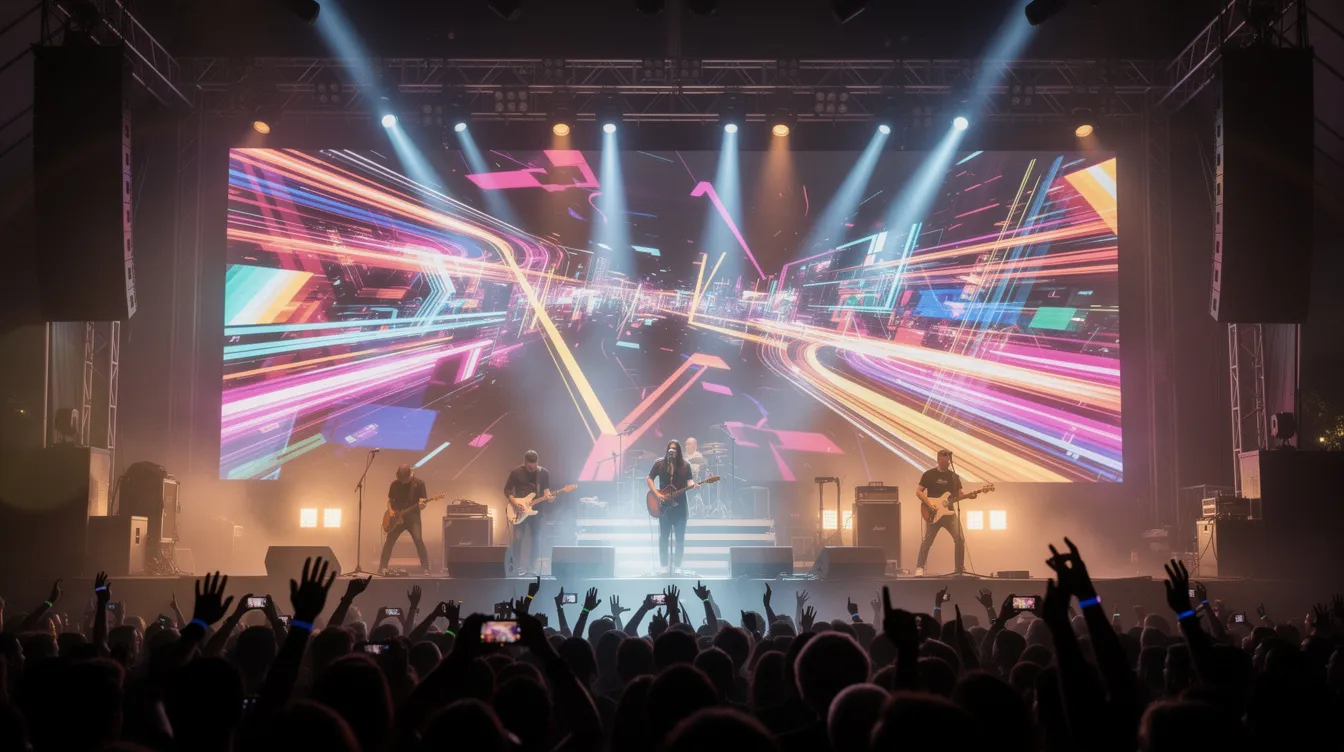
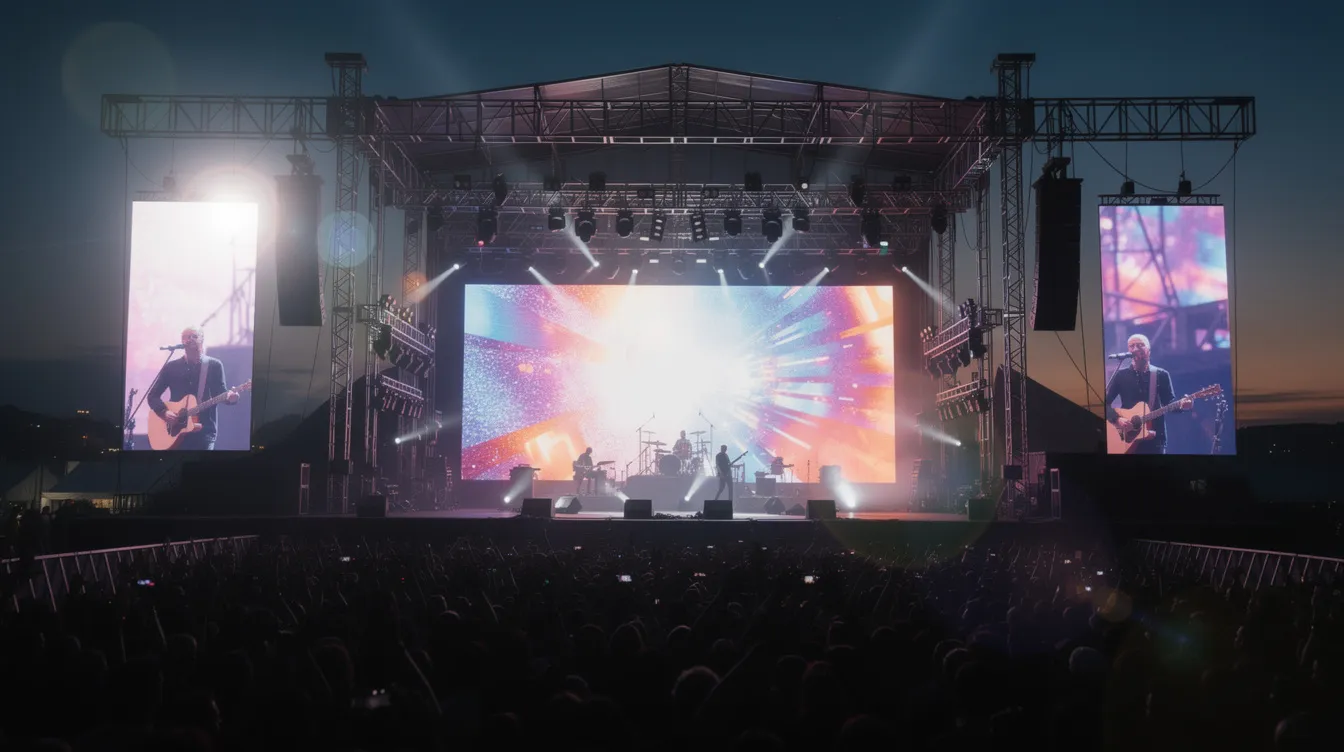
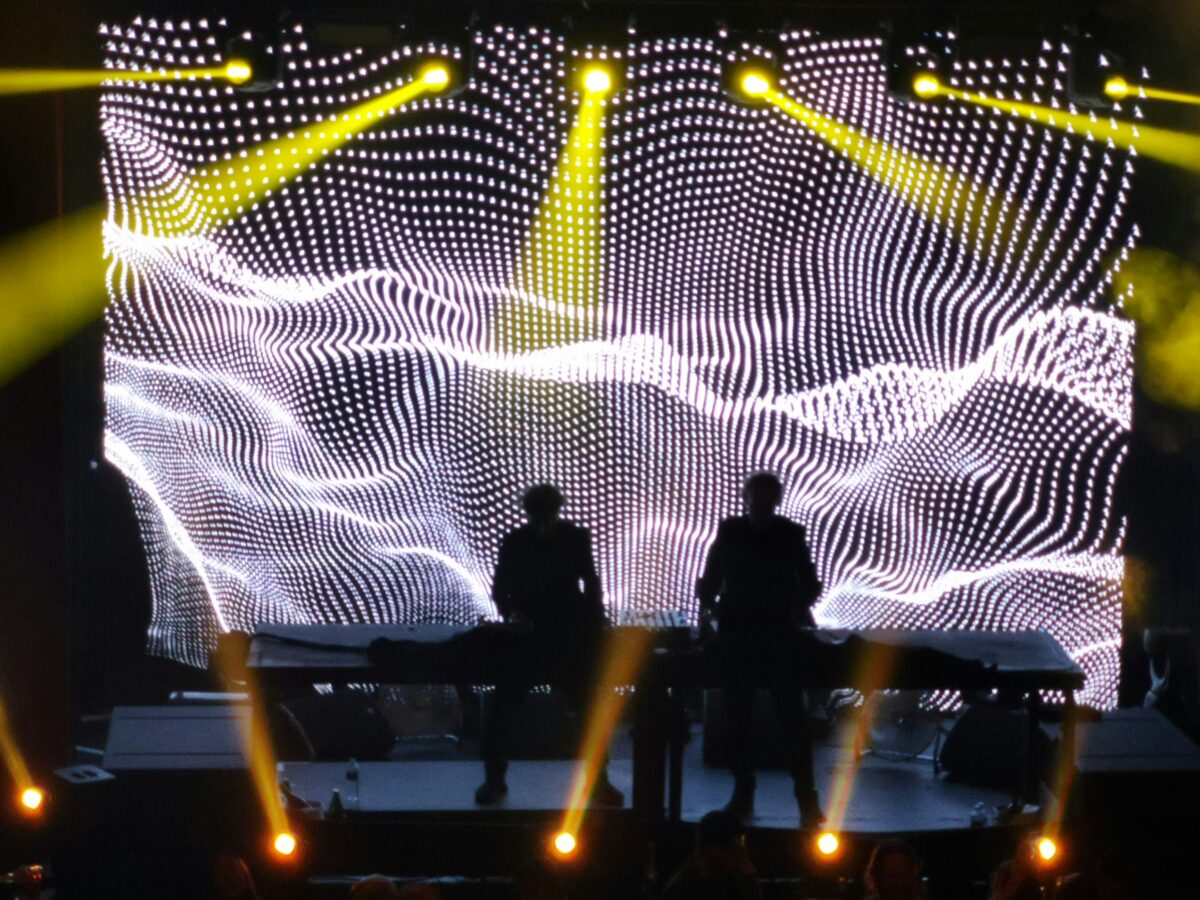
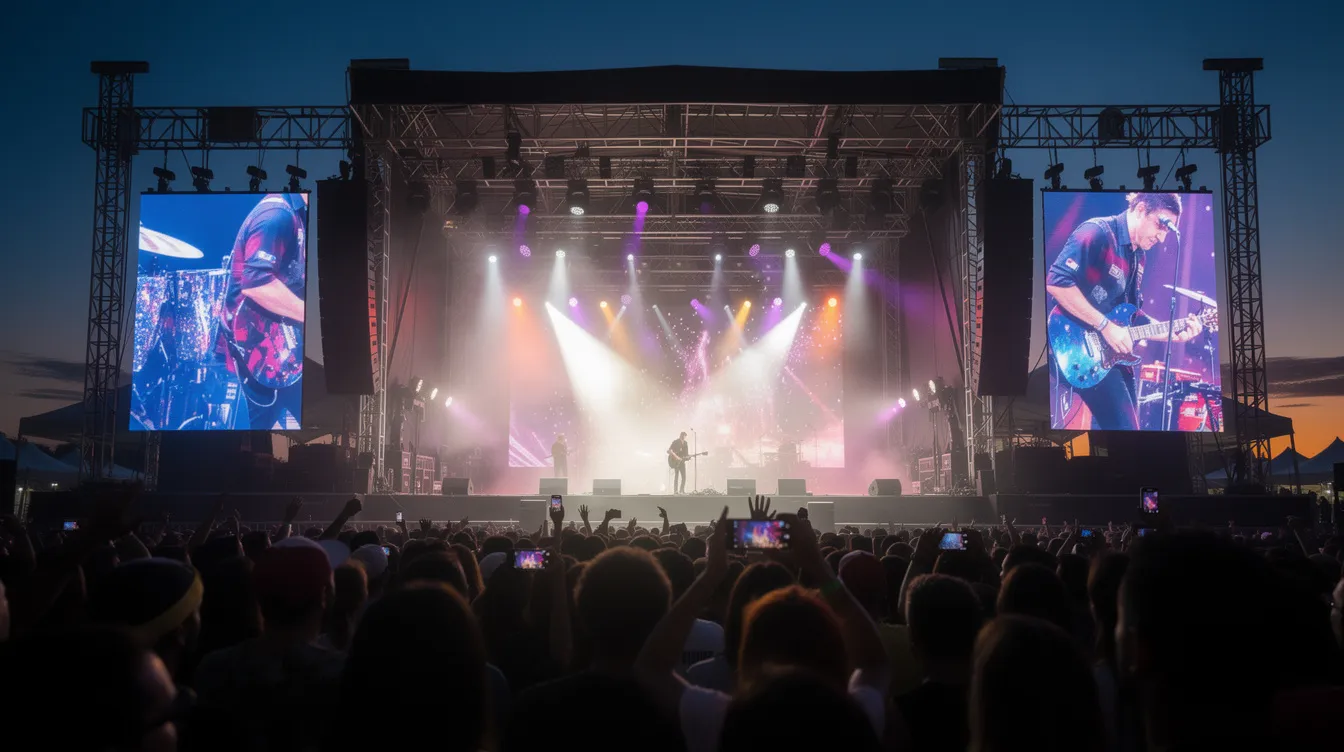
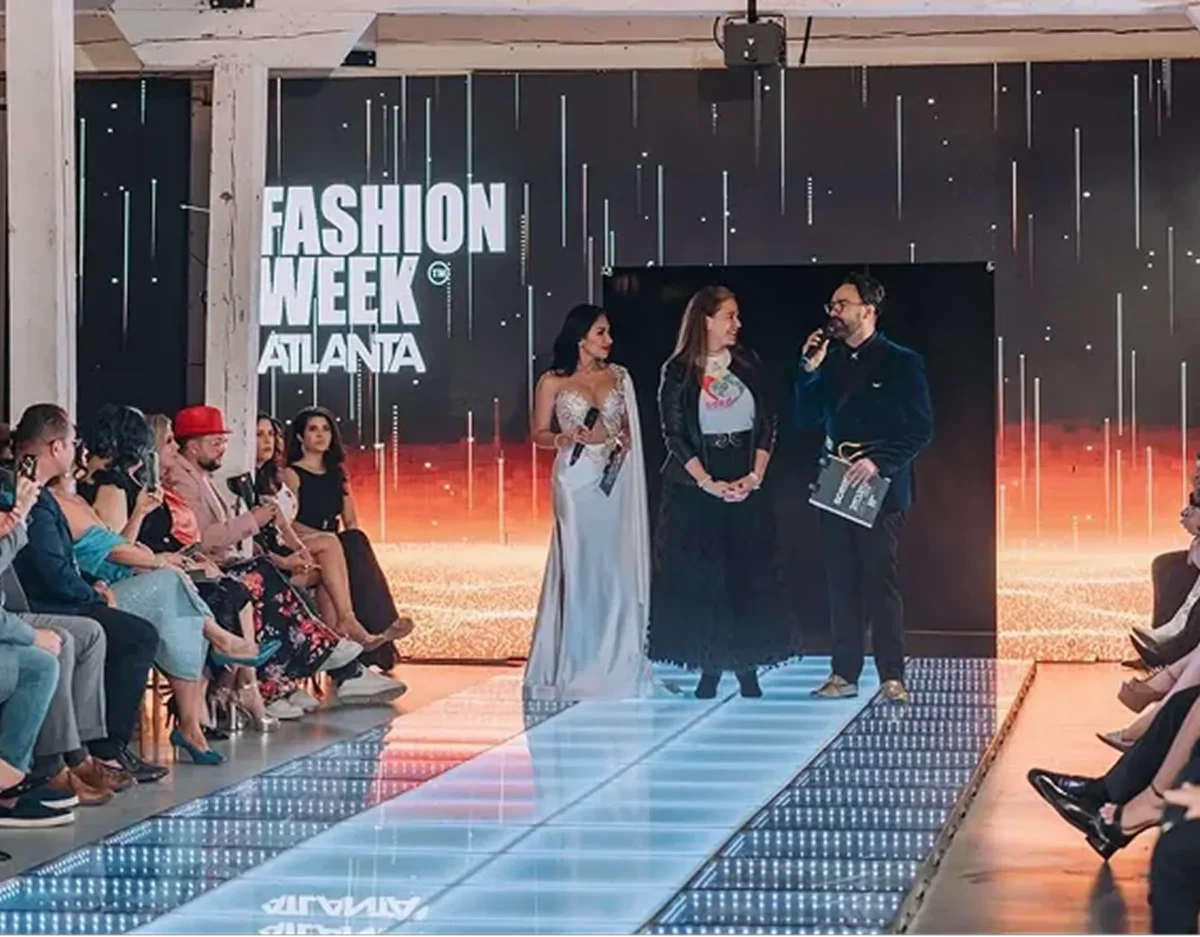
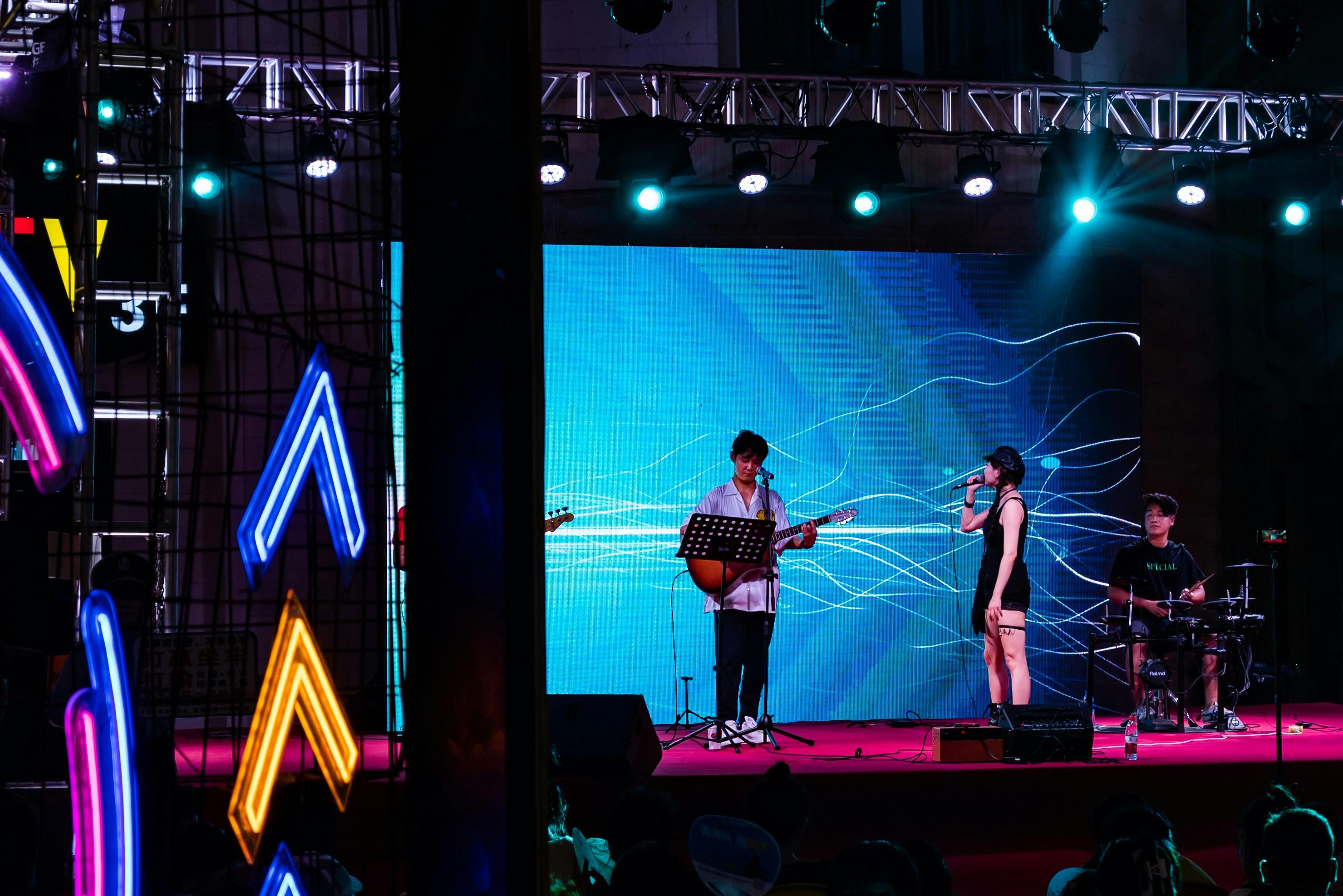
The image depicts a vibrant concert stage featuring a large LED video wall displaying colorful motion graphics, creating an immersive visual experience behind a band performing under dynamic stage lights. An enthusiastic audience is visible in the foreground, engaged with the live performance, highlighting the event's energetic atmosphere.

How Stage Dimensions and Venue Layout Shape the LED Screen Design

Stage and room geometry drive LED choices more than creative preferences alone. Screen size should match the venue size and audience distance – not the other way around.

  • Proscenium width and trim height set maximum screen dimensions. A 50 ft wide proscenium typically supports a main LED wall around 40 ft wide, leaving room for masking, side wings and speaker stacks. Trim height determines how tall the wall can go without blocking rigging or followspot positions.

  • Venue type changes what feels balanced. In clubs under 1,000 capacity, a 20–30 ft wide wall can feel immersive. In theaters seating 1,500–3,000, that same screen looks small unless scaled to 35–50 ft. For arenas above 8,000, main backdrops often exceed 60 ft and may be distributed across multiple surfaces.

  • Audience layout matters. Raked seating allows a screen placed lower to be seen clearly. Flat floors may require higher trim heights and side screens. Balcony overhangs and sight obstruction zones limit where screens can hang or be viewed effectively.

  • Competing elements such as doorways, emergency exits, followspot positions, line-array speakers and scenic pieces can limit where LED structures can safely live on or above the stage.

LED walls are modular and can fit various stage dimensions efficiently. Modular LED walls simplify transport and setup at different venues, making them practical for touring productions that play rooms of varying size across a region. Front Row FX maps LED options to specific venues, using scaled diagrams and 3D visualizations to propose the right stage layout rather than guessing at generic dimensions.

One Large Backdrop vs Multiple LED Surfaces

Choosing between a single led wall stage backdrop and multiple LED panels depends on the room, the audience and the content mix.

One large central LED backdrop creates a unified canvas. Benefits include a simpler content pipeline, a strong focal point and consistent visual impact. For headline concerts and music festivals, this approach often becomes the signature element of the stage design. The tradeoff: less flexibility for side viewing areas, a larger rigging requirement and greater risk if a panel or connection fails.

Multiple LED surfaces work better in wide venues, rooms with long-throw viewing distances, or events with multiple performance zones. Corporate events, trade shows and mixed-format shows that combine stage performances with presentations often benefit from separate screens – one for scenic content, others for IMAG or text-heavy slides. LED walls can be configured into various shapes to fit venue constraints, and LED walls allow for real-time audience interactivity during events when multiple surfaces are used to display different content streams.

Consider these scenarios:

  • A 3,000-seat theater with fan-shaped seating uses a central wall plus two side IMAG screens so audience members 120+ feet off-center can still see performers clearly.

  • A corporate general session in a ballroom uses a panoramic main wall for branding and two flanking screens for presentation slides and sponsor rotation.

  • A festival main stage uses a single 60×20 ft backdrop because sightlines are centralized and content is purely scenic.

Content complexity increases with multiple surfaces – you need pixel mapping, additional playback layers and disciplined content-safe areas. Planners should engage Front Row FX early to weigh creative goals against the complexity and budget of a multi-surface approach.
Common LED Stage Screen Layouts and When to Use Them

Each layout type serves a different production need. Here are the most common approaches used for concerts and live events.

Single central LED backdrop: Typical dimensions range from 32×12 ft to 60×20 ft. This is the workhorse layout for theaters and mid-size outdoor stages, serving as the main canvas for artist visuals, branding, scenic playback and IMAG. It works best when viewing angles are reasonably centralized and audience depth is moderate.

Panoramic LED wall: Ultra-wide aspect ratios – 80×16 ft or wider – span the full stage width to create an enveloping stage background. Best suited to arena-level shows, corporate general sessions and large music festivals where immersive visual experiences are the goal.

Central wall with side screens: The center wall handles scenic and motion content while left and right stage screens provide IMAG for audiences deeper than 120 ft or seated in wide fan-shaped configurations. This is a common choice for larger venues and touring productions.

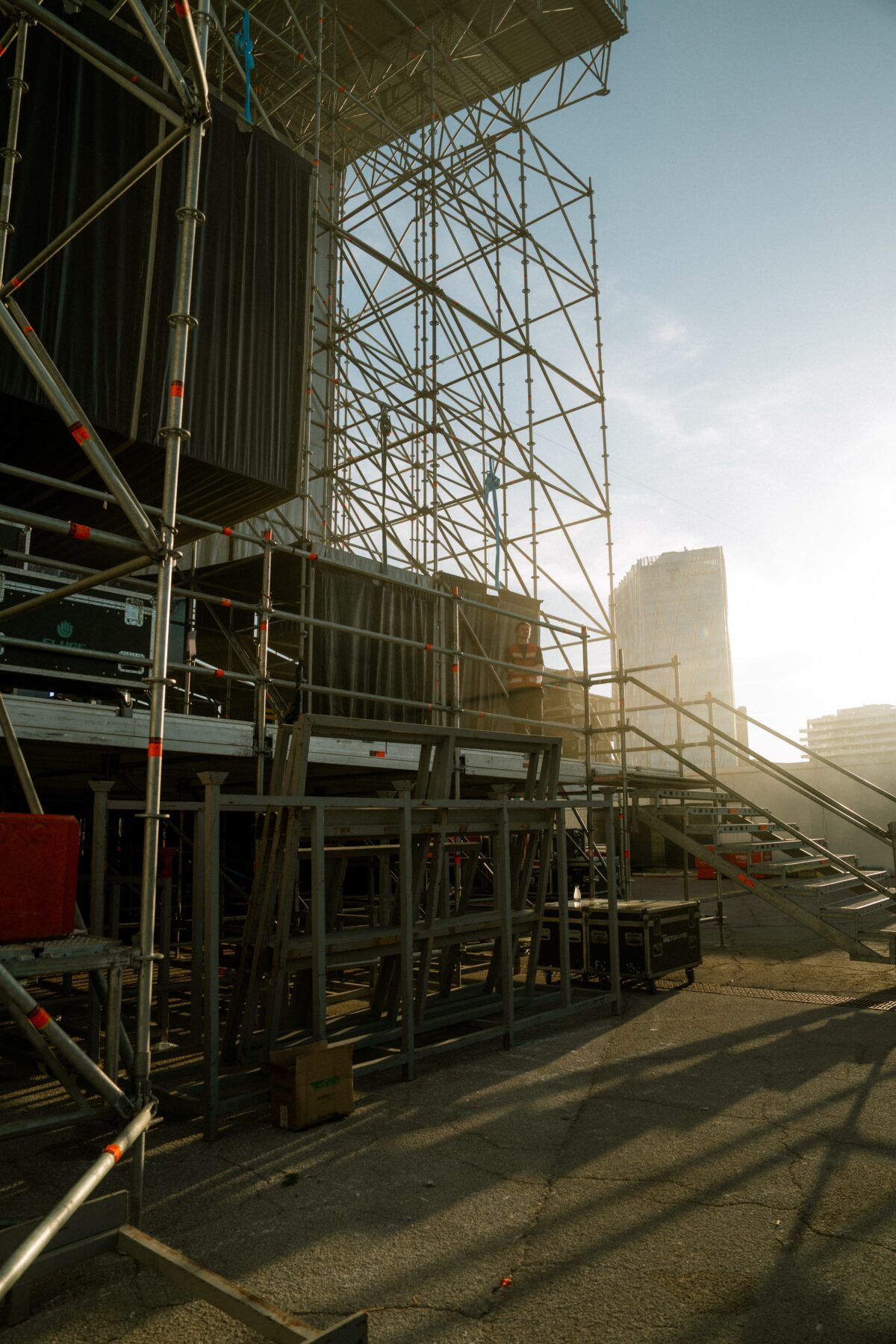
Ground-supported layouts: When rigging is limited – historic theaters, ballrooms, hotels – ground stacks or self-climbing structures support the screen from the stage deck. These consume stage depth but avoid ceiling weight limits entirely.

Flown LED systems: Where rigging capacity exists, flown walls keep the stage deck clear, allow flexible height positioning and optimize sightlines from near seats. Structural questions should be addressed through a dedicated rigging review.

The global market for rental staging is expanding robustly, and for organizations that use LED walls infrequently, renting remains the most practical approach. Utilizing local AV production resources reduces costs and improves support compared to shipping equipment across the country.
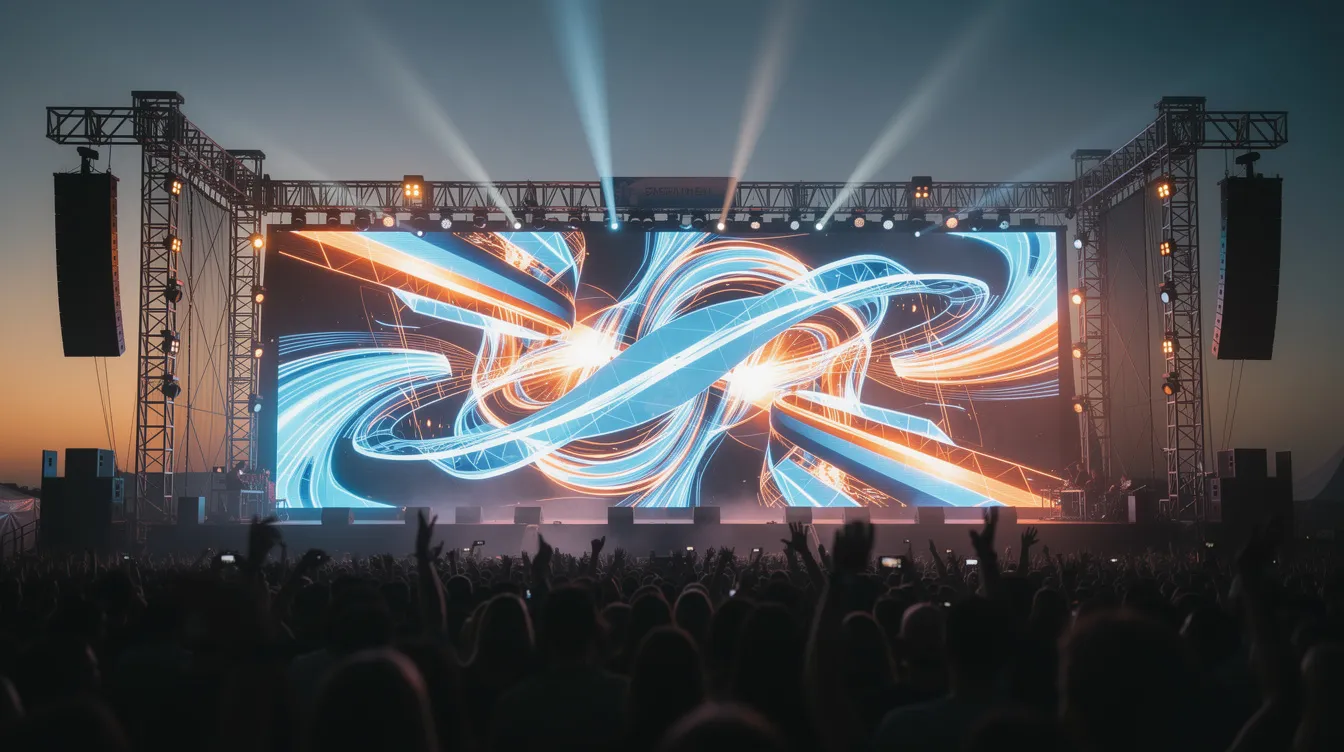
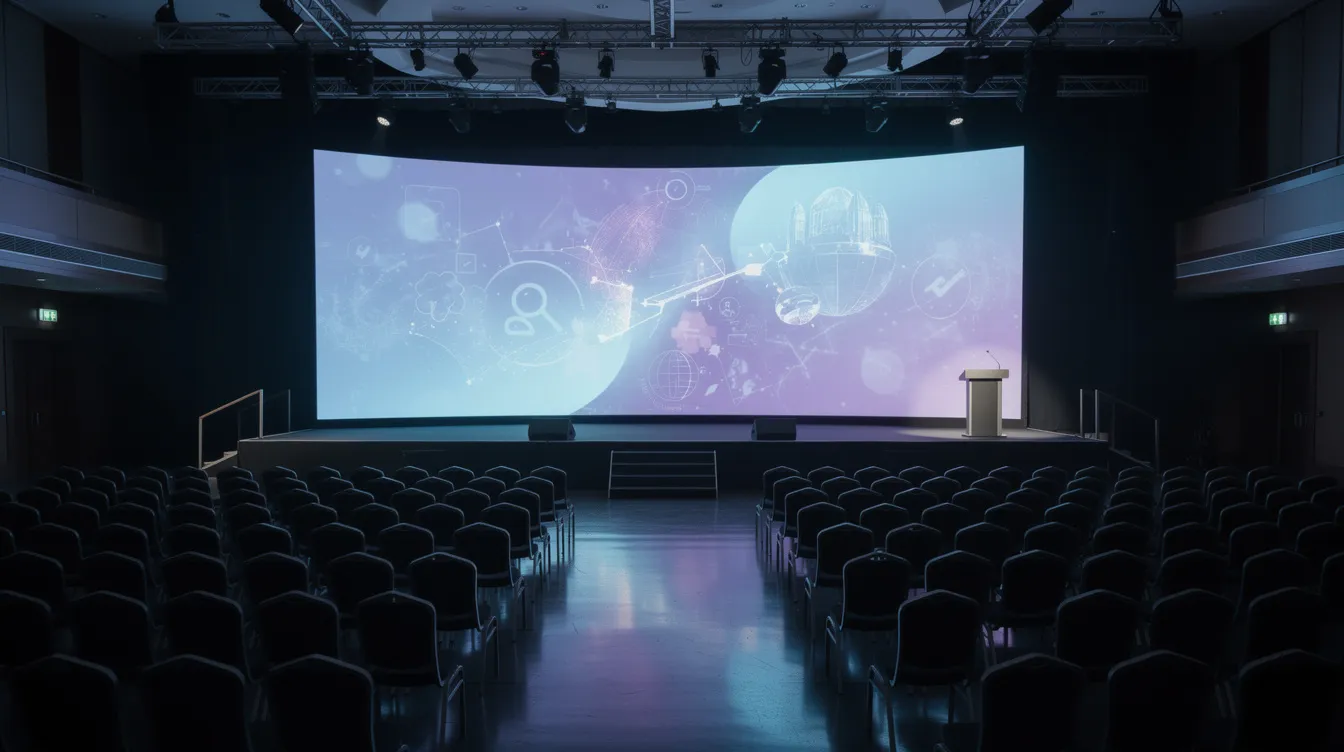
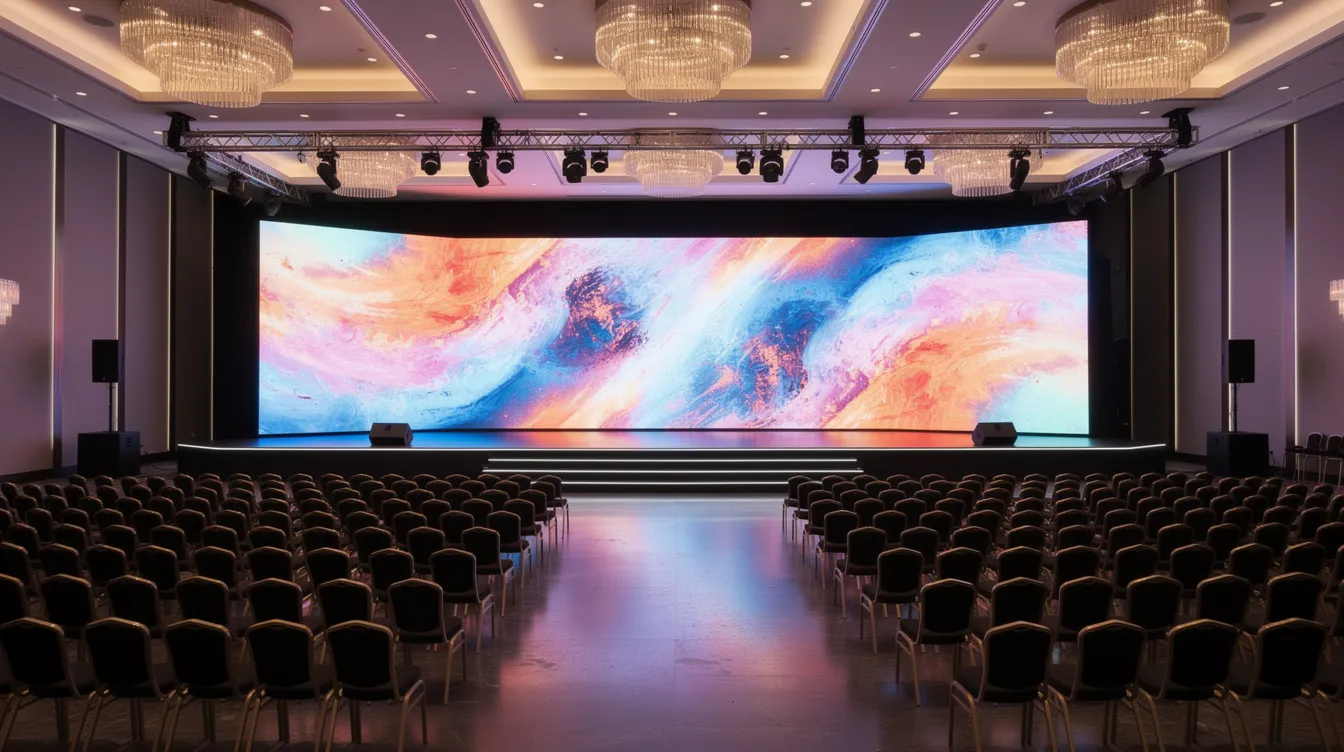
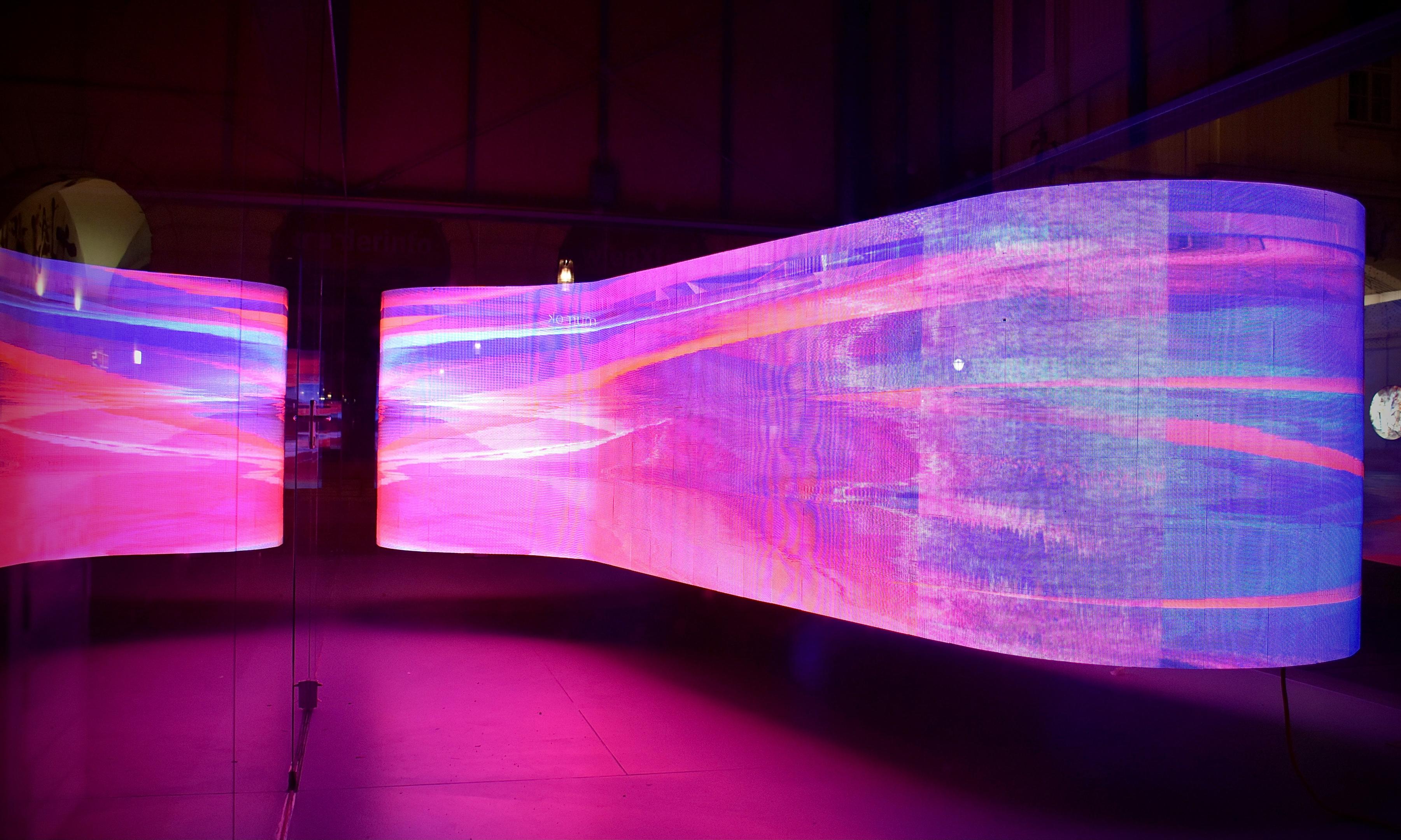
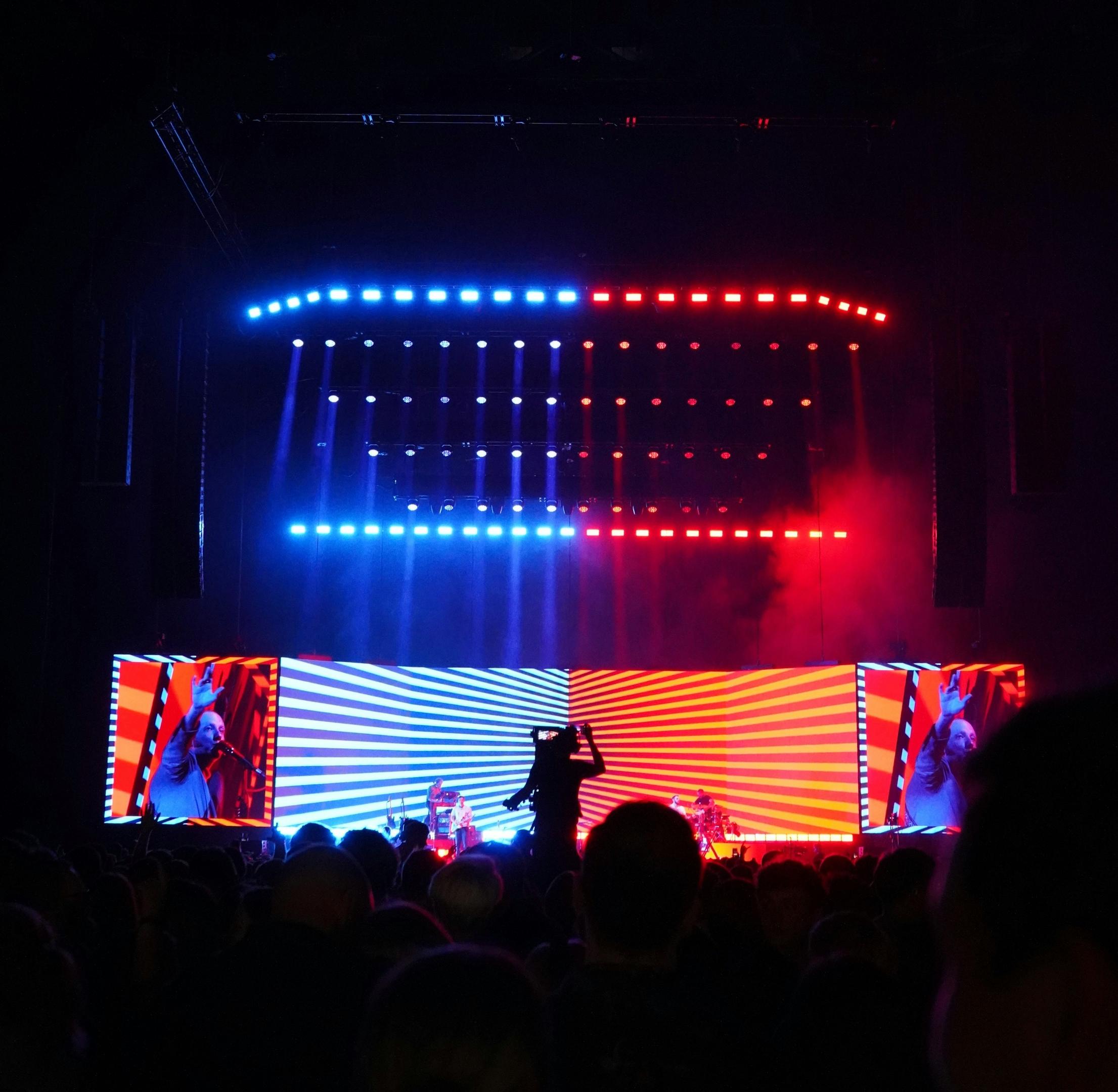
The image depicts an outdoor festival main stage at dusk, featuring a wide panoramic LED wall stage backdrop that spans the entire width of the stage. The vibrant blue and orange motion graphics on the large LED wall create an immersive visual experience, enhancing the atmosphere of the live event.

Scenic Columns, Staggered Panels and Modular LED Arrangements

Creative LED wall layouts go beyond the standard rectangle. Because LED panels are modular, stage designers can build architectural screen shapes that serve both scenic and functional purposes.

  • Vertical LED columns – for example, four 3×10 ft towers spaced across the upstage line – frame performers, extend visuals to stage edges and support dynamic light chases synced with stage lights. LED walls emit their own light, delivering vivid colors and true black levels that make columns visually striking even at narrow widths.

  • Staggered or offset panels create steps in depth and height, adding visual layers while keeping performers in clean negative space for camera framing. This layered approach adds dimension without requiring a continuous surface.

  • Broken backdrops use separated rectangular blocks instead of one continuous wall, allowing gaps for lighting beams, performer entrances and scenic elements. These arrangements offer creative flexibility but increase alignment and processing complexity.

  • Curved or angled surfaces using flexible LED panels or custom structures can wrap around stage edges or form arcs. Curved LED structures enhance visual presence in large arenas, though they require specialized hardware and distortion correction. Lightweight cabinets and unique shapes are possible but must be matched to appropriate rigging and processing.

LED floor panels can also create a fully digital stage environment when combined with rear and side walls.

Not every creative idea is structurally or operationally efficient. Front Row FX evaluates modular layouts against support hardware, processor capacity, cabling paths, power distribution and crew access during installation and strike.
Audience Sightlines, Viewing Distance and Screen Size

Sightlines and viewing distance often decide screen size more than creative mood boards do.

  • Vertical placement must balance front-row comfort with back-row visibility. If the first row is 15 ft from the stage and the last row is 200 ft back, the screen height must make content legible at the rear without overwhelming people in front.

  • Horizontal viewing angles in wide venues may require side screens or taller central walls so people far off-center see key information and real time camera feeds clearly.

  • Pixel pitch directly affects screen resolution and viewing distance. LED screens can have pixel pitches from 1.5 mm to 4.81 mm. A common guideline: minimum comfortable viewing distance in meters roughly equals the pixel pitch in millimeters. A 3.9 mm wall reads cleanly from about 4 meters (13 ft). For indoor events, 2.6–3.9 mm pitch serves audiences at 30–150 ft. For outdoor stages with longer throws, 3.9–6.9 mm is typical. High pixel density is now a standard expectation in LED displays, and high-resolution pixel pitches prevent pixelation in close-up views or VIP zones.

  • Content type matters. Scenic content (textures, abstract animation) is forgiving of coarser pitch. Sponsor logos, small typography and close-up faces demand finer pitch and higher physical resolution. Larger LED screens may have lower pixel density and resolution, so scaling up screen size without adjusting pixel pitch can reduce clarity.

Event planners should share seating maps and estimated audience numbers so the production team can model sightlines and suggest appropriate led screen stage dimensions.

Resolution, Aspect Ratio and Content-Safe Areas

Physical screen size and pixel pitch combine to determine native resolution – and that resolution is almost never a standard broadcast format.

  • A 40×16 ft wall using P3.9 panels may yield approximately 3,072×1,280 pixels. A 500×500 mm cabinet at P3.91 produces only 128×128 pixels per module. A wall six cabinets wide and four high totals just 768×512 px – far less than HD or 4K. Content must be built to match the actual pixel map, not standard video resolutions.

  • Aspect ratios vary widely. A 16:9 ratio is standard for IMAG and presentation content. Panoramic walls may run at 2.5:1 or wider. Tall scenic columns have narrow vertical ratios. Each surface needs its own content composition, not just a scaled version of the same file.

  • Content-safe areas are inner margins where critical text, faces and logos stay clear of edges, seams, masking or camera crops. In asymmetrical layouts or separated panels, some surfaces may be partially blocked by performers or staging from certain audience positions.

  • Video and graphic design should begin only after the final layout and pixel map are confirmed. Front Row FX provides content templates and playback specs so creative teams know exactly what resolution, aspect ratio and safe margins they are designing for. This prevents scaling artifacts, soft typography and video transitions that shimmer on screen.
Coordinating LED Video with Event Lighting

LED and lighting design must be built together. When they are planned in isolation, the result is washed-out screens, over-lit stages or performers lost in silhouette.

  • Brightness balance is essential. Brightness for indoor events typically ranges from 1,200 to 2,000 nits – enough to compete with stage lights without overpowering performers. The LED display must be calibrated so key and back light levels on performers match both in-person viewing and camera exposure.

  • Color coordination prevents clashes. Lighting palettes should complement the video content per song or scene. Overuse of saturated whites or bright primary colors on the LED wall can blow out or visually overpower the lighting design.

  • Beam placement matters. Strong backlight and side-light beams should frame performers without directing glare into cameras or onto the screen surface. LED walls maintain deep contrast and brightness under various lighting conditions, but direct fixture wash onto the panels reduces that contrast.

  • Cue integration ties both systems together through timecode. Moments where screens intentionally go dark highlight a solo or key speech. Synchronized color stories between video and lighting create cohesive visual impact across each song.

Front Row FX delivers event lighting production alongside LED screen wall production, so a single team manages both visual systems and avoids the conflicts that arise when lighting and video are designed by separate vendors with no shared plan.

Designing Around Performers, Cameras and Stage Movement

Good LED wall stage design keeps performers and cameras – not the hardware – at the center of the frame.

  • Artist blocking and staging (band positions, drum risers, runways, B stages) define safe distances between performers and the stage LED display. Too close and you get moiré patterns on camera. Negative space behind the performer creates contrast that helps both in-person viewing and broadcast framing.

  • Camera considerations include IMAG framing, lens field of view and jib paths. Camera platforms need clear sightlines to the LED wall. Bright, high-contrast content directly behind a performer’s face complicates camera exposure – softer, dimmer backgrounds often produce better close-up shots for live camera feeds.

  • High-refresh LED panels are essential for live streaming applications. If the wall refresh rate conflicts with camera shutter speed, visible flicker or banding appears on broadcast and recorded content.

  • Scenic elements such as stairs, props, inflatables and scenic portals must integrate with LED surfaces so entrances, exits and reveals work cleanly. LED walls are highly durable and require minimal maintenance, but physical interference from staging hardware should still be avoided.

Front Row FX collaborates with tour managers, show directors and broadcast crews to align the LED layout with the run-of-show and camera script before content production begins.
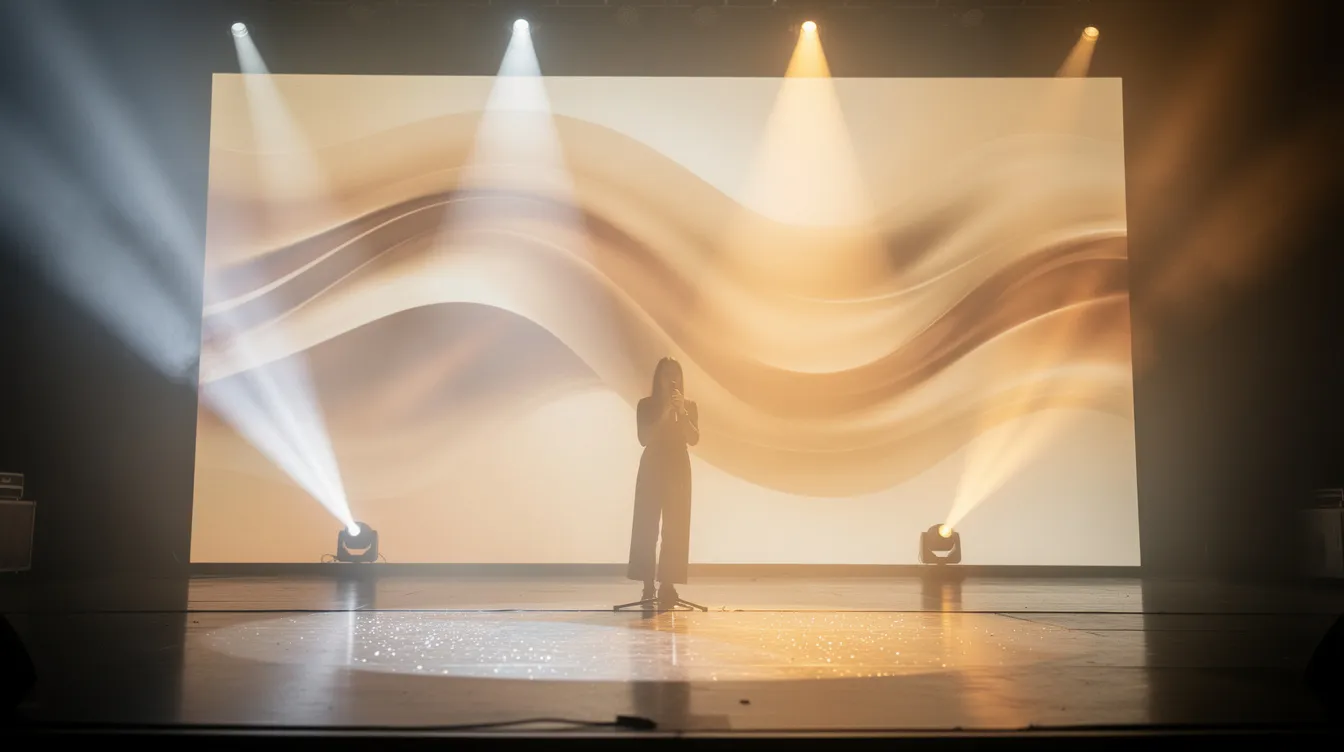
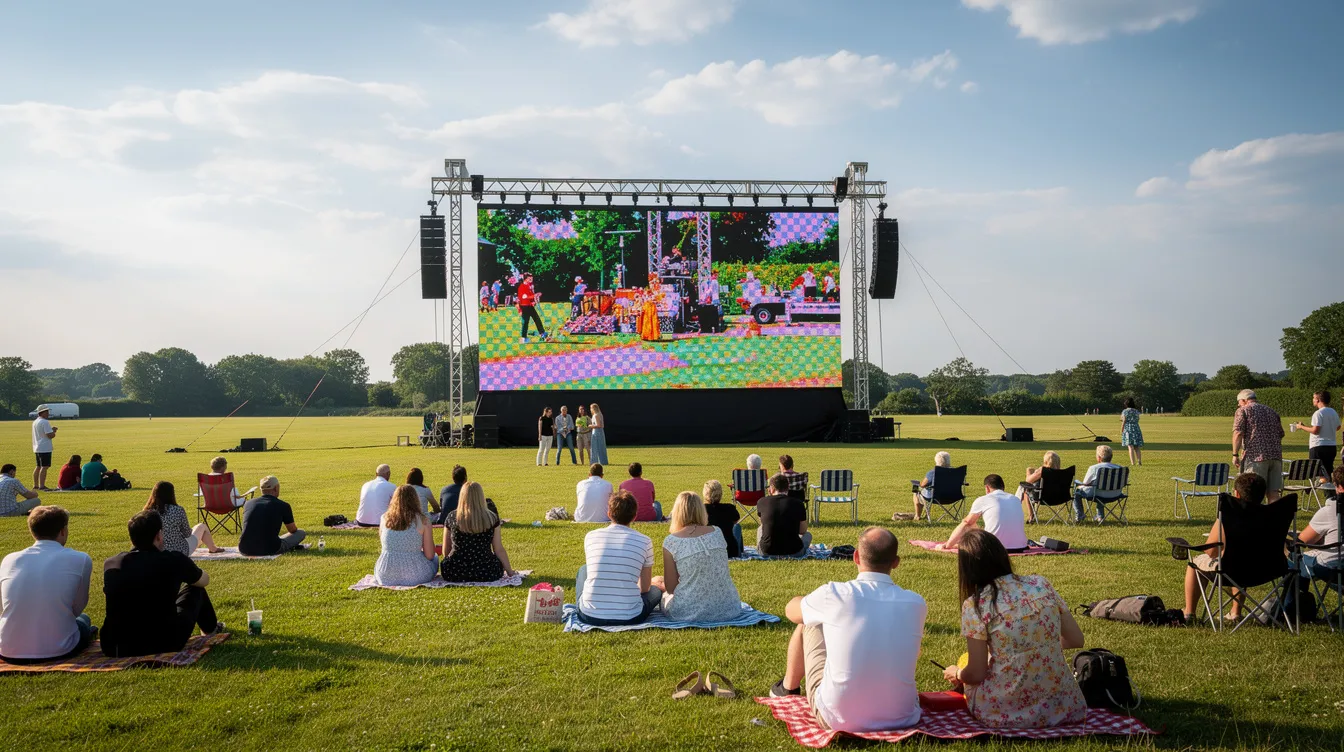
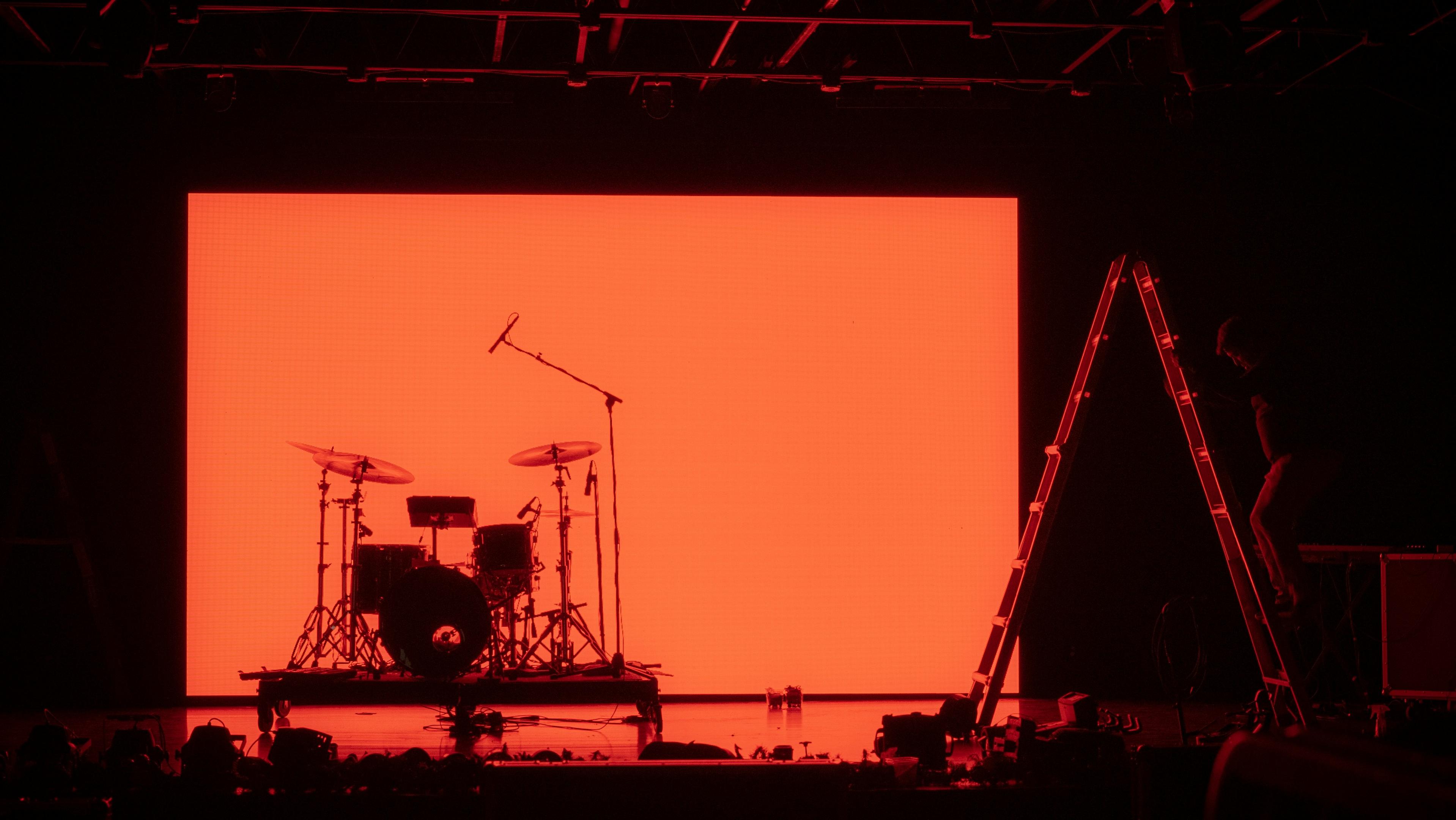
A performer stands on stage illuminated by beams of light, with a large LED wall backdrop displaying warm-toned motion graphics that create an immersive visual experience. The combination of stage lights and the vibrant LED display enhances the atmosphere of this live event.

Indoor vs Outdoor LED Wall Stage Backdrop Considerations

Indoor and outdoor stages present different technical demands for LED wall backdrops.

Indoor stages (theaters, arenas, ballrooms):

  • Tighter pixel pitch (2–3.9 mm) is appropriate because viewing distances are shorter and ambient light is controlled

  • Brightness for indoor events should be 1,200 to 2,000 nits

  • Ceiling reflections, color temperature variations and in-house rigging grids must be factored into placement

  • Ballrooms and hotels may limit rigging positions and ceiling heights, increasing reliance on ground-supported led screen stage solutions

Outdoor stages (festivals, amphitheaters, concert grounds):

  • Outdoor events require LED panels rated at 5,000 nits or more to remain visible under direct sunlight. High brightness LED panels are essential for outdoor visibility from afternoon soundcheck through the night headliner.

  • Many LED panels feature weather-resilient designs for outdoor events. An IP65 rating indicates dust-tight and water-resistant features suitable for outdoor use.

  • Sun angles, heat management and airflow around panels need careful planning, especially for summer festivals in the Upper Midwest.

  • Ground-supported structures are used more frequently outdoors. Wind exposure must be assessed for both flown and stacked configurations.

  • Day-to-night adaptability makes LED walls suitable for various events – processors can adjust brightness as ambient light shifts from full sun to darkness.

Front Row FX adjusts panel choice, brightness targets and processor settings differently for indoor tours versus outdoor festival runs. The production approach for a corporate event in Minneapolis looks very different from a three-day outdoor music festival.

Rigging and Ground-Support Implications (Without Structural Calculations)

Structural support is critical to every LED wall installation, but detailed engineering, ballast quantities and load calculations belong in a dedicated resource – not a design overview.

  • Flown LED walls hang from venue beams or grids using certified rigging hardware. They elevate the screen above backline and performers, keeping the stage deck clear and improving sightlines.

  • Ground-supported systems use truss stacks, base plates and ballast. They are the standard when fly systems are unavailable or ceiling capacity is limited. They consume stage depth but avoid overhead weight concerns.

  • Screen size, weight per panel, total array weight and wind exposure (outdoors) all affect which approach is safe and practical. Initial costs for LED stage screens can be relatively high, and rigging hardware adds to both budget and load-in time.

  • Creative layouts – columns, staggered panels, asymmetrical hangs – must still conform to available support hardware, connection methods and the venue’s approved rigging plan.

For structural detail, planners should review Front Row FX’s dedicated LED wall rigging guidance, which addresses load paths, safety factors and venue-specific engineering without duplicating that content here.

Preproduction, Visualization, Testing and Show-Day Operation

Strong backdrop LED wall stage design is proven in preproduction, not improvised at load-in.

Preproduction includes:

  • Gathering venue data: stage dimensions, trim height, rigging capacity, power availability, audience seating layout and distances

  • Collecting content requirements: IMAG, branding, sponsor rotation, scenic playback, presentation slides

  • Locking the LED layout, pixel map and content templates before any design work begins

Visualization tools – 2D scaled plans and 3D renders – show how the led wall stage backdrop, side screens and lighting will appear from key audience positions: front row, center orchestra, balcony, side aisle. These reveal sightline obstructions and screen size imbalances before a single panel is loaded.

Pixel mapping and content tests verify aspect ratios, safe areas, color calibration, refresh rate and latency with camera systems. Smooth playback depends on properly configured control software and frame-locked processors. Testing for stable performance before doors open prevents on-show surprises.

Show-day operation requires dedicated LED wall operators, backup playback systems, clear cue sheets and continuous communication with stage management and lighting directors. Display videos, live cuts and motion graphics must transition seamlessly through the run-of-show.

Front Row FX supports partial or full show operation, from LED system technicians to integrated video direction for concerts, festivals and large-scale event productions.

Layout Comparison Table: Choosing the Right LED Wall Stage Backdrop Approach

The following table compares common led stage screens options by visual purpose, applications, content needs and key production requirements.

Layout Type

Primary Visual Purpose

Best-Suited Event Types

Content Considerations

Key Production Requirement

Single LED Backdrop

Strong central focus for scenic, branding and IMAG

Theaters, clubs, mid-size outdoor stages, special occasions

Single content feed; standard or custom aspect ratio

Adequate rigging height or ground-support depth

Panoramic LED Wall

Full-width immersive environment

Arenas, corporate general sessions, large music festivals

Ultra-wide content composition; motion-heavy scenic design

Wide stage, extended truss or ground frame, high panel count

Central Wall with Side Screens

Combined scenic impact and audience coverage

Wide venues, touring productions, theatrical performances, conferences

Separate feeds for center (scenic) and sides (IMAG or sponsors)

Additional processors, extra cameras, synchronized outputs

LED Columns or Modular Surfaces

Scenic architecture and performer framing

Concerts, galas, brand activations, different events requiring visual depth

Content mapped per surface; independent or synced playback

Precise alignment, multiple signal paths, modular rigging

Layered or Custom Scenic Layout

Visual depth, creative staging, audience attention through dimension

Headline tours, festivals, stage productions with high design intent

Custom compositions per layer; complex pixel mapping

Extended content design timeline, specialized support hardware, longer load-in

Align your choice with event type, audience layout, content mix and the available rigging or ground-support profile. No single layout is universally superior – the right answer depends on the specific production.
Planning Checklist and LED Stage Design FAQs

Planning Checklist

Before engaging a production partner, gather these details:

  • Event date and city
  • Venue name and whether it is indoor or outdoor
  • Stage dimensions (width, depth) and trim or ceiling height
  • Audience size and seating layout (raked, flat, fan-shaped)
  • Viewing distance range (first row to last row)
  • Desired screen size, screen shape or layout preference
  • Event type (concert, festival, corporate, gala, trade show, wedding stage)
  • Content types: IMAG, branding, sponsors, scenic playback, presentation
  • Camera requirements (number of cameras, broadcast or in-house)
  • Lighting scope and whether lighting production is included
  • Load-in window and show schedule
  • LED screen budget range or flexibility

These details allow Front Row FX to propose a screen solution matched to the performance, venue and audience rather than offering generic sizing.
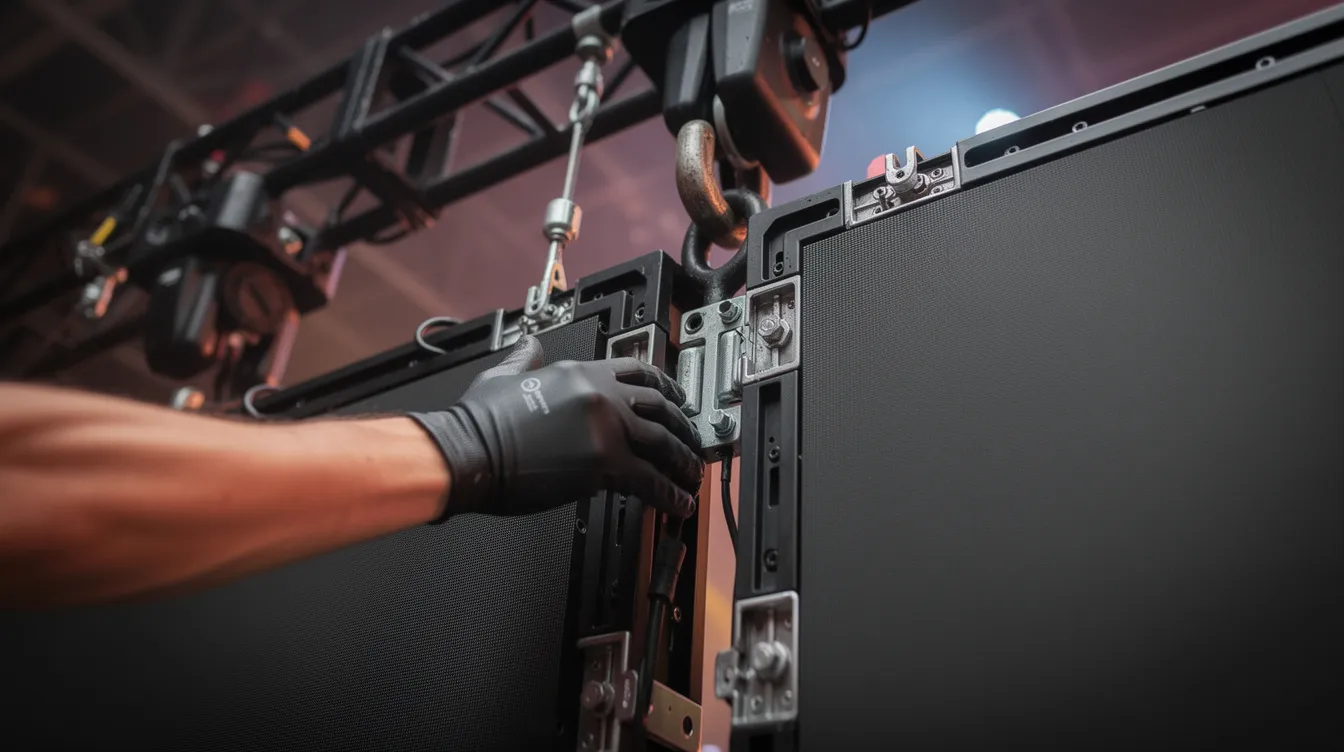
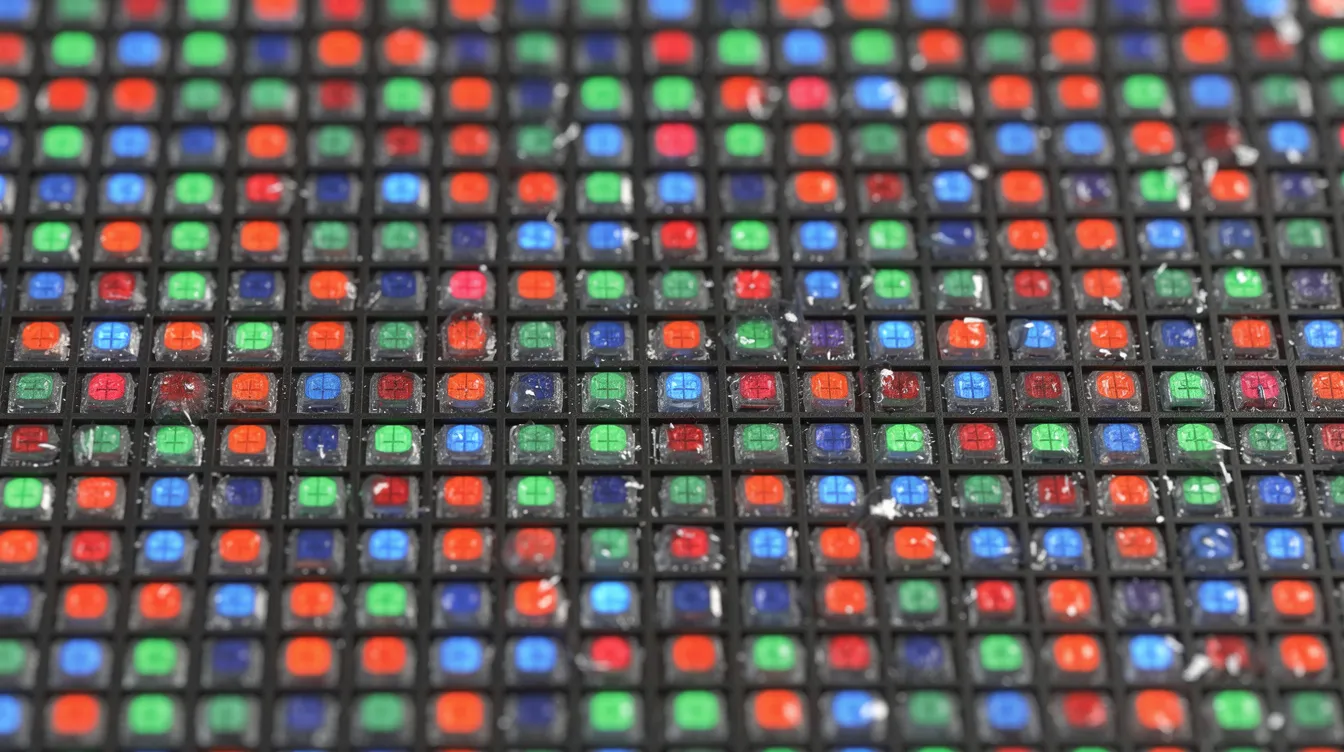
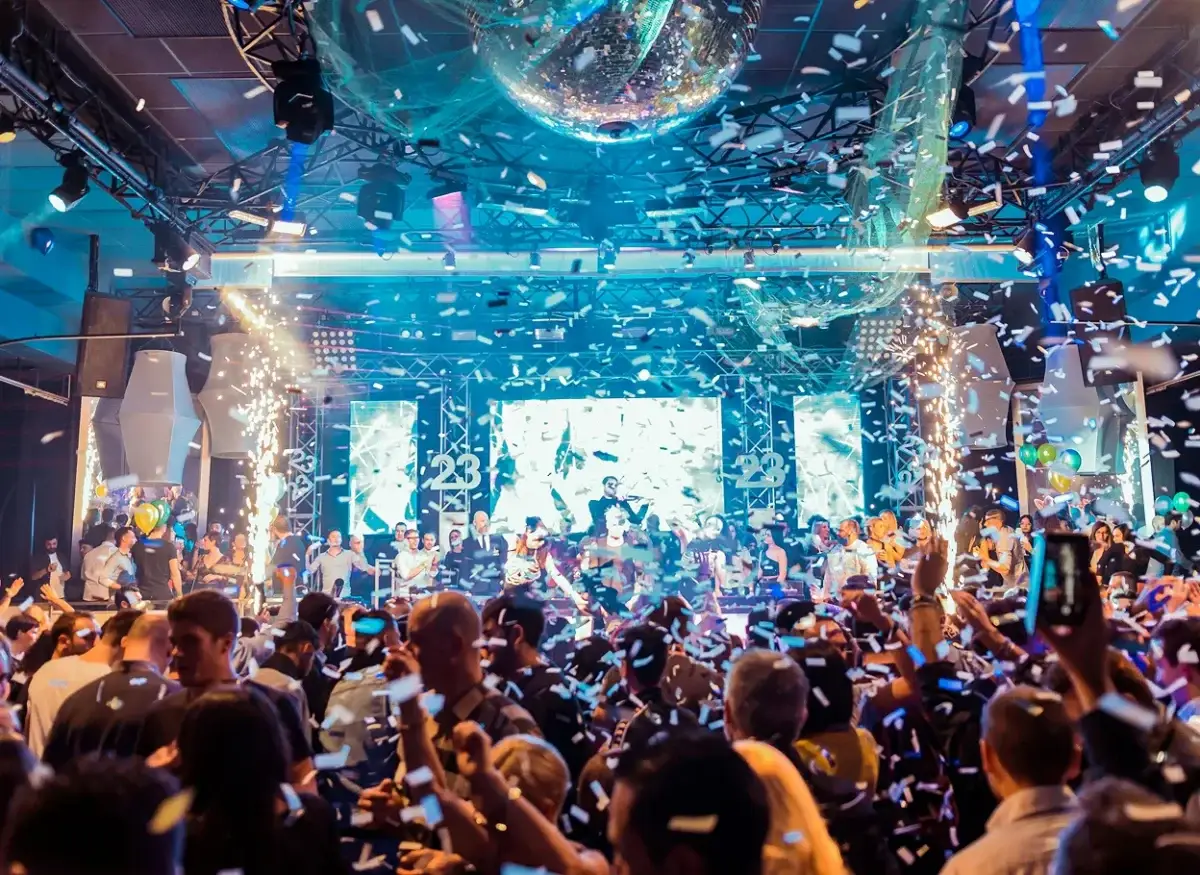
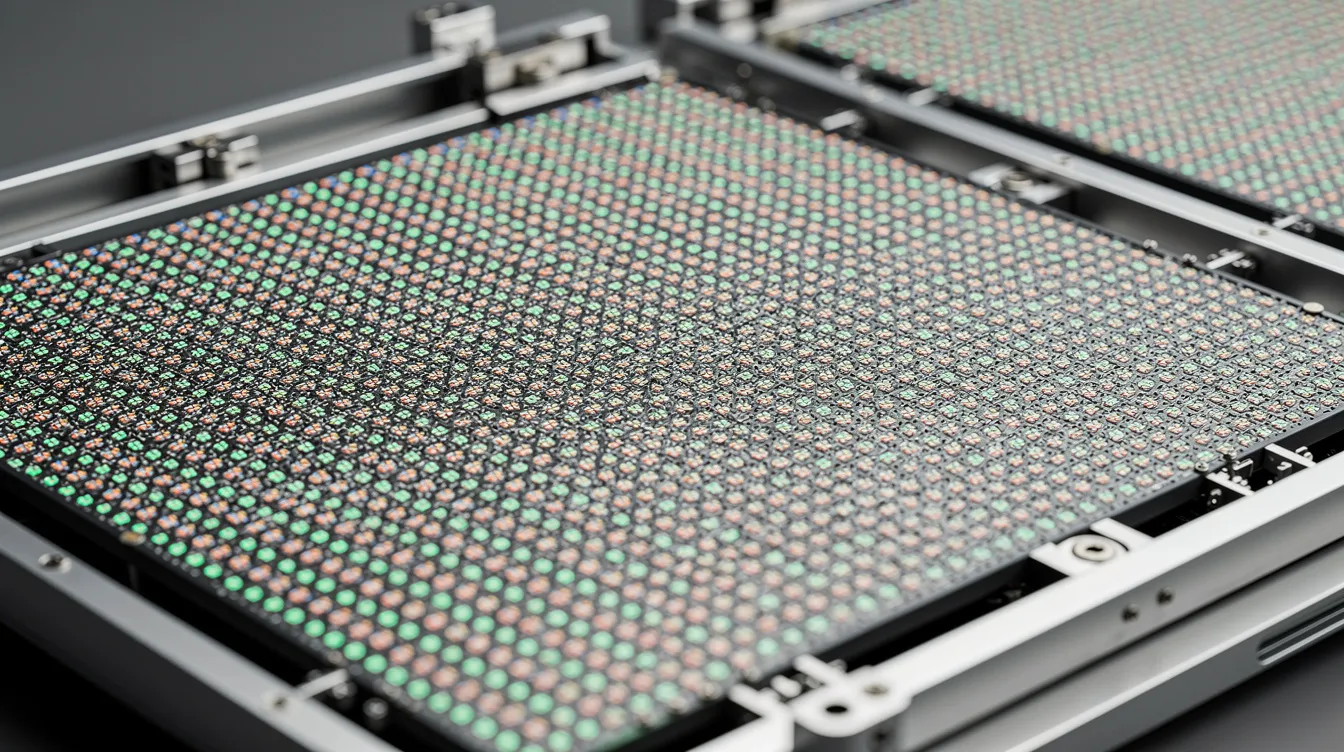
A close-up view captures multiple modular LED panel cabinets being connected on a stage, with rigging hardware visible overhead, showcasing the intricate setup of a vibrant LED wall stage backdrop designed for live events. The image highlights the lightweight cabinets and seamless splicing that contribute to an immersive visual experience for audiences.

Why Bigger Isn’t Always Better: Balancing Scale, Concept and Practicality

The largest possible screen is not automatically the strongest stage design. An enormous rectangle in a smaller venue can overpower performers, complicate lighting balance, exhaust content budgets and leave audience attention divided between too-bright visuals and too-dim artists. Viewing angle can suffer when a screen dominates the room rather than complementing it.

A deliberately composed modular layout – a central wall flanked by scenic LED columns, or broken-backdrop blocks that allow lighting beams through – can create more visual impact and lasting impression than one oversized rectangle. The key features of a strong design are proportion, integration and intent, not raw square footage.

Creative LED wall stage design must remain coordinated with structural realities, cabling paths, power, processor capacity, load-in time, crew access and quick installation windows. Audience engagement is earned through a coherent visual system, not sheer screen area.

If you are planning a concert, tour, festival, corporate show or trade show, share these details with Front Row FX: event date, city, venue, stage dimensions, audience size, viewing distances, indoor or outdoor environment, preferred screen arrangement, content formats, camera needs, lighting scope and production schedule.

With this information, Front Row FX can develop a tailored LED wall stage backdrop design that supports the performance, fits the venue and delivers a coherent visual system for both audiences and cameras. Whether you need LED screen wall production for a single concert, LED screens for a multi-city tour or integrated lighting and video for a festival main stage, the design starts with the right details – not the biggest screen in inventory.
FAQs

Most frequent questions and answers

A common starting point is 60–80% of the proscenium or stage width, with height proportionate to trim height and first-row distance. For a 50 ft wide stage, a 32–40 ft wide wall is typical.

Larger screens work in larger venues and for audiences seated farther back. Smaller venues benefit from more modest screen sizes that do not overwhelm the concert stage.

A single large led wall creates a unified visual anchor and simplifies the content pipeline.

Multiple screens improve visibility in wide venues, support IMAG for distant seating and allow simultaneous scenic and presentation content.

The choice depends on audience width, camera use and how many content streams you need to manage.

Yes. Modular LED panels support columns, curves, asymmetrical groupings, broken-backdrop blocks and angled configurations.

However, every creative layout must be assessed for appropriate support hardware, processing capacity, seamless splicing and safe rigging. Creative direction that ignores structural and operational realities creates risk.

Lighting must be balanced with LED brightness, color-coordinated with video content and planned to avoid washing out or visually overpowering the screens.

Stage lights pointed directly at the LED wall reduce contrast. Shared color palettes between lighting and video create a cohesive visual system rather than two competing elements.

Side screens become important when the venue is wider than the central LED wall can serve, when seating extends beyond 120–150 ft from center, when balcony seating limits sightlines to a low-mounted main wall, or when the event relies heavily on IMAG or detailed presentation content that must reach every seat.

No. Content must follow confirmed screen dimensions, pixel map and aspect ratio.

Designing content before the layout is locked leads to scaling artifacts, soft typography and mismatched compositions. Front Row FX provides content templates once layouts are confirmed so creative teams build to the exact native resolution.

Categories
LED Screens & Video Walls

LED Wall Rigging: What Event Planners Need to Know

LED Wall Rigging: What Event Planners Need to Know

What “LED Wall Rigging” Means

LED wall rigging is the engineered system used to suspend, support, stabilize and secure an LED wall or LED display for live events. It includes the structural frame, mounting hardware, safety measures and the procedures that hold everything together from load-in through strike.

The correct rigging method depends on the total weight of the complete LED video wall system, screen dimensions, venue structure, available rigging points, environmental conditions, and manufacturer documentation. LED walls can weigh up to 5,000 pounds, so none of these variables are optional. Rigging must be performed by qualified personnel on every project, regardless of support method.

This article covers what planners need to ask, who to involve, and what documentation to require. It is not a do-it-yourself rigging or ballast-calculation guide. The sections below compare four main support types: ground supported LED walls, flown LED walls, freestanding or ballasted structures, and mobile LED trailers. 

Front Row FX provides LED screen wall production and complete audiovisual production across Minnesota, Wisconsin, Illinois and Georgia, working with qualified rigging and engineering resources so planners are not left making structural decisions alone.

Ground-Supported vs. Flown LED Walls: Core Options and Tradeoffs

Two support methods account for the majority of LED wall installations at corporate events, concerts and conferences. Each carries distinct planning tradeoffs.

A ground supported LED wall transfers the entire system load to the floor or ground through engineered frames, bases, or a ground stack system. Ground support is preferred for quick setups and temporary installations and is versatile for various events, from trade shows to ballroom stages. The tradeoff: ground-supported installations need significant floor space behind the wall, typically 4 to 8 feet of depth for rear bracing and technician access. Floor loading must be verified, and taller builds may require ballast.

A flown LED wall is different in almost every respect. Flown LED panels are suspended from overhead rigging systems using rated hardware and, often, chain hoists or motors. Flying installations maximize floor space but require ceiling support with documented load capacity at each attachment point. Sightlines improve because the screen can be positioned higher, but approvals for rigging points, trim heights, and total weight must be confirmed before anything leaves the warehouse.

Freestanding or ballasted LED wall structures serve outdoor or open spaces where no building structure exists. Mobile LED trailers use an integrated support system but still require suitable ground conditions, positioning, clearance from overhead utilities, and a weather plan. None of these options is automatically safe; each requires LED wall structural support to be evaluated for the specific event.

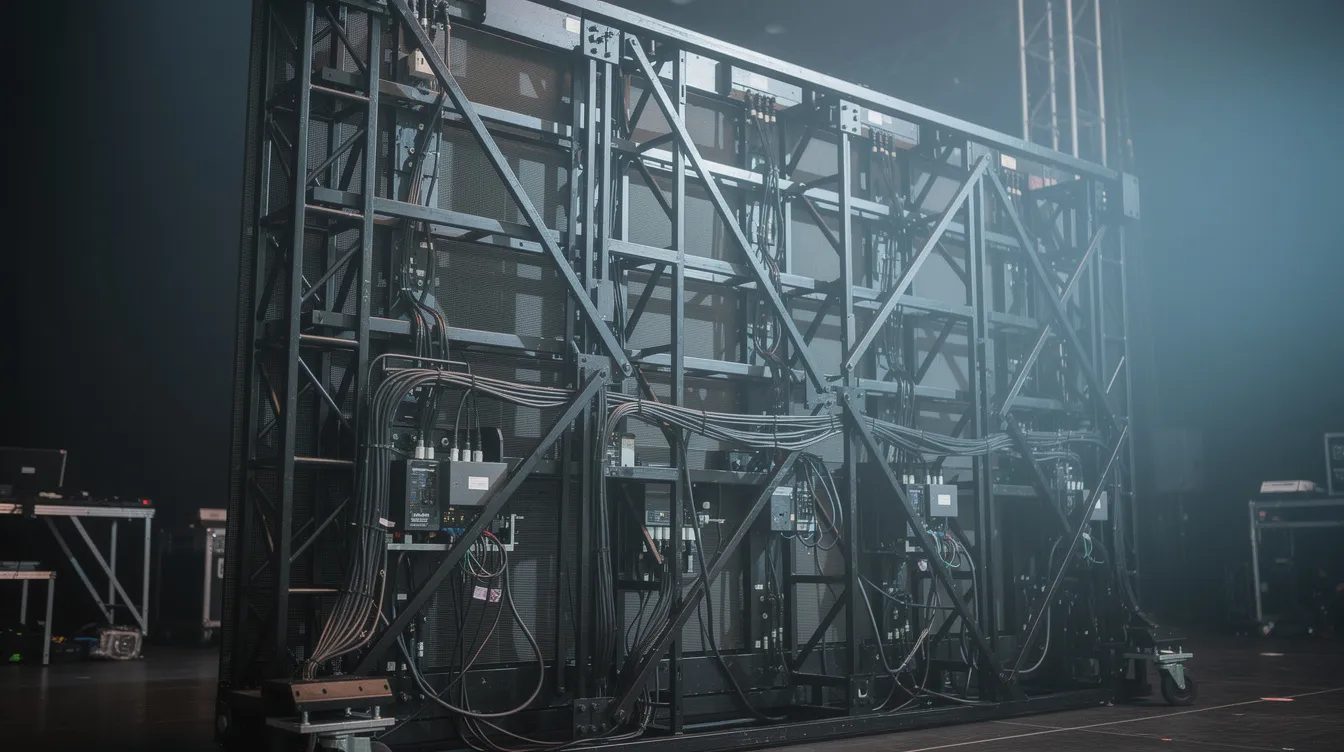
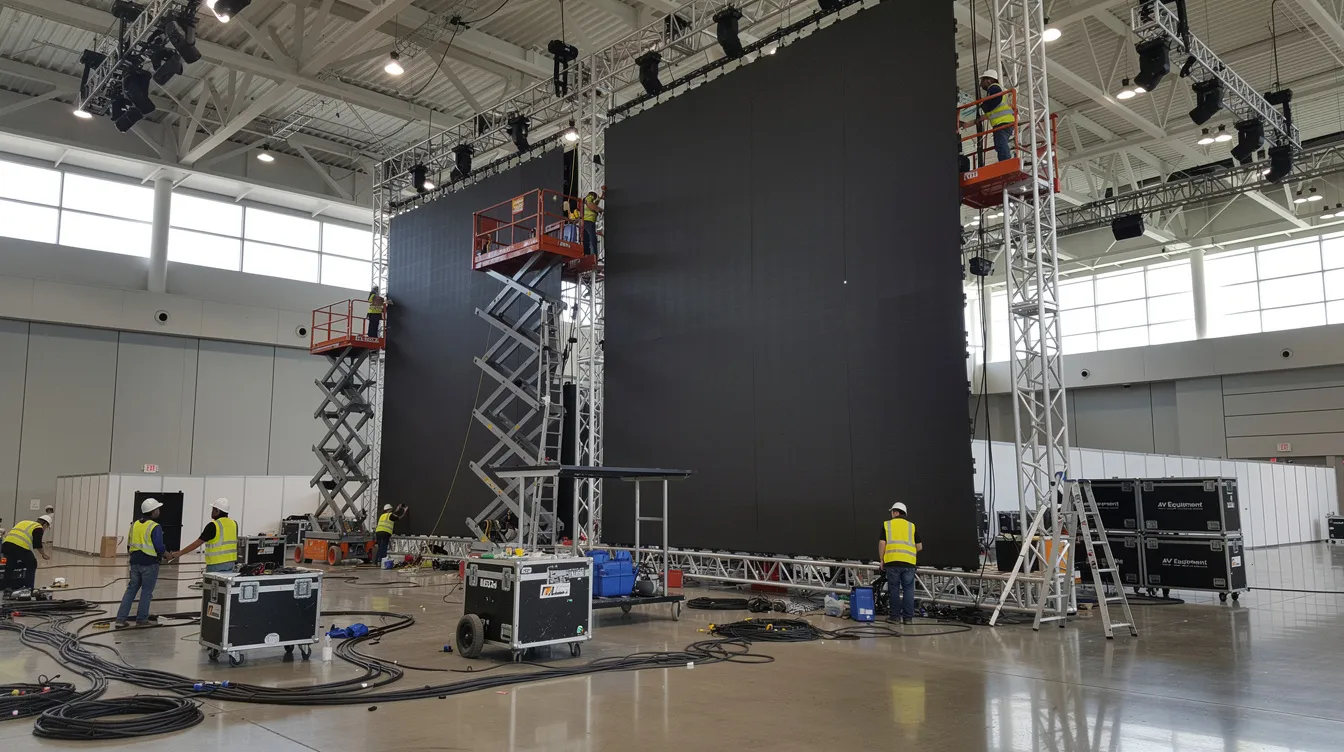
The image shows the rear view of a large LED video wall on a stage, highlighting the metal support frames and bracing structure essential for safely hanging the LED panels. The setup includes ground supported walls and rigging points that ensure the stability and security of the installation during events.

Support Methods Compared: Ground-Supported, Flown, Ballasted and Mobile

The table below summarizes how each method fits different venues and events. Ground-stacked displays require stabilizers for support; flown systems depend on overhead rigging capacity; ballasted and mobile builds have their own site requirements.

Support Method

Typical Applications

Principal Advantage

Venue / Site Requirements

Primary Planning Consideration

Ground-supported

Corporate conferences, trade shows, ballroom stages

No overhead rigging points required

Floor loading capacity; 4–8 ft rear clearance; level surface; potential ballast

Full system weight assessment; base frame design; access lanes

Flown

Concerts, arenas, theaters, large corporate events

Saves floor space; flexible screen height

Documented rigging points; point load data; trim height; qualified riggers

Rigging plan approval; total weight including motors and truss

Freestanding / Ballasted

Outdoor festivals, temporary stages, brand activations

Independent of building structure

Engineered frame; soil or ground bearing; wind and weather plan

Calculated LED wall ballast; structural engineer input; local permits

Mobile LED trailer

Street festivals, sports viewing, roadshows

Integrated structure; faster deployment

Level ground; overhead clearance; accessible load-in path

Site grade limits; road permits; power routing

The choice should align with event goals, venue constraints and engineering review, not preference alone.

Total System Weight: Why It Drives LED Wall Rigging Requirements

LED panels are only one component of total weight. Frames, hanging or stacking hardware, truss, bumper bars (which provide rigging points for LED panel arrays), chain hoists, cabling, processing racks mounted on the structure, and any attached scenic or lighting elements all contribute. LED panels are remarkably heavy and act as large wind surfaces, which compounds the structural challenge outdoors.

A typical 20×12 foot LED wall weighs 3,500 to 4,500 pounds in panels alone. Add 15 to 20 percent to panel weight for hardware and cables, and the total climbs further. Total weight calculation includes panels, hardware, and cables; omitting any component can lead to an undersized support structure. Chain hoists typically have capacities from 1/2-ton to 2-ton, so even the hoist selection depends on an accurate weight figure.

Manufacturers publish LED panel weights and hanging or stacking system data. ESTA’s published standards, including ANSI E1.2 for aluminum trusses and towers and ANSI E1.21 for temporary outdoor structures, inform how professionals design structures for these loads. Planners should never specify hardware size, ballast quantity or load limits themselves. Instead, ensure that rigging, structural and equipment professionals have complete weight information early. Front Row FX helps compile realistic total system weights for proposed LED video wall designs before approaching venues or engineers.

Venue Rigging Points, Structural Capacity and Floor / Ground Conditions

Overhead rigging and floor or ground capacity are separate constraints, and both must be confirmed. A flown LED video wall cannot be attached to any convenient-looking beam or ceiling member. The venue or a qualified structural and rigging professional must confirm which rigging points can be used and at what loads. Inspect the venue’s overhead rigging points to ensure compliance with load limits before any planning progresses. Flying installations need proper load calculations for safety; skipping this step is dangerous.

Venues typically provide rigging plots or load tables indicating allowable loads at specific points. For ground supported and ground stack systems, floor loading and ground bearing capacity must be checked. Ballroom stages, ice arenas, turf fields and outdoor lawns all behave differently under concentrated loads. Verify the venue’s load capacity and safety clearances before setup. Local guidelines may require structural sign-offs for heavy setups in Minneapolis and other metro areas.

Planners should gather venue information early: ceiling height, known rigging points, floor type, access routes, dock and door sizes, and any existing rigging or floor-loading policies. OSHA 1926.251 requires rigging equipment to be inspected before each use and loaded only within rated capacities, reinforcing the need for properly rated gear, though OSHA alone does not define every aspect of entertainment rigging practice. Front Row FX coordinates with house riggers, venue management and, when needed, independent engineers to align LED wall rigging with the building’s capabilities in markets like Minneapolis, St. Paul, Wisconsin, Chicago and Atlanta.

Support Structures: Truss, Frames, Bases, Ground Support and Ballast

An LED screen truss spans between rigging points or towers for flown LED walls. Its capacity and configuration must follow manufacturer documentation and relevant standards such as ANSI E1.2. The span, chord strength, and joint integrity of the truss all affect how much weight it can carry and over what distance.

For a ground supported LED wall, stacking or ground support frames, base truss, base plates, rear braces and outriggers control tipping and distribute loads. LED displays can also be wall-mounted for seamless integration in permanent or semi-permanent venues.

Ballast is added weight, for example concrete, steel or water, used in engineered quantities to keep a freestanding or ground supported LED wall from sliding or overturning. Ground support requires ballast of 50 to 100 percent of wall weight, depending on height, wind exposure, support geometry and configuration. Even indoor ground support systems can require ballast depending on design. ROE Visual’s hanging and stacking systems illustrate this principle: professional LED walls require compatible manufacturer accessories and configuration-specific ballast evaluation, not improvised hardware.

Certified rigging hardware must adhere to entertainment industry standards. Rigging hardware must support a minimum 5:1 safety factor. Shackles must show stamped Working Load Limit ratings. Bridle angles should never exceed 45 degrees from vertical; at 30 degrees, loads increase by 15 percent due to bridle angles. Bumper bars provide rigging points for LED panel arrays in both flown and stacked configurations. Planners should expect to see drawings and documentation for support structures and ballast, and should not approve ad-hoc weight choices such as “a few extra sandbags.”

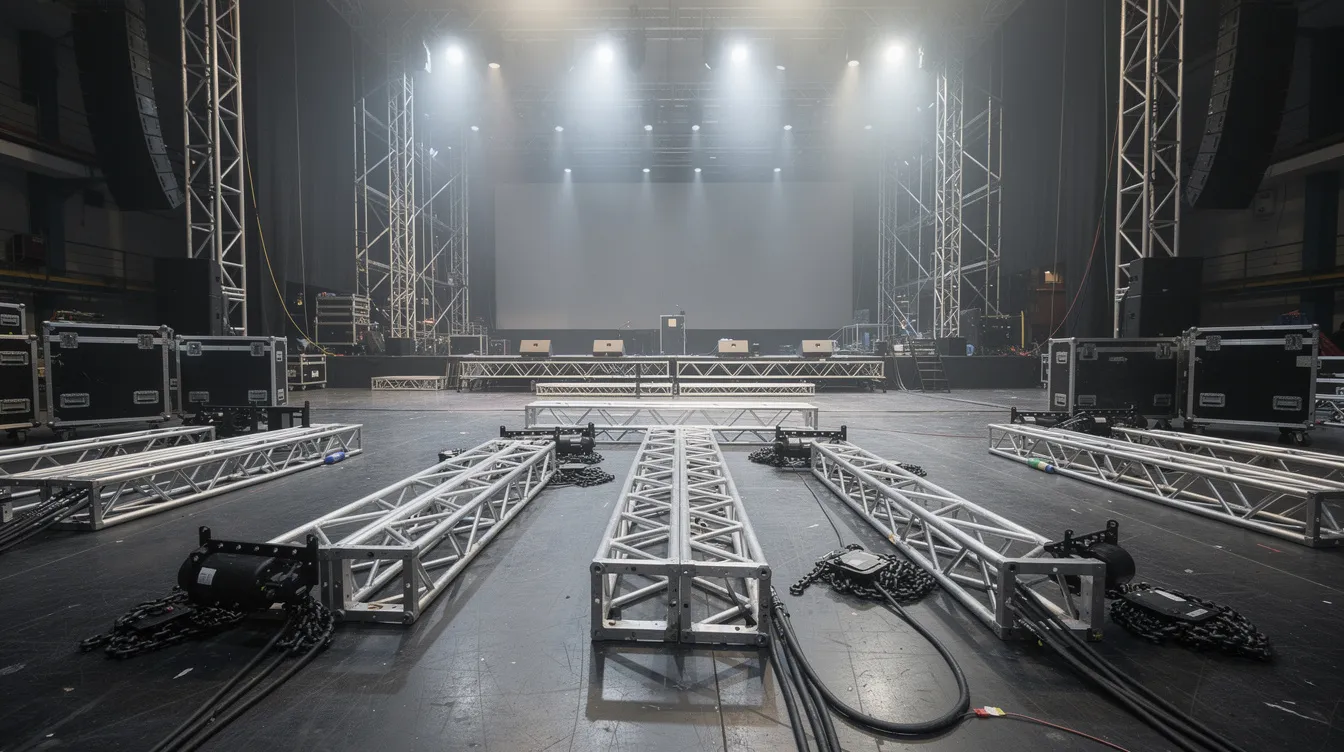
The image depicts a wide shot of aluminum truss sections and chain hoists arranged on the stage floor, preparing for the assembly of an LED wall. Various components are visible, indicating the setup for a video wall rigging system, showcasing the structural support needed to safely hang the LED display.

Indoor vs. Outdoor: Structural, Weather and Safety Considerations

Indoor LED walls eliminate wind and rain loads but introduce their own constraints: ceiling heights, rigging grid capacity, sprinkler and life-safety clearances, floor loading, egress routes behind the video wall, and coordination with other production elements sharing the same space. LED walls generate substantial heat requiring adequate ventilation, which matters in enclosed ballrooms and theaters. Perform static load tests and dynamic simulations before live operation to confirm the assembly behaves as designed.

Outdoor LED walls and outdoor LED screens face additional structural demands. Wind loading, rain and moisture protection for power and data connections, ground softness, and movement of the structure on uneven terrain all require engineering attention. ANSI E1.21 and related ESTA documents address temporary outdoor entertainment structures, helping engineers and riggers define minimum design criteria for towers, roofs and ground supported systems. The American Meteorological Society’s weather safety statement supports the need for a formal weather plan at public outdoor gatherings, including defined responsibilities, monitoring and response triggers for high winds, lightning and severe weather.

A ballasted or mobile LED wall may need to be lowered, retracted, or powered down at specific conditions defined by the manufacturer and project engineering. Planners must know who is authorized to make that call during the event. Universal “safe wind limits” cannot be given in an article; actual limits must come from manufacturer manuals and project-specific engineering documentation.

Cable Management, Power, Access and Operational Safety Around the LED Wall

Rigging is more than holding the screen up. It also means maintaining safe surroundings for crew and audience. Cable management is crucial to avoid interference and maintain safety. Power and signal cables for LED walls and processors must be routed so they do not create trip hazards, stress connectors, or block egress paths. Power distribution must be mapped to prevent voltage drops across the system.

Technicians need safe access behind and beside the LED wall to service LED panels, power supplies and cabling. Wall-mounted displays provide front access for maintenance, but ground-supported and stacked configurations need rear clearance lanes. Planners should account for that space instead of placing the screen hard against walls or audience barriers.

Flown LED video walls may require exclusion zones below the structure during load-in and load-out, plus fall-protection systems for riggers working at height in line with standards such as ANSI E1.39. Prior to opening, check every connection and verify the wall is mechanically secure. Maintain a clear emergency plan covering potential rigging failures. Front Row FX’s onsite technicians coordinate power distribution, cable runs, and access planning as part of LED screen wall production and broader concert production and tour support.

Coordination, Documentation and Qualified Personnel

Planners are not expected to be the structural engineer. They are responsible for assembling the right team and information. Professional LED wall installation relies on collaboration between the production provider, venue, rigging vendor, and when appropriate, a structural engineer.

Venues and authorities may request: a rigging plot, total weight and anticipated point loads, support-structure drawings, a ballast plan for ground supported walls, and proof that equipment follows manufacturer instructions. Maintain current rigging documentation to ensure safety and compliance throughout the event lifecycle. The Event Safety Alliance notes that laws and regulations set only minimum legal requirements; voluntary, peer-reviewed consensus standards and documented safety planning fill the remaining gaps.

Certified riggers are essential for overseeing proper setup and safety checks. A minimum 5:1 safety factor applies to LED wall rigging hardware. Front Row FX is not acting as the event’s structural engineer of record. We serve as a production partner that helps organize required information, work with house riggers and connect planners with the appropriate technical experts for corporate event production and large-scale live events.

What Planners Should Provide to Get a Safe, Realistic Recommendation

Before requesting LED wall rigging options, gather the following: event date(s), city and venue name, whether the setup is indoor or outdoor, approximate LED wall size and aspect ratio, and desired screen locations on your stage or site plan.

Content and use matter too. Whether the screen will carry IMAG, presentations, LED video backgrounds, live camera feeds, or sponsor loops can influence screen height, width, resolution and, ultimately, system weight.

Collect venue documentation where possible: rigging plots, ceiling heights, known load limits, floor construction, and any published ground support or “no-rig” zones. Note the floor or ground conditions near the proposed LED wall location: concrete slab, ballroom with raised stage, temporary deck, turf, asphalt, gravel, or lawn.

Share the broader production picture: lighting positions, audio hangs, scenic elements, and paths of travel for equipment and crew. This allows LED wall structural support to be integrated rather than competing for the same rigging points or floor space. Front Row FX uses this information to propose appropriate LED wall configurations, coordinate with venues across Minnesota, Wisconsin, Illinois and Georgia, and bring in rigging and engineering resources as needed.

Quick Planning Checklist and FAQ

Planning checklist:

  • Confirm event date, location and venue

  • Define LED video wall purpose and approximate size

  • Identify indoor vs. outdoor setup

  • Collect rigging plots and floor or ground information from the venue

  • Determine whether ground supported, flown, ballasted or mobile options are feasible at the site

  • Confirm who at the venue approves video wall rigging plans

  • Plan for weather monitoring (outdoors) and access around the wall

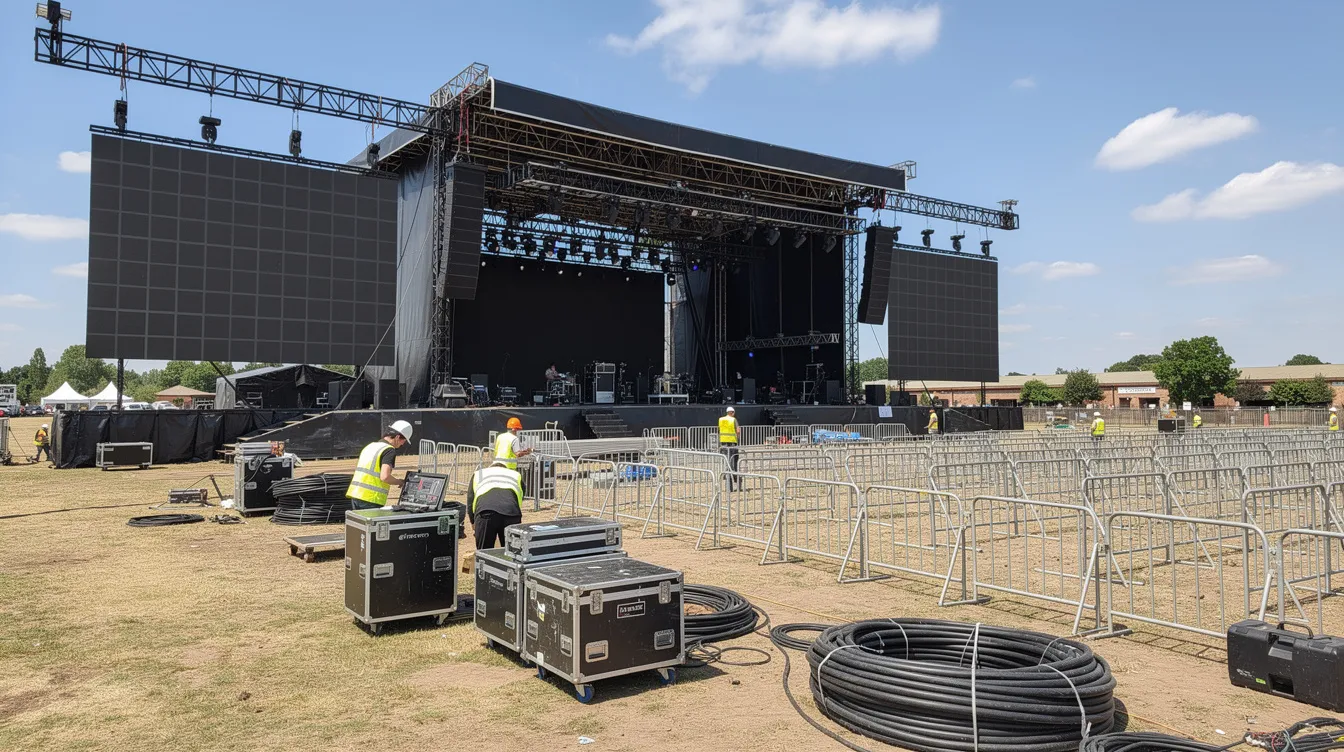
An outdoor event site is being prepared for a festival, featuring a temporary stage structure with large LED screens, including a video wall rigging system for optimal display. The setup involves careful assembly of ground-supported walls and overhead rigging to ensure safety and support for the total weight of the equipment.

Next Steps: Coordinate Your LED Wall Rigging Plan with Front Row FX

Safe LED wall rigging is an engineered process shaped by screen size, total weight, venue structure, ground conditions and weather. Planners’ primary role is to assemble accurate information and qualified partners, then let the technical professionals do what they do best.

Contact Front Row FX with your event date, location, venue, indoor or outdoor environment, desired LED wall dimensions, stage layout, proposed screen positions, available rigging information, floor or ground description, and production schedule. With this information, we can recommend whether a ground supported LED wall, flown LED video wall, ballasted structure or mobile solution is appropriate, and coordinate with venues, riggers and engineers to document a responsible approach.

Explore our LED screen wall production, concert production and tour support, or full event production services for more on how we work. Collaboration, safety and clear communication form the foundation of successful video wall rigging for corporate events, galas, festivals and concerts.

FAQ

Most frequent questions and answers

Many LED walls can be ground supported with appropriate frames and ballast, provided floor loading, space and structural requirements are met by a designed system.

Ground support requires proper ballast, typically 50 to 100 percent of wall weight, depending on the configuration.

Total weight varies by product and screen size. A typical 20×12 foot LED wall weighs 3,500 to 4,500 pounds before adding hardware and cables.

Exact values come from manufacturer documentation and project-specific calculations, not a single standard number.

Many ground support systems, especially taller or curved configurations and outdoor builds, do require engineered ballast.

The amount depends on the specific structure, height, angle and environmental conditions and must be calculated by qualified professionals.

Safety decisions rest with qualified riggers, a structural engineer when required, and the venue’s responsible authorities.

They use manufacturer documentation, applicable standards and project-specific engineering. Front Row FX facilitates this process but does not replace those roles.

Venues typically request total weight, support method (ground supported, flown, ballasted or mobile), point loads if flown, structural drawings or system descriptions, and confirmation that qualified personnel will perform the work.

Categories
LED Screens & Video Walls

How to Choose Outdoor LED Screen: A Guide to Your Best Options

How to Choose an Outdoor LED Screen for an Event

Selecting an outdoor LED screen for a live event is not as simple as picking the biggest display or the lowest quote. The best outdoor LED screen for a downtown Minneapolis watch party differs from the right choice for a rural Wisconsin festival, even when the physical dimensions look similar on paper.

How to Choose an Outdoor LED Screen: Key Factors at a Glance

Choosing an outdoor LED screen requires evaluating many factors simultaneously: audience size, viewing distance, daylight exposure, screen dimensions, weather conditions, structural support, power distribution, content format and venue restrictions. Each of these shapes the final system in ways that a spec sheet alone cannot communicate.

Here are the core decision areas every event team should work through:

  • Screen size relative to audience layout and sightlines

  • Brightness measured in nits for the specific lighting conditions

  • Pixel pitch matched to viewing distance and content type

  • Weather resistance verified through IP ratings and manufacturer specs

  • Mounting method: ground-supported, flown, trailer or wind-permeable

  • Structural engineering, ballast and wind management

  • Power availability, cable paths and energy efficiency

  • Content resolution, aspect ratio and outdoor readability

  • Venue access, permits and local restrictions

Total cost considerations for outdoor LED include installation, maintenance, and energy costs, not just the rental price of panels. Front Row FX works as a production partner across Minnesota, Wisconsin, Illinois and Georgia to match the complete outdoor LED wall system to each specific event, coordinating everything from LED screen wall production to on-site technical operation.

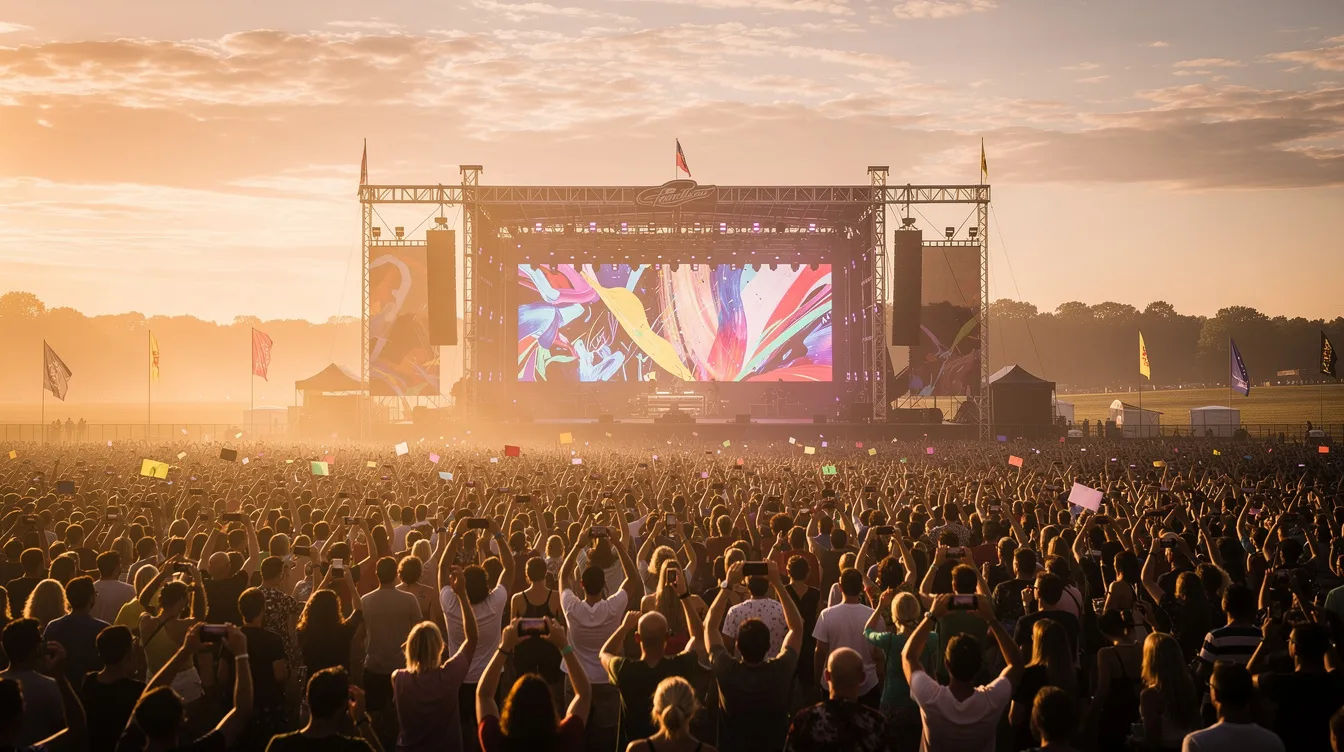
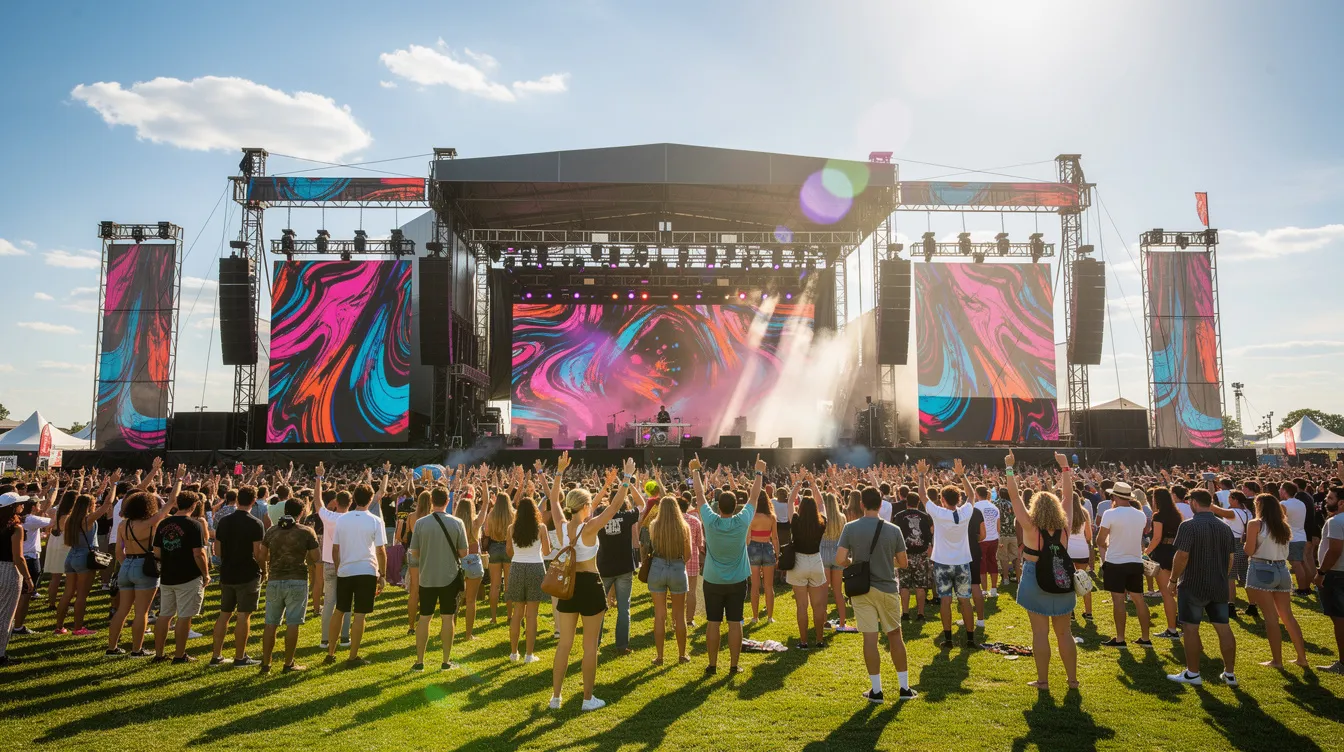
A wide shot captures a vibrant crowd at an outdoor festival, gathered in an open field as they enjoy a large outdoor LED screen displaying dynamic visuals against a stunning sunset backdrop. The scene highlights the importance of high brightness and excellent visibility for outdoor LED displays, ensuring that attendees can clearly see the content even in the fading light.

Defining Audience, Viewing Distance and LED Wall Size

Audience size, layout and sightlines are the foundation for any outdoor rental LED screen decision. Before discussing brightness or resolution, you need to understand where people will stand or sit relative to the screen.

Start by estimating three distances: first row (closest viewers), mid-crowd and back-of-house (farthest spectators). For a community watch party, the first row might be 20 feet away and the back 80 feet. For a large festival, those numbers could be 30 feet and 300-plus feet.

  • A few hundred attendees in a park typically need a smaller LED wall, perhaps 12 to 16 feet wide

  • Mid-size events of 500 to 2,000 people often call for screens in the 16 to 24 foot range

  • Large-scale gatherings of several thousand may require video walls 28 feet wide or larger, sometimes with multiple screens

A taller LED wall often matters more than adding width in flat outdoor spaces. People standing farther back need to see above the heads and staging in front of them. Height improves sightlines dramatically.

Aspect ratio should follow content type: 16:9 for live camera and video, 4:3 for presentation slides, and custom layouts for scoreboards or sponsor loops. The ideal screen size always depends on context. For deeper sizing strategy, see our guide on LED wall size for events.

Brightness and Visibility in Daylight, Shade and at Night

Outdoor LED screen brightness is measured in nits (candelas per square meter), which describes how much light the display emits per unit of surface area. Unlike indoor environments, outdoor LED screens must overpower ambient light from the sun, sky and surrounding reflective surfaces to ensure visibility.

Outdoor LED screens require high brightness over 5,000 nits for daytime use, and outdoor LED displays need brightness over 5,000 nits especially when facing direct sunlight. Bright sunlight and snow glare necessitate high brightness levels for readability, sometimes pushing requirements to 6,500 nits or higher. High brightness combats glare in direct sunlight effectively, but brightness impacts visibility in various lighting conditions differently:

  • Daytime in direct sun: 5,000 to 8,000+ nits depending on orientation and reflective surroundings

  • Shaded or semi-outdoor conditions: 3,000 to 5,000 nits often sufficient

  • Evening and night events: lower brightness with dimming to avoid glare, light pollution and neighbor complaints

Brightness levels can be adjusted based on ambient light. Screens with auto-brightness sensors or operator-controlled dimming automatically adjust output at dusk, reducing energy consumption and improving comfort. LED displays are designed for high visibility in harsh conditions, but content design matters equally: bold fonts, high-contrast graphics and large elements read far better outdoors than fine detail.

Brightness levels must consider daytime conditions in Minneapolis for clear visibility, and local regulations in Minneapolis govern the brightness and operational limits of LED displays. Front Row FX assesses sun paths, venue photos and event schedules to recommend suitable brightness capabilities for each deployment.

Pixel Pitch, Viewing Distance and Image Clarity

Pixel pitch is measured in millimeters between LED centers and directly affects the clarity of images on LED displays. A smaller pixel pitch provides higher resolution displays with sharper images, while a larger pitch reduces cost and weight.

The general rule of thumb is 1 meter of viewing distance per millimeter of pixel pitch. Here is how common pitches map to distance:

  • P4 to P6 panels: suitable for audiences starting around 4 to 6 meters away, common for mid-size outdoor events

  • P8 displays are best viewed from 10 to 30 meters away, making them practical for festivals and fairgrounds

  • P10 displays have a best viewing distance of 8 to 24 meters (some sources cite 10 to 30 meters), ideal for long distance visibility at large gatherings

A smaller pixel pitch is ideal for close-up viewing and camera-heavy productions using IMAG, where higher pixel density improves image clarity for close viewers. Smaller pixel pitch is needed for closer viewing distances, but choosing an extremely fine pixel pitch for a large field event increases cost without visible benefit when viewers are too far away to perceive the extra resolution.

High refresh rates reduce visual distortion in LED displays, which matters for camera capture and fast-motion content. For detailed technical guidance, see our resource on LED wall pixel pitch. Front Row FX balances the right pixel pitch with content resolution, physical screen size and viewing distance rather than optimizing any single factor in isolation.

Weather-Resistant Outdoor LED Panels and IP Ratings

A weather resistant LED screen relies on sealed modules, conformal coating on circuit boards, gaskets between panels and outdoor-rated power and data connections. These features protect the light emitting diodes and electronics from moisture, dust and ultraviolet rays.

IP ratings follow the IEC 60529 standard. The first digit (0 to 6) indicates solid particle protection, and the second digit (0 to 9K) indicates water resistance. LED displays should have at least an IP65 rating for weather protection, meaning fully dust-tight and protected against water jets. Many outdoor LED screens are rated IP65 or higher for weather protection, with some systems offering IP66 or IP67 for harsher environments.

However, “weather resistant” is not the same as weatherproof in all conditions. Outdoor LED screens must withstand extreme temperatures and humidity, and outdoor LED displays withstand high humidity and extreme temperatures within their rated range. LED displays can operate in wet conditions like rain and snow, and outdoor LED screens are designed to resist high winds during storms, but each system has manufacturer-defined limits. LED screens must have lightning protection for outdoor installations, and electrical safety through GFCI protection, proper grounding and weather-protected power distribution is as important as the panels’ IP rating.

For events in the Upper Midwest, sudden rain showers, spring snow, heavy dew and wide temperature swings between afternoon and late evening are practical realities. Front Row FX reviews manufacturer specs and weather guidelines for each outdoor LED screen rental deployment.

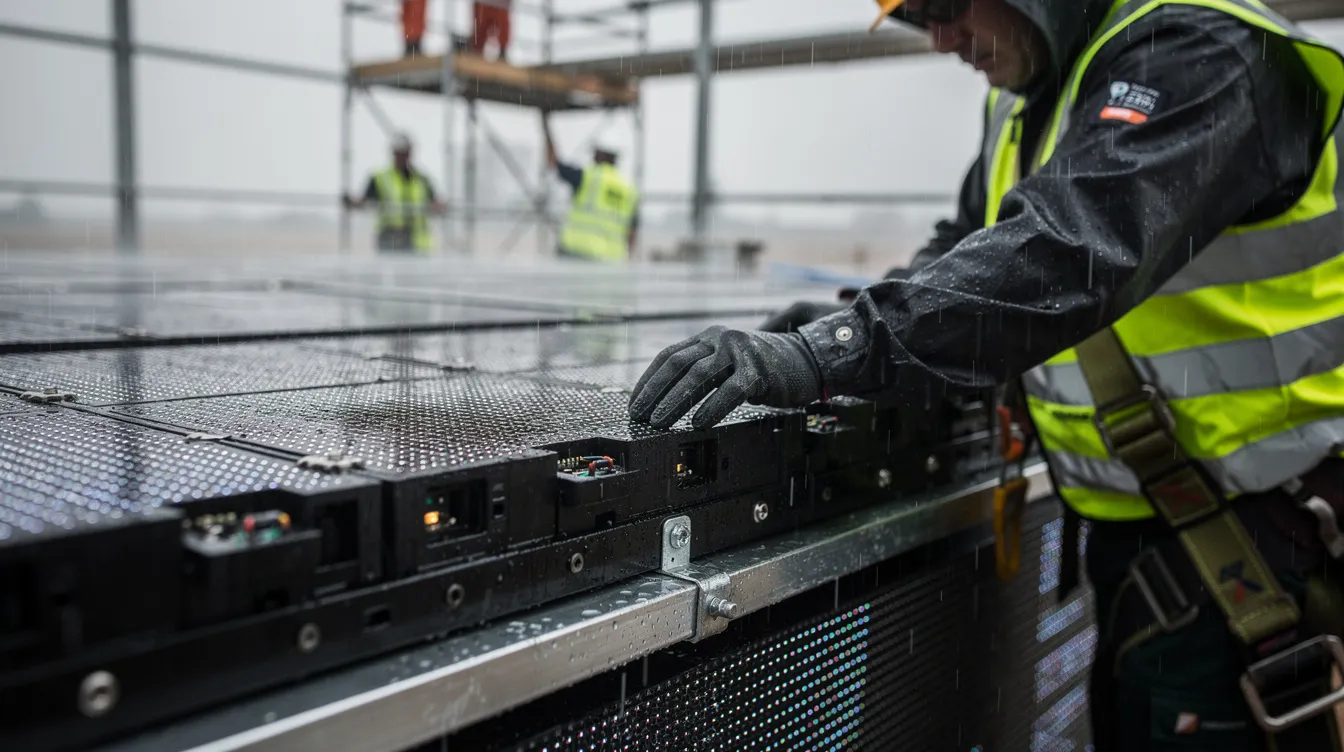
A close-up view of outdoor LED screen panels being assembled in light rain, with crew members wearing safety gear to ensure a secure installation. The image highlights the importance of outdoor LED display technology in various weather conditions, emphasizing the need for excellent visibility and durability in public spaces.

Mounting Options: Ground-Supported, Flown, Trailer and Blow-Through Screens

The support structure is a major safety and logistics decision for any outdoor LED wall. Here is how the four primary options compare:

Configuration

Typical Application

Primary Advantage

Key Planning Consideration

Ground-supported outdoor LED wall

Festivals, fairgrounds, corporate outdoor programs

Flexible placement; ground support systems allow flexible height and width adjustments

Ground loading capacity, ballast requirements, level surface needed

Flown outdoor LED wall

Touring concerts, large stages with roof systems

Better audience sightlines with elevated position

Flown mounting requires strong structural support for safety; certified rigging points required

Mobile LED screen trailer

Community watch parties, one-day city events, temporary activations

Fast setup and teardown; self-contained power and data

Truck access, parking footprint, trailer weight on surface

Wind-permeable / blow-through LED screen

High-wind venues, open plazas, exposed locations

Reduced wind load by allowing airflow through panels

Does not eliminate need for engineering, ballast, rigging or wind monitoring

LED screens can be wall-mounted for a clean look in certain venue configurations, and mobile LED screens are often mounted on vehicles for events where load-in windows are tight. Installation methods affect maintenance access and overall cost, so the choice shapes both budget and logistics.

Blow-through LED screens allow air to pass through, reducing but not removing wind loads. They still require professional engineering, ballast, active wind monitoring and documented shutdown thresholds. A mobile LED screen trailer may be the most practical giant LED screen rental choice for one-day community events with street closures or limited setup time. Front Row FX evaluates stage design, audience placement, venue rigging capacity and access routes before recommending any mounting method.

Structural Engineering, Ballast, Rigging and Wind Management

Structural safety is non-negotiable. Large LED walls act like sails, and wind loads often govern structural requirements more than the weight of the panels themselves. Wind-rated structural engineering is essential due to potential severe weather in Minneapolis, where weather conditions include significant temperature swings and heavy snow.

Engineering requirements depend on the LED wall size, height, support system, surface conditions and local regulations. Ballast or anchoring is almost always required for ground-supported screens, and the amount must come from engineered drawings and manufacturer guidance rather than generic formulas. For flown walls, certified hardware, proper bracing and regular inspections during the event are essential.

Thermal management systems are required to prevent overheating during summer events in Minneapolis and similar climates. Active wind management includes monitoring forecasts, using real-time wind sensors, maintaining documented threshold actions and coordinating decisions with event management. Front Row FX does not publish universal ballast values or wind-speed limits but works with structural engineers, venues and local authorities to design compliant outdoor LED wall installations.

Power, Cable Paths and Energy Efficiency Considerations

Estimating power needs early is critical. The total load includes LED panels, video processing, control systems, audio and lighting. LED billboards consume 30 to 46 times more energy than households, making power planning essential for outdoor use.

Energy-efficient LED displays reduce operational costs significantly. Industry targets aim to reduce power consumption from 660 watts to 110 watts per square meter, and some LED displays now consume only 100 watts per square meter. Auto-brightness adjustment optimizes energy use in LED displays by lowering output during twilight and nighttime hours, which also reduces generator size and fuel costs.

  • Confirm whether house power or a generator is available, and coordinate capacity early

  • Plan cable routes that avoid vehicle and foot traffic hazards using ramps or overhead trays

  • Use separate power circuits to prevent voltage drops and nuisance breaker trips during high-brightness content

  • Prepare emergency power plans including backup generators or orderly shutdown procedures

Front Row FX maps cable paths around audience areas, barricades and vendor tents to ensure safety and comply with local codes across each state served.

Content Resolution, Aspect Ratio and Outdoor Readability

Content resolution, aspect ratio and LED processing combine to deliver clear visuals on the chosen LED wall. Matching your media content to the display’s native pixel matrix avoids scaling artifacts that degrade image quality, especially with high resolution camera feeds.

  • Match content resolution to the LED wall’s native pixel matrix when possible

  • Choose an aspect ratio that fits primary content: 16:9 for live camera and video, custom layouts for scoreboards or sponsor grids

  • Avoid tiny text, thin lines and low-contrast color combinations that disappear in daylight

For LED screens for concerts, IMAG camera feeds, lyrics and branding need specific layout planning so critical information sits within the most visible central viewing area. Content management systems enable remote updates for LED displays, and a dedicated content operator ensures smooth transitions and emergency messaging capability. Front Row FX helps clients preflight graphics and videos for outdoor LED display visibility.

Venue Access, Load-In, Permits and Local Restrictions

Logistics and approvals often determine which outdoor LED wall option is realistic, especially in city centers and public spaces.

  • Truck and trailer access for LED panels, truss and mobile screen trucks

  • Load-in windows relative to street closures, park hours and neighboring events

  • Required footprint for ground-support bases, ballast, control and power distribution

Permitting may involve city or park authorities, building management and transportation departments. Some municipalities enforce limits on maximum brightness, operating hours and advertising content for outdoor signage. Front Row FX coordinates approvals, access routes and build schedules with event producers and local partners in Minnesota, Wisconsin, Illinois and Georgia.

Outdoor LED Screen Selection Checklist

Use this checklist when gathering information for your outdoor LED screen planning:

  • Event basics: date(s), city, venue, schedule, expected attendance and programming style (concert, festival, ceremony, watch party, corporate program)

  • Visual goals: type of content (live camera, slides, sponsor loops, scores, feeds), desired LED screen size and approximate viewing distances

  • Environment: sun direction, shade, typical weather, wind exposure, surface type (pavement, turf, gravel)

  • Technical: brightness expectations, pixel pitch preference (if known), audio needs, camera use, content sources and format

  • Structure: preferred mounting (ground-supported, flown, trailer, blow-through), rigging options, known venue restrictions

  • Power and logistics: power availability, generator plans, access routes, load-in times, cable paths, local permits and neighborhood considerations

Sharing this checklist with Front Row FX allows the team to recommend an appropriate outdoor rental LED screen system and complete LED screen wall production package.

Planning Your Outdoor LED Screen with Front Row FX

Choosing an outdoor LED wall involves screen size, brightness, pixel pitch, weather resistance, support structure, power, content and logistics working together as a system. The right configuration depends on your specific event, not a catalog model number.

Contact Front Row FX with these details to begin:

  • Event date(s)

  • City and venue

  • Expected audience size and general layout

  • Viewing distances to the LED wall

  • Preferred screen dimensions or rough size ideas

  • Event hours and whether the screen runs in full daylight, twilight or after dark

  • Screen orientation if known (e.g. facing west toward the sunset)

  • Content format (camera, slides, media files, feeds)

  • Available power and generator plans

  • Expected outdoor conditions and any known venue restrictions

Front Row FX uses this information to recommend a complete production configuration, including LED display technology, support structure, video processing, power distribution and on-site technicians. Reach out early in the planning timeline for outdoor events in Minnesota, Wisconsin, Illinois and Georgia so site visits, engineering reviews and permitting can be completed without schedule pressure.

Outdoor LED Screen FAQ

Most frequent questions and answers

Outdoor-rated LED displays can operate in light to moderate rain within their IP and manufacturer specifications.

Heavy storms, lightning and high winds may require powering down or lowering the screen. Each system has specific limits that must be reviewed before deployment.

Brightness is measured in nits.

Screens in direct sunlight generally need over 5,000 nits, while shaded or evening events may work with 3,000 to 5,000.

There is no universal value. Front Row FX selects appropriate brightness based on orientation, schedule and outdoor environments rather than applying a single number.

Size depends on audience count, viewing distance, venue sightlines and content type.

A 500-person park gathering and a 5,000-person fairground concert require very different screen dimensions.

Share your event map so Front Row FX can propose specific sizing through a detailed consultation.

Nearly all large outdoor LED walls require engineered support.

Ground-supported systems need calculated ballast; flown systems need certified rigging hardware.

Generic formulas are not sufficient. Engineering must be specific to the configuration, venue and local requirements.

Yes. High brightness LED displays with appropriate orientation, contrast-rich content and careful placement achieve excellent visibility in direct sun.

Screen positioning and schedule planning are important to ensure clear visibility throughout the event day.

Standard practices include lowering or rotating ground-supported walls, powering down systems, securing structures and evacuating front-of-house areas if needed.

These actions follow the event’s overall severe-weather plan and documented wind threshold procedures.

Categories
LED Screens & Video Walls

LED Screens for Concerts: Size, Placement and Production Planning

LED Screens for Concerts: Size, Placement and Production Planning

A concert LED screen must be planned around far more than panel dimensions. The audience, stage layout, viewing distance, content format, camera system, lighting design, rigging method, weather exposure and production schedule all determine whether the screen system will actually work on show day.

Concert LED screen essentials (quick answers first)

Screen size alone does not guarantee a successful visual production. A massive LED wall that is poorly located, running low-resolution content at the wrong aspect ratio, or mounted without proper structural evaluation will underperform a smaller, well-planned system every time. Concert LED screens are integrated components of the wider production-not isolated equipment rentals.

The difference between adequate results and outstanding performance starts with how the project is scoped:

  • Screen-only rental mindset: renting LED panels with minimal content support, no custom design, limited staffing, and little coordination with lighting, audio or staging.

  • Full LED screen wall production: includes content creation and specification, video processing, rigging or ground-support engineering, lighting and show integration, camera and IMAG setups, qualified crew for operation and troubleshooting, pre-production testing, color calibration and schedule coordination.

Key planning factors at a glance:

  • Stage width, depth and available trim height

  • Audience capacity, depth and sightline geometry

  • Content type-scenic playback, IMAG, sponsor messaging or a combination

  • Pixel pitch relative to closest and farthest viewing distance

  • Rigging capacity or ground-support requirements

  • Indoor or outdoor setting, including weather conditions and brightness needs

  • Load-in window, rehearsal time and show schedule

Front Row FX is a full-service audiovisual production company based in Minnesota, serving concerts, festivals and live events across Minnesota, Wisconsin, Illinois and Georgia.

Why LED screens are used in concert production

LED screens, video walls and LED displays have moved from optional backdrops to essential production layers in modern concerts, music festivals and tours. They solve visibility problems, support visual storytelling, deliver sponsor value and create immersive atmospheres through synchronized animations and effects.

LED screens enhance storytelling by visualizing song narratives and engaging audiences in ways that stage lighting alone cannot accomplish. Using LED screens transforms concert production from simple backgrounds to essential elements of the show design.

Primary functions include:

  • IMAG (image magnification): live camera feeds driven by a video director so audience members in distant seats can see performer close-ups. Large LED screens enable close-up feeds for audiences in the back rows of venues.

  • Artist visuals and playback content: pre-rendered motion graphics, lyric treatments, album art and video content synchronized with the music.

  • Scenic LED: content designed for stage geometry-columns, ribbons, floor panels, wrapping structures-to create theatrical depth and atmosphere.

  • Sponsor and partner messaging: dedicated content slots for sponsor logos, brand bumpers, walk-in and walk-out loops.

  • Audience information: safety announcements, set times, event messaging during intermissions or delays.

As a concrete example, a 2025 summer festival in Minneapolis used a central upstage LED wall approximately 40 ft wide plus flanking side screens for IMAG, allowing upper lawn and back-of-house attendees to see performer expressions clearly. High-definition LED displays are crucial for maintaining engagement in large venues like this, where the farthest seats may be 200 ft or more from the stage.

LED screens improve production value by enabling high-quality visual displays during events. They integrate directly with audio, lighting and staging-not as a standalone add-on, but as a core layer of the show design where video content, lighting cues and audio timecode often run in sync.

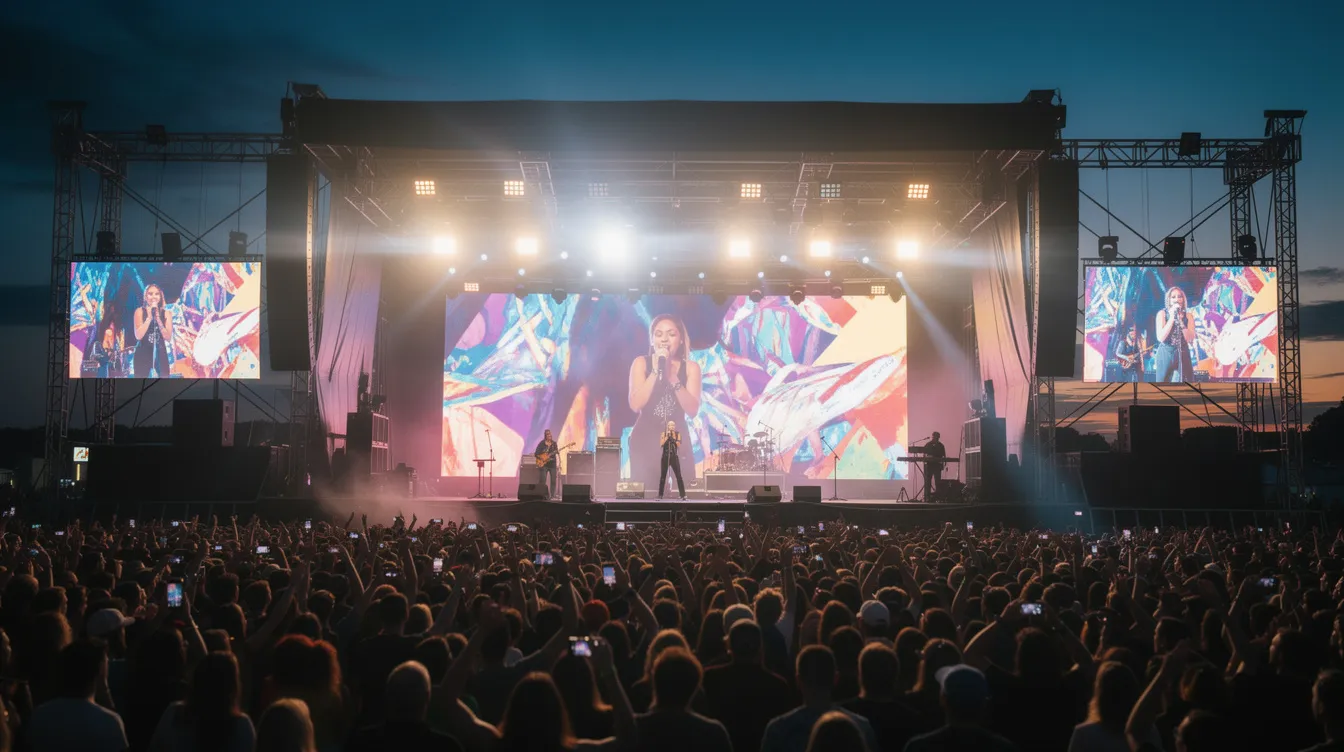
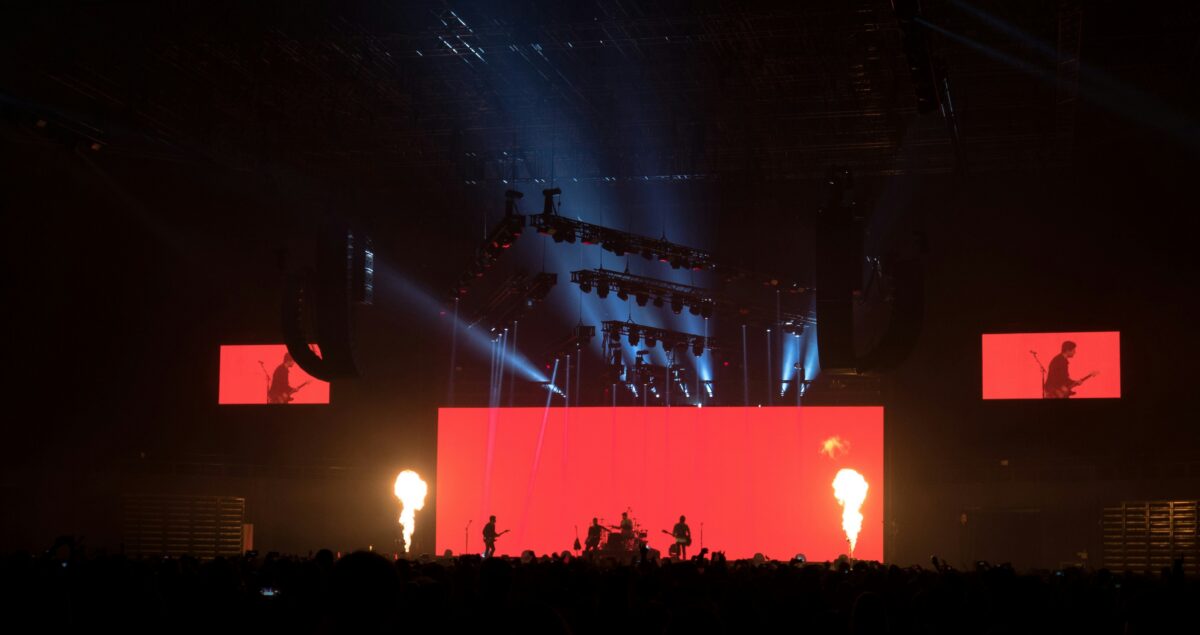
A wide shot of a large outdoor concert stage at dusk showcases vibrant LED video walls behind the performers, flanked by LED displays on either side, creating a visually striking atmosphere for the audience members enjoying the concert experience. The high brightness and clear image quality of the screens enhance the visual impact of the live event, making it an unforgettable moment.

Selecting LED screen size for concerts: audience and stage first

LED wall size depends on stage width, available trim height, venue capacity, audience depth and whether the screen is primarily scenic or intended for live camera magnification. Giant LED screens can be configured to any size or shape, but the right dimensions are always driven by the specific show, not a universal chart.

Practical ranges to consider:

  • For a 40 ft (12 m) wide festival stage, a typical upstage concert LED screen might be 24–36 ft wide and 12–16 ft tall.

  • For a 60 ft (18 m) main stage, walls often extend 40–50 ft wide with heights of 15–20 ft.

  • The goal is that the content fills a reasonable field of view for mid-house without overpowering lighting or scenic elements.

Three common scenarios:

  • Club or theater under 1,500 people: stage width 30–50 ft; screen width 12–20 ft; pixel pitch in the 2.6–3.9 mm range; IMAG may be unnecessary if the venue is shallow.

  • Mid-sized arenas, 3,000–8,000 capacity: stage widths 50–80 ft; upstage LED walls 30–50 ft wide plus side IMAG screens; pixel pitch between 3.9–5.9 mm.

  • Outdoor festivals, 10,000+ people: stage widths 60–100 ft; main upstage walls 40–60 ft wide or more; coarser pixel pitch (4.8–6.9 mm); high brightness panels to handle daylight.

Modular designs allow for customizable screen sizes, so walls can be scaled precisely rather than forced into fixed dimensions. Front Row FX helps translate creative direction and content resolution into concrete LED wall dimensions rather than offering a one-size solution.

Common concert LED screen placements and configurations

Most concert stages use some combination of central, side and scenic LED surfaces. The specific configuration depends on the venue, audience layout, creative brief and structural capacity.

  • Central upstage LED video wall behind the band. The primary content surface for artist visuals, motion graphics and scenic looks. Standard for touring productions and festival main stages. Often the largest single screen in the system.

  • Left/right side screens for IMAG in arenas and outdoor shows. Dedicated to live camera feeds so off-axis and distant audience members can see performers. Common in arenas, amphitheaters, stadiums and deep festival fields.

  • Scenic LED panels, ribbons or columns built into risers and set pieces. Used for theatrical-style productions, design-heavy tours and shows where visual effect matters as much as content delivery. Modular LED designs allow for creative stage configurations and dynamic backdrops.

  • Ground-supported outdoor LED screen when rigging points are limited. Self-supporting frames or ballast-weighted structures used in venues without adequate overhead capacity. Height may be limited by structural constraints.

  • Multi-screen or asymmetric layouts for tours and festivals. Mixes of central, side, scenic and depth panels used to create distinctive looks, serve multiple audience zones or reinforce branding.

Most large concerts combine several surfaces-for example, one big upstage wall plus two side video walls for visibility-with scenic strips or columns adding visual depth. LED technology allows for extensive customization in visual setups for concerts and events, and modular LED panels allow customizable configurations for various events, adapting to each show’s requirements.

Center-screen, upstage and side-screen applications

An upstage LED wall is the centrally located screen behind performers. Side IMAG screens sit stage-left and stage-right, dedicated primarily to live camera feeds. Secondary surfaces-scenic columns, floor LED, fascia strips-fill supporting roles.

The central upstage LED wall:

  • Primary use: artist visuals, motion graphics, scenic looks, logo and album art.

  • Typical aspect ratios include 16:9, ultra-wide 32:9 or custom proportions for panoramic content. Full-width content is common.

  • LED panels maintain sharp contrast and vivid colors under intense concert lighting, making this surface effective even with aggressive stage washes.

Side IMAG screens:

  • Positioned left and right of the stage for camera feeds.

  • Sized so faces and instruments are readable from the back of the audience area.

  • Content is typically simpler-live camera rather than heavily produced graphics.

Some productions pull camera feeds into the upstage wall while side screens show IMAG simultaneously. Other designs keep the upstage wall reserved for artistic visuals and dedicate side screens exclusively to IMAG. The choice depends on content budget, performer movement and creative direction.

Screen placement must align with truss positions, line array speaker hangs, followspot locations and sightlines from VIP areas, FOH and delay tower positions. A screen that sits behind a speaker array or below a lighting truss line becomes invisible to significant portions of the audience.

When side screens and IMAG are necessary for audience visibility

IMAG-image magnification-uses live cameras to feed LED screens so that distant audience members can see performers clearly. It is a production decision, not just an equipment add-on, because it requires cameras, operators, switching, signal distribution and careful planning for latency and image consistency.

Side LED screens become important when:

  • Outdoor fields are deeper than approximately 150–200 ft (45–60 m) from stage to the farthest rows.

  • Arenas, amphitheaters and stadiums have upper seating sections where performers appear as small figures.

  • Festivals use multiple audience pens and FOH positions set far from the stage.

Side IMAG screens are especially important for seated audiences, corporate hospitality areas and sponsors expecting clear views. Screens displaying live camera feeds and social media content enhance audience interaction and help every attendee feel connected to the moment on stage, regardless of their position.

Adding cameras, switching and signal distribution is a production-level decision that must be scoped during preproduction. Front Row FX can provide camera systems, operators and switching alongside the LED displays as part of broader live event production.

Choosing LED wall pixel pitch and brightness for concerts

Pixel pitch is the distance in millimeters between the center of one LED pixel and the next. A smaller pitch produces a higher resolution display with finer detail, but increases cost per square meter, power consumption and processing demand. High pixel density ensures detailed visuals at concerts, and the right pitch depends on viewing distance and content type.

Practical ranges for concert LED screens:

  • Indoor theaters and close viewing: 2.6–3.9 mm pixel pitch.

  • Arenas and mid-size fields: 3.9–5.9 mm.

  • Large outdoor stages with long throw distances: 4.8–6.9 mm and beyond.

A finer pixel pitch allows closer seating and more detailed content-suitable for front-row VIPs or broadcast-quality requirements-but increases cost and processing requirements. A P3.9 panel, for example, offers good clarity at minimum viewing distances of approximately 20–26 ft.

Brightness requirements vary significantly:

  • Indoor concerts: typically 800–1,200 nits is adequate under controlled lighting.

  • Outdoor daytime festivals: 4,000+ nits and calibrated contrast are often required. Some festivals use 5,000–6,000 nits to counter direct sunlight. LED screens provide high brightness and clarity for better visibility, and high contrast enhances clarity in large outdoor venues.

Blow-through or wind-permeable LED panels are used in some outdoor designs to reduce wind load, but they still require engineering, ballast and weather monitoring. They offer easy maintenance with module replacement options, which simplifies servicing during multi-day festivals. Products like the R Series panels feature seamless splicing for a flat display surface even across large configurations.

The image features a close-up view of an LED panel surface, showcasing individual pixel modules meticulously arranged in a grid pattern. This high-resolution display exemplifies the visual quality and brightness often found in LED screens used for outdoor events and concerts.

Content resolution, aspect ratio and playback preparation

The LED display must be designed around actual content resolution and aspect ratio-16:9, ultra-wide, portrait columns or custom canvases. Mismatched content results in stretched, letterboxed or cropped visuals that undermine the entire investment.

Panel counts translate directly into total pixel dimensions. If 500 × 500 mm panels are arranged 20 across and 8 high, the wall is 10 m wide and 4 m tall. The native pixel resolution of each panel multiplied across the array determines the content canvas size. Align this with common content formats (1080p, 4K or custom resolutions) so that files render at native resolution without scaling artifacts.

Content types to plan for:

  • Playback: artist visuals, lyric treatments, motion graphics, sponsor logos, transitions.

  • Show branding: tour titles, city and date slides, walk-in and walk-out looks.

Preparing content for the LED screen:

  • Request final files at correct pixel dimensions and frame rates well before load-in.

  • Provide safe areas to avoid critical details near edges or behind scenic masking.

  • Test colors and contrast against stage lighting in rehearsal when possible.

Front Row FX can coordinate with creative teams and agencies to define content specs and test them against the planned LED screen layout, ensuring that every visual element lands where it should.

Live cameras, playback and video signal workflow

Live camera IMAG and playback content are separate source types that merge through the video signal workflow before reaching the LED screen system. Understanding the difference-and planning the signal path-is what separates a reliable show from one plagued by dropouts, sync issues or misrouted feeds.

Core video workflow elements:

  • Cameras and operators capturing performer close-ups and wide shots.

  • Video switcher or production desk where a director selects and transitions between camera angles.

  • Media servers or playback systems storing and triggering pre-rendered content.

  • Signal distribution to LED processors and screens via SDI, fiber or Ethernet.

Planning considerations:

  • Latency and sync across multiple LED screens or video walls must be controlled, especially when combining IMAG and graphics on adjacent surfaces.

  • Each concert LED screen surface may receive a different feed-upstage wall for playback, side screens for IMAG, scenic strips for timecode-driven effects.

Practical needs:

  • Redundant feeds where appropriate to protect against signal loss.

  • Clear labeling and cable paths between FOH, stage and processor locations.

  • Intercom and communication between camera operators, director and LED techs.

Front Row FX provides end-to-end video workflow design, staffing and show operation-not just the LED panels. LED screens provide vibrant visuals for concert-goers, but only when the signal chain behind them is properly designed and operated.

Rigging, ground-support and structural planning for LED walls

Suspending a concert LED wall requires proper rigging points, structural evaluation and qualified personnel. This is not an area for improvisation. Every flown screen needs engineered load calculations, rated hardware (truss, chain motors, shackles with documented working load limits) and safety backups.

Common approaches:

  • Flown concert LED wall hung from venue or festival truss using rated motors and rigging bars.

  • Ground-supported LED video wall with self-supporting frames or ballast-weighted structures.

  • Hybrid setups mixing a flown center wall with ground-stacked side screens.

Planning considerations:

  • Total system weight including LED panels, frames and rigging hardware. Each modular panel weighs 7.6 kg for a 500 × 500 mm size, and weights accumulate quickly across a large wall.

  • Available trim heights, sightlines and masking to ensure the screen is visible without blocking lighting or audio positions.

  • Rigging access, lifts and timing during load-in-flown walls require overhead access and adequate schedule.

Lightweight touring panels are often preferred for multi-city runs to reduce transported and suspended weight and improve load-in efficiency. Modular LED panels can be quickly assembled and disassembled, and LED screens can be quickly set up and taken down, which matters when load-in windows are tight. However, lighter cabinets still require professional rigging and structural compliance.

Front Row FX works with venues, promoters and structural professionals to ensure appropriate rigging or ground support for each show, including documentation and safety verification.

Outdoor concert LED screens: weather, brightness and wind

Outdoor concerts add complexity that indoor settings avoid: weather exposure, direct sunlight, wind loads, uneven ground and extended cable runs. LED screens can perform reliably in different lighting conditions including daylight, but only with proper planning.

Weather-related planning:

  • IP-rated LED screens and weather-resistant signal and power connections. Outdoor LED screens can have an IP65 protection rating, protecting against water jets and dust ingress. Modular LED panels are designed for both indoor and outdoor use.

  • Rain plans for gear protection and safe shutdown procedures, including covered power disconnects.

  • Temperature considerations-LEDs and processors have operating ranges, and summer festivals in Minnesota or Wisconsin can swing from near-freezing mornings to intense afternoon heat.

They are designed to withstand rain, wind and dust, but structural engineering remains non-negotiable:

  • Both solid and blow-through video walls must be engineered for wind. Wind creates lateral loads that must be resisted through anchoring, ballast and guy wires.

  • Ballast, proper anchoring and monitoring weather forecasts are essential for any outdoor event.

  • Blow-through panels reduce, but do not eliminate, structural requirements.

Outdoor brightness:

  • High brightness LED screens for direct sun conditions-outdoor LED screens maintain visibility in bright sunlight at 4,000–6,000 nits. LED screens maintain visibility even in bright sunlight when properly specified.

  • Calibration of brightness after dusk to avoid washing out cameras or overpowering the concert experience at night.

A vibrant outdoor festival stage is set against a bright afternoon sky, featuring large LED screens displaying colorful visuals to an enthusiastic crowd gathered on a grassy field. The high-resolution LED displays enhance the concert experience, creating a dynamic visual impact for the audience members enjoying the live event.

Power, cable paths, testing and show operation

A concert LED display system is more than panels. It needs power distribution, signal paths, processing, networking and operators to function reliably. LED technology consumes less power and generates less heat compared to older display systems, but a large screen still demands careful electrical planning.

Power planning:

  • Estimate total power draw for LED screens, processors and playback gear. A typical panel may draw approximately 100 watts, and a large wall with hundreds of modules can demand hundreds of amps.

  • Coordinate with the venue or generator provider on tie-in locations and distribution.

  • Separate clean power for video where practical to avoid interference.

Cable and signal paths:

  • Plan routes between stage, FOH and any delay or satellite screens.

  • Allow for protected crossings and cable ramps in audience areas.

  • Build in slack and redundancy where possible.

Testing and rehearsal:

  • Allocate time for pixel checks, color calibration and playback tests.

  • Run through full show cues and camera looks when time allows.

  • Confirm failover procedures with the tech team.

Operation:

  • Define who calls video cues-tour LD, show caller or video director.

  • Ensure Front Row FX or client-provided operators are briefed on show flow and contingencies.

Concert LED screen planning checklist and comparison table

This section provides a quick-reference comparison table and a planning checklist for promoters and production teams.

Application

Primary Purpose

Typical Planning Considerations

Typical Productions

Upstage LED wall

Artist visuals, scenic content, branding

Stage width, trim height, content resolution, rigging capacity

Touring shows, festival main stages, arena concerts

Side IMAG screens

Live camera magnification for distant audience

Audience depth, camera count, signal routing, sightlines

Arenas, amphitheaters, large outdoor events

Scenic LED columns or surfaces

Atmospheric and theatrical visual effect

Set design integration, custom shapes, timecode control

Design-heavy tours, theatrical productions

Ground-supported outdoor screen

IMAG or content where rigging is unavailable

Ground conditions, ballast, wind load, access

Festivals, temporary outdoor stages, parks

Flown concert LED wall

Large-format display with clear stage floor

Structural capacity, motor ratings, safety documentation, trim height

Arenas, permanent venues, festival roofs with rated steel

Planning checklist:

  • Event basics: date, venue, city, indoor or outdoor, expected audience size.

  • Stage details: width, depth, trim height, roof or rigger notes, available power.

  • Screen goals: scenic vs. IMAG vs. sponsor content-or a combination.

  • Technical needs: pixel pitch, camera system, playback sources, image quality requirements.

  • Content: resolution, aspect ratio, file format, delivery timeline, safe areas.

  • Logistics: load-in window, rehearsal time, curfew and load-out schedule.

  • Weather contingency (outdoor): wind plan, rain plan, brightness settings for daylight vs. night.

For related planning resources, see Front Row FX’s pages on concert production and tour support and LED screen wall production. LED screens create immersive atmospheres through synchronized animations and effects when every item on this checklist is addressed before load-in day.

FAQs about concert LED screens and next steps with Front Row FX

Most frequent questions and answers

There is no single answer. Screen size depends on stage width, audience depth, venue capacity, content format and whether the screen serves scenic, IMAG or sponsor purposes.

A 40 ft stage might use a 24–36 ft wide upstage wall, while a 60 ft main stage could require 40–50 ft.

The screen should fill a clear image for mid-house without overwhelming the stage design. Various sizes and several options exist for every scale of production.

The most common placement is a central upstage LED wall behind the performers, often combined with side IMAG screens for visibility in deeper venues.

Scenic LED surfaces, columns and floor panels are placed according to the set design.

Every placement must be coordinated with lighting fixtures, audio positions, scenic elements and camera angles.

An upstage screen is the main backdrop behind the performers, typically showing playback content, artist visuals and scenic looks.

IMAG screens are side-positioned surfaces showing live camera feeds so distant audience members can see performers at a readable scale.

Some productions blend both roles on a single surface; others keep them separate for creative control.

Yes. Outdoor LED screens require high brightness panels (often 4,000–6,000 nits), weather-rated enclosures (IP65 or higher), structural engineering for wind loads and contingency plans for rain and temperature extremes.

The screen price and production scope increase for outdoor use because of these added requirements, but the endless possibilities for visual impact make outdoor LED a standard tool for festivals and outdoor concerts.

It depends on the configuration. Flown LED walls require rated rigging points, structural evaluation and certified hardware. Ground-supported walls use self-supporting frames or ballast.

Quick installation is possible with modular touring panels, but professional rigging or structural support is always required regardless of the method.

A fixed installation in a permanent venue may use dedicated mounting points.

Content is typically created by the artist’s creative team, a visual agency or an in-house design team.

The production company-such as Front Row FX-coordinates content specifications, manages the media server and playback systems, operates switching for IMAG and ensures that every file plays back at the correct resolution and in sync with the show.

Videos, motion graphics and live camera feeds all require qualified operators and a planned signal workflow to deliver the right message at the right moment.

Share your event date, venue, city, indoor or outdoor setting, stage dimensions, expected audience, desired screen positions, content format, camera requirements and production schedule.

Front Row FX uses these details to evaluate the appropriate screen configuration-pixel pitch, brightness, placement, rigging method and crew-and to build a complete production plan rather than a simple equipment list.

Reach out to start the conversation.

Categories
LED Screens & Video Walls

Choosing the Right LED Wall Pixel Pitch for Optimal Viewing Experience

What Is Pixel Pitch in an LED Wall? (Event-Focused Guide)

Introduction: LED Wall Pixel Pitch Explained Fast

Pixel pitch refers to the distance in millimeters between the centers of two adjacent pixels on an LED display. It is the single spec that most directly shapes how sharp your LED wall looks at any given distance. A smaller pixel pitch means higher pixel density-more pixels packed into the same area-which produces sharper images and supports closer comfortable viewing. A larger pixel pitch works well when the audience is farther away, the screen is bigger, or the production is outdoors.

There is no single “best” answer for every event. The ideal pixel pitch depends on viewing distance, content detail, screen size, and budget. Front Row FX is a Minneapolis-based LED video wall production partner that helps event planners and venues across Minnesota, Wisconsin, Illinois, Georgia and the Upper Midwest choose the right LED display solutions-not just rent hardware.

How Pixel Pitch Affects Image Quality and Viewing Distance

Pixel pitch directly affects resolution and image quality. For a given LED wall of the same physical size, decreasing pixel pitch increases total resolution because you fit more pixels into the same area. That higher pixel density delivers better image clarity for fine detail like slide text, data charts, sponsor logos, and camera close-ups, producing a seamless image with smoother gradients and improved color accuracy.

Pixel pitch and viewing distance have an inverse relationship. A simple rule of thumb: minimum viewing distance in meters roughly equals pixel pitch in millimeters. The ideal pixel pitch is approximately half the optimal viewing distance in meters, which also serves as a shorthand method to estimate viewing distance and determine acceptable viewing distance for your installation environment.

  • A 1.5mm pixel pitch is best viewed from around 1.5 meters away, making it suited for close range applications.

  • A 2mm pixel pitch requires a viewing distance of about 2 meters and is suitable for viewing ranges of about 20–25 feet.

  • A P2.9 LED wall looks clean from around 3 m (10 ft) and beyond-common in conference rooms or ballrooms.

  • A P3.9 LED wall works well when most attendees are 4–5 m (15–16 ft) or farther, such as mid-size stages and small arenas.

  • P4–P5 LED walls fit larger stages where the front row is 20 ft or more away, common for festivals and outdoor town events in the Midwest.

Smaller pixel pitches are ideal for close viewing distances, while clear image quality is maintained even with larger pixel pitches when viewed from significant distances. The viewing distance for larger pitch LEDs typically starts around 5 meters for outdoor use. Pixel pitch alone does not define indoor versus outdoor suitability-weather rating, higher brightness, and panel construction must be considered separately.

The image depicts a vibrant outdoor festival stage featuring performers in front of a large LED video wall, which enhances the visual experience with its high pixel density and crisp images. The audience can be seen standing at a distance under an evening sky, enjoying the performance while the LED display provides a colorful backdrop.

Common Pixel Pitch Ranges for LED Video Walls (With Event Use Cases)

Event LED displays are commonly grouped by pixel pitch ranges rather than single values. Pixel density impacts which content types benefit from specific pitches, so understanding these bands helps you start choosing the right pixel pitch for your production.

Pixel Pitch Range

Typical Use Cases

Approximate Minimum Viewing Distance

P1–P1.9

Exhibition booths, executive conference rooms, control room environments, broadcast sets

3–6 ft (1–2 m)

P2–P2.9

Conferences, galas, presentations with detailed text, IMAG-focused productions

8–10 ft (2.5–3 m)

P3–P3.9

Concerts, touring stages, hybrid indoor/outdoor productions

12–15 ft (3.5–4.5 m)

P4–P5

Large outdoor stages, summer festivals, bold graphics and live camera content

15–20 ft (4.5–6 m)

P6+

Stadium boards, civic events, long-distance signage

20+ ft (6+ m)

  • A 1.2mm pixel pitch is ideal for close viewing distances and is suitable for trade shows where attendees stand just feet from the screen. Common recommendations suggest a pixel pitch under 2mm for close indoor viewing. Ultra-fine pitches are also cost-effective for control rooms and retail environments requiring high detail.

  • P2–P2.9 is often the best pixel pitch for mid-size conferences where attendees sit 10–40 ft from the LED wall, supporting clear PowerPoint text and data visualizations in ballrooms and hotel conference centers.

  • P3–P3.9 panels are widely used in concerts, touring productions, and hybrid indoor/outdoor stages where most of the audience is 20–75 ft from the LED video wall. Medium pixel pitches are also recommended for indoor signage. For mixed-use spaces, a mid-range pitch can optimize perceived sharpness across seating areas.

  • P4–P5 panels are common for larger outdoor stages at fairs and summer festivals across Minnesota and Wisconsin. Larger pixel pitches provide sufficient quality for large venues, usually viewed from farther distances.

  • P6 and above focuses on stadium boards and long-distance signage where average comfortable viewing distance is 100 ft or more. Outdoor LED walls often use pixel pitches over 5mm. Larger pixel pitches suit long-distance viewing applications, but individual pixels are visible up close, so these are not used for conference rooms.

These are planning guidelines, not rigid rules. Front Row FX evaluates the entire production environment before recommending a specific LED wall pixel pitch.

P2.9 vs P3.9 LED Walls: Which Fits Your Event?

P2.9 LED walls and P3.9 LED walls are two of the most requested options for professional events in the Upper Midwest. Understanding pixel pitch at this level helps you balance image sharpness against practical production factors.

  • “P2.9 LED wall” = 2.9 mm pixel pitch, finer and better suited for closer seating or detailed content.

  • “P3.9 LED wall” = 3.9 mm pixel pitch, coarser but efficient for larger stages and longer viewing distances.

Factor

P2.9 LED Wall

P3.9 LED Wall

Pixel density

~112,896 pixels per square meter

~65,536 pixels per square meter

Optimal viewing distance

10–40 ft

15–75+ ft

Best for

Conferences, galas, detailed slides, camera close-ups

Concerts, outdoor shows, large ballrooms, bold graphics

Image quality for text

Significantly higher resolution for fine detail

Acceptable for large titles, less sharp for dense text

Relative cost

Higher (more LEDs per same size LED module)

Lower

Favor P2.9 for corporate conferences in Minneapolis hotels where the front row is 12–25 ft from the LED display, breakout rooms with detailed charts and dense text, and events where recordings and photography capture the wall at close range demanding higher image clarity.

Favor P3.9 for concert stages and touring shows where audiences are typically 30–100+ ft away, outdoor or tented events around Minnesota and Wisconsin where rigging weight and weather rating matter, and productions where the LED wall is very large and primarily shows live IMAG and bold motion graphics.

A larger pixel pitch reduces resolution but can be sufficient for distant viewing. Total cost increases with smaller pixel pitches due to more required LEDs and power-smaller pixel pitches increase production costs significantly. Higher pixel density also leads to higher manufacturing complexity. Cost considerations are important when choosing pixel pitch based on intended audience distance, and larger pixel pitches reduce costs without sacrificing performance when audiences are farther away.

  • Choosing the right pixel pitch is about matching viewers’ distance and content type.

  • The right pitch is not always the smallest number-it is the one that fits your event.

  • Over-specifying wastes budget; under-specifying hurts the viewing experience for the front rows.

Beyond Standard Panels: Specialized LED Wall Designs for Events

Not all LED displays are flat, solid panels. Some events call for specialized LED wall designs that involve tradeoffs in resolution, brightness matter, and structural requirements.

  • Lightweight touring panels are designed to reduce overall rigging weight and speed up installation and teardown for concerts and touring productions. Often paired with P3–P4 pixel pitches for efficient coverage of large stages, they are common on multi-city runs through Minneapolis, St. Paul, Milwaukee, and regional Midwest venues.

  • Wind-permeable or blow-through LED panels feature gaps or mesh that allow airflow, making them useful for certain outdoor stage configurations. These reduce wind load compared to a solid wall but do not replace engineering, ballast, wind monitoring, or professional rigging.

  • Curved, flexible, or faceted LED systems are used for custom scenic designs, curved backdrops, and immersive brand activations. Pixel pitch options can be more limited, so image quality and ideal pixel pitch must be balanced with creative goals.

  • Transparent or mesh LED displays let designers maintain visibility through the LED structure-useful in front of scenic elements, windows, or architectural features. These displays trade some resolution and contrast for transparency and reduced visual obstruction, creating less empty space visually while still delivering a clear image from the intended viewing distance.

All of these specialized display solutions involve tradeoffs that Front Row FX evaluates on a case-by-case basis.

How Front Row FX Helps You Choose the Ideal Pixel Pitch

Understanding pixel pitch is one thing. Applying it to your specific venue, audience, and content is where production expertise matters. Front Row FX acts as a production partner-not a box-rental service-reviewing every factor that shapes your LED video wall production recommendation.

Key factors we evaluate:

  • Viewing distance: closest seat, average comfortable viewing distance, visual acuity distance, and retina distance for the furthest audience member

  • LED wall size and aspect ratio relative to the larger screen dimensions your venue requires

  • Content type: dense presentations, simple branding loops, detailed videos, live camera, or mixed show content

  • Camera usage: IMAG requirements, broadcast recording, and how the LED wall will look on camera

  • Venue conditions: ceiling height, rigging capacity, ambient light, indoor vs outdoor, and sightlines

  • Structural and safety requirements: rigging method, staging, wind considerations for outdoor setups

  • Budget alignment: focusing on the right pitch and configuration that achieves the creative goal without unnecessary overspec-see our guide to LED wall rental cost for deeper budget planning

Planner checklist-have these ready when requesting a recommendation:

  • Event type and dates

  • Venue name and city (e.g., Minneapolis, St. Paul, Rochester, Eau Claire, Madison)

  • Approximate LED wall width and height

  • Closest and furthest audience distances

  • Indoor or outdoor environment, including any tented or partially covered setups

  • Primary content formats (slides, video, live camera, mixed)

  • Whether the event will be recorded or live-streamed

Conclusion: Share Your Event Details for a Pixel Pitch Recommendation

The best LED wall pixel pitch balances image quality, viewing distance, LED wall size, content detail, structural requirements, and production budget. Choosing the smallest available pixel pitch is not always necessary or cost-effective-especially for large stages, outdoor events, or audiences seated well beyond two pixels being distinguishable.

Share your event details with Front Row FX so we can recommend the ideal pixel pitch and LED configuration for your specific production:

  • Event date or dates

  • Venue name and location

  • Desired LED wall dimensions or approximate size

  • Closest and furthest audience viewing distances

  • Whether the event is indoor, outdoor, or tented

  • Primary content formats (presentations, video playback, live camera, mixed) and any 4K requirements

  • Any broadcast, streaming, or camera considerations

If you are planning an event in Minnesota, Wisconsin, or the Upper Midwest, reach out to Front Row FX for tailored LED video wall production support built around your venue and audience-not just a spec sheet.

FAQs: LED Wall Pixel Pitch for Events

Most frequent questions and answers

Pixel pitch describes the distance in millimeters between two adjacent LED pixels on a display.

A smaller the pixel pitch, the closer viewers can stand before seeing individual pixels, and the higher resolution the wall delivers for a given screen size.

It is one of the most important specs when choosing the right pixel for any event.

For most indoor conferences, a fine pixel pitch between P1.9 and P2.9 works well.

Dot pitch in this range supports readable text, detailed data visualizations, and crisp images from camera feeds.

The same answer applies to breakout sessions and training rooms where the audience is relatively close.

A higher pixel pitch like P3.9, P4.8, or P5 is typically the right choice.

Content is mostly live camera and bold motion graphics viewed from distance, so a larger pixel pitch delivers sufficient image sharpness without the added cost and weight of finer LED clusters.

Larger pixel pitches are suitable for long-distance viewing applications where one pixel is never scrutinized individually.

No. A lower pixel pitch delivers higher resolution pixel pitch performance, but it also increases cost, power consumption, processing load, and rigging weight.

If your audience is far from the screen, a higher pixel pitch provides the same perceived image quality at a fraction of the expense.

The goal is the right pixel pitch for your event, not the smallest available.

Some pitches-like P2.9 and P3.9-exist in both indoor and outdoor-rated panels. However, pixel pitch does not determine weather suitability.

Whether an LED solution works outdoors depends on its IP weather rating, brightness matter in direct sunlight, and panel construction.

Always confirm that the specific LED module is rated for your installation environment.

Categories
LED Screens & Video Walls

Understanding LED Wall Size: A Guide to Choosing the Right Dimensions

What Size LED Wall Do I Need for My Event?

There is no single standard LED wall size that works for every event. The right LED screen size for events depends on viewing distance, room dimensions, stage layout, content format and the role the screen plays in your production.

How to choose the right LED wall size

Rather than searching for a generic led wall calculator, start with the inputs that actually drive the decision:

  • Audience size and farthest viewing distance

  • Venue dimensions, ceiling height and rigging options

  • Stage width and screen placement

  • Content type (slides, video, IMAG, sponsor loops)

  • Whether the LED wall is your primary visual focus or a scenic backdrop

Physical LED wall dimensions describe the screen’s width and height in feet. Resolution is a separate measure – it depends on how many cabinets are assembled and what pixel pitch is used. Two walls of identical size can have very different pixel counts.

Typical sizes for LED walls range from 6 to 50+ feet wide. A smaller breakout may use around 10×6 ft, while a large general session might start around 22×10 ft. These are illustrative starting points, not universal specs.

LED wall screens are built by locking together individual LED cabinets or tiles, and modular LED tiles allow for flexible configurations and custom dimensions. Front Row FX approaches LED video wall production as part of the complete AV package – lighting, audio, cameras, staging and technical operation – rather than as an equipment-only rental.

A wide LED video wall is prominently displayed on a stage in a large, dimly lit ballroom, with rows of chairs arranged in front, ready for an event. The setup showcases the potential for high-resolution content and custom layouts, ideal for indoor applications.

The five factors that determine event LED wall size

Every event LED wall size decision at Front Row FX is built around five practical factors, not just what fits on a truck. Here is how each one works when we are working through a recommendation:

  • Audience size and farthest LED screen viewing distance – deeper rooms need taller or multiple walls to maintain readability.

  • Venue dimensions and available installation area – ceiling height, rigging points and access paths expand or limit what you can install.

  • Stage width, sightlines and screen placement – the wall must feel proportional and remain visible from all major seating sections.

  • Content format and LED wall aspect ratio – slide-heavy presentations, widescreen video and panoramic graphics each suggest different shapes.

  • Pixel pitch, resolution needs and camera use – closer audiences and on-camera applications demand finer resolution.

Bigger is not automatically better. A concert-scale wall can overwhelm a low-ceiling ballroom, while a small conference LED screen may be ineffective in a large convention hall. Front Row FX evaluates these factors consistently across indoor and outdoor productions throughout Minneapolis, St. Paul, greater Minnesota, Wisconsin, Chicago and the broader Midwest.

Audience size and farthest viewing distance

Readability for the person in the last row is the primary driver of screen height. Front Row FX does not rely on a single universal formula, but accepted guidelines help frame the conversation.

  • Screen height should usually be one-sixth to one-tenth the distance to the furthest viewer. The common viewing distance rule indicates the furthest viewer should be no more than 6 to 8 times the screen height.

  • Viewers sitting very close to the screen require smaller physical size with tighter pixel pitch to avoid visible pixel structure.

  • Theater-style seating, banquet rounds, flat floors and raked seating each change what size feels appropriate.

  • Camera image magnification (IMAG) for keynotes or performers often justifies a larger wall so faces remain visible from the back.

A 150-person corporate meeting in a hotel breakout room might start around 10×6 to 12×7 ft. A 1,000-person general session in a convention center ballroom often requires 18–24 ft wide or larger, depending on layout and content.

Venue dimensions and available installation area

Many LED wall ideas are limited or expanded by the actual room.

  • Ceiling and trim height – low ceilings in older hotels around Minneapolis or Madison may cap wall height at 12–14 ft. Clearance above the screen is needed for lighting truss, scenic headers and speaker arrays. Indoor installations generally require lower brightness targets of 500 to 1,200 nits, but bright ambient light from windows may push that higher. Mitigate ambient light by opting for high-brightness panels in bright locations.

  • Width limitations – stage platforms, stairs, podium positions, emergency exits and venue rules about blocking doors all affect available width.

  • Rigging and structure – some rooms support flying a large LED video wall from house points; others require ground support structures that consume floor space and backstage clearance.

  • Access paths – loading docks, elevators and narrow corridors affect what LED wall dimensions are practical to bring into a venue, especially in downtown Minneapolis, St. Paul and Chicago properties.

Outdoor sites introduce wind loading, ballast and weatherproof requirements. Outdoor-rated LED panels must withstand weather conditions with appropriate IP ratings. Simple room sketches or phone photos of the space are extremely helpful early in the plan.

Stage width, sightlines and screen placement

The LED wall must feel proportional to the stage and remain visible from as many seats as possible.

  • On a 24 ft-wide stage, a single 22 ft-wide wall may feel dominant but balanced. On a 40 ft-wide stage, the same wall might look undersized.

  • Placement options: single center wall behind the presenter, dual side screens with scenic center, or wide panorama wall spanning much of the upstage line.

  • Sightlines: avoid blocked views behind chandeliers, columns or balcony fronts. Adjust height so attendees at banquet rounds can see above heads. Consider camera angles so lenses do not cut off part of the screen.

Line-array speakers, scenic elements and decor compete for stage real estate, so LED wall dimensions must be coordinated with the full stage plot. For concert production, a concert LED wall is often intentionally very wide to create a strong visual canvas for live IMAG and LED video content, while corporate and nonprofit events typically prioritize balanced proportions.

Content format and LED wall aspect ratio

Content format should drive aspect ratio decisions. The typical LED screen aspect ratio is 16:9 for widescreen video presentations, and a 16:9 LED wall is ideal for most business uses – slides, Keynote decks, 1080p camera feeds and hybrid meeting layouts.

Common aspect ratios include 16:9, 4:3 and 21:9. A 21:9 ratio is suitable for immersive visual experiences like scenic backdrops, concerts and creative stage designs. Ribbon or strip LED walls can serve as accent bands above or below a main screen. Aspect ratio affects content fit and viewing experience directly.

  • Mismatched ratios cause black bars, stretching or cropping – choosing the wrong ratio is one of the most common mistakes.

  • Custom aspect ratios require careful planning for content. Designers must build assets specifically for the wall’s pixel map.

Front Row FX helps plan aspect ratio alongside content production, ensuring LED wall dimensions align with slide templates, lower thirds, live camera frames and sponsor loops. These applications are designed so planners can focus on messaging and show flow rather than technical details.

Pixel pitch and image resolution

Two LED walls with the same dimensions can have very different resolution. The difference is pixel pitch – the distance between LED dots measured in millimeters. Smaller numbers mean more pixels and finer detail.

  • For indoor viewing distances, a pixel pitch of 1.5mm to 2.9mm is recommended for clarity. Larger pitch is acceptable for long distances, especially outdoor events.

  • Front Row FX uses internal tools that function as an LED wall resolution calculator – we combine pixel pitch, cabinet resolution and wall dimensions to calculate the final pixel count and select the right configuration.

  • Higher resolution improves IMAG quality and readability of fine text but may increase cost, power requirements and processor needs.

For most corporate, nonprofit and gala events, the key questions are: will text and logos be crisp from the back of the room, and will live camera shots look clean on the chosen wall size and pitch? Front Row FX recommends pixel pitch options once we know audience distance, indoor or outdoor status, and whether live cameras are part of the production.

Representative LED wall sizes for common event scenarios

The following examples are starting points, not guaranteed prescriptions. Final LED wall dimensions always depend on venue and production design.

Scenario

Audience

Venue Type

Representative Size

Primary Use

Key Planning Notes

Smaller corporate presentation

50–150

Hotel breakout

~8×5 to 12×7 ft

Slides, video

Small LED walls typically measure 6 to 10 feet wide; keep proportional to tight rooms

Ballroom conference or gala

200–500

Hotel ballroom

~16×9 to 20×11 ft

IMAG, branding, slides

Medium LED walls commonly range from 10 to 25 feet wide; consider table layouts and sightlines around pillars

Large general session

500–1,500+

Convention center

~22×10 to 32×12 ft

Dominant main screen, IMAG

May need support screens for side seating; verify rigging capacity

Concert or live performance

500–5,000+

Theater, arena, outdoor stage

~24×12 to 40×16 ft

IMAG, concert visuals

Large LED walls are usually 20 to 50+ feet wide; additional LED strips or side walls common

Outdoor watch party

200–2,000+

Park, fairground, lot

~16×9 to 30×16 ft

Live feed, broadcast

For outdoor setups, brightness requirements range from 5,000 to 10,000 nits to combat glare; weather-rated cabinets essential

Front Row FX adjusts these baselines once we review actual room drawings, seating maps and content plans.

A large, bright outdoor LED screen is prominently displayed on a grassy field, with a diverse audience gathered at a distance, watching the event during the daytime. The LED video wall captures attention with its vibrant colors, showcasing high resolution and designed for outdoor applications.

Information we need to recommend an accurate LED wall size

A quick call or email with a few specific details allows Front Row FX to size your event LED wall far more accurately than any generic wall calculator. Here is what helps us the most:

  • Event date(s) and schedule (load-in, rehearsal, show, strike)

  • Venue name, city and room

  • Expected audience size and room layouts (theater, classroom, rounds, mixed)

  • Farthest viewing distance or approximate room depth

  • Indoor or outdoor environment and any daylight concerns

  • Stage dimensions and any existing set elements

  • Whether the LED wall is the main screen, backdrop or part of a multi-screen design

  • Content types (slides, spreadsheets, videos, IMAG, sponsor loops)

  • Preference for standard 16:9 aspect ratio vs. creative or ultra-wide configurations

  • Any venue rules about rigging, weight limits or noise

Basic diagrams, CAD drawings or even phone photos of the room help us dial in wall size and placement. Reach out early so LED wall decisions integrate smoothly with lighting, audio, staging and show calling.

Frequently asked questions about LED wall size

Most frequent questions and answers

A free LED Wall Calculator is available online and determines screen dimensions and resolution.

Users can input panel size and pixel pitch in the calculator, and it estimates power requirements and provides insights on heat management for LED walls.

You can find and download these tools in any browser. However, online calculators rarely account for room-specific rigging, sightlines or content complexity. Front Row FX uses professional design tools internally and can walk you through options quickly.

Guest count is only one factor.

A 300-person event in a deep, narrow room may need a different wall than 300 people in a wide, shallow room. Room depth and seating style matter just as much.

A 16:9 ratio is usually the most practical for presentations and standard LED video.

Concerts and brand activations sometimes benefit from custom ratios. Content format should lead the decision.

Wall size is measured in feet. Resolution depends on how many cabinets and what pixel pitch are used.

An LED wall resolution calculator helps Front Row FX ensure content looks sharp from the planned viewing distances.

No. Oversized walls can feel out of scale, reduce scenic flexibility and increase cost and power requirements without improving the audience experience if the room does not support them.

Getting it wrong in either direction affects your event.

Attendees should be close enough to read text comfortably but far enough that individual pixels are not distracting.

Front Row FX shapes size and pixel pitch around that balance for each event.

Cost depends on wall size, pixel pitch, indoor vs. outdoor use, rigging method, event length and overall production scope.

Rather than relying on a generic price list, share your event details and request a production proposal for an accurate quote.

Categories
LED Screens & Video Walls

LED Wall vs. Projector: Which Is Better for an Event?

LED Wall vs. Projector for Events: Which Is the Better Option?

Choosing between an LED wall and a projector is one of the first display decisions any event planner faces. The answer depends on your venue, your content, your audience and your budget – not on a single technology being universally superior.

LED Wall vs. Projector: The Quick Answer for Event Planners

Neither an LED wall nor a projector is always the better option. The right choice depends on ambient light, audience size, viewing distance, venue layout, content type and budget.

Projectors can be the stronger pick in dark, controlled indoor rooms with enough throw distance and a suitable projection screen surface. They produce very large images economically in those controlled settings. LED walls are generally the better option when brightness, flexible size, high-impact visuals, outdoor use or irregular screen shapes are priorities. LED walls are ideal for high-visibility outdoor events where projectors simply cannot compete.

Typical projector wins: ballrooms with lighting control, classroom-style presentations, single front screen, tight budgets. Typical LED wall wins: trade shows, outdoor concerts, bright expo halls, arena shows, product launches, corporate events, galas, etc.

Front Row FX helps clients in Minneapolis, St. Paul, Minnesota, Wisconsin, Chicago and the broader Midwest choose the right large display as part of complete audiovisual production – not just an equipment rental decision.

How LED Walls and Projectors Produce an Image

An LED video wall is made of individual LED panels that lock together into a seamless surface. Each pixel contains red, green and blue LED emitters that produce direct light – no external light source or screen required. LED walls are modular, allowing seamless scaling without losing sharpness, and LED displays generally generate higher resolution images than projectors at equivalent sizes.

A large projector works differently. A light source inside the small device sends an image through a lens onto a projection screen or flat surface, where reflected light reaches the audience. Projectors have a fixed native resolution that is scaled to the chosen image size, and the projected image quality depends heavily on screen material and room conditions.

Both technologies can support HD and 4K conference video display, but they differ in how they maintain clarity at very large sizes.

Brightness, Ambient Light and Image Contrast

Brightness and ambient light are often the deciding factor in any LED wall vs projector comparison for events. Projectors are sensitive to room lighting, and that sensitivity directly affects display quality.

  • LED video walls offer thousands of nits of brightness – typically 800–1,500 nits indoors and 4,500–8,000+ nits for outdoor LED screens. They maintain vibrant visuals regardless of ambient light, performing well under stage lighting, expo hall lighting and natural light from windows.

  • Many projectors deliver 5,000–10,000 lumens for event use, with high-end laser models reaching 20,000+. However, projectors struggle in bright environments, leading to washed-out images. Projectors require controlled lighting – including blackout curtains when possible – to maintain image quality.

  • LED walls produce deep blacks and vivid contrast because individual pixels can turn off completely. Projector displays cannot achieve true black; the screen surface and room light limit contrast.

  • LED video walls provide better color accuracy and uniformity across the display, especially in well lit environments. High ambient light requires LED walls to maintain visual impact.

In a dark, controlled ballroom, a quality large projector can still deliver sharp images and be the better option over an overspecified LED wall. Front Row FX routinely evaluates ambient light in Minneapolis hotels, convention centers and Midwest venues before recommending either technology.

Image Size, Resolution and Viewing Distance

Large display size, higher resolution and viewing distance determine whether your audience can read slide decks, see camera shots and appreciate branded motion graphics.

  • LED video walls scale by adding LED panels while maintaining fixed pixel pitch. Closer viewing needs finer pixel pitch: the rule of thumb is minimum viewing distance (in feet) ≈ pixel pitch (in mm) × 3.

  • A large projector can create a very large image if throw distance allows, but effective resolution is limited by the projector’s native spec and the quality of the projection screen.

  • For large venues, LED walls maintain image integrity from all seats. LED walls offer consistent image quality across wider viewing angles – often 160° or more horizontally – while projectors tend to dim for viewers seated off-axis.

  • For a 500-person sales conference, a 16:9 LED wall at 3–4 mm pixel pitch preserves text clarity for back rows 60–80 feet away. For breakout conference rooms of 100 people, a large projector screen at 12–16 feet wide is often the more practical and cost-effective choice.

Indoor vs. Outdoor Performance

This section focuses on temporary event use: festivals, outdoor concerts, corporate activations and seasonal gatherings.

  • LED screens dominate outdoors. Their high brightness, weather-rated cabinets and independence from projection surfaces make them the clear choice for any outdoor LED screen application.

  • Projectors outdoors face severe limitations: washed-out images in daylight, large tensioned screens vulnerable to wind, and high sensitivity to ambient light from nearby sources.

  • Indoors, the picture is more nuanced. LED walls excel on bright trade show floors and atriums. Projectors remain fully viable in darkened ballrooms, theaters and meeting rooms where light control is strong.

Front Row FX designs both indoor and outdoor LED video wall production throughout Minnesota, Wisconsin and Chicago, taking local weather and seasonal daylight into account.

An outdoor concert stage is illuminated at dusk, featuring bright LED video panels on either side of the performers, enhancing the viewing experience with sharp images. A lively crowd is visible in the foreground, enjoying the vibrant atmosphere created by the ambient light and large display.

Venue Space, Throw Distance and Screen Placement

Throw distance – the space between a projector lens and the screen – is central to any wall vs projector decision.

  • Projectors require specific distance calculations for optimal placement. Chandeliers, trusses, low ceilings or audience seating areas can block the beam path. Short-throw projectors help but have size limitations for very large event screens.

  • LED walls sit exactly where the image is needed. They can be wall mounted, flown or ground stacked, and they do not require long projection lines.

  • In a narrow hotel ballroom where the projector must be mounted high above the audience, or on a stage where talent would constantly walk through the beam, an LED wall eliminates those problems entirely.

Front Row FX reviews floor plans and CAD drawings for Minneapolis and Midwest venues to determine realistic projector positions vs LED wall placement.

Ground Support, Rigging and Installation Considerations

Both LED walls and large projectors must be installed safely, under venue rules, with qualified riggers and technicians.

  • Ground-supported LED walls use staging platforms, base plates and truss structures. Flown LED walls require rigging points, structural review, professional rigging crews and venue approval. LED walls require specialized rigging and can generate substantial heat, so power distribution and ventilation matter.

  • Projectors are lighter and easier to transport than LED walls. Projectors are generally easier to install – mounting to ceiling truss or lifts with safety-rated hardware.

  • LED walls are modular in nature, so individual LED panels or other components like power supplies can be swapped if technical issues occur. A single projector is more of a single point of failure.

  • LED walls can be moved and reconfigured for dynamic stages. LED video walls are designed for easy operation by non-experts once assembled.

Front Row FX approaches display selection as part of broader corporate event production, coordinating rigging, staging, power and labor with each venue.

Content Format, Aspect Ratio and Screen Layout

Content format and aspect ratio should be decided early – not the night before the event.

  • Standard 16:9 works well for both LED walls and projectors and suits presentations, live video and hybrid events.

  • LED walls can be built in custom sizes and aspect ratios: ultra-wide panoramic, vertical towers or ribbon displays. This creative flexibility requires content designed to match.

  • Projectors typically project onto standard 16:9 or 4:3 screens. Ultra-wide blended projection is possible but adds complexity in alignment and processing.

  • LED wall processors can route and scale multiple content sources – Keynote decks, IMAG camera feeds, sponsor loops, motion graphics – into independent zones on a single wall.

Planners should decide whether they need one large unified image, multiple content zones or a mix before locking in technology.

Cameras, Presentations and Live Video (IMAG)

IMAG – image magnification – puts a live camera feed of speakers or performers on a large screen so the back of the room can see facial expressions and detail. LED walls are suited for live streaming and high-impact visuals in these scenarios.

  • LED walls handle cameras well: strong contrast, saturated color and full brightness keep faces and branding visible even under bright stage lighting with low-latency processing.

  • Projectors deliver good IMAG in darker rooms, but contrast and color may suffer if the room must stay bright for note-taking or networking.

  • Pixel pitch matters for camera work. Fine pitch (2.5–4 mm) reduces moiré patterns and visible pixel grid on video recordings.

  • For presentations – slides, spreadsheets, charts – both technologies work, but LED walls often keep text more legible in large rooms with mixed lighting, providing a better viewing experience overall.

Cost, Value and Production Complexity

This section outlines relative cost and complexity without listing specific prices.

  • Projectors often have a lower initial rental cost for a single large display. Projectors are more cost-effective for standardized presentations in dim environments.

  • LED video walls are about 20% more expensive initially than projectors, driven by the number of panels, pixel pitch, rigging and processing. For commercial applications requiring brightness and scale, the investment pays off in visibility and impact.

  • Over time, projector light engine replacements can equal initial LED costs. Light engines and projector lamps need replacement approximately twice a year, and projectors require bulb replacements at roughly that same frequency. Projectors often require cleaning to extend their life. That frequent maintenance and regular replacement cycle adds up.

  • LED walls have lower long-term maintenance costs than projectors. LED walls maintain brightness and colors for years without replacing major components. LED wall components are mostly replaceable for easy maintenance, though LED video walls require regular maintenance inspections and regular maintenance schedules.

  • LED walls may require more setup time and signal routing. Projectors require careful alignment, screen rigging and environmental control but fewer moving parts.

Cost drivers to share with your AV partner: audience size, indoor vs outdoor, screen width and height, scenic requirements, camera use and number of days on site.

Best Option for Corporate Events and Conferences

Common corporate scenarios include annual meetings, sales kickoffs, medical conferences, association conferences and nonprofit galas.

  • A large projector is usually the better option in darkened ballrooms, lecture-focused sessions with a single front screen and modest scenic design with limited budgets.

  • A corporate event LED wall becomes the stronger option in bright rooms, with complex stage lighting, scenic backdrops, ultra-wide canvases and heavy use of video and motion graphics.

  • Breakout rooms and smaller meetings: projection often remains practical. LED walls are typically reserved for general sessions, plenaries and exhibit halls where the viewing experience matters most.

  • For hybrid events and streaming, LED walls produce clean backgrounds for cameras and remote attendees, helping both in-room and online audiences see high resolution images clearly.

Best Option for Concerts, Shows and Live Events

This category covers concerts, festivals, touring productions, large fundraisers with bands, cultural celebrations and city events.

  • Concert LED screens are preferred for their high brightness under stage lighting, outdoor visibility, creative screen shapes and strong impact for live audiences and cameras.

  • Projection can still work in darker theaters, smaller venues and where scenic projection-mapping on set pieces adds creative value to the production.

  • LED walls can be flown behind stages, built as side screens or configured as vertical columns. Projectors may need placement far from the stage to avoid beams crossing performers, creating distorted images or shadows.

Front Row FX supports concert production across Minnesota and the Midwest, helping artists, promoters and venues decide when LED wall rental is justified and when well-executed projection is sufficient.

LED Wall vs. Projector Comparison Table

Use this table as a quick reference before speaking with your AV partner.

Criteria

LED Wall

Projector

Brightness

Excellent – thousands of nits, full brightness in any room

Adequate in dark rooms; washed out in bright space

Ambient-light performance

Maintains quality in well lit environments and outdoors

Requires controlled, dim lighting

Image contrast

Deep blacks, vivid contrast

Limited by screen surface and room light

Scalability (size and shape)

Modular – any width, height or shape

Rectangular; ultra-wide needs blending

Throw distance needs

None – display is self-contained

Requires clear projection path and specific distance

Outdoor use

Strong – weather-rated options available

Very limited in daylight

Installation

Panel assembly, rigging, processing

Simpler mount, but precise alignment needed

Content flexibility

Multiple zones, sources, creative layouts

Typically single input per screen

Viewing distance

Wide viewing angles, consistent off-axis

Narrower optimal viewing cone

Production complexity

Higher setup labor, more components

Lower setup labor, fewer parts

Typical best use

Expos, concerts, outdoor events, scenic stages, galas, corporate events.

Dark ballrooms, breakouts, lecture formats

Practical Decision Checklist for Event Planners

Walk through these questions before choosing projector or LED wall.

  • Indoor or outdoor? Outdoor daytime defaults to LED.

  • Can house lights and windows be dimmed? If not, lean LED.

  • Audience size and closest viewing distance? Large venue with close front rows needs fine-pitch LED.

  • Ceiling height and rigging availability? Low ceilings may limit projection throw.

  • Screen shape? Non-rectangular or ultra-wide generally means LED.

  • Content type? Slides in a dark room suit projection. Heavy video, IMAG and motion graphics favor LED.

  • Camera use or live streaming? LED walls produce cleaner camera backgrounds.

  • Budget flexibility? Tight budgets in controlled rooms can use projection effectively.

Note your answers and share them when you request a production proposal from Front Row FX.

How Front Row FX Helps You Choose and Implement the Right Display

Front Row FX is a full-service audiovisual production and event technology partner. The team evaluates venue diagrams, ambient light, audience layout, staging, power, rigging, content plans and camera needs before recommending any display system.

Whether the project calls for LED video wall production, traditional projection or a hybrid solution, Front Row FX coordinates every element – from technical design through show operation – so the display works within the full production plan.

To get started, provide:

  • Event date, venue and city

  • Indoor or outdoor environment

  • Audience size and preferred screen dimensions

  • Content type (presentations, video, IMAG)

  • Scenic goals or creative requirements

Share those details with Front Row FX and receive a tailored production proposal for your next event.

Frequently Asked Questions: LED Wall vs. Projector for Events

Most frequent questions and answers

Yes—with one important qualification. For most modern events where brightness, scale, visual impact and content flexibility matter, an LED wall is the stronger display solution. It produces its own light, remains visible in bright environments, requires no projection distance and can be configured into dimensions that become part of the stage design.

Projection is an older but still functional technology. It can remain appropriate for smaller, budget-conscious presentations in controlled, darkened rooms where visual impact is not the primary objective. However, it becomes more vulnerable to ambient light, shadows, limited placement and declining image contrast as the environment changes.

The right choice ultimately depends on the venue, audience, content and production priorities. If the goal is simply to display slides in a dark room, projection may be sufficient. If the screen must remain bright, polished and visually commanding throughout a conference, concert, gala or live event, an LED wall is generally the better investment.

Projectors rely on reflected light, so even moderate ambient light or natural light from windows degrades the picture.

LED displays emit direct light and maintain vibrant image quality regardless of room conditions – making them essential in expo halls and outdoor settings.

For LED walls, minimum comfortable viewing distance in feet is roughly the pixel pitch in millimeters multiplied by three.

For projection, ensure screen size and projector resolution are matched so text remains readable from the back row. Note that home theaters use different calculations – event displays require different planning.

Yes. Many events use a central LED wall for the main stage with side projection screens or confidence monitors.

This hybrid approach balances visual impact with cost.

Event type, date, venue and city, indoor or outdoor environment, audience size, front and back row distances, preferred screen dimensions, content type, camera and IMAG plans, and any scenic goals.

Front Row FX provides complete audiovisual production – technical design, video processing, show operation, onsite technicians and system integration – not bare equipment rentals.

The team supports events across Minneapolis, St. Paul, Minnesota, Wisconsin, Chicago, Atlanta and the Upper Midwest.

Categories
LED Screens & Video Walls

How Much Does It Cost to Rent an LED Wall for an Event?

How Much Does It Cost to Rent an LED Wall for an Event?

If you’re planning a corporate conference, concert, gala or brand activation and starting to research LED wall options, you’ve likely noticed that finding a straightforward answer to this question is complicated. Here’s why-and what you actually need to know.

Quick Answer: How Much Does an LED Wall Cost to Rent for an Event?

There is no single universal price for renting an LED wall. How much an LED wall costs to rent depends entirely on the full production scope: screen dimensions, pixel pitch, indoor or outdoor use, rigging method, power distribution, video processing, content requirements, labor, transportation, event duration and venue access.

To give you useful context: renting LED panels typically costs about $95 to $290 per panel per day. LED wall costs range from $600 to $3,000 per panel depending on specifications, and LED screen panels themselves cost between $68,000 and $800,000 to purchase-which is precisely why renting for events makes financial sense. Total project costs for event LED wall production generally land between $30,000 and $150,000 depending on size, complexity and duration.

Front Row FX does not publish flat rate pricing because each event LED wall cost is scoped to the specific venue, schedule and technical requirements. We provide LED video wall production across Minneapolis – Minnesota, Milwaukee Wisconsin, Chicago – Illinois, Atlanta -Georgia and the broader Midwest, and pricing is delivered via tailored proposals once we understand your event details. If you wonder how much it costs to rent an LED wall for your specific event, the most direct path is sharing your project information so we can build an accurate estimate.

The Principal Factors That Affect LED Wall Rental Cost

Many factors combine to determine total video wall rental cost, and they interact with each other in ways that make generic pricing misleading. A larger screen with a coarser pixel pitch might cost the same as a smaller screen with ultra-fine resolution. An indoor setup in a venue with easy dock access might be less expensive than a smaller outdoor wall requiring weatherproofing and structural engineering.

Here are the key cost drivers:

  • Screen size and aspect ratio – more LED panels mean more structure, cabling and labor

  • Pixel pitch and resolution – tighter pitch increases cost per square foot significantly

  • Indoor vs. outdoor use – outdoor walls require higher brightness, weatherproof cabinets and additional safety measures

  • Ground-supported vs. flown installation – flown systems add rigging hardware, certified riggers and engineering review

  • Power distribution and video processing – video processors, scalers and media players add to production costs

  • Content requirements – content creation tailored to specific resolutions involves additional budgeting

  • Event duration and rehearsals – multi-day events and extended rehearsals increase staffing hours

  • Venue access and logistics – dock access, freight elevators, union labor rules and load-in distance all affect the total

  • Location and labor rates – cost is affected by pixel pitch, placement and local labor rates

You should also factor in a 15–30% increase for overall project costs due to hidden expenses like permitting, overtime and last-minute adjustments. Installation complexity influences total project costs significantly, and larger LED walls typically have dramatically different budgets based on panel counts.

A wide LED video wall brightly illuminates a large event stage in a modern ballroom, surrounded by neatly arranged rows of chairs. The display features high-resolution LED panels that enhance the visual experience for attendees at the event.

Screen Size and Aspect Ratio: How Big Should Your LED Wall Be?

LED wall size-described in width by height-is one of the biggest drivers of LED screen rental cost. LED walls are modular, meaning costs increase proportionately to their size. Larger LED displays require more panels, increasing total cost along with structure and setup time.

LED walls offer flexible custom sizing for events, which means you aren’t locked into standard display dimensions. Consider these planning points:

  • A main stage wall for a 500-person corporate event in Minneapolis might be 16–20 feet wide in a 16:9 aspect ratio for presentations and IMAG

  • A wide, curved concert LED screen for a 3,000-person venue in Wisconsin could run 40+ feet in a 21:9 panoramic format

  • Vertical totems or ribbon-style screens for brand activations use fewer panels but require custom content design

  • When choosing between a single main video wall and a multi-screen layout, account for how each additional display adds panels, processing and cabling to your budget

Matching screen dimensions to your room depth, audience size and stage design is essential. A screen that’s too small wastes the investment; one that’s oversized for the space wastes money on resolution nobody can appreciate.

Pixel Pitch and Viewing Distance: How Sharp Will the Image Look?

Pixel pitch defines the distance between pixels measured in millimeters. A smaller number means pixels are packed more tightly, producing higher resolution at closer viewing distances. Fine pitch means higher resolution and closer viewing distances, but LED wall costs increase as pixel pitch decreases.

Here’s what matters for your event:

  • A 2.9mm pixel pitch is affordable for corporate environments and delivers sharp text, logos and presentation content at moderate viewing distances

  • Standard LED panels typically have a 3mm diameter size, which works well for most conference and gala applications

  • Higher resolution LED panels are more expensive than standard ones-cost per square foot typically increases with tighter pixel pitches

  • SMD panels have smaller diodes and are generally more expensive, while curved LED panels provide an immersive experience and require special handling

  • Transparent LED panels use specialized materials and are costlier, typically reserved for specialty installations

A practical viewing distance guideline: multiply the pixel pitch in millimeters by 8–10 to get the minimum comfortable viewing distance in feet. For audiences seated 30–60 feet away, a 3.9–4.8mm pitch may be appropriate. For tight rooms or stage backdrops behind presenters where cameras are close, finer pitches are recommended.

Panel quality directly affects costs, with premium solutions being more expensive. Front Row FX advises clients on the right pixel pitch for their audience distance and content type, balancing image quality with overall event LED wall cost. LED panels include standard, SMD, curved and transparent types-each suited to different applications and price points.

A close-up view of LED panel modules reveals the intricate pixel grid and the edges of the cabinet, showcasing the quality and design of the video wall. This detailed image emphasizes the importance of pixel pitch and resolution in creating a bright, high-quality display for events and installations.

Indoor vs. Outdoor LED Walls: Environment, Brightness and Weather

Indoor and outdoor LED walls are built differently, and those differences have a direct impact on LED screen rental cost.

  • Outdoor LED walls require weatherproofing and higher brightness capabilities-typically 5,000+ nits compared to 1,000–1,500 nits for indoor screens

  • Brighter LED panels are suited for outdoor use and cost more due to robust electronics and heavier cabinet construction

  • Outdoor walls require high brightness and weatherproof cabinets, often rated IP65 or higher for moisture and dust protection

  • LED walls can compete with sunlight for visibility, which is why outdoor-rated panels carry a 25–40% cost premium over equivalent indoor setups

  • Wind loading, temperature extremes and structural engineering for outdoor stages add layers of complexity to the production plan

For an outdoor concert LED screen on a Minnesota summer festival stage, expect heavier structure, weather contingencies and brighter panels. For an indoor ballroom corporate event LED wall for a winter gala in Minneapolis, ambient light control is simpler and fewer weather-related cost drivers apply-though proper video processing and room design still matter.

Ground-Supported vs. Flown LED Walls and Rigging Requirements

Ground-supported LED wall systems stand on staging, baseplates or truss towers. Flown LED walls are hung from venue rigging points or roof structures using rigging hardware, motors and safety cables.

  • Flown walls require venue-approved rigging plans, certified riggers and detailed load calculations, adding to video wall rental cost

  • Structural engineering may cost $1,000 to $5,000 for heavy installations requiring detailed analysis

  • Permitting may be required for structural and electrical installations-Minneapolis may require specific electrical and structural permits

  • Ground-supported solutions are typically used in ballrooms, flat-floor venues, temporary structures and rooms with lower trim heights

  • Larger LED walls require more robust power distribution and structural support regardless of mounting method

Front Row FX evaluates each venue across Minnesota, Wisconsin, Chicago and the greater Midwest to determine safe rigging options and their cost implications.

Power Distribution, Video Processing and Signal Flow

A professional LED wall is part of a complete signal chain. The panels are just one piece of the production puzzle.

  • LED walls consume significant power and may require electrical upgrades-large walls or multiple screens at a conference or concert need careful power planning

  • Video processors and scalers range from $2,000 to $20,000 for LED walls, depending on the number of sources and outputs

  • Video processors, media players and content management systems add to installation costs

  • Calibration and commissioning may cost $500 to $3,000 for LED installations requiring precise color matching

  • Installation may include a mounting structure, electrical work and calibration as part of the total production process

  • Multi-source switching for a conference (slides, cameras, video playback) vs. time-coded video for a concert require different processing architectures

Electrical infrastructure often requires upgrades to accommodate LED walls, particularly in older venues or temporary outdoor sites.

Labor, Setup, Rehearsals, Show Operation and Teardown

Labor is a major part of overall LED wall rental cost and is essential for safety, reliability and professional show execution. Labor costs for LED wall installation can vary significantly based on event complexity and venue constraints.

Typical crew roles include:

  • LED technicians who build and align panels

  • Video engineers managing processors, switching and playback

  • Riggers for flown systems

  • Stagehands for loading, staging and strike

  • Project managers coordinating the full production schedule

  • Show operators running live cues during performances

Event schedule drives labor cost: early load-ins, late strikes, tight turnarounds, multiple show days and extended rehearsals all increase staffing hours. Venue access details-dock access, freight elevators, distance from dock to ballroom, union vs. non-union labor rules-affect time and crew size.

Installing an LED wall typically ranges from $300 to over $3,000 per square meter when accounting for full production labor. Ongoing maintenance typically reserves 5–10% of the original system cost per year for long-term installations, though for event rentals this is built into the rental rate. Share your production schedule and access details early to help build accurate labor estimates.

A production crew is assembling a large LED video wall made of multiple LED panels on a truss structure inside a convention center, showcasing the detailed setup process that involves rigging hardware and careful planning for the event. The bright display is designed to provide high-quality visuals, with considerations for pixel pitch and resolution to meet the expectations of the production.

Pricing Considerations by Event Type: Conferences, Concerts, Galas and Brand Activations

How much does an LED wall cost varies meaningfully by event format because technical and creative needs differ. Here’s how the principal cost drivers play out across common event types:

  • Corporate conferences and meetings: main stage LED wall, side screens, confidence monitors, IMAG, multiple days, rehearsals-resolution and video processing precision drive cost

  • Nonprofit galas and fundraisers: LED backdrops for presentations, fundraising thermometers, sponsor loops, scenic integration-production values are high but schedules may be tighter

  • Concerts and festivals: large concert LED screen, side screens, outdoor-rated LED panels, time-coded content, touring needs-size, brightness and rigging dominate the budget

  • Brand activations and experiential events: custom screen layouts, scenic integration, tight timelines, unique venues or pop-ups-nonstandard configurations and short booking windows can increase cost

Front Row FX supports these event types throughout Minnesota and the Midwest with scalable production solutions tailored to each format rather than one-size-fits-all pricing.

What a Professional LED Wall Production Package May Include

A full LED wall package from Front Row FX is a complete production solution, not just a stack of panels dropped at the door. Core inclusions:

  • LED panels and frames configured to the agreed screen size and pixel pitch

  • Supporting structure (ground support or flown hardware) and safety elements

  • LED processors, video switchers and playback systems matched to event needs

  • Cabling, power distribution equipment and signal infrastructure

  • Onsite technicians, engineers and show operators for setup, rehearsals, live cueing and teardown

Optional or situational elements may include camera systems for IMAG, recording feeds, scenic elements around the LED wall, and integration with lighting and audio as part of complete audiovisual production. Proposals itemize these components at a high level so planners understand what is included in their LED wall rental cost.

LED Walls vs. Projectors: When Each Makes Sense

Both LED walls and projection are valid tools. Front Row FX recommends the best fit based on the event and venue.

  • LED walls require only 5–6 feet of depth behind the screen, while projection screens need 24–30 feet of throw distance-a critical distinction in tight rooms

  • LED walls provide brighter images than traditional projectors and perform well in ambient light, making them the clear choice for outdoor settings or venues with limited light control

  • A projector may be considered for very large single-surface images in fully darkened rooms or budget-sensitive scenarios where image quality requirements are moderate

  • Decision points include room size, ambient light, ceiling height, rigging options, scenic design and content style

Discuss both options early in your planning process so the production team can compare event LED wall cost with projection-based approaches.

Information Needed for an Accurate LED Wall Rental Quote

To answer how much does an LED wall cost for your specific event, Front Row FX needs project details to build an accurate proposal:

  • Event date(s) and full production schedule (load-in, rehearsals, show times, strike)

  • Venue name, address, city (e.g., Minneapolis, St. Paul, Duluth, Madison, Milwaukee, Chicago) and room layout

  • Estimated audience size and typical viewing distances

  • Desired LED wall dimensions or stage design concept, including whether there are multiple screens or a single main video wall

  • Indoor or outdoor location and any known environmental factors (sunlight, weather exposure)

  • Content type and format (PowerPoint/Keynote, video playback formats, camera feeds, live IMAG)

  • Integration needs with other systems (audio, lighting, streaming, recording)

This information allows Front Row FX to engineer the right LED panels, pixel pitch, structure, power, staffing and processing for a precise LED screen rental cost estimate.

Next Steps: Requesting a Production Proposal from Front Row FX

Front Row FX is a full-service audiovisual and LED video wall production company based near Minneapolis, supporting productions throughout Minnesota, Wisconsin, Chicago and the broader Midwest. We don’t cut corners, and we don’t send you a cheap price sheet that leaves out half the production.

To receive a properly scoped proposal, share your event date, venue and city, estimated audience size, desired LED wall dimensions, indoor or outdoor location, content format, production schedule and any special requirements. Whether you need conference AV production or concert production and tour support, accurate planning starts with a conversation about your specific event.

Frequently Asked Questions About LED Wall Rental Cost

Most frequent questions and answers

Front Row FX focuses on full-service LED video wall production rather than equipment-only rental.

Panels without proper processing, rigging, power distribution and technical oversight create reliability and safety risks that don’t serve your event or your audience.

Internal calculations may use these units as starting point, but client proposals are scoped to the whole production.

You’ll receive a comprehensive proposal that accounts for every component rather than a per-unit guess that omits critical pieces.

For conferences and galas, 6–12 weeks is a reasonable minimum. For concerts, festivals and large-scale productions, 3–6 months allows time for proper site evaluation, content planning and equipment allocation.

Peak season dates in the Midwest fill quickly.

Yes, with proper video processing.

A switcher and processor can cut between slides, video playback and live IMAG feeds.

This is standard in conference AV production but requires planning for source management and rehearsal time.

Extended support beyond the contracted schedule typically involves additional crew hours.

Share sort of a realistic schedule upfront-including buffer time-so your proposal reflects the actual scope.

Yes. As outlined above, concerts typically require bigger, brighter, outdoor-rated screens with more complex rigging, while corporate events prioritize resolution and processing.

The cost drivers are different even when the wall dimensions are similar.

Categories
Event Production

What Does an Audiovisual Event Production Company Actually Do?

Bringing an event idea to life requires several creative and technical disciplines working together under one production direction.

What Does an Audiovisual Event Production Company Actually Do?

An audiovisual event production company turns an idea into an experience that can be executed inside a real venue.

That sounds simple, but most event ideas cross several disciplines at once:

  • Creative and visual direction
  • Video and LED systems
  • Lighting design and programming
  • Professional audio
  • Stage and performance support
  • Power, signal and technical infrastructure
  • Production management and on-site execution

Each discipline may be highly specialized. The real value of a production company is its ability to make them work together.

A screen affects stage placement. Stage placement affects sightlines. Lighting affects the screen, décor and photography. Entertainment requirements affect audio, power and setup time. A decision made in one department can create consequences throughout the entire production.

Professional AV standards exist partly to reduce complexity, improve performance and control risk across audiovisual projects. AVIXA describes standards as a way to create more consistent systems, increase productivity and reduce project complexity. (AVIXA)

From an idea to something executable

A client may begin with a reference video, a venue and an idea of how the room should feel.

The production team must then determine:

  • What systems are required
  • Whether the venue can support them
  • How they will be installed
  • Who will operate them
  • How long setup will require
  • How content and entertainment will connect
  • What must happen if conditions change

The job is not simply to supply equipment. It is to translate creative ambition into a coordinated plan that can survive contact with the real world.

One experience, several disciplines

Guests should not experience video, lighting, audio and entertainment as unrelated departments. They should experience one room, one program and one continuous progression.

That is what audiovisual production ultimately does:

It brings different creative and technical disciplines into alignment so the audience experiences one intentional event.

Categories
Event Production

Event Production vs. AV Rental:

AV rental provides access to equipment. Event production provides the planning, people and execution required to make that equipment work together.

Event Production vs. AV Rental: What Is the Difference?

AV rental and event production can involve similar equipment, but they solve different problems.

A rental company gives you access to equipment. A production company accepts responsibility for turning an event concept into an operating system.

Neither option is automatically better. The right choice depends on what the event actually requires.

When rental may be enough

Suppose you need two speakers, a small controller and a microphone for a simple gathering. You understand how the equipment works, the room is straightforward and the consequences of a minor technical issue are limited.

In that situation, renting the equipment may be the most practical and affordable choice.

Not every gathering needs a production company.

When production becomes necessary

Now imagine a concert, gala, corporate event or large celebration involving:

  • Several technical systems
  • Custom content
  • Stage or performance requirements
  • Multiple vendors
  • Complex power and signal paths
  • Limited installation windows
  • A visible program with no room for improvisation

You would not purchase a random collection of equipment online and attempt to learn audio, video, lighting, staging and show operation on the morning of the event.

Large productions may begin planning weeks or months in advance because every department affects another. AVIXA’s project-management guidance emphasizes requirement analysis, coordination, risk management and quality control when integrating complex audiovisual systems. (AVIXA Xchange)

The difference is execution

A rental quote primarily answers:

What equipment are you receiving?

A production scope must also answer:

  • Who designed the system?
  • Who verified that it fits the venue?
  • Who installs and tests it?
  • Who operates it during the event?
  • Who coordinates with entertainment and other vendors?
  • Who responds when conditions change?

Some rental companies also offer production services. A smaller number can provide both strong inventory and high-level execution.

The important distinction is not the label on the company. It is the level of responsibility it is prepared to carry.

Equipment gives you possibilities. Production gives those possibilities a reliable path to showtime.