Front Row FX | Audiovisual & Event Production

Categories
LED Screens & Video Walls

How to Plan Multi-Day AV Production for a Trade Show or Expo

Trade Show AV Production: How Multi‑Day Expo AV Differs From a One‑Day Event

A three-day trade show at a convention center is not just one event day multiplied by three. From an AV production standpoint, multi-day expos introduce a different set of planning, staffing and operational demands that single-day corporate meetings simply don’t require.

This article is for trade show exhibitors, corporate event teams, agencies and exhibit designers who need to understand what actually goes into keeping audiovisual technology running reliably across consecutive show days. Front Row FX is a Minnesota-based AV production company supporting trade shows and expos across Minneapolis, Saint Paul, Wisconsin and the Upper Midwest. Here, we walk through the full lifecycle of a multi-day trade show exhibit, from load-in to teardown, with emphasis on production continuity, daily checks and audience engagement.

Trade show AV production in this context means LED video walls, audio visual systems, video playback, lighting, content and experienced technicians all remaining consistent on a crowded show floor over multiple days. Event AV integrates multiple technologies for cohesive experiences, and early AV planning reduces costs and improves event outcomes.

Why multi-day planning matters:

  • Equipment runs continuously for several show days, requiring thermal management, daily servicing and systems designed for sustained loads.

  • LED walls enhance visibility from across trade show floors, but they need daily verification to maintain visual consistency.

  • Trade show environments feature high ambient noise and strict venue rules that affect how AV systems are configured and operated each day.

  • Staffing must cover not just setup and strike, but day-to-day operations, content changes and emergency response.

  • AV production transforms static booths into dynamic spaces that capture attention, but only when systems stay reliable across the full event schedule.

From One‑Day Event to Multi‑Day Trade Show: What Really Changes

Consider the difference between a single evening corporate meeting at a hotel ballroom and a three-day expo at a venue like the Minneapolis Convention Center or the Las Vegas Convention Center. For a one-day event, the focus is setup, rehearsal, show and strike in a tight window. Once it’s done, everything powers down and leaves.

Multi-day expo AV is fundamentally different. LED walls, audio systems, playback machines and control gear may be powered for eight to ten show hours daily over two to four days, often with limited access for major adjustments during open hours. Professional AV systems combine audio, video and lighting elements that must remain stable across all of those hours. Dynamic visuals and sound can significantly improve attendee engagement at trade shows, but only when the underlying systems hold up.

AV integration enhances audience engagement and brand visibility over time. Trade show AV suppliers must understand venue regulations and power needs because extended run time increases the importance of thermal management, cable management, signal stability and daily system verification.

Key operational differences:

  • Systems remain in place overnight, exposed to cleaning crews, venue maintenance and neighboring vendor activity.

  • Content updates, sponsor changes and marketing adjustments happen between or during show days.

  • Someone must power systems up and down, verify configurations, and answer when an exhibitor needs changes on day two.

  • Networking opportunities and attendee traffic patterns shift daily, requiring the exhibit to perform consistently each morning.

Building a Realistic Production Schedule for a Multi‑Day Expo

The production schedule is the backbone of a successful multi-day AV strategy. Early AV planning saves money and reduces risk, and planning processes should include pre-show meetings and coordination of logistics well before the show floor opens.

Typical phases for a three-day trade show with one installation day:

  • Load-in and equipment installation day, often the day before exhibitor move-in or during official setup hours.

  • Final testing, client review and content checks before doors open day one.

  • Repeatable daily pre-show checks on days two and three.

  • Final show day strike window and teardown sequence.

Front Row FX builds schedules backward from published show hours and venue access windows listed in the show’s official exhibitor manual. AV production should be integrated into booth design and messaging early on. Successful AV requires collaboration between designers and technicians, and content must be planned alongside AV technology to avoid last-minute surprises.

Coordination with booth builders, riggers and show contractors ensures LED walls, truss, power and data are installed in the correct order. A multi-day plan typically includes separate labor blocks for:

  • Installation technicians.

  • Show-day tech coverage.

  • Strike and load-out crew after the expo closes.

Early AV planning can reduce costs and improve options by locking in equipment, labor and venue services before availability tightens.

Load‑In, Installation and Initial System Testing
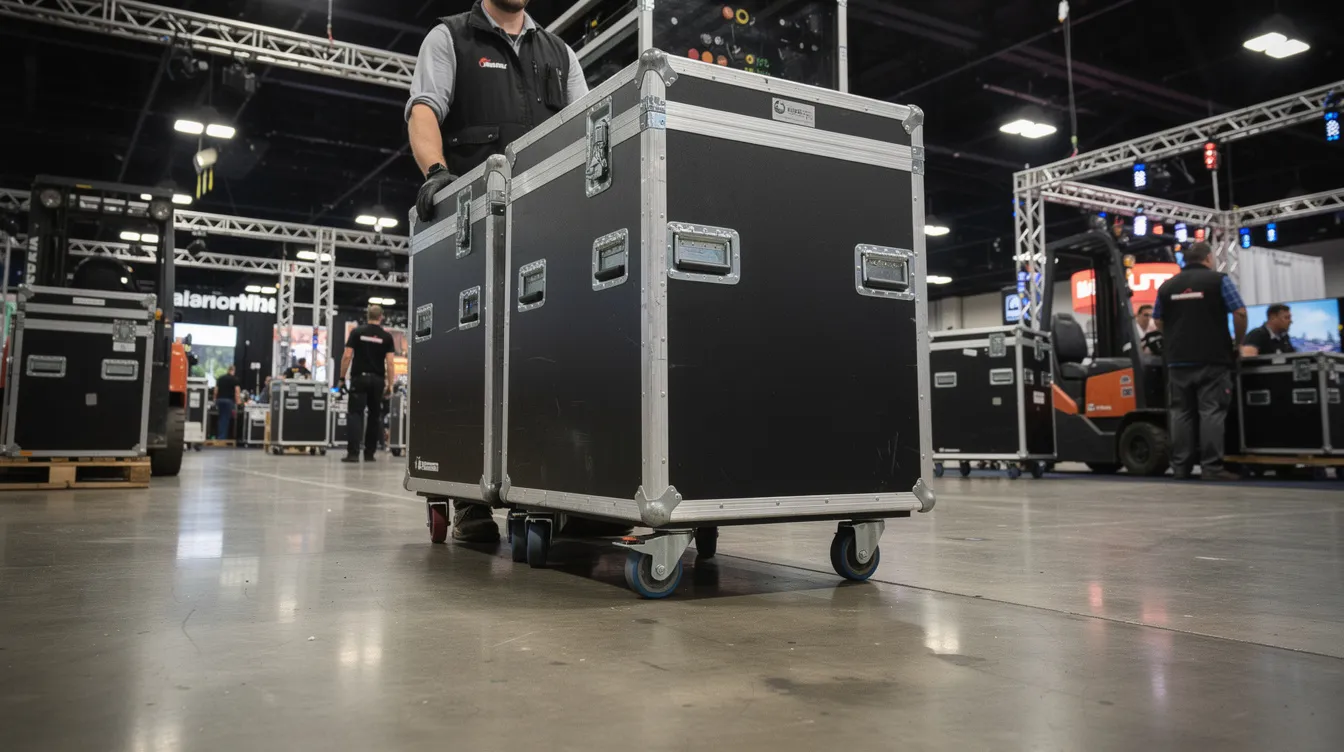
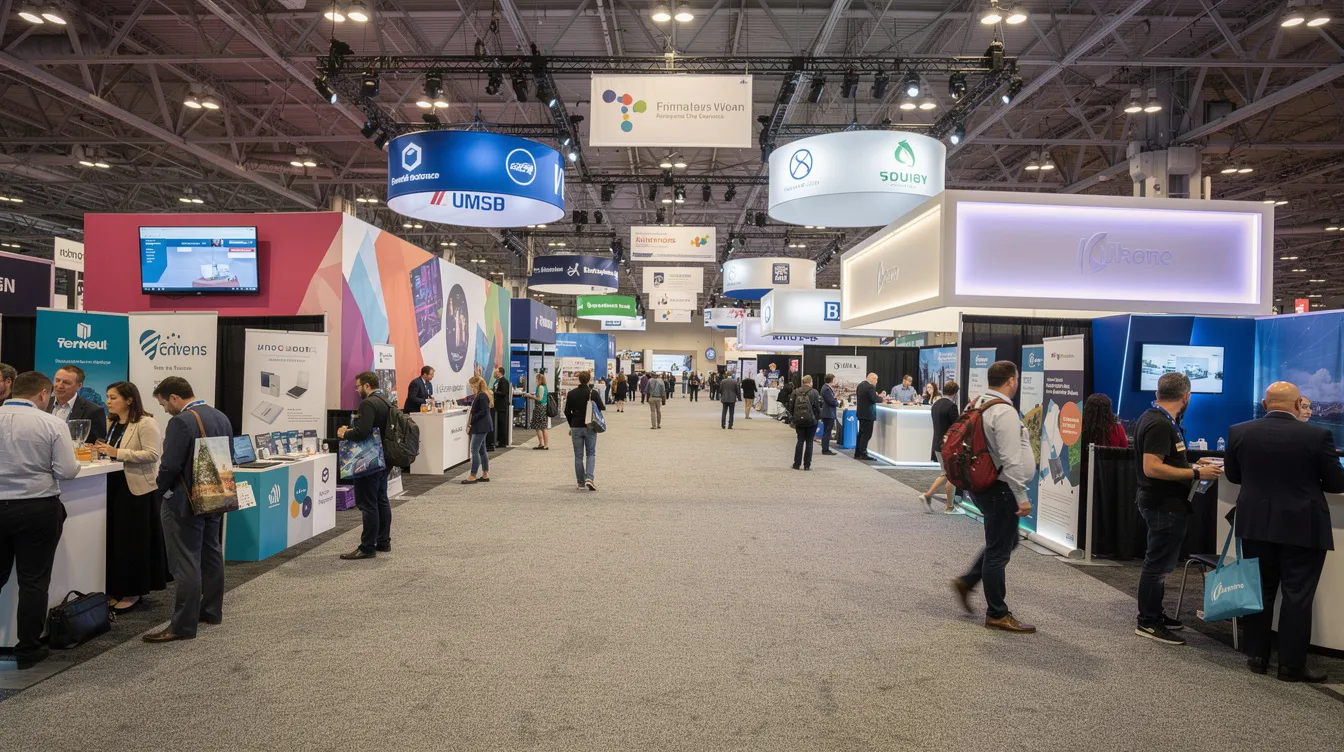
A bustling convention hall floor features large equipment road cases being wheeled across, while forklifts and booth structures populate the background, showcasing the dynamic environment of trade shows and advanced AV production setups. The scene highlights the importance of smooth operation and audience engagement in creating lasting impressions at events like those held in the Las Vegas Convention Center.

Arriving at the venue during move-in means navigating a crowded show floor with forklifts, crates, booth structures and overlapping vendors all sharing limited dock time. Selecting AV production services requires balancing technical capabilities and onsite logistical support.

What happens during load-in for a trade show exhibit using advanced AV technology:

  • Unloading LED panels, processors, audio visual racks, lighting fixtures and cabling.

  • Coordinating placement with booth design drawings to ensure LED walls, screens and speakers land exactly where exhibit designers planned. Trade show design should balance aesthetics with technology.

Front Row FX uses the installation day to:

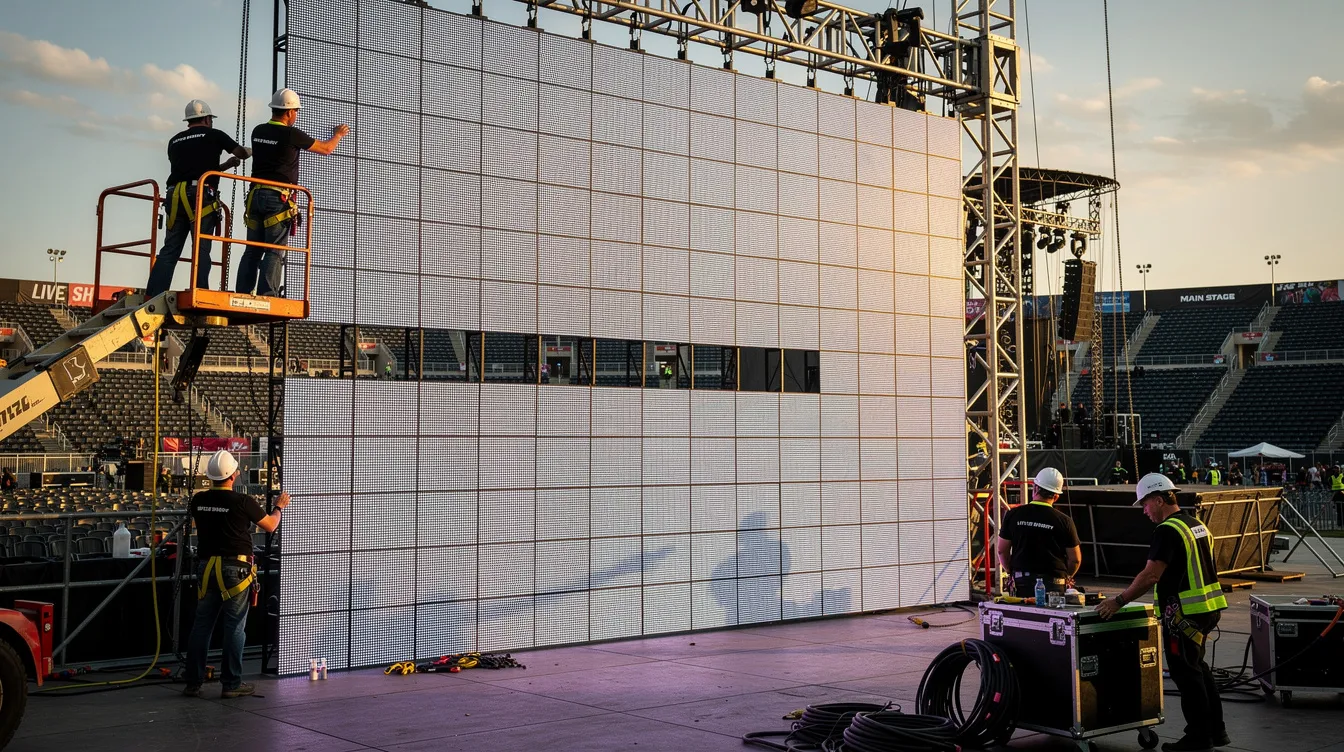
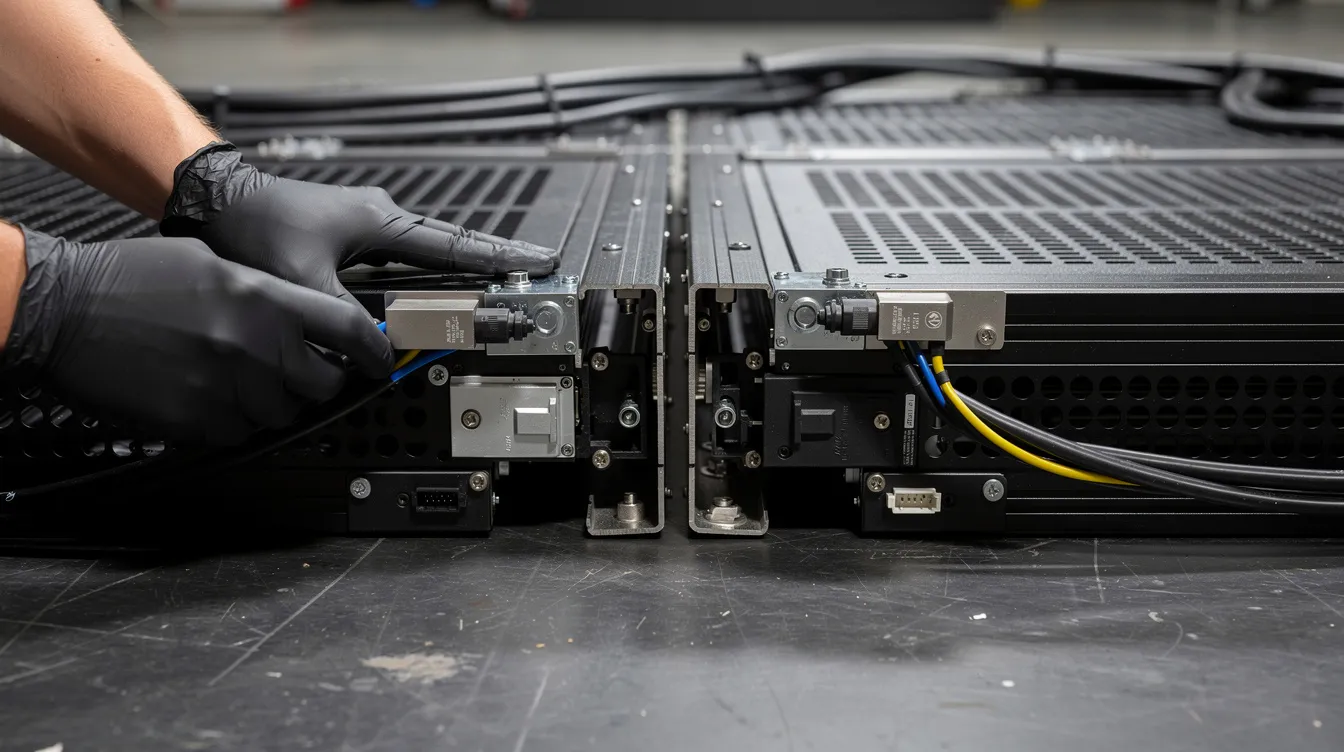
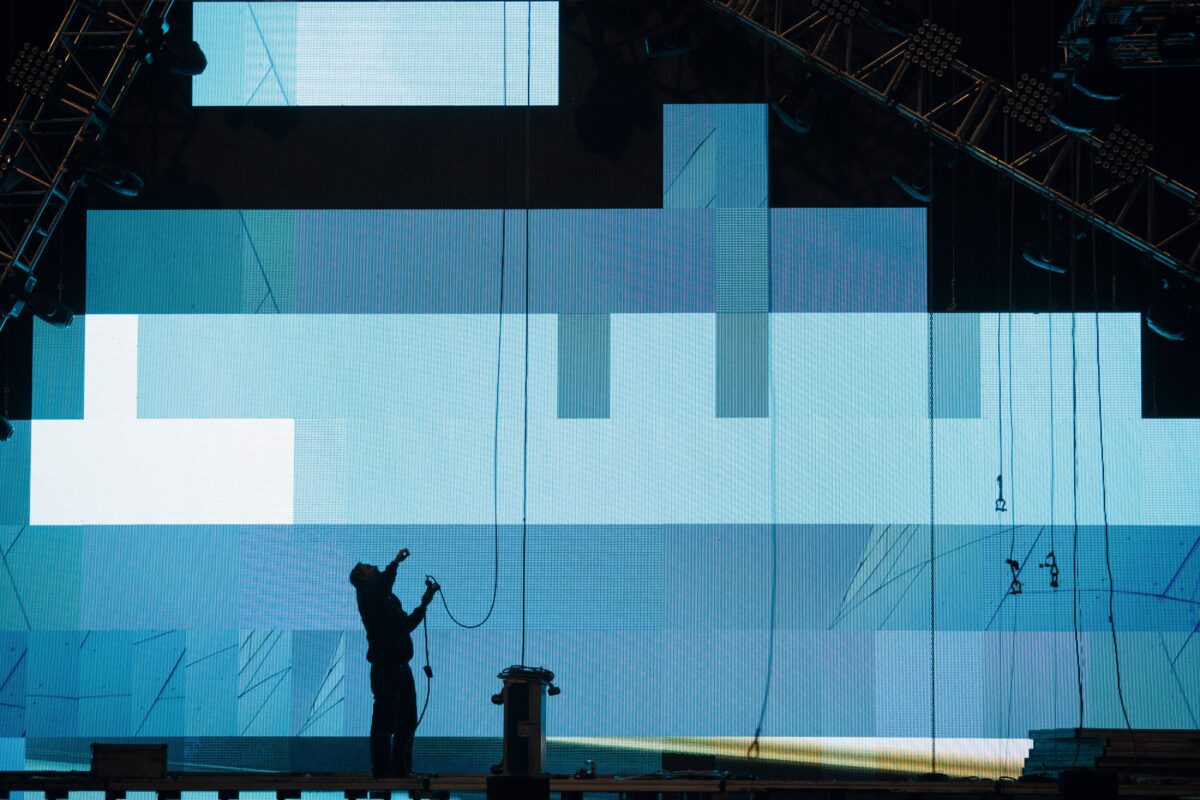
  • Assemble and rig LED walls or LED columns safely. LED technology combines scale, movement and brightness for exhibits, and modular LED systems offer designers creative freedom in large format configurations.

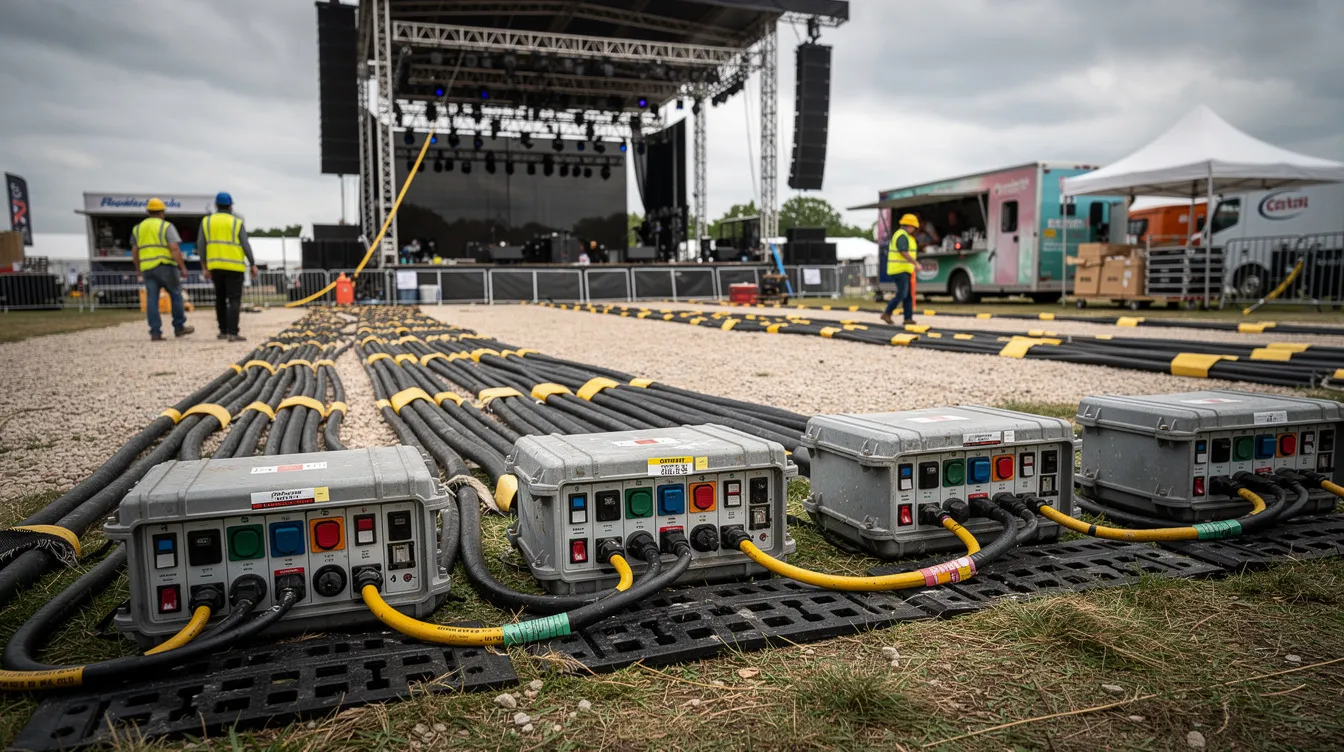
  • Run power and signal for video, audio and control, following venue electrical rules described in show or venue documentation. Strategic speaker placement delivers intelligible sound without unpleasantness, and professional audio planning considers room acoustics and audience size.

  • Label and secure all cabling to survive several show days of traffic and cleaning crews.

Initial system testing steps:

  • Verifying all LED panels are mapped correctly and free of obvious issues. High-resolution LED walls require content designed for their dimensions.

  • Confirming audio coverage for the booth or presentation area without overwhelming neighboring exhibitors.

  • Checking that media players, switchers and laptops output the correct resolutions for each LED wall or screen.

  • Lighting highlights products and architectural elements, and strategic lighting can differentiate an exhibit from its surroundings. Lighting should be coordinated with video for optimal impact.

Any needed corrections are best discovered and resolved before the first attendee walks onto the floor.

Daily System Checks, LED Walls and Content Across Multiple Show Days

In multi-day AV production, the work each morning before doors open is just as important as the original installation. This is what separates a professional production from a simple equipment drop-off.

A typical pre-show routine on day two or three:

  • Front Row FX technicians arrive before exhibitor access or early in the access window defined in the show schedule.

  • Systems are powered up in sequence: power distribution, processors, playback, then LED walls and displays.

Specific checks for LED walls used over several days:

  • Confirm processors and video routing are online and recalling the correct configuration.

  • Verify signal path from media players or show laptops to every LED wall, LED banner or digital signage display. LED displays can communicate messages faster than static signage, and LED walls can serve multiple purposes at trade shows, from branded visuals to product demonstrations.

  • Walk the viewing area to look for color shifts, module issues or misaligned panels. LED walls can enhance visibility from across the trade show floor.

  • Confirm brightness levels appropriate for the hall’s ambient light and show policies. Effective lighting design influences the overall atmosphere of an event, and strategic lighting can highlight products and enhance brand visibility. Lighting enhances scenic elements and improves camera images at events.

Content playback needs daily attention:

  • Ensuring scheduled loops, product videos and motion graphics start at opening time. Professionally produced content communicates information quickly and effectively.

  • Quickly loading updated brand messaging, revised product slides or same-day session information requested by marketing teams. This is how a company can tell its brand story consistently across every show day.

  • Confirming clear audio levels on any videos or demos so they’re consistent from day to day. Audio clarity is crucial for effective communication at trade shows, and trade show audio must compete with neighboring exhibit noise. An experienced audio engineer understands sound behavior in spaces, and audio management is crucial for clear communication during events. Clear communication through audio systems and visual aids is essential for presentations. High-quality microphones, displays and lighting ensure presentations are easy to see and hear.

These daily checks keep advanced technology invisible to attendees. They just see a consistently sharp, bright LED wall and hear audio that cuts through the floor noise every time they return to the booth.

Technician Coverage, Mid‑Show Changes and Redundancy

Multi-day trade show AV is as much about people as equipment, especially when marketing teams are adjusting key messages in real time. Trained technicians should be on-site during show hours to address technical issues. Technical staffing is crucial for successful event execution.

What technician coverage can look like:

  • A dedicated Front Row FX technician assigned to the exhibit during show hours.

  • A roaming tech shared across several exhibitors, coordinated with show management.

  • On-call support with defined response times when full-time coverage isn’t necessary.

Common mid-show needs on a three-day expo:

  • Swapping in new product videos or price points after a successful day one. You might also create content for live streaming to reach remote audiences or a global audience following the event online.

  • Adjusting LED wall layouts or playlists to feature a sponsor or time-sensitive campaign using collaboration tools that keep the team aligned.

  • Responding to signal issues, loose connections or accidental power cycles when neighboring vendors adjust their own booths.

Interactive elements also require ongoing attention. Interactive displays encourage visitors to explore products actively and can increase attendee engagement significantly. Interactive touchscreens allow visitors to explore at their own pace, while games and interactive installations can increase attendee dwell time. Digital demonstrations simplify complex services for attendees, and live polling turns conference attendees into active participants. AV production enhances lead generation by inviting attendees to participate in interactions.

Redundancy at a practical level:

  • Keeping spare LED panels, feed cables or playback devices on site when the project scale and budget justify it. Redundant systems and backups are critical in high-stakes live environments.

  • Using backup inputs on processors or switchers so a laptop or media player can be swapped quickly.

  • Planning simple content fallbacks if live feeds or complex interactive elements are temporarily unavailable.

Selecting audiovisual partners requires evaluating operational, technical and financial elements. Front Row FX’s role is ongoing technical responsibility across all show days-the job is consistent, smooth operation and quick response without disrupting the trade show experience for clients or attendees. This level of pro av expertise and engagement is what separates production from rental.

Overnight Considerations, Equipment Security and Working Around Show Hours

Once the exhibit hall closes, AV systems still need a plan. LED walls, control racks and laptops remain in place for several nights, and what happens overnight directly affects how the next morning goes.

Typical overnight considerations:

  • Deciding, together with the client and in line with venue policies, which components remain powered and which are safely shut down.

  • Confirming that systems will restart cleanly the next morning without manual reconfiguration.

Security and access:

  • Using lockable racks or secured enclosures for media players, processors and audio visual gear left in the booth.

  • Coordinating with the exhibitor and show security teams about who is authorized to touch AV systems after hours.

Show schedules often include:

  • Limited early-morning access windows before attendees enter.

  • Specific overnight maintenance periods for cleaning, carpet work or facility checks that AV teams must work around.

Front Row FX plans daily routines around these access windows, ensuring all system checks, content updates and configuration changes are completed before the trade show floor opens each morning.

Final Show Day, Teardown and Why Multi‑Day Pricing Is Structured Differently
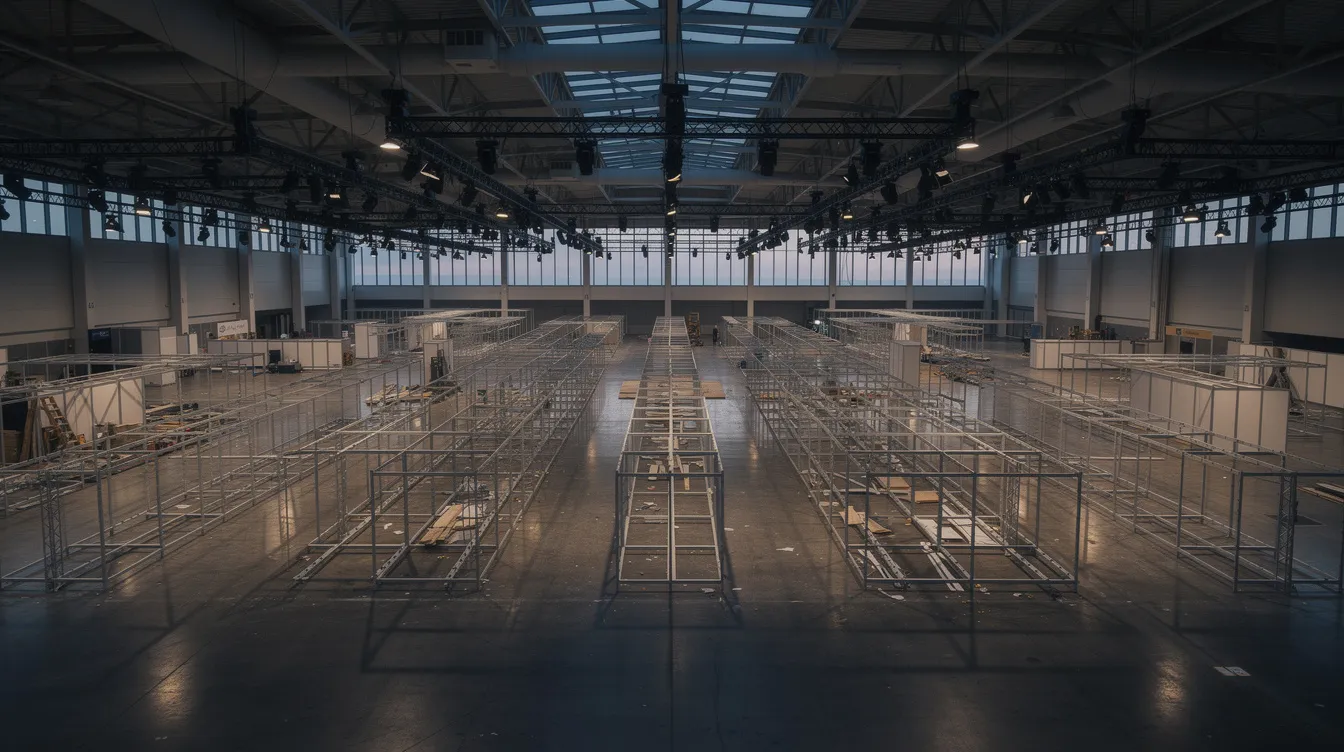
The image depicts an empty convention hall at dusk, showcasing overhead rigging and booth frameworks that hint at future installations for digital signage and interactive displays. The space, typically vibrant during trade shows, is now quiet, awaiting the advanced AV technology and dynamic lighting that will engage audiences and create a lasting impression.

The final show day has two simultaneous priorities: delivering a complete guest experience until the last minute and exiting the venue safely once the hall closes.

Final-day operations:

  • Maintaining full system performance and audience engagement through the last presentation or giveaway. The innovation and energy of the exhibit should be just as strong at close as it was at opening. Engage audiences through every showcase moment until the end.

  • Coordinating with exhibitor teams to avoid shutting down LED walls, audio or dynamic lighting before they finish show-closing activities.

Teardown and load-out:

  • Powering down systems methodically, protecting LED panels and electronics from rushed disassembly.

  • Carefully packing and labeling LED walls, audio, cabling and control gear for transport back to Front Row FX’s warehouse in Minnesota or direct to the next site and project.

Why multi-day trade show AV pricing is not simply “one day of AV services multiplied by three”:

  • Installation labor and teardown labor are usually single occurrences regardless of how many show days fall in between.

  • Multi-day shows occupy equipment inventory for the entire period, preventing that gear from being used at other events or regional expos.

Additional pricing factors:

  • Technician coverage across multiple days, including overtime when show hours extend or access is restricted.

  • Daily system checks, content revisions and operational support that don’t exist in the same way for one-day corporate meetings.

  • Additional production days such as rehearsals, sponsor previews or pre-show content programming sessions.

Transparent pricing and budget clarity can prevent unexpected costs during events. Front Row FX explains these elements clearly so exhibitors and organizers can budget accurately for multi-day event AV solutions and capture attention with maximum impact every day of the show. Explore what’s possible when you partner with a production company that treats every show day as a professional commitment to your event goals and your brand.

Plan Your Multi‑Day Production

Successful multi-day trade show AV production depends on planning, daily system readiness and consistent technical support-not just dropping off video walls or audio equipment. When you work closely with a production partner from the start, AV solutions integrate naturally into your exhibit and deliver a lasting impression across every show day.

  • Involve Front Row FX early in booth design and show planning so production can be built into the project from the beginning.

  • Discuss your event scope, exhibit timeline and AV needs before venue deadlines close.

  • Contact Front Row FX to talk through your upcoming trade show, expo or multi-day corporate event and build a production plan that keeps your AV systems show-ready from load-in to load-out.
Categories
LED Screens & Video Walls

How to Choose an Event Production Company in Minnesota

Choosing an Event Production Company in Minnesota: Practical Guide for Corporate & Live Events

Picking the right event production company in Minnesota starts with a question most buyers skip: what does your event actually require? Not what gear you think you need, but what technical systems, crew and planning will make the difference between an event that runs smoothly and one that doesn’t.

This guide walks through the real operational factors that matter when evaluating production partners in Minneapolis, Saint Paul and the broader Upper Midwest – from understanding event complexity to reading proposals, asking the right questions and knowing when integrated production is worth the investment.

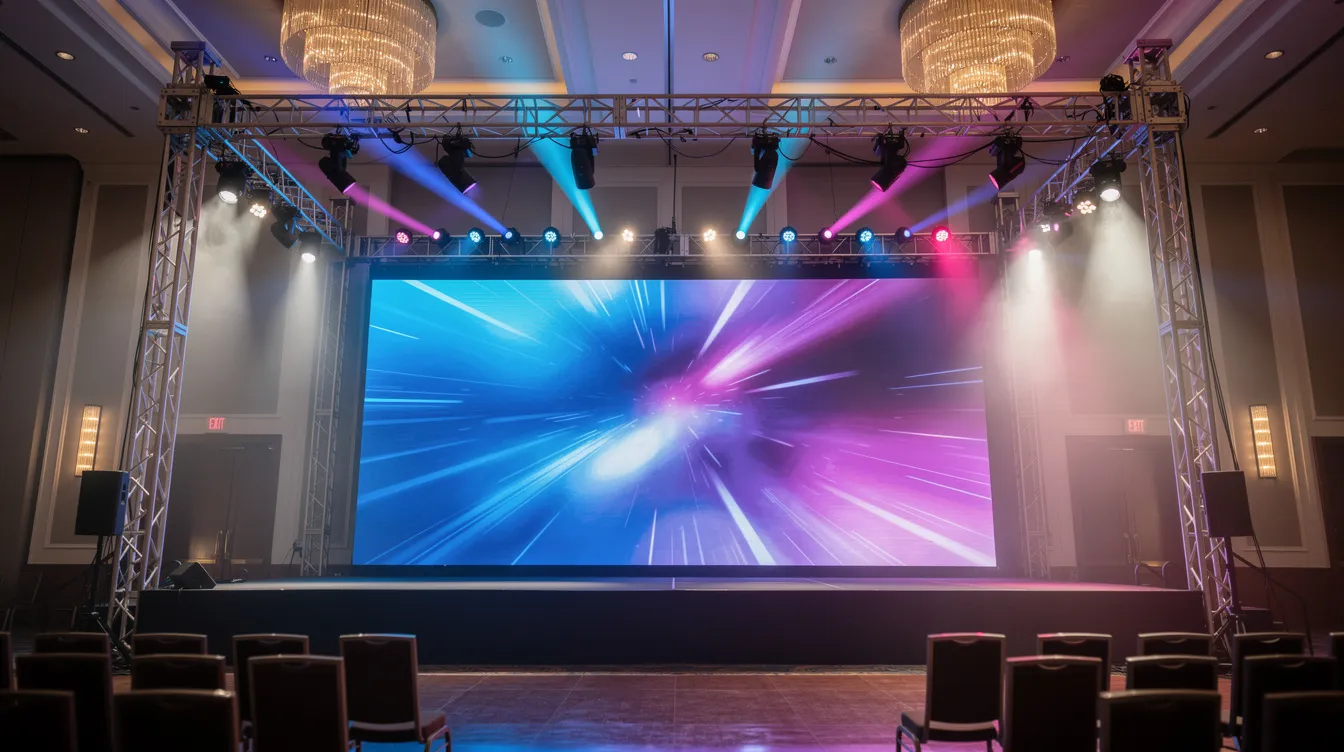
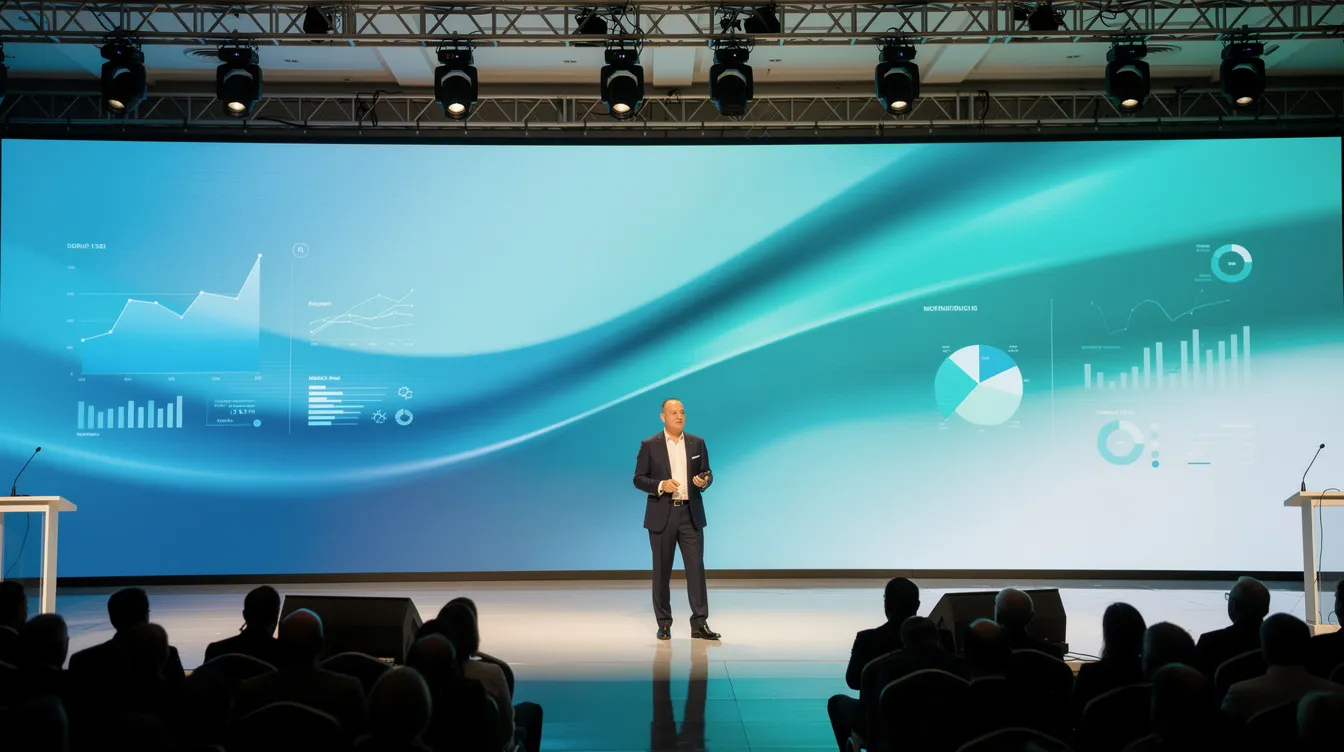
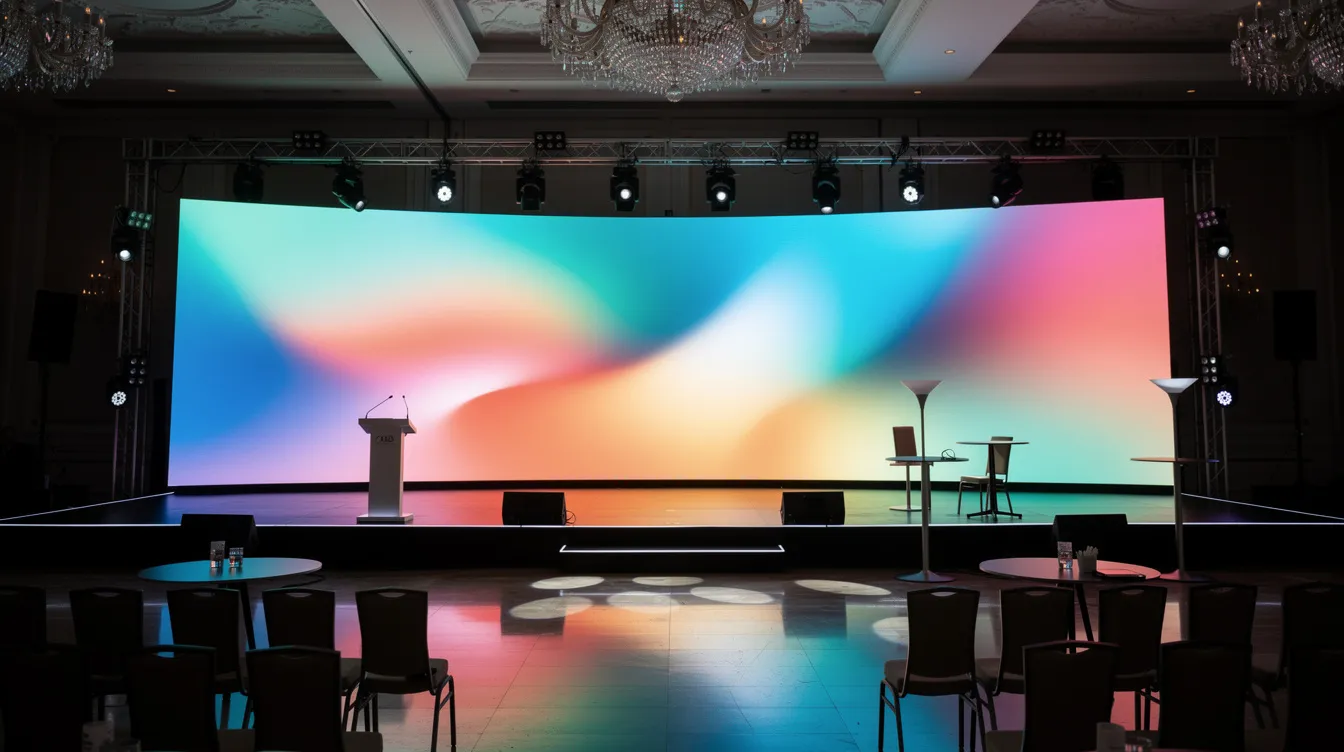
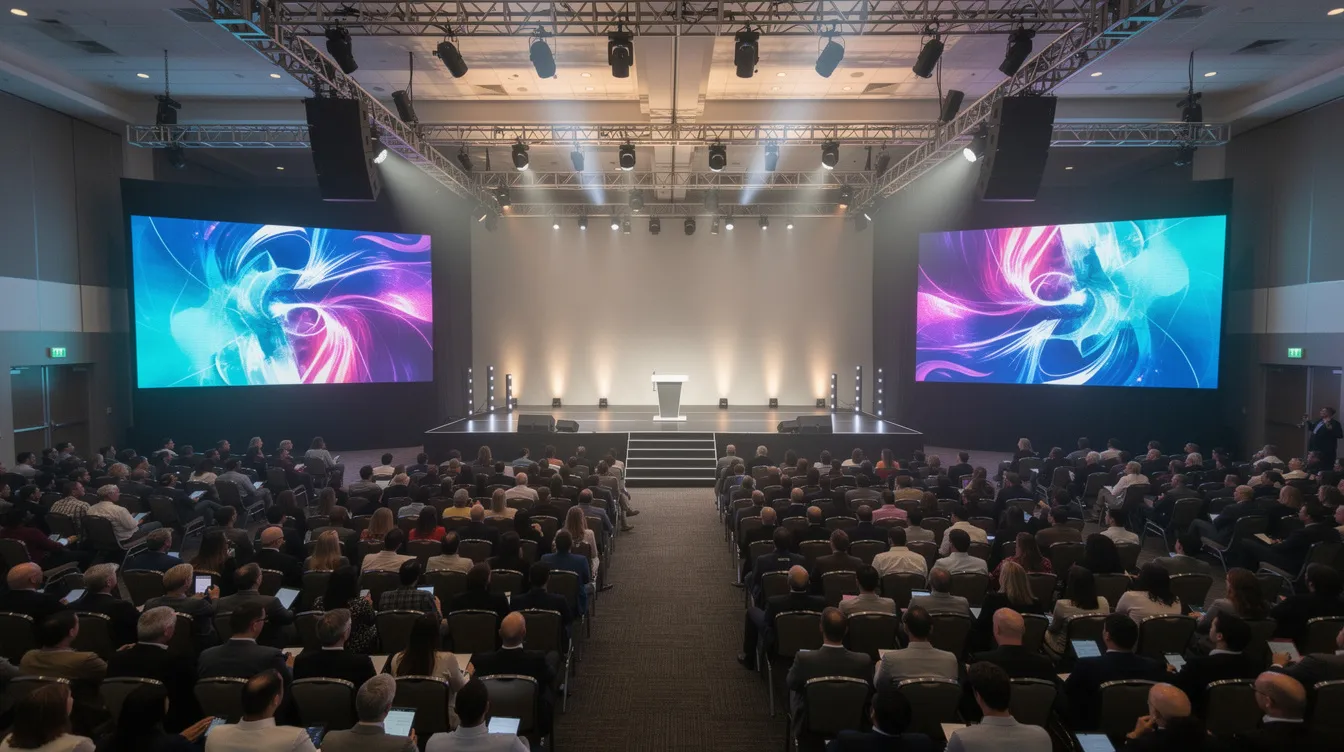
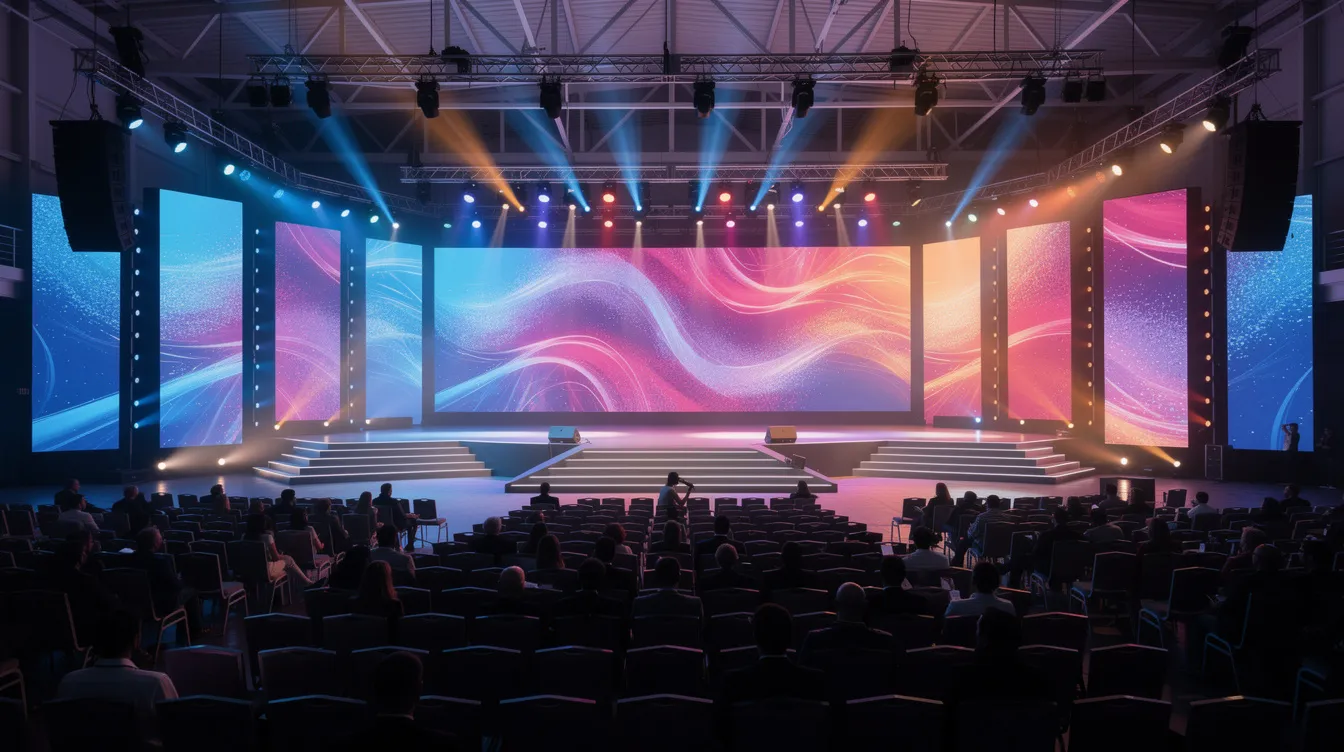
The image shows a wide view of a professional event stage set up for corporate events, featuring vibrant colorful lighting and large LED screens, with neatly arranged audience seating in a spacious venue. This setup is designed to create unforgettable experiences and elevate the connection between the event and its audience.

Start with Your Event: Type, Scale and Complexity

How you pick the right production partner depends almost entirely on what you’re producing. A 150-person sales meeting in a hotel boardroom has different technical demands than an 800-person nonprofit gala or a multi-day conference with breakout sessions across several rooms. Events include corporate meetings, concerts, and galas – and each format carries its own set of production requirements.

The first step is honest scoping. Before you contact any provider, get clear on what your event is, who it’s for and what success looks like.

Small Internal Meetings

A quarterly business update for 100 people in a hotel meeting room may only need a projector, two wireless microphones and a confidence monitor. There’s no complex show flow, no livestream, no entertainment. In these cases, basic in-house AV or simple equipment rental may be enough. You don’t need a full production team for a straightforward presentation.

Mid-Size Corporate Events and Galas

Once you move into the 300–800 person range – think annual conferences, nonprofit fundraisers, corporate galas or brand activations – the technical dependencies start multiplying. You need sound reinforcement that ensures speech intelligibility across the entire room. You need LED video or projection scaled for audience distance. You may need stage lighting, live camera feeds, entertainment support, content playback and possibly hybrid or virtual streaming with secure live-streaming platforms and remote audience integration.

Each of these dependencies adds coordination complexity. Multiple wireless microphones require RF coordination. LED video walls need the right pixel pitch and brightness for the room. Show cues need a caller. Remote participants need a separate signal chain with dedicated crew. This is where an integrated event production company becomes critical.

Large Public Productions

For events with 1,000+ attendees, multiple stages, outdoor setups or touring acts, you’re looking at full-scale production: staging, rigging, power distribution, multi-system integration, crowd safety, backline coordination, trucking logistics and communications infrastructure. In Minnesota – where outdoor events might happen in June sunshine or require January load-ins through snow and freezing conditions – local experience is not a luxury. It’s a practical necessity.

Concrete Minnesota Examples

Consider the range of events that happen across the Twin Cities every month:

  • A two-day corporate training in downtown Minneapolis with a general session in one ballroom, breakouts in adjacent rooms and plenary sessions livestreamed to remote executives. This requires full design, crew and show operation across multiple rooms.

  • An annual fundraiser gala in Saint Paul with a dinner program, live auction, entertainment, video content, mood lighting and branded staging. The production needs to create emotional connections while supporting fundraising goals.

  • A summer outdoor festival in a Minnesota park with staging, power generation, weather protection and audience flow management.

Define Goals Before You Shop

Defining goals up front is what separates effective event planning from reactive scrambling. Are you optimizing for message clarity to stakeholders? Audience engagement? Brand impact? Fundraising targets? An event unforgettable enough to shape how attendees think about your organization?

These objectives drive every technical decision downstream – from how many cameras you need to whether you invest in intelligent lighting or keep it simple.

Front Row FX works primarily where audiovisual production and show operation are central to success. For a straightforward meeting with basic needs, lighter support may be the right call. But when the audience, the message and the stakes matter, integrated production changes the result.

Event Production Company vs. Equipment Provider: What You’re Really Hiring

Many buyers search “event production company Minnesota” expecting to compare similar vendors. In reality, you’ll find very different business models – from dry-hire rental houses to fully integrated production teams – and the differences have real consequences on show day.

Minnesota is home to several reputable event production companies specializing in corporate events and large-scale gatherings. Minnesota features a robust network of event production companies centered around the Twin Cities metro area. Allied Productions has operated since 1995 and has worked in 48 states and 28 countries providing AV services. Legacy Production Group is based in Minneapolis, Minnesota and specializes in corporate functions and music tours, creating unforgettable experiences for clients. Freestyle Productions has a 25-year history in event services and handles events from circus to corporate. BeEvents creates high-impact experiences for brands nationwide. Event agencies in Minneapolis focus on both corporate and private events, and event agencies across the region focus on creating emotional connections at events.

Understanding where a provider sits on the spectrum helps you hire the right level of support for your project.

Four Models of Event Production Support

Model

What You Get

What You Don’t Get

Equipment Rental Only (Dry Hire)

Gear delivered – speakers, LED panels, lighting, projectors

No crew, no system design, no show calling, no on-site troubleshooting

Basic AV Support (Hotel/In-House)

Standard packages – podium mic, small sound system, basic projector/screen

Limited customization, often stock gear, may not support LED walls, multi-camera or virtual events

Integrated Audiovisual Production

Design + technical execution + crew + show operation, including rehearsals, contingency plans and on-site decision-making

Not a one-size-fits-all package – scoped to each event

Large/Multi-Department Production

Everything above plus staging vendors, rigging departments, trucking, power distribution, backline, inter-department comms

Typically needed for multi-stage festivals, touring shows or complex multi-site events

Event production companies manage the technical and creative execution of gatherings. Event production companies in Minnesota offer audiovisual design, staging, lighting, live streaming, and logistical coordination. Event production companies offer core services including audio-visual setup, lighting design, staging, and live streaming.

Front Row FX operates in the integrated audiovisual production category – focused on complete technical execution for corporate events, live events and selective high-production private events across Minnesota and the Upper Midwest.

What Rental-Only Providers Actually Deliver

A rental house supplies inventory. You get speakers, lighting fixtures, LED panels – possibly delivered to your venue. But rental-only providers usually expect your team or separate freelancers to handle design, setup, operation and teardown. If something goes wrong during the show, there may not be anyone responsible for fixing it.

What In-House AV Typically Covers

Hotel and venue AV teams often provide solid basics: a podium, a few microphones, a projector and screen, standard stage lighting. For a simple presentation to a small audience, this works. But in-house AV is rarely engineered for dynamic lighting cues, multi-camera broadcast, LED video walls, wireless mic coordination across a dozen speakers, or the dual signal chain a hybrid event demands.

What Integrated Production Delivers

An integrated event production partner takes responsibility for the full technical picture: scoping the right systems for your room and audience, specifying equipment, scheduling crew, planning load-in and teardown, managing rehearsals, calling show cues and making real-time decisions when things change.

This is how you create unforgettable experiences – by aligning sound, lighting, LED video, content playback and special effects with the event’s brand, run-of-show and audience journey, not by renting disconnected pieces and hoping they work together.

Choosing the Right Level

The right level of support depends on your risk tolerance, audience expectations and budget. Some events can safely rely on simple AV. High-impact corporate events, mission-critical programs and productions where the audience experience defines business outcomes benefit from a production partner with passion for execution and the creativity to solve problems in real time.

Reputable event production partners align with best practices described by organizations like AVIXA and the Event Safety Alliance – covering everything from signal flow and audio standards to safety protocols.

Local knowledge also matters. A Minnesota-based AV production company understands regional venues, typical power availability, loading dock constraints, winter weather logistics and union versus non-union environments. That understanding directly affects planning and show-day reliability.

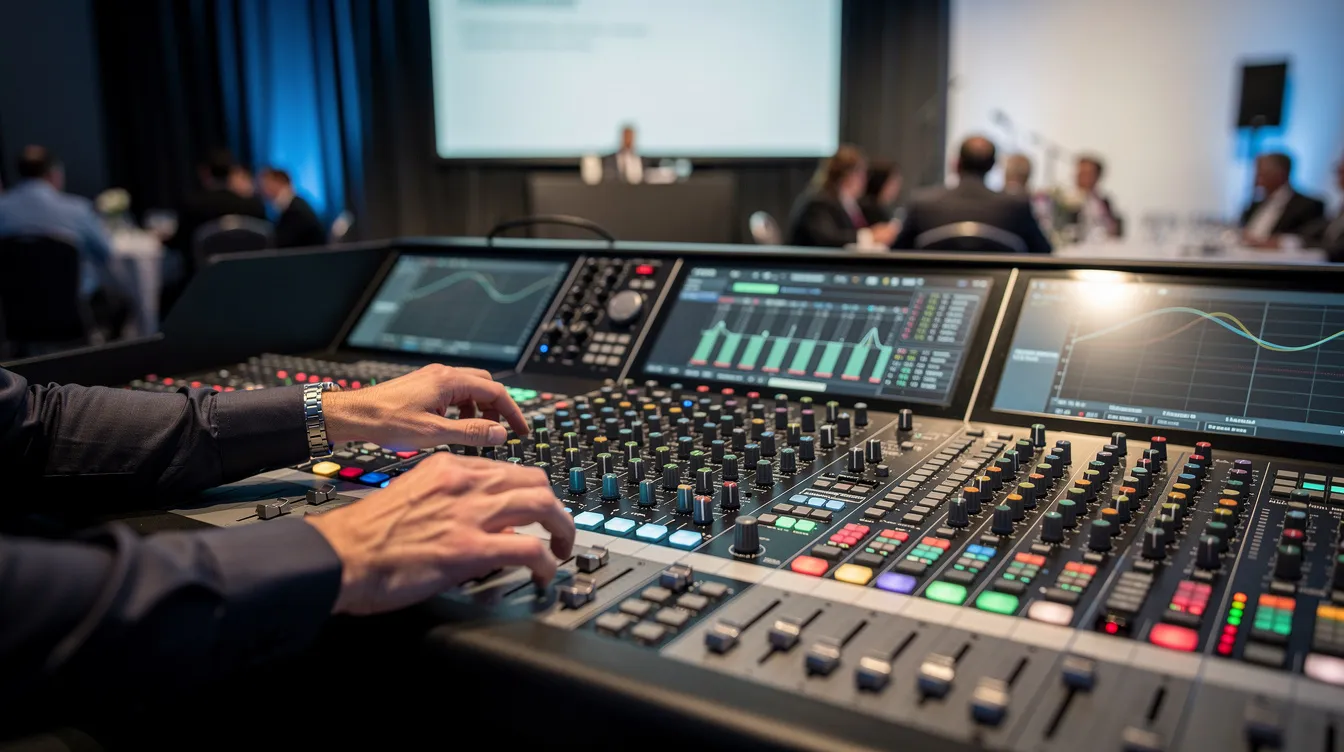
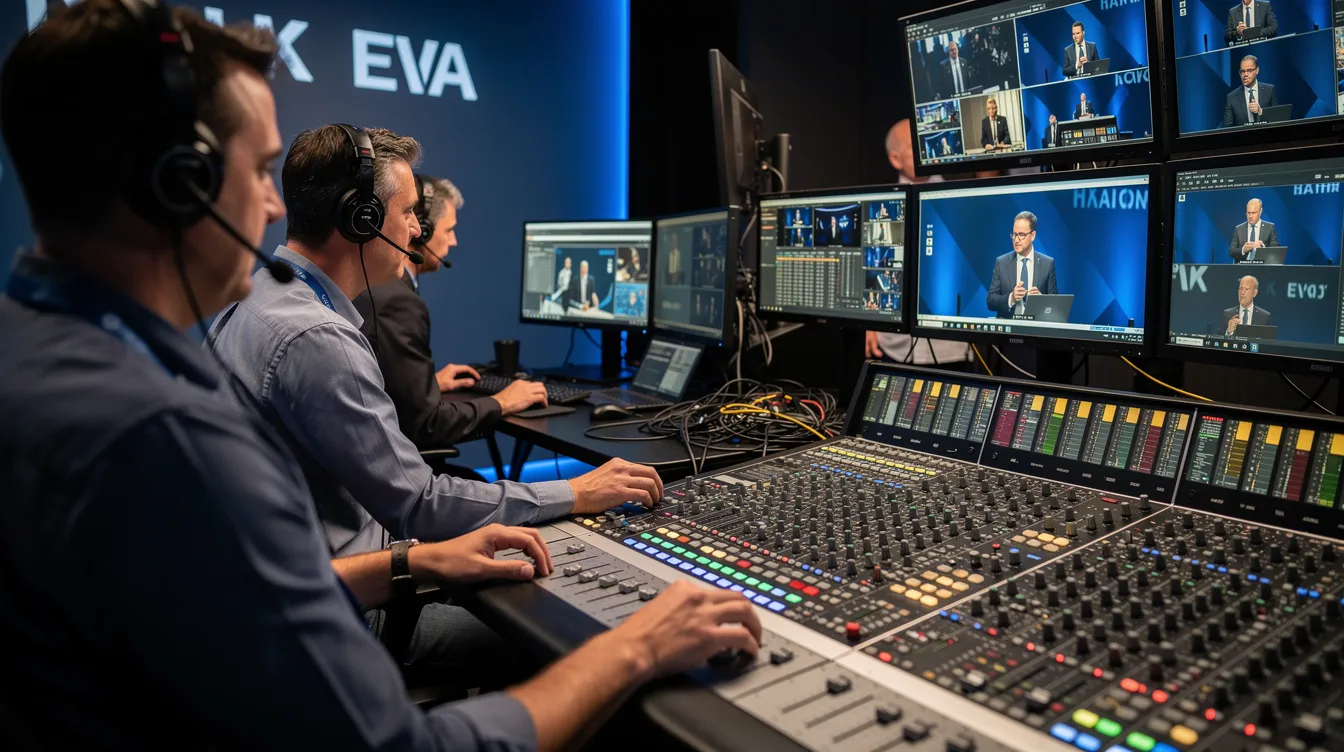
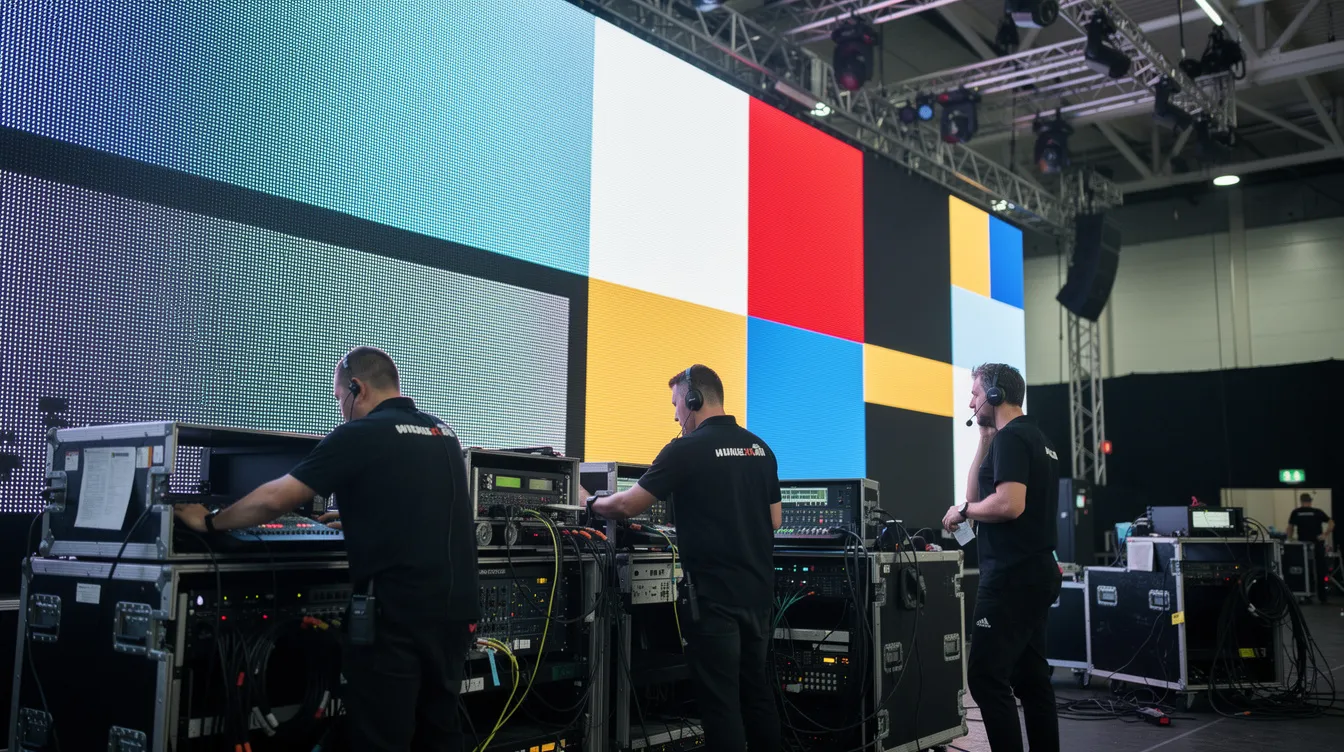
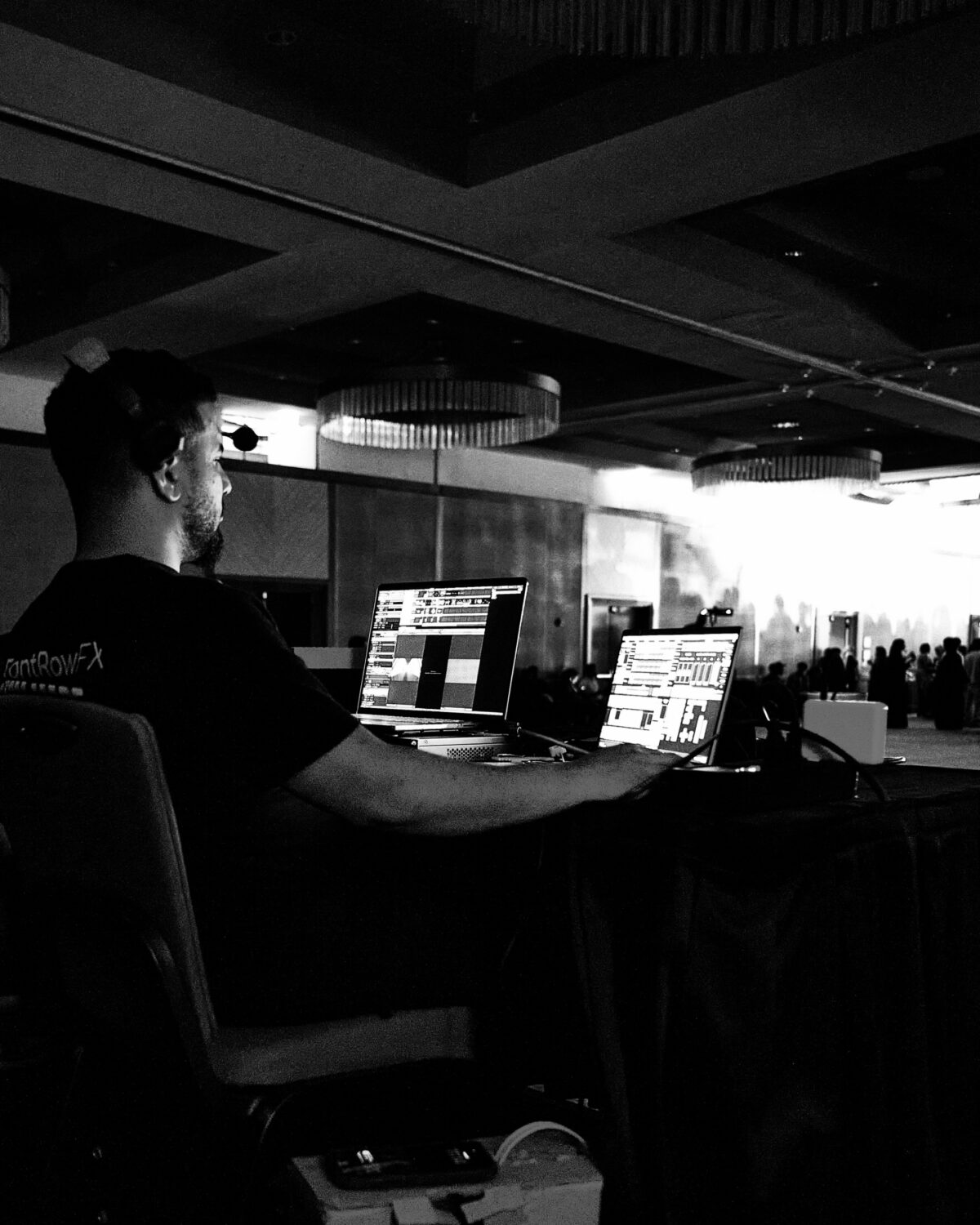
An audio mixing console is prominently displayed, with hands skillfully adjusting the controls, capturing the essence of a live corporate event. This scene reflects the dedication and creativity of the event production team in Minnesota, committed to creating unforgettable experiences for their clients and audiences.

Preproduction, Discovery and Venue Walkthroughs

Serious event production starts well before show day. The discovery process is where a production partner learns what matters to your organization and begins translating goals into technical plans.

A structured preproduction conversation should cover:

  • Event objectives and audience profile

  • Session formats, speaker count and entertainment

  • Video content, recording and streaming needs

  • Accessibility considerations

  • Timeline and content deadlines

  • Budget parameters

Audio-visual production includes sound systems, microphones, and video recording equipment – but determining which systems, in what configuration, for which rooms, requires dialogue, not a price list.

Venue walkthroughs in Minneapolis, Saint Paul and greater Minnesota help identify ceiling heights, rigging points, load-in routes, sightlines, power access and emergency exits. Every venue has quirks – freight elevator sizes, floor load limits, natural light that washes out projection, loading docks shared with restaurant deliveries.

A production-oriented company will request or create scaled floor plans, seating layouts and equipment plots. They’ll attend walkthroughs with the venue operations team, caterer and decor partners to coordinate placement of stages, LED walls, scenic elements and camera positions.

Front Row FX routinely uses preproduction and site visits to align technical design with the realities of Minnesota venues and seasonal factors – because an outdoor event in June and a winter gala in January present very different logistical challenges.

Technical Design: LED Video, Sound, Lighting, Staging and Special Effects

Technical design is where ideas become operational plans – and where the difference between a rental price list and a true AV production company becomes most visible.

A production partner translates your vision into systems:

  • Sound reinforcement sized for the room – coverage without dead spots, appropriate levels for speech intelligibility, delay or fill speakers for deep ballrooms

  • LED video walls specified by pixel pitch (based on viewing distance), brightness (for ambient light conditions), refresh rate (critical when cameras are involved) and modularity for the venue. For reference, the Minnesota State Legislature’s broadcast specifications require 1.25mm pixel pitch, minimum 3840Hz refresh rate and 700 nits brightness for on-camera LED content – a useful benchmark for understanding what professional-grade specifications look like.

  • Lighting that serves multiple functions: speaker visibility, scenic effects, mood transitions and on-camera color temperature

  • Staging and set design involving custom stage construction, scenic backdrops, ADA-compliant access and safety rails

  • Special effects – fog, haze, confetti, LED elements – requiring permits, trained operators and fire marshal compliance

Event production involves building custom stages, backdrops, and physical props tailored to the event theme. Livestreaming infrastructure and multi-camera broadcast setups allow for remote attendance, adding another layer of technical design.

The critical word is integration. All elements – audio, video, lighting, projection, LED walls, comms and special effects – must work together and be operated by a coordinated team. Front Row FX’s core capabilities are deployed as part of a cohesive production design, not as disconnected line items.

Crews, Operators and Who Runs Your Event on Show Day

For complex corporate events and live productions, the crew is as important as the equipment. They are the people making real-time decisions that keep the event on track.

Event production companies provide technical direction, cue sheets, and overall event management. Typical crew roles include:

  • Audio engineer (FOH) – mixes sound for the room

  • A2 / audio assist – manages wireless mics, monitors, stage audio

  • Video director – calls camera switches for broadcast or screens

  • LED/graphics operator – runs content playback and graphics

  • Camera operators – frame shots for screens or streaming

  • Lighting programmer – executes lighting cues

  • Stage manager / show caller – coordinates technical cues across departments

  • Riggers and stagehands – handle physical setup and safety

The difference between models is stark. A drop-off rental means no operators. Basic tech support might mean one person “on call” handling audio and projection simultaneously. A fully staffed production crew has dedicated operators for each system throughout the event.

Ask who will actually operate sound, lighting, LED walls, cameras and content playback during your event. Ask whether they are regular team members or ad-hoc freelancers sourced the week before.

As AVIXA emphasizes, competent operators and clear roles are central to safe, reliable event execution – especially where elevated platforms, rigging or high-power electrical systems are in use.

Front Row FX aligns crew levels with event complexity, ensuring corporate events and live shows across Minnesota are supported by operators who understand both the technology and the show’s objectives.

Planning, Safety and Logistics: How Professional Production Keeps Events On Track

The best production work is invisible to the audience. Guests experience seamless transitions, clear audio, beautiful lighting and content that appears on screen at exactly the right moment. Behind that experience is an infrastructure of planning, safety protocols and logistical coordination that keeps everything running.

Event production companies handle logistics such as venue coordination and labor planning. As audience size grows or technical systems multiply, these behind-the-scenes functions become as important as the gear onstage. Corporate events, nonprofit fundraisers and brand activations in Minnesota benefit when production partners follow structured planning practices rather than making ad-hoc decisions on show day.

This is where buyers learn what responsible production companies should handle beyond equipment lists.

Production Schedules, Load-In and Teardown Planning

A production schedule maps out every stage of the process:

  • Truck arrival and dock times

  • Crew call times

  • Equipment load-in order and setup milestones

  • Rehearsal windows

  • Doors open

  • Show cues and transitions

  • Teardown sequence and truck-out

Factors specific to Minneapolis and Saint Paul make realistic timing essential. Downtown loading docks are often tight and shared. Freight elevators have weight and size limits. Rush-hour traffic affects crew arrival. Winter weather can delay everything by hours.

Professional AV production companies coordinate schedule details with the venue, event planning team, caterer, decor and entertainment to avoid conflicts on the dock or stage. Ask for a written production schedule before show day, and understand who controls changes when the event timeline shifts.

Front Row FX routinely plans load-ins and load-outs around venue access windows, local ordinances and client needs – reducing overtime surprises and last-minute compromises.

Power, Technical Infrastructure and Safety Standards

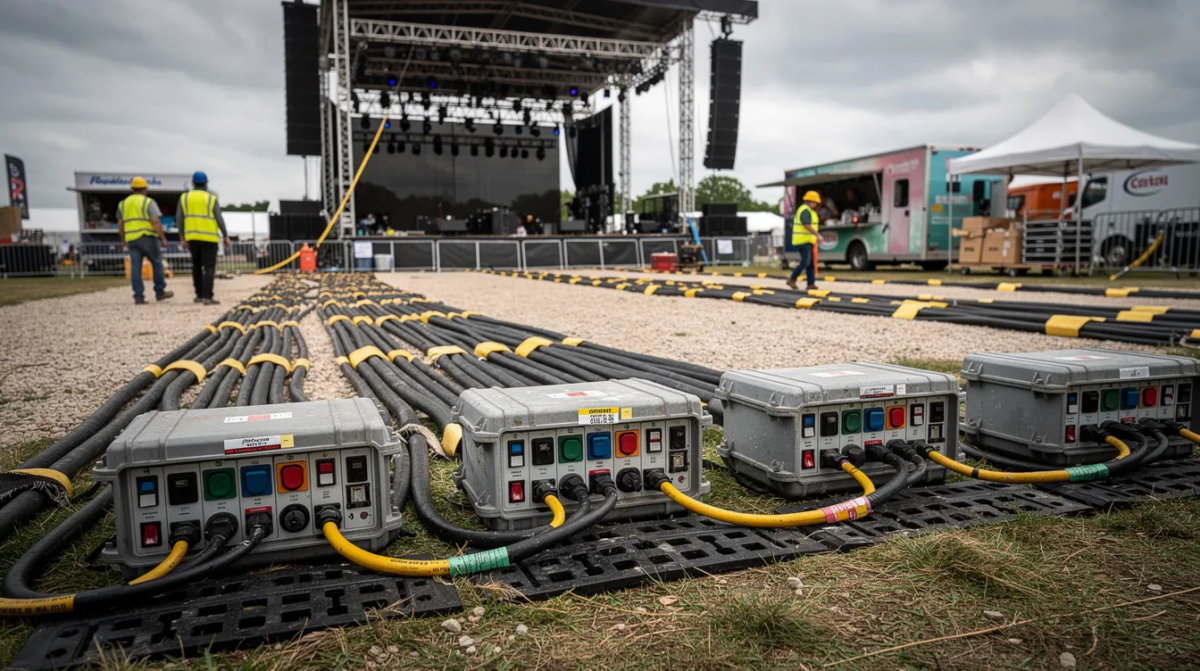
Under-planned power can shut down sound systems, LED walls and lighting at the worst possible time. It’s one of the most common and avoidable production failures.

Typical power considerations in Minnesota venues include:

  • Available 20-amp branch circuits and their locations

  • Three-phase power requirements for larger shows

  • Generator needs for outdoor events

  • Cable routing that meets electrical code and prevents trip hazards

  • Ground-fault protection for wet or outdoor environments

Reputable production partners calculate loads, specify appropriate distribution and follow the venue’s electrical rules. The Event Safety Alliance provides guidance on proper power distribution, cable management, emergency egress and weather planning.

Safe rigging practices matter when hanging lighting, speakers or LED video from truss. Trained riggers, rated hardware and venue-approved rigging points are non-negotiable. Ask how the provider protects guests from trip hazards, cable congestion, excessive loudness levels and strobe lighting issues.

Front Row FX builds safety into its technical planning, working within Minnesota venue policies and industry best practices to protect guests, staff and equipment.

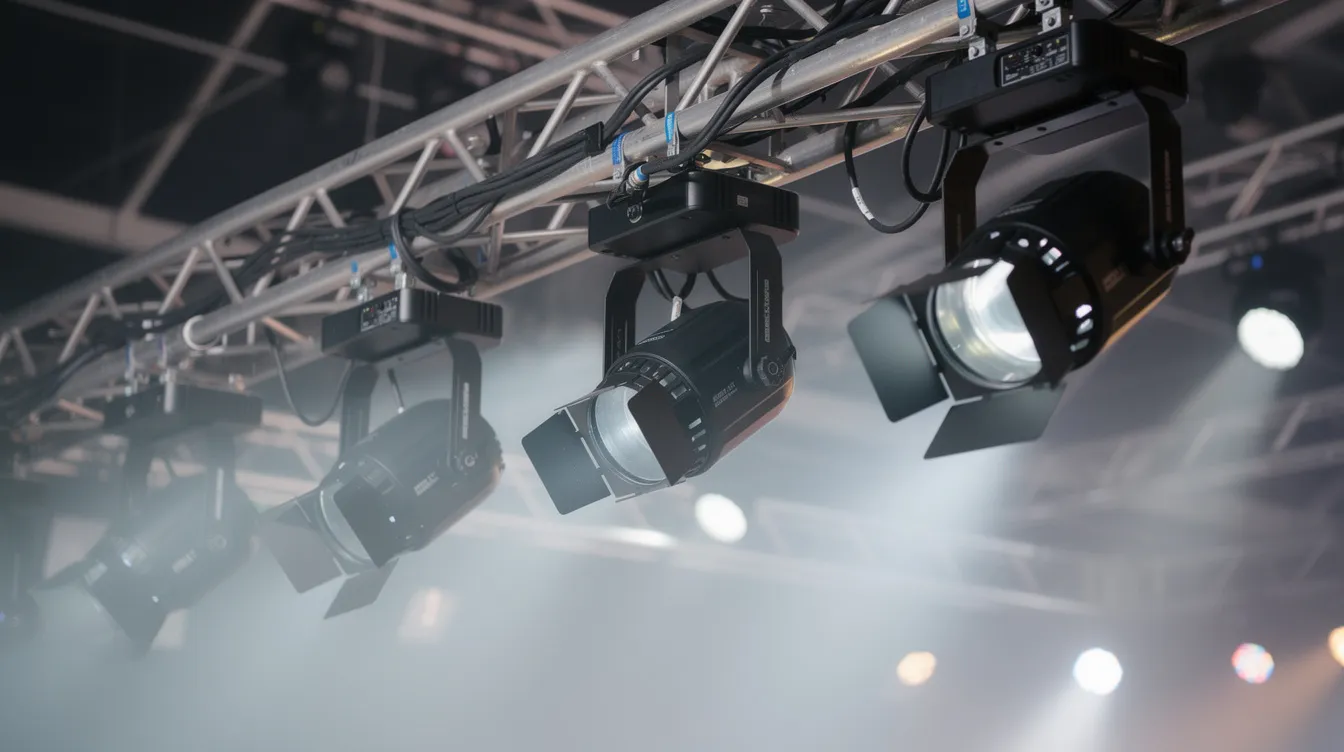
The image showcases a close-up view of professional stage lighting fixtures mounted on a truss above an event stage, highlighting the creativity and power of lighting in event production. This setup is essential for creating unforgettable experiences at corporate and virtual events, ensuring that audiences are captivated and engaged.

Insurance, Documentation and Venue Coordination

Professional event production companies should carry general liability insurance at levels that meet or exceed typical Minnesota venue requirements. This is not optional – it protects you, your organization and the venue.

What to ask for:

  • Certificates of insurance naming the venue and client as additional insured

  • Confirmation of coverage timelines

  • Detailed proposals with equipment lists and clearly defined responsibilities

  • Emergency contacts

  • Risk assessments or method statements for rigging, special effects or structural work

Direct coordination between the production company and the venue’s operations team matters. Access times, power availability, rigging approvals, fire codes and noise policies all need to be confirmed before load-in day – not discovered during it.

Front Row FX routinely interfaces with venue teams across Minnesota and the Upper Midwest on behalf of clients, freeing planners to focus on content, stakeholders and guest experience instead of technical logistics.

Rehearsals, Testing and Contingency Planning

Rehearsals and technical run-throughs are major predictors of how smooth a live event will feel to the audience. They are not a luxury – they are where problems get found and fixed before anyone is watching.

A good rehearsal block includes:

  • Line checks for all microphones

  • Content playback tests on every screen and LED wall

  • Lighting looks review for each segment

  • Camera framing and switching rehearsal

  • Walk-on and walk-off practice for presenters

  • Timing of key moments against the run-of-show

Integrated audiovisual production teams build rehearsal time into the schedule and advocate for it – especially for executive presentations, product launches and multi-speaker panels.

Contingency planning is equally important: backup microphones, redundant playback systems, spare LED modules, extra cables, plans for speaker changes and weather contingencies for outdoor Minnesota events. Industry data suggests that planning time often increases by 30–50% when hybrid elements are involved, making pre-planning even more critical for virtual events with remote audiences.

Front Row FX approaches rehearsals and backup planning as standard practice, not an add-on, to protect the integrity of corporate events and live productions.

Evaluating Proposals and Choosing the Right Minnesota Event Production Partner

By the time you receive proposals, you should already have discussed goals and basic scope with potential partners. Now the focus shifts to evaluating how each provider plans to deliver.

The goal is not simply to find the lowest price. It’s to identify the partner most likely to deliver reliable results that meet your business and stakeholder expectations. Detailed, transparent proposals usually reflect deeper thinking about your event, while vague lists or one-size-fits-all packages may signal a rental mentality rather than production ownership.

Use this section as a practical checklist when comparing event production partners in Minneapolis and across MN.

Reading the Proposal: Scope, Clarity and Accountability

A strong proposal demonstrates understanding of the whole event – not just equipment categories. Look for:

  • Run-of-show awareness – does the proposal reference your program flow, session formats and audience profile?

  • System justification – does it explain why specific sound, lighting and LED video configurations were chosen for your room and audience, or just list model numbers?

  • Role clarity – does it identify who is responsible for design, load-in, setup, operation, strike, trucking, power coordination and post-event wrap-up?

  • Narrative overview – is there a plain-language summary that non-technical stakeholders can understand alongside the technical line items?

  • Cost transparency – are labor, equipment, transport, insurance, crew, overtime and potential additional costs (permits, power, union fees) clearly broken out?

Front Row FX proposals for audiovisual production projects in Minnesota typically combine technical detail with plain-language explanations of how the design supports the event’s objectives – because the person signing the contract and the person mixing audio are rarely the same person.

Key Questions to Ask Before You Sign

Before you commit to any event production company in Minnesota, ask these questions. The way a provider answers – with specifics, examples and calm clarity – often tells you more than the equipment list.

Understanding and strategy:

  • “How would you describe the primary goal of our event?”

  • “Why did you recommend this specific sound and LED video configuration for our audience and venue?”

Crews and show operation:

  • “Who will be on-site from your team, and what are their roles?”

  • “Who is mixing audio, running graphics, operating lighting and managing cameras?”

  • “Is there a dedicated show caller for technical cues?”

Logistics and safety:

  • “How are load-in and teardown scheduled with the venue?”

  • “How do you plan power distribution – and will it require generators?”

  • “What safety practices do you follow for rigging, cable management and emergency egress?”

Communication and accountability:

  • “Who is our single point of contact, especially for changes during the event?”

  • “How do you handle last-minute changes during the show?”

  • “What is your process if something doesn’t go as planned?”

Documentation:

  • “Can we see a sample production schedule or run-of-show?”

  • “Will you provide certificates of insurance naming us and the venue as additional insured?”

  • “How far in advance do you need final content files and run-of-show?”

The providers who answer these questions with specificity and care are the ones most likely to deliver when it counts.

When Front Row FX Is the Right Fit

Front Row FX offers scalable production solutions for corporate events, conferences, galas, concerts, brand activations, cultural events and technically demanding private events across the Twin Cities and beyond. The company adds the most value when audiovisual production, technical design and coordinated show operation are central to the event’s success.

Front Row FX is not a pickup-style rental house. The company focuses on complete audiovisual production, technical design, systems integration and show operation throughout Minneapolis, Saint Paul, Minnesota, Wisconsin and the Upper Midwest. Production is scaled to match each event – from focused LED video wall or audio support to full multi-system productions with coordinated crews – without forcing a rigid package approach.

If you’re helping people connect with a message, a brand or each other, and the production needs to elevate that connection rather than just project a slide deck, a conversation with Front Row FX is worth your time. Planners, agencies and out-of-state producers should reach out early in the event planning process to discuss goals, learn about venue options and work through preliminary technical concepts.

The earlier you bring a production partner forward in the planning process, the more creative and production value you’ll get from your investment.

Discuss Your Production

Categories
LED Screens & Video Walls

Trade Show AV in Minneapolis: What Exhibitors Need to Plan Before Show Day

Trade Show AV Minneapolis: Practical Guide to Exhibit Audiovisual with Front Row FX

Introduction: Trade Show AV in Minneapolis for Serious Exhibitors

This article is a practical guide to trade show AV in Minneapolis and Saint Paul for exhibitors, corporate event teams, and live events producers. It is written from Front Row FX’s perspective as a local AV production partner that plans, installs, operates, and tears down complete exhibit audiovisual systems.

Minneapolis Convention Center is a key venue for large-scale tech exhibitions, with Exhibit Hall A alone offering roughly 99,000 square feet and ceilings near 29 feet 10 inches. Saint Paul RiverCentre provides over 68,000 square feet of continuous exhibit space with utilities built into floor boxes throughout. Hotels like the Renaissance Minneapolis Hotel connect to downtown venues via skyway, making the Twin Cities a natural hub for regional and national trade shows. AV technology-which includes LED walls, sound systems, and lighting-enhances audience engagement at trade shows, and effective AV integration can transform ordinary events into memorable experiences.
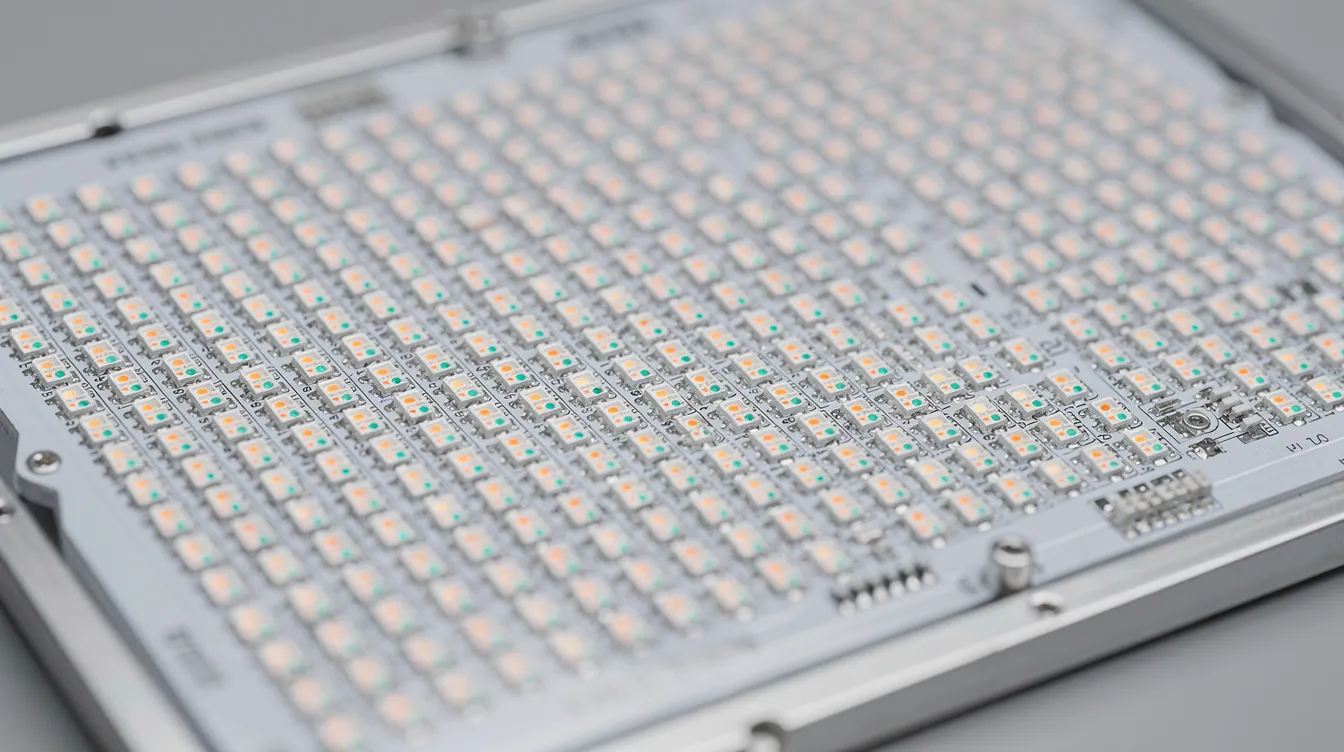
The guidance here applies to expos and corporate meetings across the region. Whether your team is exhibiting at a local industry conference or a multi-day expo, the goal is the same: plan AV production before show day so monitors, LED walls, lighting, audio, and content all work together inside the booth. There is a meaningful difference between picking up rental equipment and hiring a full-service av production team that handles design, signal routing, equipment installation, staging, and on-site support. Front Row FX operates in the latter category.

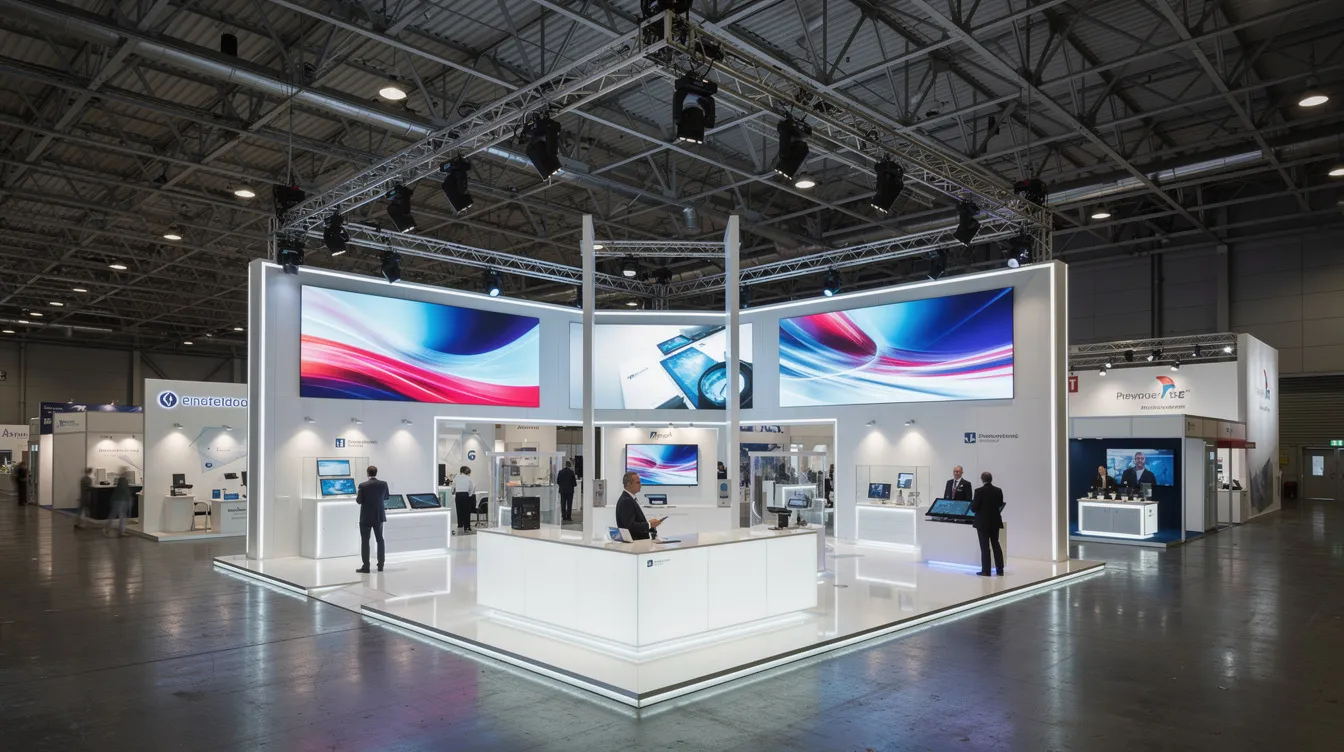
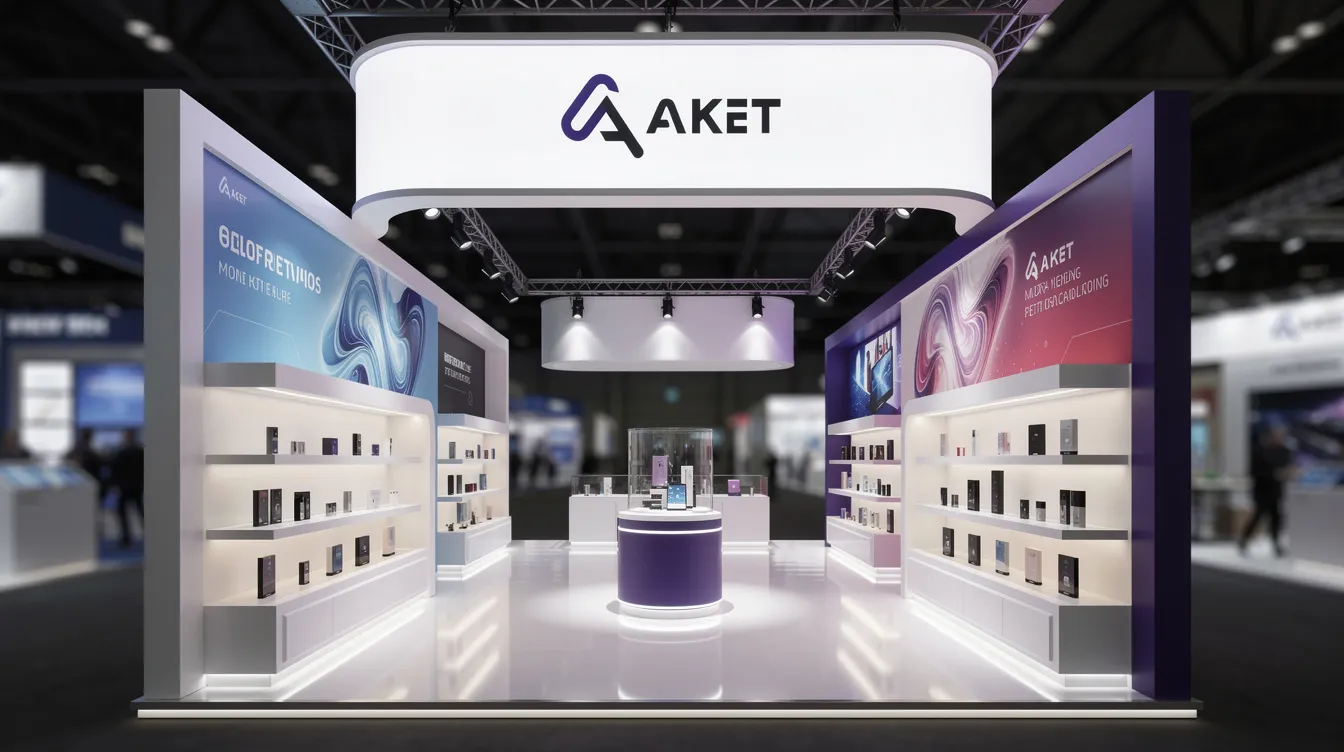
The image depicts a professional trade show booth featuring large LED video walls and accent lighting, set within a spacious convention center with high ceilings. This vibrant setup is designed to engage audiences and showcase innovative solutions, attracting attention on a crowded show floor.

Start with the Purpose of Your Minneapolis Trade Show Exhibit

Trade show AV decisions should be driven by exhibit goals, not equipment wish lists. Early AV planning reduces costs and improves event execution, and it starts with understanding why your company is on the show floor.

  • Lead capture and demos: Demo-heavy booths need multiple screens, localized sound, and interactive displays that increase visitor dwell time at exhibits. Interactive touchscreens and collaboration tools at demo stations keep attendees engaged longer.

  • Brand awareness and brand activations: High-traffic exhibits may prioritize a large LED wall to attract attention across aisles, bold lighting, and digital signage loops that showcase key messages.

  • Thought leadership: Scheduled presentations require microphones, mixing, timed content, and seating-closer to a small conference setup.

  • Product launch or private meetings: Controlled environments within the booth demand focused lighting, localized audio, and screens sized for close viewing.

Consider the difference: a medical device company at a regional healthcare expo in March might need fine-pixel-pitch displays and detailed product visuals, while a SaaS firm at a tech trade show in October could favor a large LED video wall, dynamic lighting, and ambient sound to engage audiences passing through a crowded show floor.

Minneapolis hosts targeted regional expos for audiovisual technologies, including events like FORTÉ LIVE, a regional technology expo focused on workplace audiovisual solutions, and the AVL Rep Expo, designed for audio, video, and lighting professionals in the Midwest. Many regional expos offer free or low-cost registration for trade professionals, and local AV events often include career fairs and networking opportunities. Even InfoComm, a major global pro-AV show focused on professional audiovisual systems, influences how exhibitors at venues far from the Las Vegas Convention Center approach their own booth design. AVI LIVE is another industry platform many meeting planners and integrators in the Midwest attend to explore innovation and ideas.

Front Row FX works with exhibitors and exhibit designers early to align AV production with trade show design and corporate messaging, so every detail supports your vision.

Choosing the Right Displays: Monitors, LED Displays, and LED Video Walls

Trade show AV in Minneapolis often mixes standard monitors with LED displays and LED video walls, each suited to different viewing distances and budgets.

  • Large-format LCDs (55–98 inches): Best for close viewing at 1–2 meters. Ideal for product demos, small corporate meetings inside a booth, or breakout-style content. Interactive displays can increase visitor engagement at trade shows when paired with touchscreen software.

  • LED video walls: LED walls can capture attention from across a trade show floor. They are ideal for long sightlines in bright environments like the Minneapolis Convention Center, where house lighting is strong and monitors alone may not cut through. LED walls enhance visibility from across the trade show floor and serve as visual beacons.

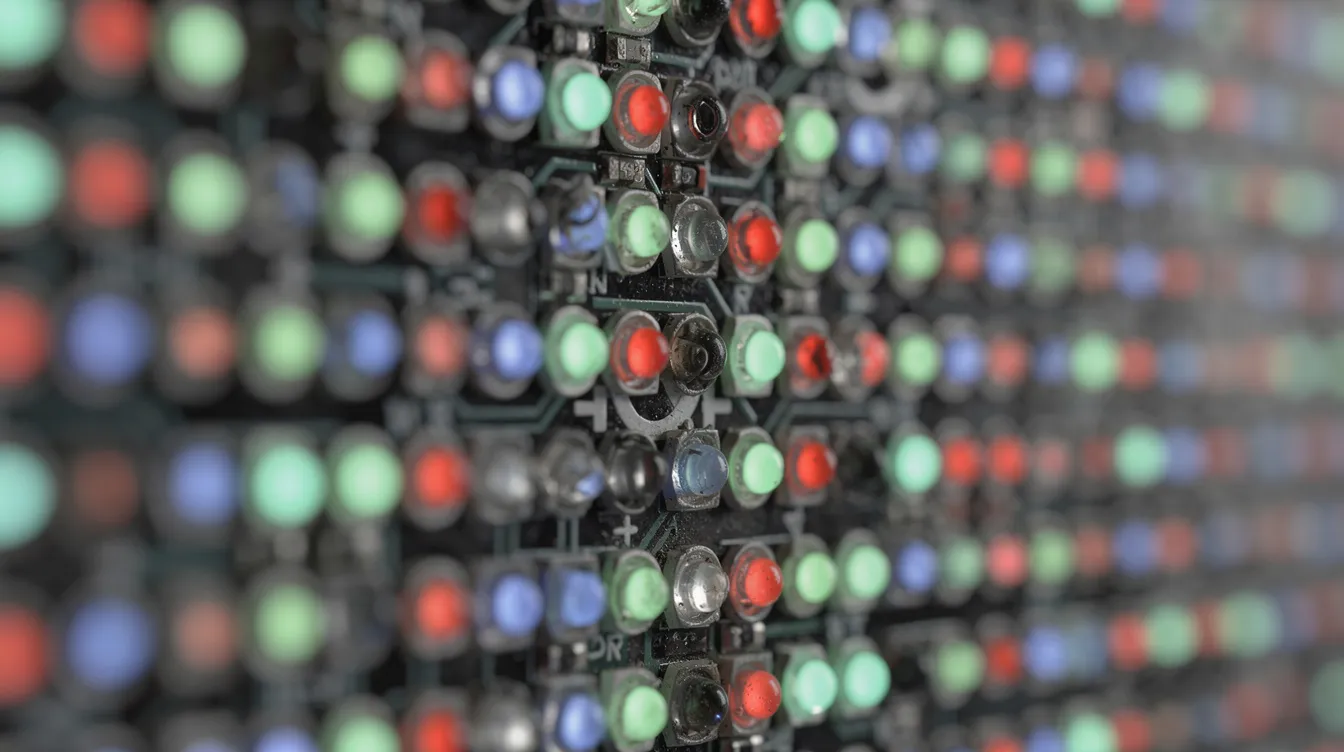
  • Key LED considerations: Pixel pitch matters-finer pitches like 2.6 mm deliver sharp close-up clarity but cost more and draw more power, while 3.9 mm works well for distance viewing. Content resolution must match the wall’s native pixel count to avoid scaling artifacts. Mounting options include ground-supported stacks, wall-mounted, or flown configurations.

  • Use cases: LED walls can serve multiple purposes at trade shows-product loop video, timed presentations, sponsor content rotation, live feeds from a demo station, or interactive installations that bring a booth to life.

Interactive displays increase attendee engagement and dwell time, making them valuable for exhibitors who want visitors to spend more time in their space rather than walking past.

Booth Lighting and Brand Presentation on the Show Floor

Lighting is a core aspect of trade show design, not an afterthought. Default hall lighting at most venues is flat and unflattering. Strategic lighting highlights products and differentiates exhibits from neighbors.

  • Practical lighting layers: Use general wash lighting to brighten the booth above ambient levels, accent lighting to draw the eye to products or key display areas, and branded color washes or gobos to reinforce your brand palette and logo.

  • Photography and video: If your marketing team plans to capture content during the event, coordinate lighting with camera needs. LED walls produce saturated light that can clash with overhead fluorescents-fill lights and careful color temperature matching prevent washed-out footage.

  • Alignment with displays: Lighting can highlight products and define meeting areas at trade shows, but if lighting is too bright near an LED wall, contrast drops. If the booth is too dark, monitors become unreadable. Coordinated lighting and video design prevents both problems.

Front Row FX provides event lighting design, fixture selection, and programming specifically for trade shows and corporate meetings in Minneapolis.

The image depicts a vibrant trade show exhibit featuring layered accent lighting that highlights various products, with a color wash that aligns with the company's brand. This innovative display is designed to attract attention on a crowded show floor, showcasing advanced audiovisual technology and interactive installations to engage attendees effectively.

Audio Strategy: When and How to Use Sound Inside Your Exhibit

Not every booth needs a PA system, but high-quality audio is crucial for clear communication during events where demos or presentations are scheduled. Professional audio planning considers room acoustics and speaker placement-even inside a 10×20 booth. AV technology includes sound reinforcement and interactive technology, and your audio visual strategy should reflect that.

  • Noise realities: Large exhibit halls at the Minneapolis Convention Center are reverberant and loud. On a crowded show floor, intelligibility drops fast without localized sound solutions.

  • Localized options: Small PA systems for mini-presentations, directional speakers to limit bleed into neighboring booths, sound domes for immersive content, and headset listening stations for video or virtual events content delivered to remote audiences watching via live streaming.

  • Neighbor relations: Audio needs to be intelligible without creating complaints. Front Row FX’s audio visual engineers can model coverage and select the right approach for your booth size and layout.
  • Microphones and mixing: Wired, wireless, headset, or handheld microphones for scheduled presentations or corporate meetings within the booth, with professional mixing, monitoring, and on-site technician support.

Content and Creative Services: Plan Media Before You Arrive

The best event AV plans in Minneapolis start with content, not hardware. Mismatched content resolution is one of the most common trade show mistakes-and early AV planning saves money and reduces risks.

  • Coordinate specs early: Screen dimensions, LED wall pixel counts, aspect ratios, playback formats (USB, media server, direct feed), and color space should be locked with your AV team 4–6 weeks before show open.

  • Common content types: Motion graphics loops, product explainer video, live demo capture, social media walls, sponsor rotations, and digital signage feeds for conferences and corporate events.

  • Creative services: Front Row FX can provide content formatting, motion graphics, and last-minute updates during multi-day events-part of what makes a production company different from a one stop shop rental counter.

  • Content run-of-show: Plan a detailed schedule mapping video loops, presentation times, standby content, product launch moments, and transitions. This document becomes the platform for a flawless production experience. Ensure key messages are timed to peak foot traffic.

Content designed for trade shows can often be adapted for virtual events or shared with remote audiences, extending the life of your investment.

Power, Internet, and Signal Paths at Minneapolis Venues

Power and internet are typically ordered through the venue or official show services. Requirements vary between the Minneapolis Convention Center, Saint Paul RiverCentre, and hotel ballrooms.

  • Official resources: Consult the Minneapolis Convention Center exhibitor services and Saint Paul RiverCentre Exhibitor Guide for current electrical and internet ordering details, deadlines, and pricing. Do not guess.

  • AV power questions: Total draw of LED walls, monitors, lighting, computers, and charging stations. Determine whether single-phase or three-phase power is required. Identify power drop locations within the booth floor plan.

  • Internet and networking: If your exhibit depends on streaming demos, cloud-based apps, lead retrieval, or collaboration tools, determine bandwidth needs early. Smart City Networks is the exclusive technology provider at the convention center, offering options up to 10 Gbps dedicated circuits-wired connections are essential for reliable, advanced technology applications.

  • Signal path planning: Map how content moves from laptops or media servers through processors and controllers to LED walls and displays. Cable routes and distribution hardware should be designed before the booth is built to minimize visible runs and safety hazards.

Front Row FX coordinates closely with show services so power, internet drops, and AV equipment align with the final floorplan.

Mounting, Structural Integration, and Trade Show Design

Trade show AV is part of the structural design of the booth, not something bolted on at the last minute. Trade show design should balance aesthetics with technology.

  • Mounting approaches: Ground-supported LED walls, wall-mounted monitors, freestanding kiosks, ceiling-hung displays (where venue rules allow), and integrated structures designed by exhibit houses. Each has weight, access, and cost implications.

  • Structural coordination: Work closely with exhibit builders on weight loads, rigging points, and allowable heights. At the Minneapolis Convention Center, rigging in certain halls requires advance submission and approval.

  • AV and design collaboration: Front Row FX can collaborate with exhibit designers to ensure LED walls, monitors, and lighting positions are safe, serviceable, and visually balanced within the overall booth structure.

  • ADA and traffic flow: Traffic flow analysis is critical for trade show success. Keep cables out of aisles, maintain open sightlines, and make demo areas accessible to all attendees. These details matter for both safety and attendee experience.

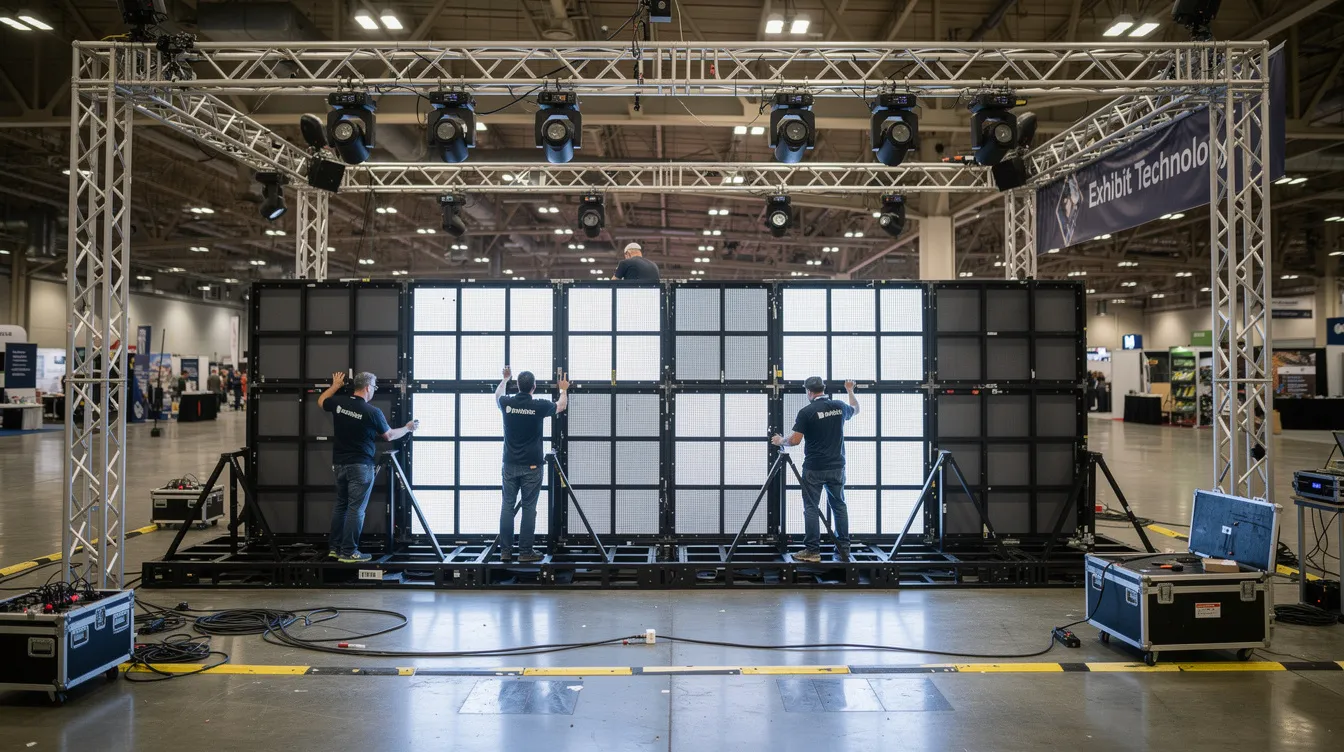
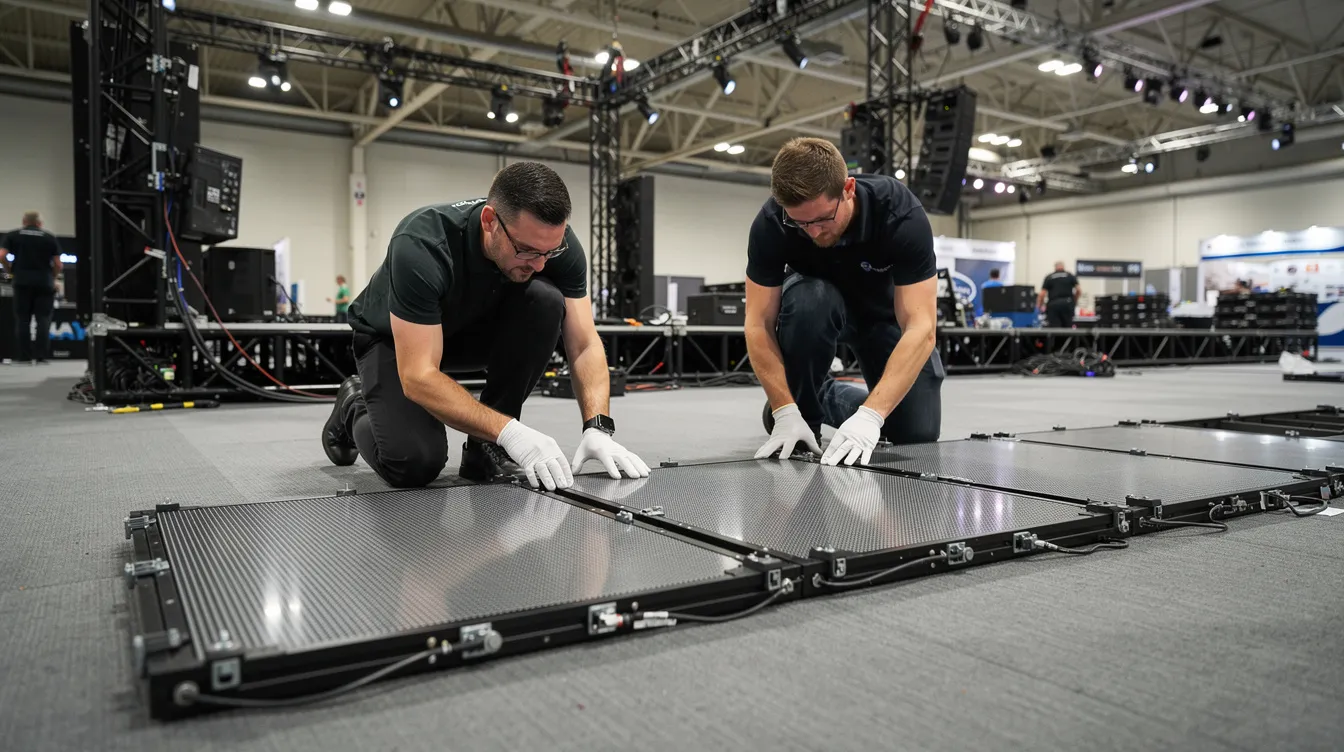
A ground-supported LED video wall is being assembled inside a convention center exhibit booth, with truss and lighting fixtures overhead, creating an engaging environment for corporate meetings and trade shows. Experienced technicians work closely to ensure flawless production and innovative solutions for showcasing key messages and attracting attention on the crowded show floor.

Show Services, Load-In, and Technical Checks Before Doors Open

Venue-controlled services-electrical, internet, rigging, material handling-must be ordered on deadline, often several weeks in advance. Exhibiting at trade shows often requires contacting event organizers several months in advance to secure booth space and services.

  • Load-in flow: Target your assigned move-in window, check in through the marshaling yard or loading dock, complete booth set, then begin AV installation. Coordinate with your exhibit builder so staging and AV happen in sequence, not in conflict.

  • AV installation: Front Row FX coordinates installation of LED walls, lighting, audio, and control systems around exhibit builder schedules so the booth is show-ready on time-a critical detail for a flawless experience.

  • Technical checks: Before doors open, verify power, content playback, audio tuning, lighting focus, backup media, and all cues. Walk through the booth from an attendee’s perspective to confirm sightlines and sound coverage.

  • On-site review: Schedule a specific meeting with your AV team and your exhibitor team at least half a day before opening to confirm playlists, demo procedures, and contingency plans. Many major AV events in Minneapolis are specifically tailored for local systems integrators, but your booth needs to impress every attendee, not just industry insiders.

On-Site Support, Multi-Day Events, Content Updates, and Teardown

After the show opens, the question shifts from setup to operations. Who runs the system? How are issues handled?

  • On-site support: Front Row FX provides experienced technicians available during show hours for LED walls, audio, lighting, and playback systems. This is fundamentally different from self-serve rentals where you are on your own if something fails.

  • Multi-day trade shows: Overnight power may be reduced unless ordered otherwise. Daily system checks before doors open-LED refresh, audio balancing, lighting program reset-keep everything performing at its best for each day’s audience.

  • Content updates: New product video, updated messaging, schedule changes-content updates can be handled during the show via USB, remote file transfer, or media server access. Advance planning and a clear run-of-show document make updates smoother.

  • Teardown: Adhere to the venue’s dismantle window. Safe disassembly of LED walls and rigged equipment, cable removal, and coordination with exhibit dismantle crews and show services prevent damage and delays.

For exhibitors doing a series of live events or trade shows across the Upper Midwest, Front Row FX can help standardize AV packages and content for consistent execution at every stop.

Working with Front Row FX: Local Trade Show AV Production in the Twin Cities

Minneapolis has a strong community of audiovisual production companies. Front Row FX is a Minnesota-based AV production company focused on integrated trade show, corporate event, and live event audiovisual technology-not one-off gear drop-offs. Effective trade show AV can enhance audience engagement, and that takes expertise, not just equipment.

  • Core services: LED walls, monitors, projection, event lighting, audio systems, playback and switching, creative services, content formatting, and complete audiovisual production management. We bring innovative solutions and professional execution to every project.

  • Regional reach: We support corporate meetings, conferences, brand activations, and trade shows across Minneapolis, Saint Paul, and the Upper Midwest, with travel support for exhibitors doing multiple regional shows. Whether you need to connect with your audience at a conference or maximize impact at the industry’s biggest expo, we help you create the best event experience possible.

  • Planning process: A typical discovery call covers exhibit goals, venue and dates, booth size, AV wish list, budget range, and any corporate events or live events tied to the same trip. We help you showcase your business and engage attendees through every aspect of AV production.

Explore our experiences to see how we bring audiovisual technology to life for exhibitors and event teams.

If you are planning trade show AV in Minneapolis, contact Front Row FX early. The earlier your team and ours align on vision, floorplan, and content, the stronger the result on the show floor.

Categories
LED Screens & Video Walls

Planning LED Walls and AV at Minnesota Convention & Expo Venues

Minneapolis Convention Center AV: Planning LED Walls and Audiovisual Production With Front Row FX

Overview: Minneapolis Convention Center AV Planning Guide

This is a practical guide for planning LED video walls and audio visual production at the Minneapolis Convention Center, written by Front Row FX, a Minnesota-based audiovisual production company serving corporate events, conferences, trade shows and large-scale live productions across the Twin Cities and Upper Midwest.

The Minneapolis Convention Center is Minnesota’s largest convention facility, with 480,000 square feet of exhibit space, more than 90 meeting rooms, a 28,000 square foot ballroom and a 3,400-seat auditorium. These dimensions directly shape how LED walls are sized, where audio systems are placed, how rigging is planned and how much power is required. AV services at the venue include sound reinforcement, video projection, and event lighting, but the specifics depend heavily on which rooms you book and how your event is structured.

Effective AV planning should begin before equipment is ever selected. The first questions are about goals, audience size, room layout, rigging options and power availability at the convention center. A 2,000-person general session in the auditorium is a fundamentally different production from a 200-booth trade show in Exhibit Hall A, and both require different technical approaches from the start.

Front Row FX is a local production partner that coordinates LED video walls, audio, lighting, on site technicians and show operation across Minneapolis convention venues. We are not the in-house AV provider at MCC. We are an independent audiovisual production company that works alongside venue teams and show management to deliver high-impact events at convention centers, hotels and specialty venues throughout Minnesota.

All venue-specific details in this article are based on publicly available information from the official Minneapolis Convention Center website and exhibitor resources. Planners should always confirm current specs, policies and pricing directly with their MCC event manager, as facility details can change.

Later sections of this guide cover AV considerations for other major Minnesota convention venues, including Saint Paul RiverCentre, Mystic Lake Center, Mayo Civic Center and the Duluth Entertainment Convention Center (DECC), for teams planning multiple events across the region.

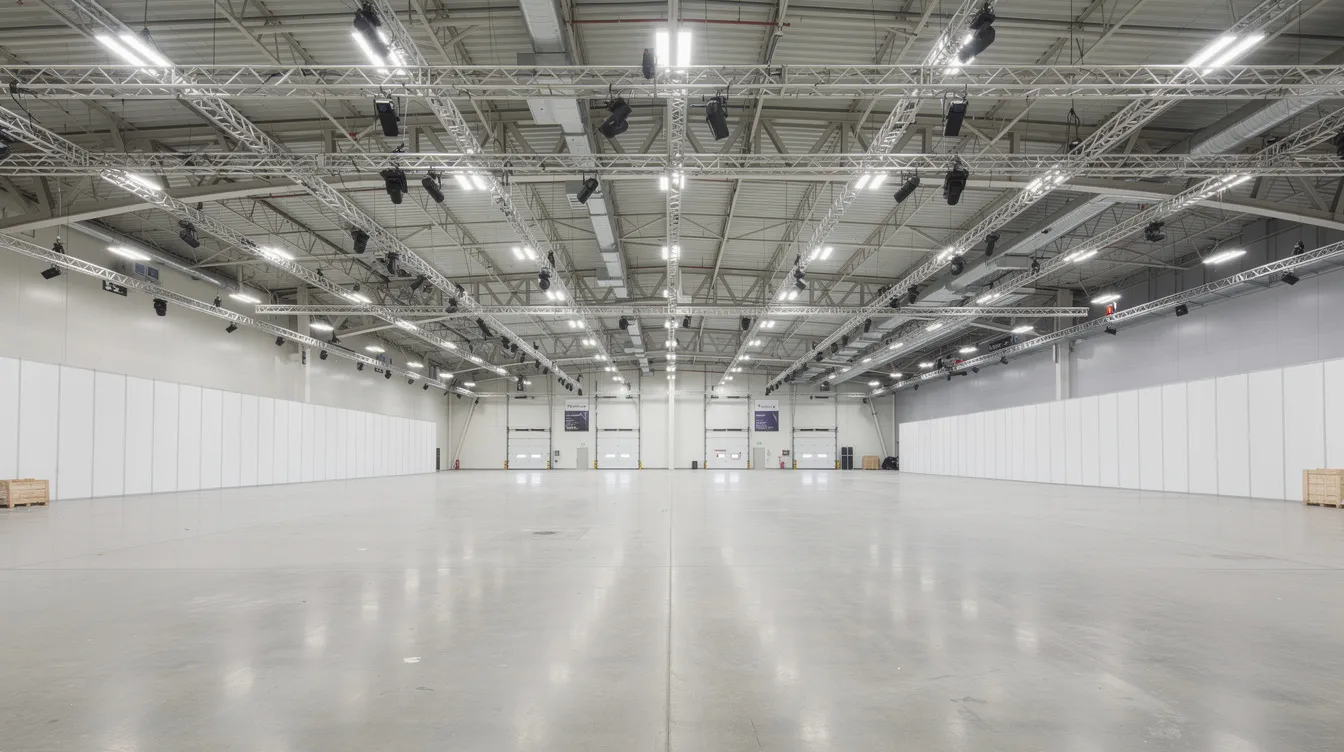
The image shows a wide interior view of a spacious exhibit hall at the Minneapolis Convention Center, featuring overhead truss lighting and an open floor space that is prepared for event setup. This versatile area is ideal for trade shows, corporate meetings, and various events, with expert support available for audio visual needs.

Minneapolis Convention Center AV, LED Walls and Room Logistics

The Minneapolis Convention Center occupies a massive footprint in downtown Minneapolis, connected by skyway to nearby hotels. The building’s main event areas include:

  • Exhibit Halls A through E totaling roughly 475,000 to 480,000 square feet of combinable exhibit space

  • A fixed-seat auditorium seating approximately 3,400

  • A 28,000 square foot ballroom divisible into sections

  • 90+ meeting rooms on multiple levels, ranging from small classrooms and breakout sessions to 15,000 square foot combined conference spaces

The center regularly hosts public shows, conferences, and trade shows, often requiring simultaneous AV support in general sessions, breakout rooms and exhibit halls during the same event. Audio-visual needs for large events can include multiple screens and live streaming, all running concurrently across different areas of the building.

Built-in House Systems

MCC has a supervised public address system that was originally installed in 1995 and upgraded in 2017, serving both emergency announcements and meeting room sound reinforcement. Select meeting rooms include built-in audio panels with microphone input, volume control, record outputs and background music control. Some presentation spaces have installed video projection.

These house systems work well for meetings and smaller breakout sessions, but most producers planning large general sessions, galas or branded keynotes bring in full-scale production systems. The venue features high-clarity sound systems suitable for large spaces, yet the difference between house PA and a purpose-designed concert or conference audio rig is significant when you are filling a ballroom or exhibit hall with 1,500 or more people.

How AV Requirements Differ by Event Type

Audio visual requirements shift substantially depending on what kind of event you are running at the Minneapolis Convention Center:

Event Type

Typical AV Needs

Corporate General Session

Flown or ground-supported LED wall, line array audio, stage lighting, IMAG cameras, confidence monitors, playback systems

Trade Show / Expo

Distributed audio zones, booth-level LED displays, sponsor signage, localized PA, power coordination across exhibitor booths

Association Convention

Multiple breakout room setups, plenary LED wall, streaming/hybrid, presentation switching, room-turn support

Public / Consumer Show

Branded entrance LED, ambient lighting, zoned audio, ticketing and registration AV, crowd flow signage

Gala / Awards

Stage scenic with LED backdrop, theatrical lighting, walk-up music, speech reinforcement, video playback

Planners should review MCC’s official floor plans for exhibit halls, ballroom layouts and meeting level maps to verify ceiling heights, room capacities and stage placement options before finalizing any AV design.

Sightlines, Ceiling Height and LED Video Wall Placement

Ceiling height is one of the first constraints that shapes LED wall planning. Exhibit Halls B through E on Level One have ceiling heights to the lowest truss of approximately 30 feet. Exhibit Hall A on the Lower Level offers roughly 29 feet 10 inches to the lowest truss. Meeting rooms vary from about 16.5 to 20 feet.

For the auditorium, the fixed seating rake determines audience sightlines. Any LED wall width needs to be large enough that side sections can read content clearly. For rooms seating 1,000 or more people, LED walls typically need to be at least 16 to 24 feet wide, and when viewing distances exceed 80 to 100 feet, IMAG (live camera magnification) becomes essential so rear attendees can see presenter detail.

In the ballroom, where ceiling height is approximately 30 feet, there is room for substantial flown or ground-supported LED walls, but the screen’s bottom edge height and trim height must be planned against table heights and standing sight lines for banquet or reception layouts. The facility includes high-definition video projection and large-scale screens in certain configurations, but for high-impact branding and content, direct-view LED walls deliver superior brightness and contrast under the ballroom’s programmable LED lighting.

Rigged vs. Ground-Supported LED Video Walls

The Minneapolis Convention Center provides permanent rigging points in exhibit halls and ballrooms with varied load ratings. The venue requires strict adherence to engineering and safety guidelines for rigging. In the auditorium, installed rigging hardware (I-bolts) is rated for 500 pounds each, with point loads from main beams up to 2,000 pounds per point.

Key rigging rules at MCC:

  • Rigging plans with load calculations must be submitted at least 21 days in advance

  • All items to be suspended over 50 pounds or longer than 10 feet require installation by facility-designated or approved personnel

  • No rigging from air-wall tracks

  • No adhesive vinyl on drywall or wood veneer surfaces

Many events use ground-support truss structures in exhibit halls, which reduces dependency on ceiling rigging points and simplifies the approval process. MCC’s floor load capacity in Exhibit Hall A is 350 pounds per square foot, which comfortably supports ground-stacked LED wall bases and truss towers. Ground support is also a practical choice when rigging budgets are limited or when ceiling point locations don’t align with the desired screen position.

Front Row FX designs both rigged and ground-supported LED video wall systems and can advise on which approach fits your room, budget and timeline.

Audio System Approaches at MCC

Audio design at the Minneapolis Convention Center depends on space and purpose:

  • Auditorium and large ballrooms: Flown line arrays with multiple main hangs, delay speakers for rear sections, distributed fills for coverage consistency, professional mixing consoles and DSP processing for delay alignment and equalization

  • Exhibit halls: Distributed PA systems with zone control, portable speakers positioned near stages or demo areas, careful management of audio spill between neighboring booths and activations

  • Breakout and meeting rooms: Compact PA setups leveraging built-in audio panels, wireless lavalier and handheld microphones, reinforcement sized for rooms under 500 to 600 people

Consistent audio coverage and intelligible speech matter enormously for corporate meeting content, training sessions and keynote presentations. A room with uneven coverage creates dead spots where attendees lose engagement.

Lighting Design

The Minneapolis Convention Center has professional lighting design capabilities and custom stage setups available for events of all sizes. The ballroom features programmable LED lighting with zoned controls, which can be leveraged for branding color washes and mood lighting during galas or evening receptions. Exhibit halls use LED house lighting with zone on/off controls and maximum illumination around 100 foot-candles.

For stage presentations, entertainment segments and branded environments, additional intelligent lighting, front wash, side fill and effects lighting are typically brought in by the production team. Spotlight platforms on mid-level catwalks provide follow-spot positions for auditorium and large-room shows.

Trade Show Booth AV

Trade shows at MCC are a different production challenge. Exhibitors often want LED video walls inside their booth footprint for product demos, brand storytelling and sponsor activations. Audio zones for product demonstrations need to be carefully managed so sound doesn’t bleed into neighboring booths.

Front Row FX can coordinate with show management and facility services on power drops, signal runs and schedule for trade show booth LED video walls. This includes planning cable pathways from floor boxes to booth locations, timing equipment delivery around exhibitor move-in windows and providing staffing for setup, operation and teardown.

A ground-level view showcases a large LED video wall mounted on truss within a convention ballroom, surrounded by vibrant stage lighting, ideal for events like trade shows and corporate meetings at the Minneapolis Convention Center. The setup highlights advanced audio visual equipment, emphasizing the space's capability for live streaming and breakout sessions.

Power, Internet, Loading and Scheduling at the Minneapolis Convention Center

Technical logistics at MCC-power, loading access, internet and schedule-can determine what is realistically possible for LED walls, sound and lighting, especially during tight move-in windows.

Electrical Services

Electrical services for exhibit booths and events are ordered through the Minneapolis Convention Center or designated service providers. Planners should consult MCC’s official exhibitor services and electrical order forms for current specifications and pricing.

MCC’s exhibit halls provide flush-mounted floor boxes spaced on 30-foot centers, delivering electrical (120/208V, 100-amp, single-phase and three-phase), cable TV, telecommunications and microphone access to the PA system. Catwalks offer 480V panel access with 100-amp three-phase power and additional utility tie-ins.

High-power requirements for LED video walls-particularly large indoor walls with 2.6 to 3.9mm pixel pitch-must be coordinated early with MCC’s electrical services. Planning considerations include:

  • Total amperage across all LED panels, audio amplifiers, lighting fixtures and playback/control systems

  • Distribution locations relative to floor boxes, columns and wall panels

  • Redundancy in case a circuit or floor box fails during the show

  • Cable routing from floor boxes to stage, LED wall and front-of-house positions, planned safely with covered ramps or taped pathways

Distribute power loads across multiple floor boxes rather than overloading a single drop. Separate lighting power (stage wash, effects, moving heads) from LED wall and audio circuits when possible.

Internet and Signal Distribution

MCC provides wired and wireless internet options. Free Wi-Fi serves general attendee use, but producers running live streaming, hybrid sessions, registration systems or exhibitor activations should work with the venue’s official internet provider to secure dedicated wired bandwidth. Floor boxes include fiber backbone (six single-mode fibers per box) and data connections, but capacity and pricing should be confirmed well in advance.

Content playback and signal distribution-running HDMI, SDI or NDI from backstage to LED walls or projection screens-should be coordinated with both the venue and any in-house or preferred providers. Long cable runs through exhibit halls require fiber or SDI-over-fiber rather than HDMI to avoid signal degradation, and all cable pathways crossing public or service areas need venue approval.

Loading Docks and Access

The Minneapolis Convention Center has more than 40 covered loading bays, drive-in doors and a fenced, lighted marshaling area of approximately 88,000 square feet behind the facility. Exhibit Hall A features drive-in, bi-fold powered doors (18 feet high by roughly 20 feet wide) and two freight elevators rated at 10,000 pounds with dimensions of about 9 feet 9 inches wide by 13 feet 9 inches deep by 10 feet high.

Load-in and load-out times are typically tightly scheduled by show management. Planners should share freight schedules, dock assignments and targeted move-in times early with their AV team so that truck parking, gear unload, LED wall assembly and line checks can be completed without impacting exhibitors or other vendors sharing the dock.

Multi-Day Operation

Multi-day conventions and trade shows at MCC require daily technical management. Dedicated technology services provide on-site management for audio-visual needs, including daily power-up sequences, rehearsals, session turns, show calling and overnight monitoring for complex LED and audio visual systems. Front Row FX structures multi-day support with on site technicians covering every show hour, plus pre-show checks and post-show shutdown.

Pre-Proposal Checklist for Minneapolis Convention Center AV

Before requesting an AV proposal for MCC, gather answers to these questions:

  • Which room(s) or hall(s) are confirmed, and what are the expected attendance numbers?

  • Where will the stage be placed, and what is the audience seating layout (theater, classroom, banquet)?

  • Is rigging available and approved for your rooms, or will ground support be required?

  • Where are electrical drops located relative to the stage and LED wall positions?

  • What are the internet bandwidth needs for streaming, hybrid or exhibitor activations?

  • What are the official show hours, rehearsal windows and move-in/move-out dates?

  • Are there sponsor or brand requirements affecting LED content, staging or lighting?

Working With Front Row FX vs. In-House and Other AV Providers

The Minneapolis Convention Center offers built-in audio and video in certain spaces, and some events work with in-house or preferred AV vendors. Minnesota venues often require in-house AV services for basic setups in meeting rooms. Other events choose external production partners for larger or more complex shows.

Front Row FX is an independent Minnesota-based audiovisual production company. We are not the in-house AV provider at MCC. Event planners should always confirm the venue’s policies on outside AV and any related fees with their MCC sales or event manager before engaging an external team.

The difference between Front Row FX and rental-only providers or basic AV support is scope and responsibility. We provide:

  • Full production planning and technical design

  • LED video wall engineering and installation

  • Audio system tuning and coverage mapping

  • Lighting design for stage, branding and entertainment

  • Show operation, crew management and on site technicians

  • Multi-system integration and signal workflow design

Front Row FX collaborates with MCC’s technical staff and any in-house systems. For example, tying into existing paging or distributed audio where appropriate while supplying additional LED walls, stage lighting, cameras and playback for higher-impact shows.

The Minneapolis AV landscape includes a range of providers. Visual Horizon Communications provides audio-visual stage production. Encore offers full AV setups for hybrid events. AVEX specializes in event production and equipment rental. AV For You provides audio, visual, and lighting rental services. Front Row FX differentiates through hands-on production management, regional convention experience and the ability to support events not only at MCC but across Saint Paul, Rochester, Duluth and casino convention properties throughout MN and the Upper Midwest.

Planners considering hybrid or streaming elements at MCC should involve their AV partner early to coordinate encoding hardware, streaming platforms, camera placement and integration with the venue’s internet services.

If you are planning an event at the Minneapolis Convention Center and need expert support beyond basic meeting room AV, contact Front Row FX to discuss your room layouts and schedules and receive a tailored technical approach rather than a generic equipment list.

LED Video Walls and Audiovisual Planning Across Major Minnesota Convention Venues

Many organizations plan multi-venue event series across Minnesota, and AV strategies should adapt to each convention center’s layout, rigging grid, electrical infrastructure and audience profile. A design that works at MCC may not translate directly to a casino ballroom in Prior Lake or an arena-adjacent hall in Saint Paul.

Front Row FX supports events throughout Minnesota and the Upper Midwest, including at Saint Paul RiverCentre, Mystic Lake Center, Mayo Civic Center in Rochester and the Duluth Entertainment Convention Center. The following sections provide planning context for each venue based on publicly available official information.

Beyond these major facilities, smaller Minnesota venues also serve the meetings and events market. The McNamara Alumni Center offers custom AV with on-site technicians for university-affiliated conferences. Breezy Point Resort has 25,000 square feet of flexible function space for retreats and regional meetings. The Ministry Conference Center can accommodate up to 200 people for training sessions, workshops and small corporate gatherings. Each venue has its own infrastructure profile, and planners should always verify AV policies before selecting equipment.

An aerial view of downtown Minneapolis showcases the bustling cityscape featuring the Minneapolis Convention Center, with interconnected skyways linking various hotels. The scene highlights the vibrant atmosphere of corporate meetings, trade shows, and events, emphasizing the city's role as a hub for audio-visual support and expert services.

Saint Paul RiverCentre: Downtown Saint Paul Conference and Expo AV

Saint Paul RiverCentre is the Twin Cities’ second major convention facility, located in downtown Saint Paul and connected to the Xcel Energy Center arena. The venue offers large exhibit halls (Halls A and B together provide approximately 68,000 square feet of continuous exhibit space on the Lower Level), a grand ballroom and multiple meeting rooms, all linked via skyway to Saint Paul hotels and parking structures.

The RiverCentre’s main exhibit hall and ballroom are well suited to LED video walls for general sessions, sponsor features and main stage branding. Sightlines and ceiling height should guide screen sizing and stage design-particularly in the ballroom, where banquet rounds or theater seating configurations change how far the rear audience sits from the screen.

Power and rigging considerations at RiverCentre include:

  • Floor boxes across exhibit hall floors supply electrical, phone, internet, cable, air and water where available

  • Wired internet service is available, with published rates for exhibitor lines (pricing should be confirmed with the venue’s current exhibitor services documentation)

  • The facility has areas available for rigging, but exact capacities vary by room and must be confirmed with the venue

For plenary sessions, Front Row FX can design flown or ground-supported line array audio systems sized to the room, with distributed zones for trade show floors that maintain intelligible speech during overlapping sessions. Loading dock access, truck times and freight elevator coordination should be arranged early with venue event managers and show decorators, especially when bringing in large LED or lighting rigs.

Planning questions for Saint Paul RiverCentre events:

  1. What is the expected attendance for the largest session, and which room combination will be used?

  2. Will any sessions be recorded or streamed to remote attendees?

  3. How should sponsor branding appear on LED walls-dedicated screens, logo rotation, or integrated into presentation content?

  4. Are there simultaneous breakout sessions requiring separate AV setups?

  5. What is the move-in window, and how many other groups are loading in on the same day?

Mystic Lake Center: Casino Convention AV and LED Walls

Mystic Lake Center in Prior Lake offers 130,000 square feet of indoor and outdoor event space, with its largest ballroom accommodating up to 2,177 guests. The property is connected to the Mystic Lake Casino Hotel, which makes it popular for corporate retreats, awards galas and multi-day conventions that benefit from on-site hotel rooms, dining and entertainment.

The center’s modern ballrooms with relatively high ceilings are well suited for large LED video walls, concert-style lighting and flown audio systems. For awards galas, corporate keynotes and entertainment nights, the combination of a wide LED backdrop, intelligent moving lights and a properly tuned line array transforms the space into a production-grade venue.

Casino properties often have specific load-in routes and schedule windows designed to avoid disrupting hotel guests and casino operations. Early coordination with venue operations is essential when bringing in trucks, truss and large LED packages. Plan for:

  • Designated loading paths that may route through service corridors rather than public areas

  • Time-of-day restrictions on noisy work like truss assembly and motor rigging

  • Coordination with venue electrical services or the engineering team to confirm three-phase power distribution locations for LED walls, moving lights and audio amplifiers

Front Row FX can support hybrid or streaming elements at Mystic Lake Center by coordinating camera positions, control room placement and internet requirements with the property’s IT or designated internet provider. Encoding hardware and streaming platform integration should be specified during the design phase, not improvised on site.

Planning prompts for Mystic Lake Center:

  • Will the event include a live band or DJ in addition to corporate presentations?

  • Are scenic elements (custom set pieces, drape, scenic flats) planned around the LED wall?

  • How do late-night reception or entertainment schedules impact staffing and overtime planning for technicians?

  • Does the venue’s AV infrastructure include any built-in systems that the production team should integrate with or work around?

The image depicts a beautifully arranged hotel ballroom at the Minneapolis Convention Center, set for a corporate gala with dramatic overhead lighting and a large stage designed for presentations. The space is equipped for audio visual needs, including video projection and sound, creating an elegant atmosphere for events in downtown Minneapolis.

Mayo Civic Center and DECC: Regional Convention AV in Rochester and Duluth

Mayo Civic Center in Rochester and the Duluth Entertainment Convention Center in Duluth are key regional convention facilities serving medical conferences, association meetings, sports-related events and public expos. Both venues draw national and international attendees despite being outside the Twin Cities metro.

Mayo Civic Center, Rochester

Mayo Civic Center offers large exhibit spaces, a ballroom and presentation halls, all within walking distance of downtown Rochester and Mayo Clinic facilities. The proximity to one of the world’s leading medical institutions drives high expectations for professional audio visual quality-particularly for scientific presentations, medical device demonstrations and continuing education sessions where content clarity is non-negotiable.

LED video wall and projection decisions at Mayo Civic Center should factor in room shape, balcony or tiered seating in larger halls, and whether the program includes scientific poster sessions, plenary keynotes or exhibitor product theaters needing separate AV setups. High-definition video projection may serve some breakout or poster areas, while direct-view LED walls deliver better impact for plenary stages and sponsor-facing environments.

Planners should review Mayo Civic Center’s published floor plans and exhibitor resources, including ceiling heights, rigging notes and loading diagrams, when preparing AV RFPs.

Duluth Entertainment Convention Center (DECC)

The DECC is a multi-venue complex combining convention center halls, arenas, performing arts spaces and meeting rooms along Duluth’s waterfront. Key event spaces include the 26,000 square foot Lake Superior Ballroom, the 12,000 square foot Harborside Ballroom and approximately 25 meeting rooms. This variety supports events ranging from trade shows and concerts to banquets and regional association meetings.

Large DECC halls and arenas can benefit from concert-scale LED video walls, flown line arrays and robust lighting packages, while smaller meeting spaces may only require compact audio visual setups and small LED displays or projection. Duluth AV Logistics supports events at the DECC with flexible AV programs, and planners should confirm what services are available through the venue versus what should be provided by an outside production company.

Weather and seasonal conditions in Duluth deserve specific attention. Winter storms can delay truck access and compress loading schedules. Contingency planning for gear arrival, setup time and crew call is important from November through March-build buffer days into your production schedule when possible.

Front Row FX uses a consistent technical planning process across Mayo Civic Center, the DECC and the Minneapolis and Saint Paul venues, tailoring LED wall sizes, audio coverage and staffing levels to each building’s layout and event schedule. Whether the venue is a 3,400-seat auditorium in Minneapolis or a waterfront ballroom in Duluth, the planning methodology stays the same: discover the room, design the system, deliver the show.

How to Scope Minneapolis Convention Center AV and LED Wall Projects With Front Row FX

The most successful Minneapolis Convention Center AV projects begin with a clear brief-not a pre-selected equipment list. Front Row FX helps planners translate event goals into a practical, room-specific technical plan that accounts for the building’s infrastructure, the audience experience and the production budget.

What to Collect Before Requesting a Proposal

Before reaching out, gather the following:

  • Confirmed or tentative dates and venue (MCC, RiverCentre, Mystic Lake Center, Mayo Civic Center, DECC)

  • Room assignments and expected attendance per space

  • Room set type for each session: theater, classroom, banquet, expo

  • Stage location preferences and a run-of-day or show flow document

  • Floor plans from the venue, annotated with preferred stage positions, registration areas and any sponsor or experiential zones needing separate LED, audio or lighting support

  • Sample content when available-PowerPoint decks, logo treatments, video playback formats-so LED video walls can be sized appropriately and playback systems planned for compatibility

  • Hybrid or streaming requirements, including keynotes streamed to remote attendees, recorded sessions for on-demand viewing, or social media feeds requiring camera and encoding gear

How Front Row FX Structures Multi-Day Support

For multi-day Minneapolis convention events, Front Row FX typically follows this workflow:

  1. Pre-production design meetings to align technical plans with event goals and venue constraints

  2. On-site advance and system build days for LED wall assembly, audio hang and tune, lighting focus and signal testing

  3. Rehearsals with presenters, walk-throughs with show callers and content verification on all screens

  4. Live show operation with dedicated technicians at audio, video, lighting and playback positions

  5. Daily content checks including screen calibration, microphone battery swaps and system diagnostics

  6. Post-event teardown coordinated with dock schedules and show management timelines

This is complete audiovisual production-not one-off equipment rental. Front Row FX takes responsibility for the finished show experience, from corporate event production keynotes to trade show LED installations.

Questions We May Ask During Discovery

During the planning process, Front Row FX will typically explore:

  • Which sessions are highest priority, and do any executive-level segments need extra redundancy (backup playback, redundant switching)?

  • Are there language interpretation needs requiring separate audio feeds or on-screen captioning?

  • What accessibility considerations apply (ADA seating positions, hearing loop zones, screen placement for sight-impaired attendees)?

  • Are there restrictions from sponsors, global brand teams or show management on screen content, logo placement or lighting color?

  • What feedback mechanisms exist for presenters-confidence monitors, countdown timers, stage manager communication?

Start the Conversation

Whether you are a corporate planner organizing a 3,000-person conference, a trade show exhibitor building a branded LED booth, an agency producing a product launch, or an out-of-state team coordinating your first event in Minneapolis, the planning process starts the same way: share your goals, your venue and your timeline.

Front Row FX is ready to review your floor plans and technical documents before equipment is ever chosen. Contact us to begin a collaborative AV planning process at the Minneapolis Convention Center or any major Minnesota convention venue. We will work with you to build a technical approach that fits the building, the audience and the event you are trying to create.

A production crew is focused on a mixing console and video switching station, managing audio and video elements during a live corporate event at the Minneapolis Convention Center. The scene showcases on-site technicians working diligently to ensure smooth live streaming and effective sound and video projection for the audience.

Categories
LED Screens & Video Walls

LED Video Walls for Trade Show Booths in Minneapolis: A Planning Guide

Trade Show LED Wall Minneapolis: Planning the Right Video Wall for Your Booth

Why LED Video Walls Matter at Minneapolis Trade Shows

LED video walls have changed how companies show up on the show floor. At venues like the Minneapolis Convention Center and Saint Paul RiverCentre, exhibitors are replacing static banners and printed backdrops with modular LED displays that deliver vibrant colors and superior brightness under convention hall lighting. LED video walls attract attendees with bright visuals and transform static exhibits into dynamic experiences, whether you’re running product launches, live demos, or multi-day corporate events across the Upper Midwest.

This guide is built for exhibitors, marketing teams, exhibit designers, and agencies who need a practical process for planning an LED wall that actually works inside a trade show booth. Front Row FX is a Minneapolis-based audiovisual production partner providing end-to-end LED video wall production, from technical design through teardown, not a pickup-style equipment rental house. Before diving into panels or pixel pitch, it helps to understand the core technology: LED video walls are assembled from modular LED tiles that together form a seamless, bezel-free display. Transparent displays use a variation that lets you see physical products or architectural elements through the screen. These systems are fundamentally different from a single large monitor or LCD video walls with visible seams between panels.

Start With the Booth: Space, Sightlines, and Aisle Traffic

LED wall planning starts with your booth dimensions and layout, not with picking panels from a catalog. Your booth footprint determines what’s feasible.

  • Common trade show booth sizes include 10′ × 10′ inline, 10′ × 20′ inline, and 20′ × 20′ island configurations. Each shape constrains how large your LED wall can be, where viewers will stand, and how much space remains for product showcases, meeting areas, and storage.

  • Map your viewing distance from primary aisles. In a 10′ × 10′ inline booth at the Minneapolis Convention Center, attendees walking the aisle are typically 6–10 feet from your back wall. In a 20′ × 20′ island booth, sightlines extend to 15–20 feet from the far aisle edge.

  • Place the LED wall where it captures the most foot traffic. Back walls facing high-traffic aisles create the strongest visual impact. Corner booths and peninsula spaces may benefit from angled or L-shaped configurations.

  • Consider height carefully. Content displayed above head height draws attention from a distance across the crowd, while eye-level placement works best for detail-heavy product demonstrations and live demos.

  • LED walls can adapt to different booth sizes and layouts for recurring events, and LED video walls can be integrated into booth designs seamlessly. Portable kiosks nearby can provide dedicated browsing areas for attendees who want to explore further.

The image depicts a bustling trade show floor in a convention center, featuring vibrant booth displays and numerous attendees navigating through wide aisles. Colorful LED video walls and interactive displays enhance the visual impact of the event, showcasing various products and services to an engaged audience.

Pixel Pitch and Viewing Distance: Making Content Look Sharp Up Close

Pixel pitch is the center-to-center distance between LEDs on a panel, measured in millimeters. A smaller pixel pitch results in sharper images at close viewing distances, which matters when attendees are standing just a few feet away from your display.

  • A common rule of thumb: pixel pitch (mm) × 3.5 ≈ minimum comfortable viewing distance in feet. P2.5 works well at roughly 8–9 feet; P3.9 suits distances of 12 feet or more.

  • For a typical 10′ × 10′ booth where visitors are within 6–10 feet, fine-pitch LED in the P1.9–P2.5 range delivers sharp text, detailed graphics, and high-resolution product imagery. High-resolution indoor pixel pitches maintain clear images even close-up.

  • LED video walls eliminate the visible bezels that LCD monitor walls create, producing a seamless screen surface. This makes a significant difference for brand presentations and product launches where polish matters.

  • When booth size is limited and budget is tight, a single large 4K monitor can handle one-on-one demos and presentations effectively. This is worth considering before investing in a full LED wall.

  • Active LED panels remain clear and vibrant under harsh lighting conditions, which is a real advantage in convention halls with bright overhead ambient light.

  • Front Row FX helps clients choose the right pixel pitch based on venue layout, booth size, and whether your content features fine detail or bold brand visuals.

Choosing LED Wall Size, Aspect Ratio, and Configuration

The best LED wall size supports your message, fits your booth, and works with your content. Bigger is not always better if it leaves no room for your team to work.

  • Common LED wall footprints include 10′ × 8′ for inline booths and 16′ × 9′ for larger island setups. These align naturally with standard 16:9 video content.

  • Modular LED tiles can create displays of any size or shape, including tall portrait columns, header bands, or arched configurations that frame product areas and demo pods. The M Series panels are modular and ultralight, making them ideal for trade show builds. The Flyer Series panels are slim and vertically oriented for narrow or column-style installations. The Lightning Series panels are weatherproof for outdoor use when events move outside. The C Series panels are transparent for a high-tech look.

  • Balance your LED wall scale with usable booth space. A 10′ × 20′ booth with a full back wall display still needs room for demos, meeting tables, and product showcases.

  • Transparent displays combine physical products with digital messaging, allowing attendees to see merchandise or equipment behind the screen. Transparent displays allow physical products to remain visible, which works well in larger custom trade show booths.

  • Front Row FX consults on LED wall size and configuration early, tying it to your brand goals, content strategy, and desired traffic patterns for different booth sizes.

Technicians in gloves are assembling modular LED panel tiles together in a convention hall, preparing for a trade show booth featuring eye-catching visuals and interactive displays. The setup showcases the latest technology in LED video walls, enhancing the visual impact for attendees at the next event.

Content Strategy: Branded Loops, Live Demos, and Product Launch Moments

Great content makes a trade show LED wall valuable. Hardware alone does not create interest or drive engagement.

  • Build looping content in 60–120 second reels that mix product features, customer logos, proof points, and motion backgrounds. Dynamic content can be easily swapped on LED walls without new physical graphics, giving you flexibility across show days.

  • Plan different content modes throughout the day: eye catching visuals and attention-grabbing loops during walk-in periods, quiet animated branding during one-on-one meetings, and focused presentations for scheduled product demonstrations.

  • Design visuals for LED walls specifically: high contrast, large typography, bold colors, and minimal fine-detail text. Content optimized for the chosen pixel pitch and viewing distance looks dramatically better than repurposed PowerPoint slides.

  • LED walls enhance brand storytelling and engagement at events. LED video walls support interactive experiences for attendees, and interactive displays enhance visitor engagement at trade shows. LED walls also enhance product demonstrations, making them more immersive than static graphics.

  • For Minneapolis trade shows, plan timed announcements, new product launches, and sponsor features at key moments. Front Row FX coordinates content playback, video processing, and same-day content updates during the event.

Technical Planning: Power, Structure, and Safety in Minneapolis Venues

LED walls require careful coordination with show services, venue rules, and exhibit builders. Skipping this step is one of the most common mistakes exhibitors make.

  • Coordinate with the show’s electrical provider for appropriate circuits and cable routing. LED walls draw meaningful power, especially fine-pitch panels at high brightness. Order the correct service voltage and confirm placement of floor drops relative to your LED wall location.

  • Ground-supported LED video walls are the most common trade show setup and avoid the complexity of overhead rigging. Structure-integrated or rigged walls require advance approval and load-rated hardware, governed by each venue and show contractor.

  • Consult the official exhibitor manual and Minneapolis Convention Center resources for current regulations on rigging, electrical, and safety before finalizing your booth design. Rules vary by show, and advance submissions are typically required for any suspended elements.

  • Keep cables managed, maintain required aisle widths, and ensure structures do not block exit signage, sprinkler heads, or fire suppression equipment. AV specialists ensure compliance with local union rules and venue regulations.

  • Front Row FX provides engineering-aware LED wall designs, recommends appropriate mounting methods, and collaborates with exhibit builders and general contractors for compliant setups.

Show Operations: Load-In, Daily Support, and Teardown

A multi-day trade show at the Minneapolis Convention Center follows a specific rhythm from an LED wall perspective. Here is what to expect at each stage.

  • Pre-show: Advance planning calls with Front Row FX cover exhibitor manuals, freight windows, load-in schedules, and coordination with the exhibit house on LED wall placement and booth construction timelines.

  • Load-in and installation: LED tiles, frames, video processing equipment, and cabling are staged, assembled, and tested panel by panel. Full installation and technical support include setup calibration and on-site assistance. Alignment and color calibration happen before the show floor opens.

  • Daily operation: Power up the system well before doors open. Verify content playback, check for dead tiles or color mismatch, and confirm signal routing. On-site Front Row FX technicians remain available throughout show hours for monitoring and quick troubleshooting.

  • Content flexibility: Need to update a graphic, swap a video, or add a last-minute sponsor logo? Content changes happen in real time without rebuilding the booth.

  • Teardown: Safely power down after the show closes, disassemble LED walls, pack panels into flight cases, and coordinate with show move-out schedules. This process scales whether you are running a single three-day trade show or back-to-back events across Minneapolis and other Upper Midwest cities.

A team of professional AV technicians in black shirts is diligently working behind a large LED video wall during the setup for a trade show event. The scene highlights their expertise in creating eye-catching visuals and interactive displays that will enhance the overall experience for attendees.

When to Choose LED Video Walls vs. Large Monitors

LED video walls are not always the right tool. Sometimes a single large display is more practical.

  • LED video walls excel when: your booth faces high-traffic aisles, you have a large island booth, you are running immersive product launches, you are touring multiple shows, or the venue has bright ambient light that would wash out standard monitors.

  • A large 4K monitor may be enough when: your booth is a small 10′ × 10′ with limited space, you are running focused one-on-one demos, your budget is highly constrained, or you are a first-time exhibitor testing a concept before scaling up.

  • LED walls require more planning, power, and professional technical support but deliver significantly higher visual impact, flexibility, and scale. Standard monitors are simpler to set up but cannot match the brightness or seamless screen presence of LED displays.

  • Choosing a supplier with trade show experience ensures understanding of venue specifics, from electrical ordering to union labor coordination. Front Row FX helps clients evaluate these options honestly based on booth size, content goals, and budget.

Partnering With Front Row FX for Trade Show LED Walls in Minneapolis

Front Row FX is a Minnesota-based full-service audiovisual production company serving Minneapolis, Saint Paul, and the Upper Midwest. The team provides complete LED video wall production: technical design, pixel pitch and size consultation, content playback systems, video processing, installation, multi-day show operation, and teardown.

Beyond LED walls, Front Row FX delivers complete audiovisual production including professional audio, lighting, projection, special effects, and integrated show control. These capabilities come together for cohesive trade show booths, corporate events, conferences, and brand activations where every element needs to work as one system.

If you are planning your next event at the Minneapolis Convention Center or any regional expo venue, talk to Front Row FX early in your planning cycle. Bring your booth dimensions, show dates, content vision, and goals. The earlier the conversation starts, the better the result on the show floor. Contact the team to explore what a professionally managed LED video wall can do for your trade show presence.

Categories
LED Screens & Video Walls

How to Choose an LED Wall Company in Minnesota?

Choosing an LED Wall Company in Minnesota: A Practical Guide for Event Planners

Selecting the right led wall company in Minnesota requires more than comparing panel dimensions and the lowest screen rentals price. This guide, published by Front Row FX, walks event planners through what actually matters when hiring a provider for conferences, concerts, galas, festivals, and outdoor productions.

Start Here: What to Decide Before You Pick an LED Wall Provider

A professional LED video wall provider must understand your audience size, venue layout, screen placement, sightlines, content format, signal workflow, electrical power, structural support, installation schedule, rehearsal time, live show operation, and teardown logistics. Minnesota has several companies specializing in audiovisual integration and custom display solutions, and local firms handle project management and installation for LED video walls across the state. Companies must have the capability to handle both indoor and outdoor requirements, because Minneapolis LED wall rentals support both indoor and outdoor events ranging from intimate galas to 10,000-seat concerts.

The critical distinction planners must grasp early: equipment-only display rental means someone drops off LED screens with no integration, no technician, no signal planning. Full-service LED video wall production means the system is planned, delivered, installed, tested, and operated by qualified crew. LED video walls can be rented for various events, but how they are supported determines whether your event runs smoothly or scrambles through technical failures.

Common Minnesota use cases include corporate meetings in Minneapolis–Saint Paul hotels, annual conferences at the Minneapolis Convention Center, concerts in theaters and clubs, cultural programs in community venues, festivals at parks and fairgrounds, and outdoor screens for sporting events and community celebrations across the state.

A large LED video wall is prominently displayed behind a keynote speaker on a corporate conference stage in a ballroom, providing high-resolution visuals that enhance the event experience. This setup showcases the capabilities of mobile LED displays, making it an ideal solution for corporate events and trade shows.

Match the Company’s Experience to Your Type of Minnesota Event

LED video walls can be configured for various event types, but relevant experience varies dramatically. Ask providers for evidence specific to your format:

  • Corporate conferences and sales meetings: LED walls for main-stage keynotes, breakout sessions, sponsor LED displays, and digital signage. The provider should demonstrate familiarity with tight hotel load-in schedules and technical rehearsals at Minneapolis venues and corporate events.

  • Concerts and live music: LED video walls as stage backdrops, side IMAG screens, and flown arrays. Experience with rigging, lighting integration, and stage production is essential.

  • Galas and fundraisers: High resolution LED screens for graphics, donor recognition, live auction feeds, social media feeds, and sponsor logos in ballrooms across the Twin Cities.

  • Festivals, fairs, and outdoor events: Weather-rated LED screens, higher brightness, ground support on uneven terrain, and longer viewing distances. Mobile LED displays are ideal for multi-location events, while jumbotrons are used for large-scale advertising campaigns at sporting events.

Ask for specific examples: “Show me an LED wall you delivered for a 1,000-person event in Minneapolis in 2024” rather than accepting vague claims. Owning a large inventory of LED screens does not automatically mean the company can design, rig, power, and operate a complex system reliably.

Indoor vs. Outdoor LED Walls, Pixel Pitch and Viewing Distance

Indoor and outdoor LED displays are engineered differently. LED walls require different brightness levels for indoor and outdoor use – indoor video walls typically operate at 600–1,500 nits, while outdoor panels need 3,000–5,000 nits or more to compete with direct sunlight. Minnesota’s climate necessitates weatherproof LED displays for outdoor use, with IP65-rated cabinets that handle rain, wind, and temperature swings.

Pixel pitch affects image clarity based on viewing distance. LED video walls can be configured with pixel pitches of 2.6mm, 2.9mm, and 3.9mm depending on the application:

  • Indoor (close viewing, 10–40 feet): P2.6 or P2.9 panels deliver sharp text, detailed graphics, and crisp video for corporate keynotes and trade shows.

  • Outdoor (audience 40–150+ feet away): P3.9 or larger pixel pitch panels work well for concerts, festivals, and community events where the front row is farther from the screen.

A qualified LED wall company should recommend pixel pitch based on your actual seating plan and sightlines – not simply whatever happens to be in stock. For deeper technical detail on resolution and distance trade-offs, see the LED Wall Pixel Pitch resource.

Screen Size, Aspect Ratio, and Content Preparation

Screen dimensions must be planned around stage size, ceiling height, trim height for flown screens, camera framing, and audience seating width. LED video walls can be configured for various screen dimensions, and LED tile walls can be rented up to 100 feet wide for large-format productions. LED video walls consist of multiple light-emitting diodes arranged in a matrix of LED tiles combined into a larger canvas.

  • Aspect ratios: 16:9 is standard for most video content; 16:10 and custom ultra-wide formats like 32:9 are common for product launches and brand activations. Mismatched aspect ratios cause cropping, black bars, or distortion.

  • Pixel maps: The exact pixel dimensions of your led video wall – designers need this in advance to build content that fits correctly.

  • Specialty formats: The P1.86 LED Poster Totem, with a panel size of 640 × 1920 mm and resolution of 344 × 1032, serves lobby and registration displays. Transparent LED walls create immersive experiences without obstructing views behind the screen, useful for retail activations and stage design.

A professional provider should supply content guidelines covering resolution, frame rate, safe areas for text, and file format requirements before your team builds a single slide.

Behind the Screen: Processing, Signal Path, Cameras and IMAG

Reliable LED video depends on what happens behind the screen. Video processors from manufacturers like NovaStar scale input resolutions and map content correctly across each LED wall section. LED video walls provide high-quality, high-resolution images only when processing is matched to the panel configuration. High refresh rates – 3,840 Hz and above – eliminate flicker for video applications in LED displays, which matters whenever cameras capture the screen for broadcast or streaming.

For multi-source events, a production switcher handles transitions between laptops, media servers, cameras, and playback machines. IMAG (image magnification) feeds live camera shots to LED screens so distant guests can see presenters or performers clearly – the difference between a simple Minneapolis LED screen rental with a single HDMI input and a full production system with cameras, an operator, and signal routing for recording and streaming.

Front Row FX coordinates LED processing, switching, cameras, and show operation as part of a complete AV production scope.

An outdoor LED screen displays vibrant concert visuals at a summer music festival, with an enthusiastic audience in the foreground enjoying the event. This setup highlights the impact of mobile LED displays for outdoor events, creating a memorable experience for guests.

Rigging, Structures, Power and Safety for LED Walls

Structural planning and electrical power are critical for any large LED wall – especially flown or outdoor installations. LED tiles typically weigh close to 20 lbs each, and a full wall with truss adds substantial load. End-to-end services include engineering, installation, and maintenance for LED systems, and the provider should supply rigging plots and load calculations.

  • Ground-supported vs. flown walls: Ground support uses truss or staging; flown walls require certified rigging hardware and venue beam approval.

  • Structural documents: Weight loads, ballast for outdoor structures, engineering sign-off when required. Never bypass venue rules.

  • Electrical planning: Estimate total power draw for LED panels, processors, cameras, sound systems, and related equipment. Determine whether standard 120V circuits suffice or if 208V three-phase service is needed. Coordinate with the venue before load-in day, not during it.

For detailed rigging and outdoor considerations, explore the LED Wall Rigging and Outdoor LED Screen guides.

People, Process, Weather Planning and Redundancy

Turnkey capabilities streamline the process for audiovisual setup, but that requires real people executing a real plan:

  • Crew: Experienced installation crew, LED technicians, and show operators onsite from load-in through teardown.

  • Process: Site review, advance production planning, confirmed load-in times, testing and alignment of the LED video wall, rehearsal or line check, live show operation, controlled strike.

  • Weather: For outdoor LED displays in Minnesota, define wind thresholds, rain procedures, and contingency plans before show day.

  • Redundancy: Spare LED tiles, extra cables, backup video processors or inputs, and clear procedures if a section fails mid-show. Providers should ensure the availability of spare parts for LED systems.

  • Insurance and documentation: Request certificates of insurance, risk assessments, and verify the provider handles venue paperwork. Multi-year warranties covering components and service should be included by providers on permanent installations, and transparent warranties are important for long-term LED investments.

A proper production partner will also coordinate with staging, lighting, and audio vendors so that LED walls and cabling do not conflict with sightlines or emergency egress.

Proposals, Scope of Service and Questions to Ask LED Wall Companies

Many LED wall quotes look similar on the surface. The difference lies in scope, staffing, and support. 

A clear proposal should specify: LED panel model and pixel pitch, total resolution and physical dimensions of each LED display for indoor or outdoor use, processing equipment, rigging approach, power requirements, crew roles, show hours, and overtime policies.

Questions to ask before hiring:

  • Who designs the screen layout, pixel map, and signal flow?

  • Are on-site LED technicians and operators included for the entire event schedule?

  • How do you handle weather and wind thresholds for outdoor LED walls?

  • What backup equipment is included in case an LED tile or processor fails?

  • How do you coordinate with the venue on rigging approval, power, and access?

Warning signs: Vague descriptions like “large LED wall” without specs, no mention of technicians, no reference to power or rigging, pricing far below other Minnesota LED companies without explanation, or refusal to discuss insurance and safety documentation. Combining owned equipment with professionally sourced gear is normal for larger projects, but the production company must remain responsible for compatibility, testing, and operation of the entire system.

Our Recommended Minnesota LED Wall Production Company: Front Row FX

This guide is published by Front Row FX. The recommendation below is based on how the company’s service model aligns with the planning and production standards described throughout this article – not on any independent statewide ranking.

Front Row FX is a Minnesota-based audiovisual production and event technology company that plans, delivers, installs, tests, and operates indoor and outdoor LED screen wall systems for corporate events, conferences, concerts, galas, cultural programs, festivals, and large-scale live productions. The company focuses on managed LED wall production – not equipment-only display rental. Front Row FX coordinates screen sizing, pixel pitch, placement, content requirements, pixel maps, video processing, signal distribution, rigging, electrical planning, and on-site technical operation as part of an integrated production scope.

Front Row FX primarily serves Minneapolis–Saint Paul and Minnesota venues statewide, with the ability to support qualifying productions in Wisconsin, Illinois, and selected projects in Georgia where scale and schedule justify full production support. The company provides LED video walls as standalone projects or as components of larger productions that also include professional audio, lighting, and special effects through its full production services. Learn more about the team and past experiences.

Ready to plan your next project? Contact Front Row FX with your event date, venue, location, audience size, stage dimensions, content requirements, and production schedule. The team will check availability, recommend the right LED wall configuration, and develop a production plan that turns your vision into a memorable experience for every guest in the room.

Categories
LED Screens & Video Walls

How Much Power Does an LED Wall Need?

LED Wall Power Requirements for Live Events

Why There Is No Single Rule for LED Wall Power

There is no traditional rule, no universal watts-per-square-foot figure, and no single amps-per-panel number that applies to every LED wall at every event. LED wall power consumption varies based on size, resolution, and brightness, and each system must be evaluated using its exact equipment specifications.

LED display power consumption is driven by the specific LED panels, LED technology, panel model, manufacturer data, voltage, content, brightness settings, power supplies, receiver cards, video processors and the overall power distribution design. Screen size or physical dimensions alone are not enough to calculate LED panel power consumption or average power consumption for planning circuits. A 7 m × 4 m indoor LED screen built from fine-pitch panels and the same-sized outdoor LED display built from high brightness cabinets will draw different loads from different electrical infrastructure.

This guide is written for event planners, production managers, venues and technical directors who need understanding of what electrical information must be confirmed before installing indoor or outdoor LED screens. Front Row FX is a full-service AV production company providing complete LED screen systems, power planning support and on-site operation in Minnesota, Wisconsin, Illinois and Georgia.

A production crew is assembling a large outdoor LED video wall at a live event venue, showcasing the intricate setup of LED panels that will display vibrant colors and high brightness. The image highlights the importance of proper electrical infrastructure and energy efficiency in managing the LED wall power consumption for optimal performance.

Key Variables That Determine LED Wall Power Consumption

Power consumption of LED walls for live events depends on several measurable variables. No single factor determines the total power consumption alone.

  • Panel model and LED technology. Indoor LED panels at fine pixel pitch (P2 to P3) typically draw 150 to 500 watts per square meter under operating conditions. Maximum power consumption for indoor fine-pitch displays can reach 600 to 900 watts per square meter, while average power consumption for those same displays ranges from 200 to 500 watts per square meter. Outdoor LED panels typically range from 300 to 1,000+ watts per square meter depending on brightness levels. Power density is measured in watts per square meter (W/m²), and power scales linearly with surface area for LED displays.

  • Panel count and auxiliary equipment. The number of LED panels is a primary driver, but adding ancillary gear increases the total power requirements for LED setups. Video processors, playback computers, LED controllers, routing and switching gear, and network monitoring all add to connected load. These must be included in every calculation.

  • Brightness and content. Higher brightness levels increase the power consumption of LED panels. Indoor LED displays typically operate around 800 to 1,500 nits; outdoor LED displays require 5,000 to 10,000 nits to remain legible under sunlight. Average power for outdoor high brightness displays can range from 300 to 800 watts per square meter, with maximum power reaching 900 to 1,300 watts per square meter. Displaying a stark white background can increase consumption far beyond what typical content with varying colors and large black regions draws. Brightness adjustment and content design directly affect actual consumption during a show.

  • Black level power consumption. Even when no content is displayed, drivers, receiver cards and control electronics still draw power. This standby power consumption, the black level, represents the baseline energy consumption of the system.

  • Environmental conditions. Indoor or outdoor placement, ambient light, temperature, humidity and daylight readability all influence how conservatively power must be planned. Outdoor products operating in direct sunlight need more power to maintain legible brightness.

Maximum vs Average Specifications and a Safe Planning Framework

Three distinct concepts apply to every LED wall power plan:

  1. Maximum power consumption is the manufacturer’s peak rating, measured at full brightness with white content, all LEDs on, all internal components running. Electrical engineering must use maximum peak power for breaker provisioning. This is the conservative starting point.

  2. Average power consumption reflects typical power consumption under mixed content and moderate brightness. Typical power consumption is calculated using maximum and black level consumption. It helps estimate energy costs and cooling, but using average power for infrastructure planning can lead to circuit overloads and hardware damage.

  3. Measured operating consumption is what a power meter records on-site for a specific show. It varies with content, brightness and environmental conditions.

The preliminary planning framework (estimates only, not final electrical design): Panel maximum power: total panel maximum watts = number of panels × manufacturer maximum watts per panel. Preliminary total connected load: preliminary total watts = panel maximum watts + processors + playback computers + switching and auxiliary loads. Preliminary single-phase current: Amps = watts ÷ (voltage × power factor). Energy use: kilowatt-hours (kWh) = kilowatts × operating hours.

These formulas do not determine circuit count, conductor size, connectors, feeder capacity, generator size, overcurrent protection or code compliance. Planners should request both maximum and average manufacturer specs and review them with their LED provider and a qualified electrician.

Worked Example (Illustrative Only; Not Front Row FX Specifications)

The following numbers are invented for illustration. They must never be presented as Front Row FX equipment data or applied to any other LED product.

A sample LED wall uses 28 panels with an invented maximum of 300 W per panel and an invented average of 150 W per panel. Panel maximum: 28 × 300 W = 8,400 W maximum panel load. Add auxiliary loads: 8,400 W + 600 W (processors, computers, switching gear) = 9,000 W preliminary connected load. Average panel consumption: 28 × 150 W = 4,200 W estimated average panel consumption. The power consumption formula (Screen Area × Power Density × Brightness) produces similar results when panel-level specs are converted to area-based values.

Converting: 9,000 W = 9.0 kW. For a 6-hour show: 9.0 kW × 6 h = 54 kWh, useful for forecasting energy cost, not circuit sizing. Calculating LED wall power requirements involves determining total wattage and understanding peak versus average usage.

This example does not specify a recommendation for any number of 15 A, 20 A, 30 A or 50 A circuits. Circuit allocation depends on operating voltage, power factor, manufacturer specs, continuous-load treatment, connector ratings, distribution hardware and a professional electrical plan.

Voltage, Amps, Brightness, Content and Power Distribution

Most commercial venues commonly use 120V or 208V three-phase power for heavy loads. Power (watts) = volts × amps × power factor. LED screens and their switch-mode power supplies often have power factors between 0.8 and 0.95, meaning more apparent power (VA) is required for a given watt draw. This efficiency factor must be accounted for in every line of the power plan.

Content affects LED display power consumption directly. Full-screen white at full brightness draws the maximum; darker IMAG video, motion graphics with black regions and content designed for energy efficiency draw less. LED screens consume 50% to 70% less energy than traditional displays such as fluorescent lights or older projection systems across various applications, but the actual consumption within an LED wall still varies by content and configured power levels.

Planning only from LED wall dimensions is insufficient. Planners must know panel model, panel count, manufacturer max W/panel or W/m², and average W/panel. General guidelines suggest indoor LED panels require a maximum of 14 panels per 20A breaker; outdoor LED panels recommend a maximum of 10 panels per 20A breaker. Continuous loads must not exceed 80% of a circuit’s rated capacity according to commercial electrical standards, though the qualified electrician and authority having jurisdiction make the final determination.

LED power supplies experience inrush current when first turned on, which requires careful planning and conservative margins. On large outdoor sites, long cable runs cause voltage drop that can degrade performance and longevity of the display; cable sizing and layout must be engineered, not guessed.

Only the venue, power vendor and qualified electrical professionals can determine circuit ratings, feeder sizing, overcurrent protection and connections. This guide is not a DIY wiring manual.

The image shows temporary power distribution boxes and cabling set up at an outdoor festival site, highlighting the essential electrical infrastructure needed to support various lighting systems and LED displays. This setup ensures safe power consumption and efficient energy management for the event's operations.

Generators, Outdoor Conditions, Safety and Redundancy

Generator sizing for LED display power consumption requires evaluation of voltage, phase configuration, load balance, power factor, transient behavior, grounding, environmental conditions and reserve capacity. A simple watts-to-kW conversion is not sufficient.

Dedicated distribution for LED panels, processors and show control often runs from a common generator system, but with separation between critical video systems, audio, lighting systems and general services. This reduction in shared risk helps ensure safety during high traffic areas of the show schedule.

Circuit installations must comply with local electrical codes for safety and operational standards. Minneapolis requires electrical permits for certain temporary installations related to events. Minnesota adopted the 2026 National Electrical Code effective August 17, 2026, and temporary event power in Minnesota requires specific compliance with electrical code requirements. Practices in Wisconsin, Illinois and Georgia may differ. Front Row FX coordinates with each venue and the local electrical provider to align LED wall power plans with those regional requirements.

Outdoor LED walls in rain or on damp ground require properly designed grounded systems with GFCI/RCD protection. Cables, data lines and panels must be rated for the environment, protected from standing water and vehicle traffic, and inspected for damage. Redundancy for critical shows means separating primary and backup processors onto different circuits, maintaining independent feeds for control systems and preserving spare capacity for safe limits during live operation.

Information to Confirm with Your LED Provider, Venue and Electrician

Before finalizing any LED wall power plan, gather this information:

From the LED provider:

  • Exact LED panel model(s) and configuration (indoor LED or outdoor, pixel pitch, cabinet size)

  • Manufacturer maximum power consumption (per panel and/or W/m²) and any published average power consumption or black level power consumption values

  • Total panel count, total wall area and any planned expansion for the same event

  • Estimated connected load for processors, LED controllers, playback machines, switching/routing, monitoring and control networks

  • Recommended operating brightness range for the venue and whether the provider can adjust content and brightness for energy efficiency, especially during off peak hours

From the venue and electrical provider:

  • Available voltages, phases and connection points

  • Maximum capacity allocated to the event and any specific limits for LED screens or show power

  • Required use of house power vs temporary generators and restrictions on equipment placement

  • Local policies on GFCI usage, outdoor distribution, cable routing and any mandatory third-party electrical involvement

Front Row FX typically prepares a preliminary power distribution plan, coordinates with the venue’s technical contact and the qualified electrician, and adjusts based on final panel counts, staging layout and other show systems. Involve your LED partner early in planning, ideally at the same time you confirm rigging, staging and room layouts, so that power and data paths are integrated from the start.

Learn more about Front Row FX LED screen wall services, and explore how LED wall power planning integrates into full-service event production and event experiences of every scale. Understanding LED wall amounts, screen size requirements and essential power data early in the process leads to smoother load-ins and more reliable shows.

Pre-Event Testing, Monitoring and Ongoing Energy Awareness

Even when paper calculations look correct, final testing and real-time monitoring are essential. On site, Front Row FX and the electrical provider will typically verify: correct voltage at distribution points feeding the LED display; proper phase balancing across three-phase services where applicable; tight, appropriate connections and the absence of visible damage or overheating on cables and connectors.

A controlled power-up procedure brings distribution online first, then processors and control, then LED panels in a managed sequence while monitoring for abnormal current spikes or unexpected behavior. Power monitoring during rehearsals and the live show confirms that measured operating consumption stays within expected ranges as content or brightness changes. Regular maintenance checks during multi-day events catch issues before they become failures.

Designers can work with the event team to adjust brightness and make content choices that reduce power consumption without compromising the audience experience, improving both energy efficiency and system stability. Document the final power layout, breaker assignments and notable measurements so that future events in the same venue with similar LED walls can be planned more accurately, taking into account each display’s real-world draw.

With a coordinated plan between the LED provider, venue and qualified electrical professionals, LED technology delivers reliable, high-impact visuals while managing power safely and responsibly.


Electrical Safety Disclosure

The information in this article is provided for event-planning purposes only. It does not constitute electrical engineering advice, a licensed electrical design, or instructions for building, modifying, energizing or connecting temporary electrical distribution systems. All electrical infrastructure, circuit design, conductor sizing, overcurrent protection, grounding, bonding and code compliance must be determined and implemented by qualified, licensed electrical professionals in accordance with the locally adopted electrical code and the authority having jurisdiction. Front Row FX is an audiovisual production company, not a licensed electrical contractor. Power distribution plans, generator specifications, circuit assignments and all temporary power installations for live events require the direct involvement of a licensed electrician or electrical engineer, the venue’s facilities team and, where required, local electrical inspection and permitting authorities. Electrical codes, inspection requirements and venue policies vary by jurisdiction and project. Do not rely on the general information, formulas or examples in this article as a substitute for professional electrical evaluation of your specific event, equipment and site conditions.

Categories
LED Screens & Video Walls

LED Wall Content Specifications for Live Events

LED Wall Content Resolution: How to Prepare Media for LED Video Walls at Live Events

A 30-foot-wide LED wall is not automatically 1920 × 1080 pixels. The physical size of an LED display, measured in feet or meters, is separate from its digital pixel resolution, measured in pixels wide by pixels tall. A wall’s native pixel canvas depends on how many LED panels are installed, what pixel pitch those panels use, and how the video processor maps the signal. Treating every LED wall as a full HD screen leads to blurry graphics, misaligned layouts and last-minute re-renders.

This guide covers everything event planners, agencies, designers and content producers need to prepare video, motion graphics, presentations and camera feeds for LED video walls at live events. The sections below walk through pixel pitch, screen resolution, aspect ratio, content canvas sizing, frame rate versus refresh rate, scaling, safe zones and delivery specs. Front Row FX provides complete LED screen production, including design, processing, content coordination, testing and on-site operation for events in Minnesota, Wisconsin, Illinois and Georgia.

Core LED Wall Concepts: Physical Size vs Pixels vs Content Canvas

An LED screen has two sets of dimensions that are closely linked but not interchangeable. Physical screen dimensions describe the wall’s width and height in real units, for example a 24 ft × 9 ft wall on a conference room stage. Digital dimensions describe the number of pixels the wall displays.

LED walls are built modularly from cabinets and panels. Each cabinet contributes a fixed block of LED pixels. The total pixel count across all cabinets determines the wall’s native resolution. Here are the terms that matter:

  • Physical screen dimensions. Width and height in feet or meters (e.g., 24 ft × 9 ft).

  • Pixel pitch. The center-to-center distance between adjacent LED pixels, measured in millimeters. A 2.6 mm pitch means each pixel is 2.6 mm from the next. Smaller pixel pitch produces higher pixel density and sharper images at close distances.

  • Native pixel resolution. The total LED pixels wide by pixels tall (e.g., 2304 × 864). This is the screen resolution that content must ultimately match.

  • Content canvas. The pixel dimensions designers should build their files to. It matches or maps to the native resolution.

  • Aspect ratio. The proportional relationship of width to height (e.g., 16:9, 32:9, or a custom ratio like 4:1). The screen aspect ratio is set by the cabinet layout, not by a video standard.

  • Processor output resolution. The signal the video processor sends (e.g., 3840 × 1080). The processor maps this output to the LED wall’s native pixel grid.

  • Playback resolution. The resolution of the media file itself (e.g., a 1920 × 1080 ProRes file loaded on the media server).

  • Refresh rate. How many times per second the LED hardware redraws the image, measured in Hz (e.g., 3,840 Hz). This is a display property.

  • Content frame rate. How many frames per second are encoded in the video file (e.g., 23.98, 29.97, 59.94 fps). This is a media file property.

Content frame rate and LED refresh rate are different measurements configured in different parts of the system. They interact during playback, but they are never interchangeable.

Think of it this way: the physical rectangle on stage has a width and height in feet, and overlaid on that rectangle is a pixel grid with its own width and height in pixels and its own aspect ratio. Designing content without knowing both sets of numbers leads to problems visible from every seat in the room.

Front Row FX configures complete LED screen wall systems where the physical layout, pixel map and content canvas are confirmed before creative work begins.

A wide shot of a corporate event stage featuring a large LED video wall, which illuminates the ballroom with vibrant, colorful visuals. The LED display showcases high resolution content, enhancing the visual experience for attendees.

How Native LED Display Resolution Is Calculated

Each LED cabinet or panel has a fixed pixel resolution determined by its physical size and pixel pitch. A 500 × 500 mm cabinet with a 2.6 mm pixel pitch contains roughly 192 × 192 pixels. Native resolution for the full wall is calculated by summing the pixels across all cabinets:

  • Total pixels wide = number of cabinets across × horizontal pixels per cabinet

  • Total pixels tall = number of cabinets high × vertical pixels per cabinet

Not every cabinet in a build must have identical resolution; the production team should confirm the final pixel count for each wall.

Illustrative example only: A wall built from 6 cabinets wide × 3 cabinets tall, each 192 × 192 pixels, yields a native canvas of 1152 × 576 (6 × 192 by 3 × 192). This is not a universal standard. Your wall will have its own numbers based on the specific cabinet layout and pixel pitch selected.

The content resolution dictates processing load and scaling efficiency on an LED wall. Higher resolutions require larger screens to maintain useful pixel density, and high-resolution content requires robust multi-port data routing and high refresh rates from the processing chain.

The optimal content resolution for an LED wall is its exact native pixel resolution. Designing to that target avoids resampling. Before starting any creative work, request a final pixel map from your LED provider confirming the native pixel width, height and aspect ratio. For complex creative layouts with stepped, curved or multi-zone LED walls, Front Row FX provides a detailed pixel map showing every cabinet’s position and pixel origin.

A close-up view of modular LED panel cabinets being assembled on a stage floor, showcasing the intricate details of the individual LED panels that contribute to high-resolution screens. This setup highlights the importance of pixel density and image quality in creating a visually engaging display for various indoor and outdoor projects.

Physical Dimensions, Pixel Pitch and Minimum Viewing Distance

Screen size in feet and screen resolution in pixels are related, but pixel pitch is the bridge between them. Pixel pitch measures the distance between LED pixels in millimeters. A smaller pixel pitch (e.g., 1.5 mm) packs more pixels into each square foot, producing finer detail and higher image quality at close viewing distances. A larger pixel pitch (e.g., 4.8 mm) spreads pixels further apart and is suitable for viewing from greater distances.

Common pixel pitch values for indoor and outdoor projects include 0.9 mm, 1.2 mm, 1.5 mm, 2.5 mm, 2.6 mm, 3.9 mm and 4.8 mm. The right pixel pitch depends on how close the nearest audience member sits.

A practical guideline: minimum viewing distance in meters roughly equals the pixel pitch in millimeters. A 1.5 mm pixel pitch is best viewed from about 1.5 meters away. In feet, multiply the pitch by roughly 10: a 2.6 mm pitch works well when the closest viewer is about 26 feet from the screen. For 8 feet viewing distance, 1080p is sufficient on most screen sizes. A 720p resolution is suitable for small screens up to about 20 inches, but live event LED walls are far larger.

Finer pixel pitches require higher resolutions to prevent pixelation effects from close viewing distances. Viewing distance heavily influences the required resolution for LED walls.

Event examples (illustrative):

  • A corporate ballroom LED wall with audience rows at 20 to 60 ft might use 2.6 mm or 3.9 mm pixel pitch.

  • An outdoor concert stage with the crowd 75+ ft away could use 4.8 mm or larger.

Selecting cabinets with high ingress ratings is vital to prevent moisture-related short circuits in outdoor LED installations. Environmental factors such as humidity and temperature swings can affect LED wall performance in Minneapolis and similar climates, so outdoor projects require panels rated for those conditions.

Front Row FX helps balance the right pixel pitch, budget and image quality for LED video walls in ballrooms, arenas and control rooms. Learn more about how pixel pitch and screen size interact in a full production context.

Aspect Ratio and Screen Resolution: Why 16:9 Is Not Always the Answer

Aspect ratio is the proportional relationship of screen width to screen height. Common aspect ratios include 16:9, 4:3 and 21:9. A 16:9 LED wall is ideal for most standard video content, and a standard aspect ratio like 16:9 maps to resolutions such as 1920 × 1080 (full HD) or 3840 × 2160.

Many LED video walls do not use 16:9. Because LED panels are typically square or near-square, tiling them creates screen dimensions driven by the number of cabinets in each direction, not by broadcast standards. A wall 24 cabinets wide × 6 cabinets tall might produce a native resolution of 4800 × 1200, yielding a different ratio of 4:1.

Standard aspect ratios (16:9, 4:3, 21:9) align with existing content formats: video, presentations and livestreams. Custom aspect ratios appear in ultra-wide ribbons, tall banners, curved scenic walls and asymmetrical stage designs. Custom aspect ratios require careful content planning because standard media files will not fill the screen without adaptation. Aspect ratio also impacts installation complexity and project cost; a wider or taller wall needs more panels, more rigging and more processing bandwidth.

A mismatch in aspect ratio can cause content stretching or cropping. When the screen aspect ratio matches the content aspect ratio, the image fills the wall cleanly. When they differ, the video processor must scale or crop, which introduces visual compromises.

Physical stage width, trim height, room dimensions and audience sightlines all influence the chosen LED wall shape. Front Row FX often designs LED walls starting from the content needs (presentations, branded motion loops, camera shots) and works back to an appropriate aspect ratio and pixel map. Details on how physical sizing and sightlines guide screen height and screen width choices are covered in the LED wall size planning process.

Designing Content for Standard and Creative LED Video Wall Layouts

The content canvas is the exact pixel width and pixel height that the creative team designs to. Canvas dimensions for LED walls should match their internal resolution for optimal display performance. Designing in a generic 1080p template and scaling up produces soft edges and visible artifacts.

Creative LED layouts (staggered columns, LED ceilings, curved walls, stage backdrops plus side IMAG screens) may use a single large canvas split into zones, multiple separate canvases for different LED walls, or a mix of LED and projection with each surface at its own resolution.

Practical design approaches:

  • For a standard 16:9 LED video wall, build content at the native pixel resolution or at a clean multiple (e.g., 1920 × 1080 for a 3840 × 2160 wall).

  • For custom ultra-wide walls (e.g., 5760 × 1080), design native-width timelines in After Effects, Premiere Pro or similar tools. Custom content built to these dimensions avoids resampling.

  • For segmented layouts, use guides or composition nesting to align key visual content with each physical LED zone.

Presentations and branded motion graphics should place titles and logos within the main visibility band of the screen, away from edges or panel seams. Lower thirds and speaker names should sit in the center third of the screen height to remain readable from every seat.

Front Row FX provides pixel maps and content templates for complex LED video walls so agencies and designers can build media to exact specifications. Learn more about creative stage configurations where multiple LED surfaces work together.

Content Types: Video, Motion Graphics, Logos, Presentations and Live Camera

Different content types behave differently on an LED display. Vector logos, PowerPoint slides, high-bitrate video content, live camera feeds and social media graphics each have distinct requirements.

  • Video and motion graphics. Design at the target content canvas resolution. Avoid tiny text and hairline details. Use adequate bitrates and visually clean gradients to prevent banding. High definition video files should match the content canvas, not default to a lower resolution.

  • Logos and brand elements. Supply high-resolution vector files (SVG, AI, EPS) or large PNGs with transparency. Avoid very thin lines; fine detail may flicker or disappear on individual pixels. Ensure strong contrast between the logo and its background.

  • Presentations (PowerPoint, Keynote, Google Slides). Set the slide size to match the LED content canvas or the mapped presentation region. Use large, high-contrast text with generous margins. A rule of thumb: for each 15 ft of maximum viewing distance, text should be at least 1 inch tall on the screen.

  • Live camera (IMAG) feeds. Most cameras output 16:9. If the LED wall uses a different ratio, plan whether to crop or pillarbox the feed. Compose shots so faces and key action sit in the center of the frame. Coordinate framing with the director and pixel map; account for latency in the camera-to-wall chain.

Example: A corporate general session with a 32:9 panoramic LED wall might reserve the main 16:9 area in the center for slides and high definition video, while flanking areas display decorative motion, branding and ambient visuals. Control rooms and monitoring environments prioritize fine detail, legibility of detailed content and multiple data windows, which drives the choice toward a very fine pixel pitch.

Collaborate early with your LED production team so content designers know the exact visual experience their media will deliver on site.

The image depicts a corporate event stage featuring a panoramic LED wall at its center, displaying presentation content with branded motion graphics on either side. The high-resolution LED display ensures crisp visuals and fine detail, enhancing the overall visual experience for the audience.

File Formats, Codecs, Frame Rates and Playback Compatibility

There is no single universal file format or codec for all LED video walls. Final specifications depend on the playback system, video processor and content workflow.

Common containers and codecs:

Element

Common Options

Containers

.mov, .mp4, .mxf

Codecs

ProRes 422, ProRes 4444 (alpha), DNxHD/DNxHR, H.264, H.265

Frame rates

23.98, 25, 29.97, 50, 59.94 fps

Color space

Rec. 709 / sRGB (confirm with production)

Use constant frame rates. Avoid variable frame rate exports from screen-recording software or mobile devices. Match the content frame rate to the show’s master frame rate.

Frame rate vs. refresh rate (critical distinction):

  • Content frame rate is how many frames per second exist in the media file.

  • LED refresh rate is how often the LED driver scans and updates the entire display per second (e.g., 1,920 Hz, 3,840 Hz, 7,680 Hz).

A 3,840 Hz refresh rate is a common baseline for any LED wall that will appear on camera or be livestreamed. The two values interact during playback, but they are configured in different parts of the system and measured on different scales. Smooth playback depends on both being set correctly.

Ask your LED partner for a spec sheet listing preferred container, codec, target frame rate, color space and audio requirements. Front Row FX can accommodate multiple file types but may request specific formats for efficient rehearsals and show playback.

Scaling, Cropping, Letterboxing, Pillarboxing and Safe Zones

When content resolution or aspect ratio does not match the LED wall’s screen resolution, the system must adapt the image. Scaling content improperly introduces softness, shimmering, or distortion. Low-resolution content can make an LED wall look soft regardless of its hardware quality.

Key terms:

  • Scaling. Resizing content to fit. Uniform scaling preserves the aspect ratio; non-uniform scaling stretches the image.

  • Cropping. Cutting off edges to fill the screen without black bars.

  • Letterboxing. Black bars at top and bottom when content is wider than the screen’s proportional height.

  • Pillarboxing. Black bars on the sides when content is narrower than the screen.

Matching the content resolution to the wall’s native resolution prevents scaling artifacts entirely. When a match is not possible, prefer uniform scaling that preserves the aspect ratio. Accept letterboxing or pillarboxing where necessary, or design custom background fills to replace solid black. Avoid placing critical text, logos or faces near the extreme edges of the canvas.

Safe zones: Keep key content within roughly 10% of each edge. Lower thirds and subtitles need extra margin in case the processor mapping shifts slightly during setup.

Example: A 1920 × 1080 video played on a 3840 × 1080 LED wall might be shown centered with pillarbox bars on the sides, scaled to full height with flanking areas used for secondary branding, or integrated into a wider designed background. The choice depends on the content strategy and event goals.

Test layouts on templates that reflect the full LED wall and all safe zones before locking creative.

Color, Contrast, Brightness and Image Quality on LED Screens

LED video walls are self-emissive displays. Indoor walls typically run at 800 to 1,500 nits; outdoor screens can reach 4,000 to 10,000 nits. This brightness exaggerates color, highlights compression artifacts and makes overly bright visual content fatiguing for viewers.

Guidelines for color accuracy and visual quality:

  • Use high contrast between text and background for readability in presentations and data-heavy slides.

  • Avoid pure white full-screen backgrounds at 100% brightness; they stress cameras and fatigue audiences in dark rooms.

  • Keep brand colors within broadcast-safe ranges to reduce clipping or oversaturation.

  • Be cautious with fine gradients; banding is more visible on larger screens and can undermine image performance.

  • High grayscale depth content is necessary to adjust brightness during daylight for outdoor LED walls.

Maintaining brightness in outdoor LED walls is essential for visibility in sunlight. Seasonal glare affects readability on LED walls in bright sunlight and snowy conditions, a real concern for outdoor projects in the Upper Midwest.

Pixel density and pixel pitch influence perceived sharpness: on a closer-viewed high resolution screen, small flaws, compression artifacts and aliasing become obvious. For long-throw walls, ultra-high image quality may not be required beyond a certain viewing distance.

Front Row FX calibrates LED video walls to a balanced brightness and color temperature suitable for cameras, in-room lighting and crisp visuals. Test key brand colors, skin tones and logo treatments on the actual LED wall during preproduction or rehearsal whenever possible.

A close-up photograph of an LED video wall panel showcases the tiny red, green, and blue diodes that compose each pixel, highlighting the fine pixel pitch and the intricate details of the LED technology. This image emphasizes the visual quality and resolution pixel pitch essential for high-definition video displays.

Pixel Maps, Content Templates and Working With the Production Team

A pixel map is a technical document showing the layout of all LED video walls, including pixel dimensions, coordinates, active areas and any gaps or negative space. It is the single source of truth for every agency, designer and vendor creating LED content for the event.

Content templates are designer-friendly files (After Effects compositions, Photoshop documents, PowerPoint masters) built to the exact content canvas, with native pixel width and height, screen aspect ratio notes, clearly marked safe zones and non-visible areas, and any reserved regions for overlays, camera feeds or presentation windows.

A pixel map or template from Front Row FX should include:

  • Native LED display resolution and active content areas

  • Any scaled or windowed areas (e.g., a 1920 × 1080 region inside a 3840 × 1080 canvas)

  • File format and codec preferences

  • Content frame rate

  • Delivery deadline and revision cutoff

  • Playback and backup requirements (primary and backup copies on separate drives)

For complex shows with multiple stages, breakout rooms or lobby LED walls, Front Row FX provides a separate pixel map and content spec for each LED screen. The right specification for each wall prevents mismatched files and rework.

Content Delivery, Testing, Revisions and Backup Strategy

Deliver content early enough to allow testing on the processor and LED wall. A preproduction day or dedicated rehearsal window prevents surprises during the show.

Delivery practices:

  • Use clear, consistent file naming: “MainWall_Open_3840x1080_v03.mov” indicates screen, version and resolution at a glance.

  • Maintain version control within the creative team and communicate final approved versions to the production team.

  • Include a content manifest listing all files, resolutions, durations and intended usage.

On-site testing steps:

  • Confirm each file plays at the expected playback resolution on the target LED video wall.

  • Check for cropping, scaling issues, black frames, audio problems or color shifts.

  • Verify that slides, lower thirds and critical text are readable from the minimum viewing distance and from the back row.

Backup and redundancy:

  • Supply primary and backup copies of all final files on separate media (e.g., two SSDs).

  • Consider a backup playback system (second media server or playback computer) for mission-critical shows.

  • Keep source project files accessible in case a last-minute change requires an on-site re-render.

Late changes add risk. Locking content after the pixel map is confirmed and existing content has been verified on the wall reduces technical surprises at showtime.

Key Questions to Ask Your LED Production Provider

Use this checklist when engaging Front Row FX or any LED partner. Each question connects to a critical factor covered in this guide.

  1. What is the native LED display resolution (width × height in pixels) and screen aspect ratio for each LED wall?

  2. What pixel pitch will be used, and what is the approximate minimum viewing distance for the target audience?

  3. What content canvas resolution should we design to for each wall?

  4. What processor output resolution will be used (e.g., 3840 × 1080, 1920 × 1080)?

  5. Are there areas of the wall reserved for camera feeds, presentations or overlays?

  6. What are the preferred file formats, codecs, frame rates and color settings for playback?

  7. What is the LED refresh rate, and how will it interact with our content frame rate and any on-camera capture?

  8. What is the deadline for first-draft content and for final locked files?

  9. How should we name and organize files for your playback system?

  10. What backup and redundancy plans will be in place for primary content and critical cues?

In return, share your LED wall configuration diagrams, run of show, content types, presentation platforms and camera needs so the LED team can design the right system. Early, specific communication reduces rework and ensures the LED video wall supports both the creative vision and the event schedule.

Align LED Wall Configuration, Content Resolution and Workflow Before You Render

Successful LED wall content starts with understanding physical size, pixel pitch, LED display resolution, aspect ratio, content frame rate and refresh rate, then building media to match the confirmed pixel map.

There is no single required resolution like 1920 × 1080 for all LED walls; each wall’s native resolution depends on its panel configuration and pixel pitch. The right pixel pitch and screen size depend on viewing distance, visual performance goals and budget. Content frame rate and LED refresh rate are distinct; both matter for smooth playback and clean on-camera capture.

Before final rendering, share the following with Front Row FX:

  • Planned LED wall configuration (physical size, pixel pitch, cabinet layout)

  • Content types (video content, presentations, motion graphics, logos, camera feeds)

  • Presentation platforms (PowerPoint, Keynote, media server, playback software)

  • Camera and IMAG requirements

  • Playback workflow and redundancy expectations

Confirm the final pixel map, content canvas, file specs and delivery deadlines before rendering. A confirmed pixel map is the one document that connects your creative work to the physical LED wall and protects the visual experience on show day.

Contact Front Row FX for LED screen walls, pixel maps and end-to-end LED production support for your next event.

Categories
LED Screens & Video Walls

Large LED Screens for Festivals and Outdoor Events

Large LED Screen Rental for Outdoor Events and Live Productions

Plan Your Large LED Screen Rental Early

Front Row FX provides large-format modular LED screen rentals as part of complete outdoor production. We plan, deliver, install and operate LED video walls for outdoor events; we do not offer equipment-only rentals or trailer-mounted trucks. LED video walls provide high-resolution images for events ranging from 500-person fundraisers to 30,000-capacity festivals.

LED walls can be configured for indoor and outdoor use, and LED screens can be rented for various events. This article focuses on large outdoor applications: festivals, concerts, watch parties, community gatherings and live productions with sizable audiences. LED screen rental prices vary based on size and duration, so attendance alone cannot determine the right screen. Planners must also account for audience depth and width, nearest and farthest viewers, stage placement, content type and whether live cameras will be used. Front Row FX supports outdoor productions in Minnesota, Wisconsin, Illinois and Georgia with modular LED screens, LED tiles and full technical crews. Visit our Minneapolis LED screen rental page for service details and project inquiries. For general outdoor screen selection topics like weather ratings and basic brightness concepts, see our separate Outdoor LED Screen guide; this article stays focused on large-format planning.

Events That Benefit from Large Outdoor LED Screens

A “large” LED screen in this context means a wide-format LED video wall built from modular LED tiles, typically 20 feet wide and above, scaled to the audience area. LED tile walls can be rented up to 100 feet wide. LED tile video wall rentals typically start around $10,000 depending on pixel pitch and configuration. LED screens provide high-resolution images and videos across every format below.

  • Festivals and city events. Multi-day summer music festivals, art fairs and civic celebrations where a main stage LED display plus optional side screens make performances visible from the back of the lawn.

  • Concerts and touring shows. Large LED displays support headliner concerts and regional tours with IMAG of performers and LED video content synchronized with stage lighting.

  • Sporting events and watch parties. Outdoor watch parties for football playoffs, the World Cup or NCAA tournaments where a single large video screen becomes the focal point for thousands of fans. LED displays are ideal for dynamic advertising and digital signage in fan zones, and sponsors can fill rotation with branded content.

  • Community movie nights. Parks or drive-in style screenings using high resolution LED screens instead of projection to overcome city light and ambient lighting.

  • Fundraisers and galas. Outdoor galas, charity runs and benefit events where a large screen carries sponsor loops, donation totals and live camera shots of speakers. LED displays can enhance advertising and promotional efforts for nonprofit customers.

  • Corporate events and brand activations. Product launches, campus events and brand experiences where LED walls anchor staging and presentations. Transparent LED walls create immersive experiences without obstructing views in certain corporate event production setups.

Mobile LED screens are ideal for budget-conscious multi-location events; the MAX XL, for example, is a 15′ x 8′ mobile LED display suited to smaller activations. Front Row FX focuses on professionally installed modular LED walls for larger productions.

The image shows a large outdoor music festival stage at sunset, featuring a vibrant LED video wall behind the band, creating a stunning backdrop for the performance. This setup highlights the use of high-resolution LED displays, perfect for engaging the audience at outdoor events.

Audience Layout, Viewing Distance and Sightlines

Audience layout and sightlines drive LED screen rental decisions more than headcount. Front Row FX designs screen layouts around real site maps, not attendance estimates alone. Screen size recommendations should consider audience size and viewing distance together. Our LED Wall Size article covers size-to-distance calculations in depth.

  • Audience depth. The distance from stage to the back of the crowd defines minimum screen height and approximate pixel pitch. Pixel pitch refers to the distance between LED pixels measured in millimeters; viewing distance influences which pitch keeps content legible.

  • Audience width. A wide lawn or plaza may require a single extra-wide display or multiple LED screens (main wall plus delay screens) to cover side areas.

  • Nearest and farthest viewers. Balance readability for guests 40 to 60 feet from the screen with fans several hundred feet back. There is no single correct size without site details.

  • Sightline obstructions. Tents, light poles, trees and front-of-house audio positions must be mapped before finalizing wall placement and height.

  • Standing vs seated audiences. Dense standing pits at concerts differ from spaced-out lawn chairs at community events; this affects screen elevation and aspect ratio.

  • Side angle viewing. Angling or curving LED walls, or placing secondary displays, can cover side seating or VIP areas. Our LED Screens for Concerts guide discusses stage-specific configurations.

Screen Dimensions, Aspect Ratio and Daylight Performance

Choosing a large LED screen rental means selecting overall dimensions and aspect ratio, then matching brightness and orientation to real daylight conditions. Outdoor LED systems are typically brighter and more rugged than indoor displays because they must compete with direct sunlight rather than controlled venue lighting.

  • Common aspect ratios. 16:9 is standard for live camera and broadcast content. Ultra-wide configurations work for festival stage backdrops and custom scenic LED video displays.

  • Content-driven sizing. Screen proportions follow content: IMAG, cinematic movie nights, sponsor reels, scoreboards and wide video backdrops each suggest different shapes.

  • High resolution vs physical size. “High resolution” refers to both total pixel count and appropriate pixel pitch for the expected viewing distance. A wall that looks sharp at 200 feet may waste budget on pixel density no person at that range can perceive.

  • Daylight and brightness. LED video walls offer superior brightness for outdoor events, but actual requirements depend on time of day, season, screen orientation and ambient light. Large LED screens require high brightness for daylight visibility; specifics belong in the production plan.

  • Screen orientation. Position the display to minimize direct sun on the LED face, considering sunrise and sunset direction for events running from afternoon into evening.

  • Content contrast and readability. Bold fonts, high-contrast graphics and simplified layouts remain legible in bright conditions. Consider the type of content when designing graphics for outdoor screens; what reads well on a laptop may wash out on a brighter outdoor wall for distant viewers.

See our Outdoor LED Screen guide for deeper coverage of weather ratings and brightness concepts.

A crew member is closely adjusting modular LED panels on an outdoor ground-support frame during daytime setup, preparing for an upcoming event. This setup is essential for providing high-resolution video displays for outdoor events, ensuring an amazing experience for the audience.

IMAG, Live Camera Production and Content for Distant Audiences

IMAG (image magnification) uses live cameras to enlarge performers, speakers or game feeds on a large LED display so distant guests can see clearly. The LED screen is one component; effective IMAG also requires cameras, lenses, video switching, signal distribution, processing and trained operators. On-site technical support is recommended for larger outdoor events where content changes in real time.

  • Components of an IMAG system. Cameras, a video switcher, processing hardware, cabling, a show operator and the LED wall itself. Unlike LCD video walls, which consist of multiple tiled LCD displays and suit indoor board rooms, LED video walls have a longer lifespan and the brightness needed for outdoor stages.

  • Camera positions and sightlines. Plan camera platforms or risers with clear lines to the stage that do not block audience views; coordinate with lighting and staging teams.

  • Latency and synchronization. Video processing must keep LED video, audio and on-stage action aligned so lip-sync feels natural for the crowd.

  • Content mix. Typical mixes include live camera shots, sponsor loops, scoreboards, pre-produced video segments and real-time information like schedules, social tags or fundraising totals.

  • Designing for distance. Simple layouts, large text, strong contrast and safe margins around critical information keep content readable at the back of a field.

  • Coordinated production. Front Row FX treats every screen rental as part of a complete production: technical design, content testing, rehearsals, show calling and on-site operators managing the display throughout the event.

Structures, Weather, Power and Logistics for Large LED Screens

Large-format LED screen rentals require engineered support structures, weather planning, safe power distribution and realistic logistics. Address these early in preproduction; retrofitting solutions on-site is costly.

  • Ground-supported vs flown LED walls. Ground systems use goal-post towers or base frames; flown walls rig from stage roofs or venue structures. Our LED Wall Rigging article covers structural considerations in detail.

  • Structural engineering and ballast. Wind loads, ballast requirements and structural safety must be calculated by qualified professionals. This article does not provide universal values.

  • Weather and wind monitoring. Wind safety is critical for outdoor events due to variable weather in Minnesota. Define operating limits, monitor wind on-site and maintain clear procedures for lowering or powering down the screen.

  • Rain and temperature. Outdoor LED screens should have an IP65 rating or higher for weather resistance. Signal equipment and power connections need matching protection.

  • Power distribution. Large LED walls often require dedicated power sources and proper power distribution designed by qualified electricians. Generators may be needed at remote locations.

  • Signal paths and redundancy. Route video and control lines safely around walkways and vehicles with protection, labeling and redundant paths when appropriate.

  • Load-in access. Truck access, distance from parking to the build site, ramps and venue restrictions all affect how quickly a modular LED wall can be installed. Mobile trailers offer faster setups for outdoor events, but professionally installed walls handle the scale most large productions demand.

  • Installation time and staffing. Large builds require rigging teams, LED technicians and show operators. Front Row FX provides crews for setup, testing, operation and teardown. Additional fees may apply for delivery and setup depending on venue location and access.

  • Venue coordination. Permits may be required for outdoor events, depending on location in Minneapolis and other cities. Coordinate with venues and municipalities on ground protection, overnight security and operating hours.

Information Needed for an Accurate Large LED Screen Rental Proposal

Providing detailed event information allows Front Row FX to recommend appropriate LED screen sizes, configurations and production support with competitive pricing that reflects the real scope of your next event.

  • Event overview. Event name, dates, daily operating schedule and whether it is a festival, concert, watch party, fundraiser, corporate event or other live production.

  • Location and layout. Venue name, city and state, site maps or sketches showing stage location, audience areas, vendor zones, sponsor tents and fixed obstacles.

  • Audience estimates. Expected peak attendance and how the audience is distributed: standing, lawn chairs, bleachers, VIP decks or multiple zones.

  • Stage and screen ideas. Stage dimensions, desired LED screen locations (upstage wall, side screens, delay screens) and any target widths, heights or aspect ratios.

  • Content and sources. What will be shown: live camera IMAG, sponsor loops, presentations, scoreboards, LED video playback or broadcast feeds, and what formats or systems provide those signals.

  • Camera and IMAG needs. Whether cameras are required, how many angles are desired and whether recording, streaming or in-venue IMAG only is needed.

  • Power and access. Existing electrical services, generator plans, truck access routes, hard curfews and any noise or light restrictions at the venue.

  • Budget range and priorities. Sharing a budget range and priorities (maximum coverage, front-of-stage impact, heavy sponsor visibility) helps align LED screen rental options with your production style and business goals.

Contact Front Row FX with your event location, audience layout, stage dimensions, operating schedule, content plans and camera needs. We will review the details and develop an outdoor LED screen production plan matched to your site, your audience and your budget. Start by visiting our Minneapolis LED screen rental page or reaching out through our experiences portfolio to see past outdoor productions.

Categories
LED Screens & Video Walls

Top Indoor LED Screen Rental Solutions for Your Next Event

Indoor LED Screen Rental: Practical Planning Guide for Conferences and Corporate Events

Planning an indoor LED screen rental starts with understanding what the technology actually does and how it fits your event. This guide walks through the practical decisions – screen size, pixel pitch, placement, content, cameras, and production support – so you can approach your next event with a clear picture of what’s required.

Indoor LED Screen Rental Overview

An indoor LED video wall is a self-illuminated display built from modular LED panels – sometimes called LED tiles or cabinets – that lock together to form a seamless screen surface. LED video walls use light-emitting diodes for bright visuals, and because each pixel produces its own light, the display delivers consistent brightness and contrast without relying on a projector beam or reflected light. These modular systems are customizable for various events, from intimate corporate meetings to large scale displays spanning 40 feet or wider.

Indoor LED screens can transform corporate meetings and events by serving as stage backdrops, branding canvases, IMAG surfaces, video playback screens, and multi-zone content displays. LED walls provide high-quality visuals for corporate events, conferences, general sessions, galas, trade shows, concerts, festivals, product launches, and live presentations. They are also suitable for both indoor and outdoor events, sporting events, political rallies, and large-scale productions where stunning visuals and crisp visuals matter.

Compared to traditional projection, LED walls produce their own light – typically 800 to 1,500 nits indoors – which means ambient room lighting, chandeliers, and stage wash don’t degrade the image. Compared to flat-panel LCD or OLED displays, LED walls scale to virtually any width and height because of their modular design. Renting an LED screen eliminates the need for expensive purchase prices and maintenance costs, making it a cost effective option for events of all sizes.

Front Row FX provides full-service LED Screen Walls – planned, delivered, installed, and operated – across Minnesota, Wisconsin, Illinois, and Georgia. This is not equipment-only rental. Every project includes technical design, installation, on-site operation, and teardown. Throughout this guide, you’ll find links to related resources including Conference AV Production, LED Wall Pixel Pitch, LED Wall Size for Events, and Complete AV Production for deeper dives on specific topics.

The sections that follow will help you determine the right screen configuration based on your audience, room, stage, content format, camera plans, and production requirements. Whether you’re planning a corporate conference, a trade show activation, or a gala dinner, the same core questions apply. Cutting edge LED technology has made these displays more accessible, but getting the details right still requires careful planning.

A large LED video wall brightly illuminates a corporate conference stage in a hotel ballroom, where rows of attendees are seated, engaged in the presentation. The high-resolution display showcases stunning visuals, making it an ideal solution for indoor events and corporate gatherings.

When an Indoor LED Wall Is Preferable to Projection or Conventional Displays

The decision between an LED wall and a projector should be based on environment, content, and production needs – not trend. LED walls provide sharp details and bright colors that standard projectors cannot match, but projectors still have their place.

LED screens emit light directly, allowing presenters to stand next to the display without casting shadows or obstruction. Indoor LED panels maintain high luminance and vivid colors in bright environments – hotel ballrooms with chandeliers, exhibit halls with overhead fluorescents, or convention stages with full wash lighting. A 500-person sales conference in a well-lit ballroom where projector images fade under ambient lighting is a textbook case for an LED display. Similarly, a 40-foot stage for an annual meeting general session combining branding, a video sizzle reel, and live camera feeds demands the seamless visual consistency of LED video screens.

Trade show and event stand applications benefit from LED walls at close viewing distances, where product detail and promotional videos need to remain sharp. Product launches, political rallies with broadcast cameras, and large events with mixed lighting all favor LED. LED screens are ideal for outdoor festivals and concerts, and when indoor and outdoor events share the same production, LED systems bridge both environments effectively. Even planners searching for a Minneapolis jumbotron rental often discover that an indoor LED video wall is the actual solution they need.

Projection remains viable in dark rooms with controlled lighting, simple slide-based presentations, tight budgets, or venues with limited electrical capacity. Mobile LED displays and mobile LED units offer portability for events that move between spaces, but for fixed indoor stages, a properly sized LED wall is almost always the stronger choice.

Audience Size, Room Dimensions and Sightlines

Audience size directly determines how wide and tall your LED wall needs to be. A 300-person hotel ballroom with theater-style seating and a viewing depth of 40 to 50 feet might call for a wall around 12 feet high by 21 feet wide. A 1,000-person convention center general session with side sections may require a center wall 30 to 40 feet wide plus dual flanking IMAG screens. Common LED wall sizes include 16′ x 9′ and 20′ x 40′, but LED walls can be customized to various sizes for events of any scale.

Seating layout matters as much as headcount. Theater-style rows allow a narrower screen to reach most sightlines, while rounds or banquet seating spread attendees wider and may demand a wider wall or supplementary side screens. Classroom configurations push the back row farther from the stage, which increases required screen height for text readability.

Room dimensions and ceiling height set hard limits. Chandeliers, balcony overhangs, and low ceilings constrain maximum wall height – especially when ground-stacking panels. The bottom edge of the screen must sit high enough above the floor so that heads, tables, and décor don’t block content. For a corporate atrium town hall of 100 to 200 people, a 10-foot by 17-foot wall mounted above a low riser may work perfectly; for a ballroom gala with 8-foot round tables, the bottom of the screen may need to be 6 feet or higher off the floor.

Sightline planning also means checking for pillars, lighting trusses, and scenic pieces that could obstruct views. Front Row FX performs sightline reviews – either on-site or from venue architectural drawings – for Minneapolis venues, greater Minnesota, Wisconsin, Chicago, and regional locations to recommend LED wall rentals that meet visibility requirements for every seat.

A wide-angle view of a bustling convention center general session features dual LED video screens flanking a central stage, surrounded by hundreds of attendees engaged in the event. The high-resolution LED displays showcase stunning visuals, creating an immersive experience for participants at this large-scale indoor event.

Choosing Screen Dimensions and Aspect Ratio

LED walls are built from modular grids of LED tiles – commonly 500mm × 500mm or 500mm × 1,000mm cabinets – that tile together into whatever width and height the event requires. This modularity enables standard aspect ratios like 16:9, ultra-wide formats like 21:9 or 32:9, and unique shapes including curves, L-wraps, and vertical towers.

A 16:9 LED video wall is the most common choice for conferences and general sessions because PowerPoint, Keynote, and standard video content all output natively in that format. This minimizes letterboxing and wasted screen space. LED video walls are used for dynamic presentations at conferences where slides, video, and live camera feeds rotate throughout the program.

Wider aspect ratios come into play when the stage design calls for a panoramic backdrop, when multiple content zones are needed simultaneously (slides on the left, live camera center, sponsor loop on the right), or when custom content and motion graphics are designed specifically for a wide canvas. A corporate general session with scenic integration might use a 32:9 panoramic wall spanning the full stage width.

Example configurations to orient your planning:

  • 11.5′ × 20′ (16:9) for approximately 300 to 400 attendees in a ballroom, combining slides and IMAG

  • 15′ × 27′ (16:9) for approximately 800 to 1,000 attendees in a larger general session

  • 6′ × 10.5′ for a breakout room or tradeshow theater with closer seating

These are starting points, not rules. The right dimensions depend on your room, content, and stage. Plan your content orientation – slides, lower-thirds, side-by-side presenters, remote participants – before locking in the LED video wall size and shape.

Pixel Pitch and the Closest Viewer

Pixel pitch is the distance in millimeters between the center of one LED pixel and the next. The pixel pitch determines image clarity for close viewing at indoor events: a smaller pixel pitch results in higher resolution displays, while a larger pitch is acceptable when the audience sits farther back.

LED walls can have pixel pitches as small as 1.9mm. P1.9mm pixel pitch panels provide exceptional image clarity and are often considered for exhibition booths, close-up product demos, and interactive content where viewers stand just a few feet away. For a tradeshow demo area where attendees are within 10 feet, fine-pitch panels in the P1 to P1.5 range deliver the detail needed for spreadsheets, UI mockups, or high resolution product visuals.

P2 to P2.6mm LED walls are frequently chosen for conferences, keynotes, and readable slide content in small to mid-sized rooms. When the front row sits 15 to 25 feet from the screen, this range offers a strong balance of clarity, brightness, and budget. P2.9 to P3.9mm panels can work effectively for many stages and large rooms where the closest viewer is 25 to 30 feet or more – a P3.9mm panel, for example, has a practical minimum viewing distance of roughly 13 feet and an optimal range around 25 feet.

These are not rigid formulas. Content type, text size, color contrast, LED panel quality, and video processing all influence perceived clarity. Front Row FX matches pixel pitch to the closest viewing distance, room layout, and budget for each project. For deeper guidance, review the LED Wall Pixel Pitch resource page.

A close-up view of LED panel modules reveals individual pixel clusters on a fine-pitch indoor display, showcasing the high-resolution capabilities of cutting-edge LED technology. This detail highlights the quality of LED screens suitable for indoor and outdoor events, ensuring stunning visuals for various occasions like corporate conferences and sporting events.

Content Planning: Slides, Branding, Video and Readable Text

The content you plan to show drives nearly every technical decision about your LED display. Common content types include PowerPoint slides, logo animations, sponsor loops, pre-produced promotional videos, live data dashboards, social media walls, and interactive content. LED screens can easily integrate with various live event sources and content, and LED walls can display live feeds and live streaming content during events – but each format has different resolution and formatting requirements.

Text readability is where many events stumble. A useful guideline: text height should be at least 1 inch for every 15 feet of viewing distance. If the farthest row is 60 feet from the screen, body text needs to be at least 4 inches tall on the wall. Avoid thin typefaces, low-contrast color combinations, and small fonts. Design content at the LED wall’s native pixel resolution to avoid scaling artifacts.

Brand integrity requires attention. Corporate logos, brand colors, and gradients can render differently on LED panels than on a laptop screen. Color calibration and on-wall testing before the show catch issues with color shifts, clipping, and viewing-angle variations. Provide high resolution source files – not compressed JPEGs pulled from a website.

Custom content designed for wider or non-standard aspect ratios can make a powerful visual impact, but it must be built to the exact pixel dimensions of the wall. Video playback from media servers or show computers should match the wall’s native resolution. When using multiple content zones – live camera plus slides plus a lower-third sponsor strip – video processors must route and scale each zone independently. Front Row FX reviews and tests content files in advance so there are no surprises during the show.

Live Cameras and IMAG on LED Video Walls

IMAG – image magnification – is the practice of displaying a live camera feed of presenters, panelists, or performers on LED video walls so that attendees in the back and sides of the room can see facial expressions and details clearly. It’s especially valuable for keynotes, multi-speaker panels, galas, concerts, and political rallies where connection to the speaker is essential. LED walls can display live feeds during events with minimal latency when paired with proper processing.

Camera use affects LED wall decisions in several ways. Premium indoor LED modules have high refresh rates – often 3,840 Hz or higher – to prevent flickering during video capture. Lower refresh rates can produce visible banding or flicker when filmed, which matters for livestreams, broadcast, and social media videos. Color fidelity, exposure management, and camera shading all require coordination between the video and lighting teams.

Front Row FX integrates cameras, switching, graphics, and LED processors to ensure clean transitions between slides, video playback, and live feeds. Rehearsal time is critical: camera tests check for moiré patterns, aliasing, and exposure issues on the LED display. Viewing recent Experiences from past productions illustrates how IMAG, graphics, and video come together on LED walls at scale.

Screen Placement Within the Stage Design

Where the LED wall sits on stage shapes the entire visual experience. Common placements include a center screen behind the presenter, dual side LED screens for IMAG, a wide panorama spanning the full stage backdrop, LED scenic “portals” framing the stage entrance, and LED header strips above the stage. LED walls enhance exhibitor booths at trade shows when used as branded scenic elements within an event stand.

Stage elements – lecterns, furniture, band risers, scenic pieces – must not block sightlines to the screen or create reflections in camera shots. The distance between the speaker’s movement area and the LED wall matters: if a presenter stands too close, stage lighting can wash out the screen surface. Scenic framing, curtains, and draping should complement the wall rather than compete with it.

Practical constraints include ceiling height, rigging point locations, load-bearing capacity, and venue rules. A corporate event production in Minneapolis at the Minneapolis Convention Center might feature a wide LED backdrop spanning 35 feet behind a keynote stage. A gala dinner in a hotel ballroom might use dual LED walls flanking the band, with a central gap for camera positions. Each configuration requires structural review on a case-by-case basis. Front Row FX collaborates with scenic, décor, and staging partners to ensure LED walls, lighting, sound systems, and stage elements form a cohesive design.

The image features a wide panoramic LED wall positioned behind a corporate stage, complete with a podium and sophisticated stage lighting. This setup, ideal for indoor events, showcases high-quality LED displays that enhance the overall ambiance and visual impact of corporate conferences and other large events.

Brightness, Ambient Lighting and Room Environment

LED walls rated at 800 to 1,500 nits for indoor use handle ambient light far better than projection. Rooms with large windows, full house lights, or bright stage wash no longer force a choice between visibility and atmosphere. LED screens can achieve brightness levels of 5,000 to 8,000 nits for outdoor events, but indoor applications rarely need that intensity.

Indoor LED screen brightness still must be tuned for comfort. A wall running at full brightness in a small ballroom can cause eye fatigue for front-row attendees and overexpose on camera. Dimming the wall during an intimate awards segment, then raising brightness for a high-energy video opener, is standard practice when an operator is managing the system live.

Stage lighting, haze, and scenic elements affect perceived contrast and color on LED video walls. Proper calibration and coordination between lighting and video teams ensures that wash lighting doesn’t degrade the LED image and that haze doesn’t scatter light across the screen surface. When events include both indoor and outdoor segments, brightness and panel selection may differ; Front Row FX recommends appropriate indoor and outdoor LED systems for each environment.

Power, Signal Distribution and Technical Control

LED walls require dedicated power circuits, proper distribution, and robust signal paths. A large display wall spanning 40 to 60 feet can draw hundreds of amps depending on brightness and panel count. Exact power draw and electrical requirements depend on the LED product, screen size, brightness levels, and configuration, and must be confirmed for each project.

The typical signal flow at an event runs from graphics and video playback sources to a video switcher, then through video processors that scale and map the content to the LED wall’s native resolution. Media servers handle complex playback, multi-zone routing, and synchronized content. Redundancy – backup processors, duplicate signal feeds, failover paths – is built into mission-critical productions.

Installation includes comprehensive video signal testing before doors open. Front Row FX provides trained technicians to manage LED processors, signal routing, and live content switching, integrating with broader Complete AV Production when sound systems, lighting, and video all need coordinated control.

Early coordination with venues is essential to confirm available power locations, cable path distances, and control positions – whether that’s a tech table at the back of the room, a separate control room, or a balcony position.

Load-In Access, Setup Schedule and Venue Coordination

Logistical factors directly affect indoor LED wall rental planning. Loading dock dimensions, freight elevator capacities, door widths along the path to the ballroom, and rigging schedules all need to be confirmed before production day. LED wall rentals come with delivery and setup services, and post-event teardown is included in installation services. Installation services ensure secure rigging of LED walls whether ground-stacked or flown from overhead points.

Typical set up timelines vary: a mid-sized ballroom LED wall for a conference may require a half-day (three to five hours) from empty room to show-ready. Larger productions with multiple LED displays, camera systems, and full staging can take a full day or longer – one documented case required 5.5 hours for a truss-flown wall with dual camera feeds and full lighting and stage support. Additional fees may apply for delivery and setup when venues are remote or access is limited.

Some venues require union labor, advance rigging calls, or specific safety documentation. In Minneapolis, St. Paul, Chicago, and regional convention centers, coordination across catering, décor, staging, lighting, and video teams is essential – especially when multiple vendors share the same load-in window and room turnover time. Front Row FX handles pre-production communication with venues, including CAD review, floor plans, and run-of-show timing, to ensure LED displays and AV systems are in place before doors open.

Equipment-Only LED Screen Rentals vs Full-Service LED Production

There is an important difference between choosing to rent LED walls as hardware only and hiring a full-service LED screen production partner. Equipment-only display rental typically includes LED panels, structural frames, and sometimes processors. It does not include design, rigging supervision, content testing, show operation, troubleshooting, or coordination with other vendors. It’s essential to verify on-site support before renting an LED video wall.

For context on costs: a standard 3 × 3 LCD video rental costs around $900, while a 25 × 10 feet LED wall rental costs around $800 for hardware alone. LED tile video wall rentals typically start around $10,000 when production services are included. Rental costs vary based on size, duration, and location. The gap between the hardware-only price and full-service pricing reflects the value of technical design, pixel pitch and size recommendations, content formatting and testing, delivery, rigging, configuration, line checks, live operation, and immediate problem-solving.

Full-service LED video wall production provides technicians who provide on-site support during events, managing everything from processor configuration to live switching. Front Row FX provides planned, delivered, installed, and operated solutions across its full Services menu – LED walls, audio, lighting, projection, and more. For integrated events, the Conference AV Production offering combines LED walls with full support across all production departments.

When events are high-profile, multi-camera, sponsor-driven, or complex – leadership summits, national sales meetings, investor days, multi-day conferences – full-service support is the perfect solution. Whether your event is in Minneapolis, Chicago, Las Vegas, San Jose, or Fort Worth, the same principle applies: professional production reduces risk and delivers memorable experiences. Equipment-only may reduce the initial line item, but hidden costs from rework, delays, and poor visuals often outweigh the savings.

Key Questions to Answer Before Requesting an Indoor LED Wall Proposal

Before reaching out for a custom quote, gather the following event details to help your production partner develop an accurate proposal:

Venue and logistics: Venue name and city, room name, event dates including setup days, access schedule, loading dock and freight elevator details, ceiling height, and any rules around rigging or union labor. Several audiovisual and event technology companies serve the Minneapolis area, and local AV production specialists understand venue logistics in the Minneapolis area – diverse local providers offer specialized options for LED screen rentals in Minneapolis, so specifics help differentiate proposals.

Audience and seating: Expected audience size, seating style (theater, classroom, rounds), distance from stage to front row, distance to back row, width of seating sections, and whether balconies or side seating exist.

Stage and screen: Stage dimensions (width, depth, height), desired layout, existing décor or scenic elements, preferred screen size or aspect ratio if known, and closest viewer distance to the LED screen.

Content and cameras: Types of content (slides, video, IMAG, live game feeds, social media walls), aspect ratio preferences, whether live cameras or remote presenters will be used, number of input sources, and whether the show will be livestreamed or recorded.

Technical and production scope: Indoor and outdoor needs, show schedule, rehearsal times, power availability, and whether you need broader Complete AV Production support or only LED walls and basic AV. If you have an event coming up that requires a large display with high resolution displays, sharing these details early leads to a faster, more accurate response.

Next Steps: Plan Your Indoor LED Wall with Front Row FX

Successful indoor LED wall production depends on matching screen size, pixel pitch, placement, and technical support to your audience, room, and content. Every decision – from the display configuration to the video processors behind it – works together to create an unforgettable experience for your attendees.

If you have a next event that calls for LED walls, share your venue and city, audience size, room and stage dimensions, closest viewing distance, content types, and whether cameras or IMAG are planned. Review the LED Wall Size for Events resource alongside the main LED Screen Walls page to refine your concept, then reach out to Front Row FX to start building your production plan. As a trusted partner for indoor events and large events alike, the goal is collaborative planning that delivers the right screen for your stage – nothing more, nothing less.